Seo for Content: A Practical Guide to Ranking with AI-Driven SEO
Optimising your website is non-negotiable, and getting SEO for content right is what unlocks a flood of free, organic traffic. It’s all about creating and structuring your content so search engines like Google can instantly understand it and show it to the right people. Think of this as your simple, practical playbook for making that whole process faster and way more strategic with AI.
The Realistic Starting Point for AI and SEO Content

Welcome to a new era of content creation. This guide cuts straight through the noise to show you how AI and SEO for content genuinely work together. Forget the confusing jargon; this is a hands-on playbook for getting real-world results. We're going to demystify how to use AI not just for speed, but to strategically figure out what your audience wants and then deliver it at scale.
You're about to learn the entire workflow, from uncovering thousands of hyper-specific user questions to creating high-quality articles that actually answer them. This is your blueprint for making programmatic SEO with AI an achievable and powerful part of your growth strategy, starting right now.
Uniting Strategy with Technology
The goal isn't just to churn out more content—it's to produce smarter content. This is where AI becomes a game-changer. It gives you a powerful way to analyse massive amounts of search data, spot patterns in user behaviour, and understand the subtle nuances of what people are actually looking for. It lets you move past basic keyword stuffing and into building real topic authority.
This process breaks down into a few key moves:
- Understanding user intent on a massive scale.
- Structuring your content to directly answer specific questions.
- Automating the creation of first drafts that are already optimised for search.
- Focusing your team's expertise on editing, adding unique insights, and ensuring quality.
AI should be seen as a powerful research assistant and a hyper-efficient first drafter. It handles the repetitive, data-heavy tasks, freeing up creators to focus on strategy, authenticity, and the unique human touches that make content truly great.
As AI continues to reshape the search landscape, a deeper dive into Generative Engine Optimisation (GEO) explained can provide valuable foresight. This emerging field focuses on optimising content not just for traditional search engines, but also for generative AI models like those in Google's AI Overviews. If you want to get ahead of this shift, check out our guide on Generative Engine Optimization fundamentals.
Moving Beyond Simple AI Writing
A lot of content creators have dabbled with AI, often with pretty mixed results. The most common mistake is treating AI like a magic button for instant articles. A successful SEO content strategy, however, uses AI as one piece of a much larger, human-guided system.
The real power is unlocked when you build a repeatable workflow where you define the strategy, build the templates, and then use AI to execute at a scale that was previously unimaginable. This is the very core of modern programmatic SEO.
Uncovering User Intent for Scalable Content
Before you write a single word, you have to get inside your user's head. You need to know why they're searching. This is the absolute bedrock of successful programmatic SEO and a step you simply can't skip if you want to create effective seo for content.
It’s about moving past just looking at high-level keywords and starting to map out the specific problems, burning questions, and goals your audience actually has. Getting this right means every page you generate has a clear purpose and connects with people actively looking for what you offer.
From Keywords to Intent Clusters
Thinking about individual keywords is far too limiting. The real power comes from grouping thousands of similar queries into what I call 'intent clusters'. These are just collections of keywords that all point to the same underlying user goal.
For instance, "how to fix a leaky tap" and "DIY dripping tap repair" are different phrases, but they share the exact same informational intent. Someone has a problem and needs a guide.
You can use simple AI tools to make this process incredibly fast. Feed an AI a messy list of thousands of keyword variations, and it can analyse the patterns to group them for you. What was once a jumbled spreadsheet becomes a clean, strategic content map. If you want to dive deeper into the nuances, check out our guide on understanding search intent in programmatic SEO.
The magic of programmatic SEO isn't just creating content at scale; it's understanding intent at scale. When you can map out every possible question a user might have, you can systematically build the best answer for each one.
This completely changes your content strategy. It stops being a guessing game and turns into a precise, data-driven operation. You're no longer just chasing keywords; you're methodically solving your audience's problems.
A Practical Example: Local Plumbing Services
Let's make this tangible with a real-world scenario. Imagine you run a local plumbing business. Your core service is "plumbing," but nobody really searches for that. They search for specific problems. Our job is to break that down.
First, we identify the core services, or entities:
- Leak Repair
- Drain Cleaning
- Boiler Installation
- Emergency Call-outs
Next, we pinpoint the modifiers—these are the words people add to their searches that reveal their specific intent:
- Cost-related: "price," "cost," "quote," "how much"
- Urgency-related: "emergency," "24/hour," "urgent," "same-day"
- Informational: "how to," "why is," "what does," "DIY"
- Location-based: "near me," "[city name]," "[postcode]"
Building the Content Map With AI
Here's where it all comes together. We combine these entities and modifiers to build our programmatic content map. Doing this by hand would be a nightmare. With AI, it’s easy.
You can use a simple prompt in an AI chat tool like: "Create a table of potential blog post titles for a plumbing website. Combine these services: [list your entities] with these modifiers: [list your modifiers]." The AI will spit out hundreds of potential page titles, which form the skeleton of your intent clusters.
Let's look at a few combinations:
[Service]+[Cost Modifier]= "How Much Does Emergency Leak Repair Cost in [City]?"[Service]+[Informational Modifier]= "How to Unclog a Blocked Drain Yourself"[Service]+[Urgency Modifier]= "24-Hour Boiler Repair Services Near Me"
This approach can be organised clearly in a table to guide your content creation.
Intent Mapping for a 'Local Plumbing Services' Website
Here’s an example of how you can break down a broad topic like plumbing into specific user intent clusters, which can then be used to generate targeted, programmatic content.
| User Intent Cluster | Keyword Modifiers | Example Page Titles |
|---|---|---|
| Emergency Repair | "emergency," "24/7," "urgent" | 24/7 Emergency Leak Repair in [City] |
| Urgent Boiler Repair Near Me | ||
| Cost & Quotes | "cost," "price," "quote" | How Much Does Drain Cleaning Cost? |
| Get a Free Quote for Boiler Installation | ||
| DIY & How-To | "how to," "DIY," "fix" | How to Fix a Dripping Tap Yourself |
| DIY Guide to Unblocking a Kitchen Sink | ||
| Location-Specific | "near me," "[city name]" | Best Plumbers in [Postcode] |
| Local Drain Cleaning Services in [Town] |
This table clearly illustrates how combining entities (services) with modifiers (user intent) creates a robust framework for generating hundreds of highly specific pages.
Each one of these combinations represents a distinct user need. The "how-to" queries can be answered with helpful blog posts, while the urgent, commercial queries should point straight to your service pages. This systematic approach ensures your seo for content efforts are laser-focused, covering every angle of your customer's journey from problem to solution.
Building Your Smart AI Content Templates
A solid content template is your secret weapon for scaling quality, not a machine for churning out robotic, soulless articles. Think of it as a repeatable recipe. One that ensures every single page is comprehensive, properly optimised, and genuinely helpful to your reader.
This isn’t about just telling an AI to "write a blog post." It’s about handing it a structured blueprint—a set of instructions and placeholders that forces it to create content that hits your SEO goals and matches your brand voice every time. This is the core of making SEO for content work at a massive scale.
The Anatomy of a Dynamic Template
A smart template is much more than a simple list of headings. It's a dynamic document that uses placeholders to pull in unique data for each page you generate. This is what lets you create hundreds of unique, valuable pages from a single core structure.
Let's say you're creating pages for "plumbing services in [city]." Your template needs variables that can be swapped out automatically for each location.
Here’s what goes into a dynamic template:
- Variable Placeholders: These are your tags, like
[CityName],[ServiceType],[CustomerReview], or[LocalLandmark]. They get filled in from your data source for each specific page. - Structured Outline: A predefined set of H2s and H3s that cover the topic from every angle, guaranteeing consistency and thoroughness.
- Instructional Prompts: Specific directions for the AI tucked into each section. For instance: "Write this section in a friendly, helpful tone, and include a personal anecdote about a common plumbing mistake."
- Static Content: The bits that stay the same across all pages, like a company bio, a call-to-action, or standard safety disclaimers.
This structured approach turns content creation from a manual slog into a repeatable, scalable system.
Designing Your Template Outline
Your outline is the backbone of your template. A weak outline leads to thin, generic content, no matter how good your AI is. The goal is to build an outline so robust that it forces the AI to cover every important subtopic.
Start by mapping out the user's entire journey for a given query. What questions do they have before, during, and after their main problem?
For our "emergency plumbing repair in [city]" example, a strong outline might look something like this:
- H2: What Counts as a Plumbing Emergency in [CityName]?
- H2: Common Causes of Urgent Plumbing Problems
- H3: Burst Pipes
- H3: Serious Drain Clogs
- H3: Boiler Failures
- H2: Our Emergency Repair Process Step-by-Step
- H2: How Much Does 24/7 Plumbing Service Cost in [CityName]?
- H2: Why Choose Us for Your [CityName] Emergency? (This is where you'd include the
[CustomerReview]placeholder) - H2: Frequently Asked Questions
This structure guarantees every generated page is comprehensive. It covers the problem, the solution, the cost, and social proof, making it a genuinely useful resource. You can find more inspiration and structure ideas in our detailed guide on the AI page content generation prompt.
A well-designed template is less about writing and more about architecture. You're building a scaffold that guides the AI to construct a perfect article, piece by piece, ensuring no critical information is missed.
Integrating Placeholders for Unique Content
Placeholders are what give programmatic SEO its real power. They're the bridge between your template and your unique data (which we'll get to later). By inserting these variables, you ensure each generated page is distinct and locally relevant.
For example, a section in your template could look like this:
H3: A Name You Can Trust in [CityName]
"We've been serving the [CityName] community for over 15 years. Just ask [CustomerName] from [Neighbourhood], who said: '[CustomerReview]'."
When you run the generation, the system pulls data from a spreadsheet and slots in the correct values for each page. The page for Berlin will feature a Berlin review, while the Hamburg page will have one from Hamburg. It's a simple technique that adds a layer of authenticity AI can't produce on its own.
The growth in this space shows just how important this is. The SEO software market in Germany reached USD 4.7 billion in revenue and is projected to hit USD 9.8 billion by 2030. This surge highlights how critical such tools are for scaling content, especially for SMEs, who are the fastest adopters. You can discover more insights about German digital marketing trends on ecommercegermany.com.
By building these smart AI templates, you create a powerful "content factory" that works for you. It’s a system that combines human strategic insight with the incredible speed and scale of artificial intelligence, allowing you to dominate long-tail search results.
How to Practically Implement Programmatic SEO with AI
Let's get our hands dirty. You’ve mapped your intent clusters and designed your templates. Now it’s time to put it all together into a practical workflow that actually churns out high-quality content at scale. This isn't just for developers; with modern tools, anyone can build a content engine without writing a single line of code.
Step 1: Source Your Unique Data
The foundation of a great programmatic project is your data. This is your secret sauce. If you just use generic information, your content will be generic too. Your competitive edge comes from using unique, structured data that an AI couldn't possibly invent.
Think of your data as ingredients for a recipe. It can be as simple as:
- A Spreadsheet: A Google Sheet or Excel file is often all you need. Create columns for
[CityName],[ServiceType],[LocalPhoneNumber],[CustomerTestimonial], etc. This data will be used to fill in the blanks in your template. - Internal Data: Do you have product info or customer data in another system? Export it as a CSV file, and you have your dataset.
- APIs: For more advanced setups, you can pull in live data from other services, like real estate listings or stock prices.
The goal is to gather information that makes your content authentic and hard to copy. For a deeper dive into this crucial first step, check out this guide on building a robust pSEO data pipeline.
Step 2: Generate Drafts at Scale with No-Code Tools
With your data organized and your template ready, the magic begins. You'll merge your data with your AI template to automatically produce hundreds—or even thousands—of first drafts.
You don't need to be a programmer. No-code tools are built for this. You simply connect your spreadsheet to an AI model, map your columns to the placeholders in your template (e.g., Column A in your spreadsheet fills in the [CityName] placeholder), and click "run."
The tool then goes through every row in your spreadsheet and creates a unique article for each one. A spreadsheet with 200 cities instantly becomes 200 unique, localized service pages. This is the power of combining data with AI—turning a manual chore into an automated workflow.
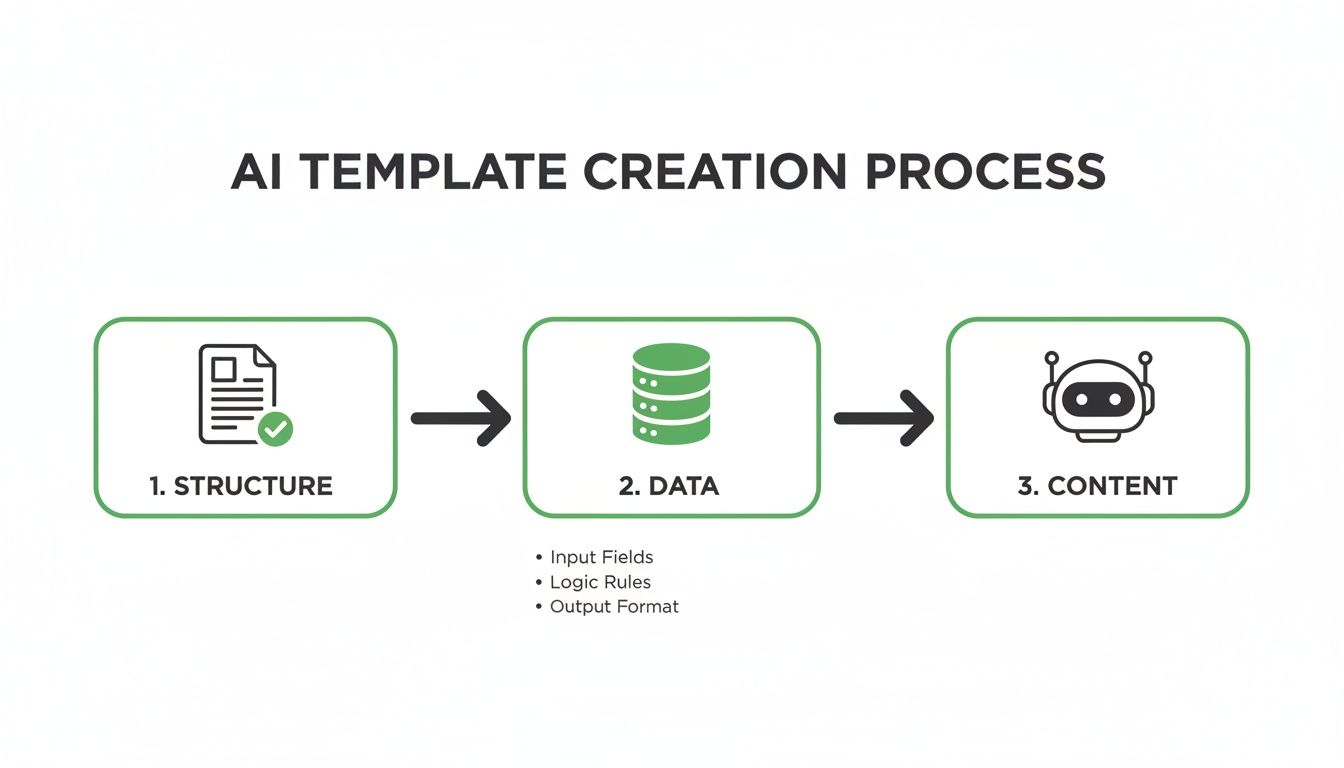
This infographic shows the simple three-step process: start with structure (your template), add your unique data, and then let the AI generate the content.
Step 3: The Crucial Human Review
This is the most important step, and where many people go wrong. AI is a fantastic assistant, but it is not a replacement for a human editor. Skipping the human review is the fastest way to create low-quality, generic content that alienates readers and harms your brand.
Your job shifts from writing from scratch to elevating AI-generated drafts. Here’s what to focus on during your review:
- Factual Accuracy: Did the AI get the details right? Are the statistics correct? Fact-check everything.
- Authenticity and Tone: Does it sound like your brand? Tweak the language, inject personality, and remove any robotic-sounding phrases.
- Unique Insights: This is your secret weapon. Add a personal story, an expert tip, or a real-world example that doesn’t exist anywhere else online.
- Formatting and Readability: Break up long paragraphs. Use bullet points and bold text. Ensure the article is easy to scan.
Think of the AI draft as a solid B-. Your job as the editor is to turn it into an A+ by adding the nuance, expertise, and polish that machines simply can't replicate. This is what separates great SEO for content from spam.
Step 4: Publish and Internally Link
Once a draft has been polished by a human, it's ready to go live. To get the most SEO value, you need a smart internal linking strategy. Internal links guide Google through your site, helping it discover new pages and understand how your content is related.
A simple and effective approach is the "hub and spoke" model. Your main service pages are the "hubs," and your new programmatic pages are the "spokes."
For example, when you publish a new page like "Emergency Plumbing in Berlin," you should:
- Link to it from a relevant hub page, like your main "Emergency Plumbing Services" page.
- Add links from the new page back to the hub and to other helpful posts, maybe one on "How to Prevent Burst Pipes."
This creates a powerful web of content that boosts the authority of every page. And as you build out your content workflow, don't forget video. Applying specific strategies for different platforms is key, so make sure to review these YouTube SEO best practices to get your video content ranking. This kind of methodical linking turns a collection of articles into a cohesive content ecosystem that Google loves.
Measuring Success and Improving Your Content Engine
Pushing hundreds of pages live is just the starting line. The real growth from any programmatic SEO effort comes from what you do next. Measuring performance and constantly tweaking your system is how you transform a one-off content project into a predictable growth engine.
This isn’t about chasing vanity metrics like raw page views. It’s about zeroing in on the specific signals that tell you whether your strategy is actually working and, more importantly, where you can make it better. This iterative process is what separates the campaigns that win from those that just add more noise to the internet.
Focusing on the Right KPIs
With programmatic SEO, the key performance indicators (KPIs) you need to watch are a bit different from your standard content marketing dashboard. We're looking for signs that our scaled-up content is getting noticed by search engines and starting to vacuum up that valuable long-tail traffic.
Forget about tracking individual page rankings, at least for now. Instead, keep your eyes on these big-picture metrics:
- Number of Indexed Pages: Is Google even finding and adding the pages you’re publishing? You can track this right in Google Search Console's "Pages" report. A steady climb here is the first sign of life.
- Total Organic Impressions: This is your earliest indicator of success. Before the clicks start rolling in, you’ll see impressions shoot up as your new pages begin to appear for thousands of hyper-specific queries. It’s proof that your content is relevant.
- Organic Clicks and Traffic: As impressions grow, clicks will naturally follow. This is the ultimate validation that your page titles and topics are hitting the mark with real users. Track the overall organic traffic growth to the pages built from your templates.
Don't get lost in the weeds by tracking every single keyword. For a programmatic project, success is measured by the aggregate performance of thousands of pages, not the ranking of one. Look at the forest, not the individual trees.
These metrics give you a clean, high-level view of your content engine's health without getting bogged down in unnecessary detail.
Using Data to Refine Your Templates
Your data tells a story about what’s working and what isn’t. Think of Google Search Console as your best friend in this process. It helps you pinpoint your strongest and weakest content templates so you can double down on what resonates with both users and search engines.
Start by filtering your performance report in Search Console to only include URLs from a specific programmatic campaign. Now, look for patterns. Are pages about a certain service type getting way more impressions? Do pages that include a "cost breakdown" section perform better than those without?
This kind of analysis gives you concrete, actionable insights. For example, you might discover that your template for "[Service] in [City]" performs exceptionally well, while the "[Service] vs [Alternative]" template is a dud. That tells you exactly where to focus your resources for the next content batch. Setting up custom SEO dashboards can make this analysis much easier and more visual. To get started, check out our guide on creating effective SEO dashboards for tracking programmatic success.
Simple Tests for Continuous Improvement
You don't need complicated tools to start improving your content's performance. Simple A/B tests on your headlines and introductions can lead to huge gains in click-through rates and user engagement.
Here’s a practical way to do it: take one of your underperforming templates and create two new versions with different headline formulas.
- Version A (Question-Based): "How Much Does Emergency Plumbing Cost in Berlin?"
- Version B (Benefit-Driven): "Get a Fast, Fair Price on Emergency Plumbing in Berlin"
Publish a small, controlled batch of pages using each new headline style. After a few weeks, dive back into Search Console to see which version gets a higher click-through rate (CTR). The winner becomes your new standard for that template. You can apply the same simple logic to test different introduction styles, calls-to-action, or even the inclusion of a specific data point.
This constant cycle of testing and refining is what turns a good content engine into a great one.
Common Questions About AI for SEO Content
As you start weaving AI into your content workflow, questions are bound to pop up. This space moves so fast that it’s easy to get tangled in conflicting advice. Let's cut through the noise and tackle some of the biggest concerns head-on.
The number one worry I hear is about getting on the wrong side of search engines. It’s a totally fair question, but the answer is simpler than you might think.
Will Google Penalise AI Generated Content?
No, Google won’t penalise your content just because AI was involved in making it. Their official line has been consistent: they reward high-quality, helpful, people-first content, no matter how it’s produced. The focus is always on the final product, not the tools used to create it.
Think of an AI writer like any other tool in your belt, whether it's a grammar checker or a word processor. As long as you’re using it to create something genuinely valuable for your audience—and not just churning out low-grade spam to game the system—you're playing by the rules. That human review step is non-negotiable; it’s what guarantees your content actually meets that people-first standard.
Another big question revolves around originality. How do you avoid creating a sea of duplicate content, which is obviously a huge SEO red flag?
How Can I Ensure My AI Content Is Unique?
Uniqueness starts with your inputs. The best way to sidestep plagiarism is to build your content templates around your own unique data, brand insights, and distinct voice. When you feed the AI proprietary information—your own customer reviews, internal data from a case study, or hyper-local details—the output is original by default.
Your unique data is the secret ingredient that makes programmatic content impossible to duplicate. An AI can't just invent your company's real-world experience or your specific customer successes.
On top of that, you should always run final drafts through a solid plagiarism checker before they go live. The human editing phase is your last line of defence here. It's your chance to layer in personal anecdotes, expert opinions, and custom examples that make the piece truly one-of-a-kind.
Finally, there’s a common myth that this kind of approach is only for the big players.
Is Programmatic SEO Only for Large Websites?
Not in the slightest. While programmatic SEO is famous for powering huge sites with thousands of pages, the principles behind it are incredibly useful for businesses of any size. It’s a way of thinking, not just a tool for corporations.
Even a small local service business can see massive benefits. By identifying dozens of specific, intent-driven topics (like 'emergency boiler repair cost in Bristol' or 'how to fix a leaking tap in Clifton'), they can efficiently create super-targeted pages that pull in qualified local customers. It's all about working smarter, not just bigger.
At Programmatic SEO Hub, we provide the guides, templates, and tools to help you master these modern content strategies. Start building your scalable content engine today. Learn more at https://programmatic-seo-hub.com/en.
Related Articles

Mobile friendly test google: A Practical Guide to Master Mobile SEO
Even though Google’s standalone Mobile-Friendly Test tool is a thing of the past, the principle behind it is more critical than ever. The simple truth is that Google now overwhelmingly uses its...

A Practical Guide to Competitive Analysis Keywords
When we talk about competitive analysis keywords, we're really talking about the search terms that are already making money for your rivals. By digging into these, you uncover their entire...

Landing Pages SEO A Practical Guide to Rank and Convert
When we talk about SEO for landing pages, we're not just talking about general website optimisation. We're getting hyper-specific. This is the art of building and refining standalone pages...