Unlocking SEO Success with Long Tail Keywords
Long-tail keywords are the unsung heroes of SEO. They're those super-specific search phrases, usually three or more words long, that cut through the noise and reveal exactly what someone is looking for. Forget the broad, hyper-competitive terms for a moment. Long-tails offer a direct line to customers who have a clear goal, which almost always means higher conversion rates and traffic that actually matters.
What Are Long Tail Keywords and Why They Matter

Let’s use a simple analogy. Picture yourself in a packed coffee shop. You could just yell "coffee!" – but good luck getting what you want. You're competing with everyone else, and the barista has no idea what to make you. That's what targeting a broad, generic keyword like "shoes" is like. The search volume is huge, but the competition is brutal, and you have no clue what the user actually wants.
Now, imagine walking up to the counter and ordering an "iced oat milk latte with caramel drizzle". It’s specific, it’s direct, and it gets you precisely what you came for. That’s a long-tail keyword. The search volume is much lower, sure, but the person typing it into Google knows exactly what they need.
The Power of Specificity
A smart SEO strategy is built on long-tail keywords. While they don't get the same search numbers as their shorter cousins individually, they make up the vast majority of all search queries when you add them all up. Their real power is in their precision.
A user searching for "women's waterproof running shoes for trails" is miles ahead in their buying journey compared to someone just typing "shoes." That specific intent is a neon sign flashing "high-quality traffic."
This specificity translates directly into real business results. Instead of attracting window shoppers, you're connecting with people who are actively looking for the exact solutions, products, or answers you offer. This unlocks a few key advantages:
- Less Competition: It's a simple fact. Far fewer websites are trying to rank for "best budget drone for filming 4k video" than for the word "drones." This gives your content a much better shot at hitting the first page of Google.
- Sky-High Conversion Rates: When a user's intent is crystal clear, the traffic you get is highly qualified. These visitors are far more likely to make a purchase, fill out a form, or sign up.
- A Stronger Audience Connection: When you create content that answers these very specific questions, you show your audience that you genuinely understand their problems. This builds trust and positions you as an authority.
To put it simply, here’s how the two types of keywords stack up.
Head Terms vs Long Tail Keywords at a Glance
This table breaks down the core differences, showing you exactly where the strategic value lies.
| Characteristic | Head Keywords (e.g., 'shoes') | Long Tail Keywords (e.g., 'women's waterproof running shoes for trails') |
|---|---|---|
| Search Volume | Very High | Low |
| Competition | Extremely High | Low to Medium |
| User Intent | Broad, Unclear (Researching? Browsing?) | Highly Specific, Clear (Ready to buy?) |
| Conversion Rate | Low | High |
| Cost-Per-Click (PPC) | High | Low |
| Content Focus | General, broad-topic pages | Niche, highly detailed articles/products |
As you can see, while head terms offer volume, long-tail keywords deliver precision and efficiency—often the two most important factors for driving growth.
A Competitive Edge in the German Market
This isn't just theory; it plays out in the real world, especially in tough markets. For instance, long-tail keywords in Germany consistently deliver 3–6% higher click-through rates (CTR) than broader terms.
Why? Because German shoppers are often very specific and well-informed. A search for something like 'günstige LED Lampen für Kinderzimmer mit Dimmer' (affordable LED lamps for a kid's room with a dimmer) perfectly matches their detailed needs. In a crowded marketplace, that kind of precision is a massive advantage. If you want to dive deeper, you can learn more about these keyword statistics and see the impact for yourself.
Decoding the User Intent Behind Long Tail Searches
Every long tail keyword tells a story. It’s not just a random string of words; it’s a direct window into what someone is thinking, needing, or wanting to do right now. Figuring out the "why" behind their search is the real secret to creating content that doesn't just rank, but actually helps people.
Think of it like this: you're a helpful assistant in a shop. A customer asks, "Where are the running shoes?" You know they're just browsing. But when they ask, "Do you have these waterproof trail running shoes in a size 10?" you know they’ve got their wallet out. Long tail keywords give you that same level of clarity online.
The Four Flavours of Search Intent
User intent usually falls into four main buckets. When you can spot which one a searcher has, you can match your content to their exact need, which builds trust and gets them where they want to go.
Informational Intent: The user wants to learn something. Their searches are often questions starting with "how to," "what is," or "best way to." They're hunting for answers and explanations. A search like "how to fix a slow draining sink" is a cry for a step-by-step guide.
Navigational Intent: The user already knows their destination and is just using the search engine as a quick taxi. Think of someone typing "YouTube" into Google instead of the URL, or "Programmatic SEO Hub blog" to jump to a specific part of a site. Your brand name is your most important keyword here.
Commercial Intent: This person is in research mode, kicking the tyres before they buy. They're comparing products, reading reviews, and weighing their options. Keywords like "best noise-cancelling headphones under £200" or "MacBook Air vs Dell XPS comparison" are dead giveaways. They're close to a decision but need that last bit of convincing information.
Transactional Intent: This is it—the user is ready to act. They want to buy, sign up, or download something now. These are your money-making keywords, often packed with words like "buy," "price," "discount," or a very specific product name like "buy Sony WH-1000XM5 headphones online."
Mastering the ability to distinguish between these intents is a huge step forward. You move from just targeting keywords to solving your audience's problems at the precise moment they have them.
Why This Matters for Your Content
Let's be blunt: aligning your content with the right intent is non-negotiable. If someone with informational intent ("how to choose a camera lens") lands on a hard-sell product page, they're going to hit the back button instantly. That signals to Google that your page is a poor answer for that query.
On the flip side, if a user with clear transactional intent ("buy Canon RF 50mm lens") ends up on a long-winded article about the history of camera lenses, they'll be just as frustrated. They wanted a 'buy now' button, not a history lesson.
By correctly identifying the intent behind your target long tail keywords, you can create the perfect piece of content for each stage of the user's journey. To go deeper on this foundational topic, you can learn more about search intent and its strategic importance in our detailed guide. This ensures every single page you publish serves a clear purpose, keeping both your users and the search engines happy.
Finding and Prioritising Your Long-Tail Keywords

Alright, you understand why long-tail keywords matter. Now for the fun part: actually finding them. Think of yourself as a detective on the hunt for clues. Your mission is to uncover the exact phrases your audience uses when they’re searching for answers. The good news? You don't need a massive budget to get started.
Some of the most powerful research happens right where your audience lives online. These free methods are brilliant for digging up authentic, high-intent long-tail keywords.
Simple and Free Discovery Methods
Your first port of call should be Google itself. The search engine is practically designed to hand you these insights on a silver platter.
- Google Autocomplete: Just start typing a broad term related to your field into the search bar. Google’s suggestions are a direct line into what real people are searching for right now. That's your first list of potential keywords.
- "People Also Ask" Boxes: Search for a term and look for the "People Also Ask" (PAA) section. This is a goldmine. These are the literal follow-up questions people have, giving you a ready-made list of informational long-tail topics.
- Related Searches: Scroll right to the bottom of the results page. The "Related searches" section shows you other ways people are thinking about your topic, helping you discover new angles you might have missed.
Once you’ve exhausted Google, head to the communities where your audience hangs out. Places like Reddit and Quora are unfiltered streams of consciousness. Browse the relevant subreddits and topics, paying close attention to the post titles and the questions being asked. These are your audience's problems, phrased in their own words.
Using Tools to Visualise Opportunities
After gathering a few initial ideas, beginner-friendly tools can help you organise your thoughts and uncover even more opportunities. A fantastic starting point is AnswerThePublic.
This tool takes your core keyword and explodes it into a visual map of questions, comparisons, and phrases people are actively searching for. It’s incredibly intuitive.
The visualisations it produces can give you hundreds of potential long-tail keywords, all neatly sorted by the type of question (like "what," "how," and "why"). This maps directly to what your user is trying to accomplish.
For a deeper dive into organising these findings, check out our guide on the fundamentals of keyword research and building a solid strategy.
How to Prioritise Your Keyword List
Finding keywords is the easy part. The real skill is in picking the right ones to go after. You’ll probably end up with a huge list, so you need a simple framework to decide where to focus your energy.
Don't get hypnotised by high search volumes. The perfect long-tail keyword is one that's super relevant to your business and gives you a realistic shot at ranking, even if only 20 people a month are searching for it.
Use these three simple criteria to score and sort your list:
- Relevance: How perfectly does this phrase match a product, service, or solution you offer? A highly relevant keyword means the traffic you attract will be much more qualified from the get-go.
- Search Volume: It doesn't need to be huge, but you do need some demand. Use a free tool to get a rough monthly search estimate. The goal is to find that sweet spot between relevance and just enough volume to be worthwhile.
- Competition: How tough will it be to rank? A quick Google search will tell you a lot. Are the top results all massive, household-name websites? If so, you might want to dig for an even more specific, less competitive variation.
This balanced approach makes sure you're not just chasing traffic, but the right traffic—the kind that actually converts. Take German users, for instance, who are known for their specificity. Research shows that 3–4 word phrases make up 39.9% of mobile searches in Germany, landing squarely in the long-tail sweet spot. You can explore more about these Google usage statistics to see the full picture.
Creating Targeted Content That Ranks and Converts
Finding a goldmine of long-tail keywords is a huge win, but it's only half the job. Now comes the crucial part: creating content that actually satisfies the user's very specific need. The goal isn't to just sprinkle keywords on a page. It's to become the single best, most helpful answer to their question, period.
Think about it. When someone searches "how to clean suede trainers at home," they aren't looking for the history of suede or a list of different trainer brands. They want a direct, actionable solution, and they want it now. Your content has to deliver that immediate value above all else.
The Answer First Content Framework
A deceptively simple but incredibly powerful way to structure your pages is the "Answer First" framework. It's designed to respect the user's time while signalling to Google that you know exactly what the searcher is after.
- Provide the Direct Answer Upfront: Start your article with a concise, clear answer to the user's core question. If the keyword is "best pressure washer for cleaning patios," your opening paragraph should literally name your top pick and give a one-sentence reason why.
- Elaborate and Add Context: Once you've delivered the initial payoff, you can zoom out. This is where you bring in the details, examples, comparisons, and nuance. You explain the "why" and "how" that support your initial, direct answer.
- Provide Supporting Value: Finish up by offering related tips, useful resources, or answers to natural follow-up questions. This simple step transforms your page from a one-off answer into a comprehensive resource, giving people a reason to stick around.
This structure just works. It mirrors how we all look for information online – we want the solution first, and the backstory later.
Giving the answer immediately kills bounce rates and boosts user engagement. Those are powerful signals that tell search engines your page is a high-quality result, which directly helps you rank higher for those valuable long-tail keywords.
On-Page SEO in Plain English
With a solid content structure in place, all that’s left are a few on-page SEO basics. This isn't about some technical wizardry; it's just about making it dead simple for both people and Google to understand what your page is about. The key is to be natural, not forceful.
Forget everything you’ve heard about "keyword density" and other outdated tricks. Instead, just focus on placing your primary long tail keyword in a few logical spots where it feels right.
- Page Title (Title Tag): This is the blue link people see in the Google search results. Your main keyword absolutely needs to be here, ideally toward the front.
- Main Heading (H1 Tag): This is the big title on the page itself. It should match your page title closely and leave no doubt about the topic.
- Introduction: Weave your keyword into the first paragraph or two. It’s a simple way to confirm to the reader that they've landed in the right spot.
- Subheadings (H2, H3): Using your keyword or close variations in some subheadings is a natural way to structure the content and make it easier to scan.
Building out this content can feel like a lot of work, but a structured process makes all the difference. To really streamline things, using a programmatic content brief template ensures every single piece is perfectly optimised right from the start.
At the end of the day, ranking for long-tail keywords isn't about finding a secret loophole. It's about demonstrating real expertise by providing the most thorough and helpful answer to a very specific question. When you do that consistently, you earn your audience's trust and the top rankings that come with it.
Scaling Your Content with Programmatic SEO
Writing great articles one by one is effective, but what if you could create hundreds of targeted pages almost instantly? That’s the magic of programmatic SEO. It’s a practical way to create content at a massive scale, letting you answer thousands of specific long-tail questions without hiring a huge team of writers.
Don’t let the technical name scare you. The concept is simple. Think of it like a mail merge for your website. You create one master page template, connect it to a spreadsheet of data, and automatically generate hundreds of unique pages. This allows you to target an incredible number of specific long-tail keywords.
For example, a real estate agency could use this for keywords like "family homes for sale in [neighborhood]" for every single neighborhood they serve. This could instantly create pages for "family homes for sale in Green Oaks," "family homes for sale in River Valley," and dozens more.
How to Get Started with Programmatic SEO and AI (Step-by-Step)
Getting this system running is easier than you think. It comes down to three practical steps.
- Find Your Keyword "Recipe": Look for a repeatable keyword pattern. Good starting points are
[service] in [city],best [product] for [use case], or[brand] vs [competitor]. These are your recipes for creating pages at scale. - Build Your "Ingredients" List (Your Data): Put all the interchangeable parts from your recipe into a spreadsheet (like Google Sheets or Airtable). One column has your services, another has your cities, and another could have unique facts about each location. This is your data source.
- Create Your Page Template: Design one great page layout in your website builder (like WordPress or Webflow). This template will have placeholders, like
{city_name}or{service_description}, that will be filled in with data from your spreadsheet.
This turns content creation from a slow, manual task into an efficient machine.
Practical AI Implementation: Making Each Page Unique
The biggest fear with this method is creating tons of identical, low-quality pages. This is where AI becomes your superpower. You can use tools like ChatGPT or Jasper to make each page feel unique and valuable. The key is to use AI as an assistant, not the writer.
Here’s a practical way to do it:
Instead of having a static sentence in your template like "We offer great plumbing services in {city_name}," you can use AI to generate unique text for each page. In your spreadsheet, add a column called "AI Intro." Then, using an AI tool, run a prompt for each row:
"Write a friendly, 2-sentence intro about the benefits of hiring a local plumber in {city_name}, mentioning a local landmark like {landmark_name}."
The AI generates a unique intro for every city, which you paste into your spreadsheet. When your programmatic system builds the pages, it pulls these unique intros, making each page feel custom. You maintain control over the structure and core info, while AI handles the creative variations. This approach keeps your content high-quality and avoids duplicate content issues. For a deeper look, explore automating content creation with programmatic SEO.
This simple flow chart shows the core process for creating effective, targeted pages at scale.
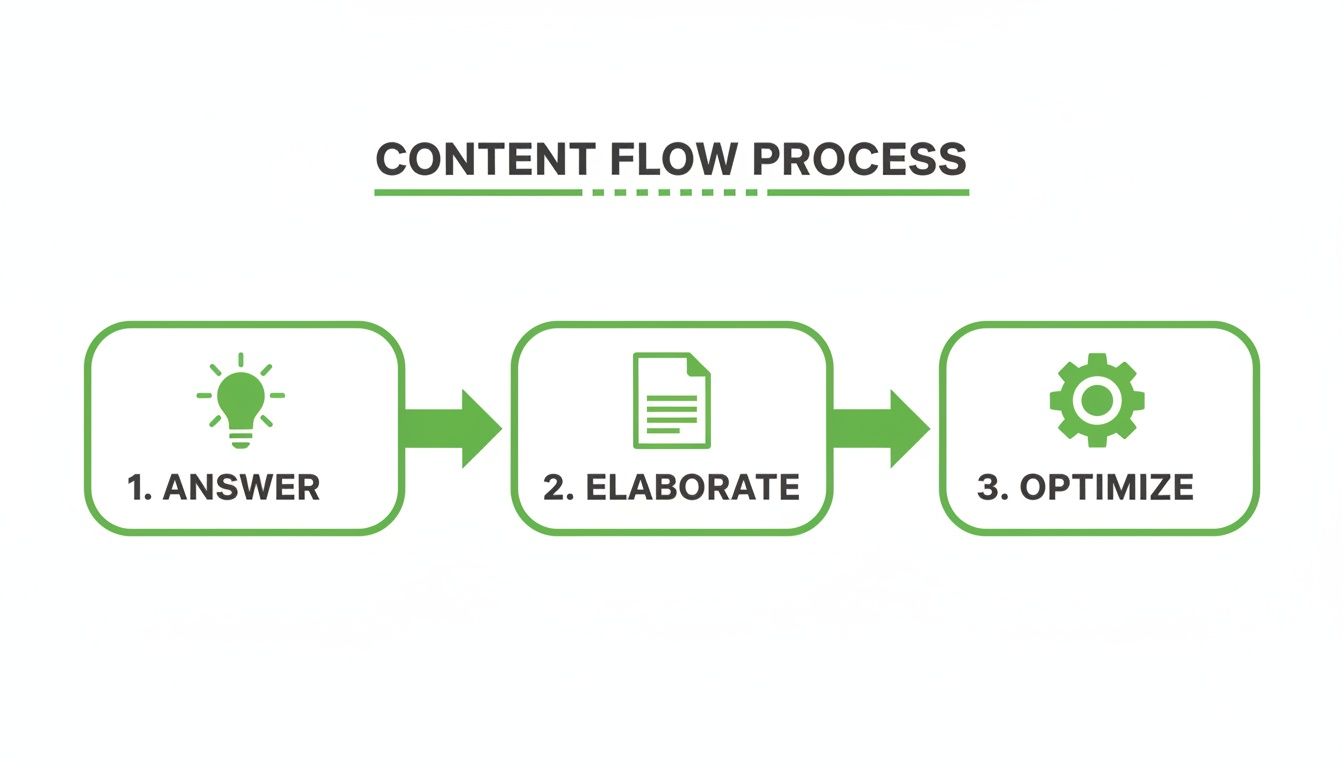
The key takeaway is this: every piece of content should first answer the user's question directly, then elaborate with helpful details, and finally be optimised for search. By combining a solid template with good data and a dash of AI, you can apply this proven formula at an incredible scale, turning your long-tail keyword strategy into a powerful growth engine.
Beginner-Friendly Programmatic SEO Tool Comparison
Jumping into programmatic SEO doesn't mean you need to be a developer. Several tools and methods make it accessible for marketers and business owners. Here’s a quick look at a few options perfect for getting started.
| Tool/Method | Best For | Technical Skill Required | Example Use Case |
|---|---|---|---|
| Whalesync + Webflow | Visual builders who want a no-code solution. | Low | Syncing a real estate property list from Airtable to create individual listing pages on a Webflow site. |
| Google Sheets + Zapier | Automating simple page creation on platforms like WordPress. | Low to Medium | Creating event pages on a WordPress blog automatically whenever a new row is added to a Google Sheet. |
| Airtable + Softr | Building data-driven web applications and directories. | Low | Creating a searchable directory of local businesses using data managed entirely within an Airtable base. |
These tools remove many of the technical barriers, allowing you to focus on finding great keyword patterns and creating high-quality data and templates. The right choice depends on your existing tech stack and how comfortable you are with connecting different applications.
How Voice Search and AI Put Your Long-Tail Strategy on Steroids
If you thought long-tail keywords were a clever tactic before, they're now absolutely essential. Two huge shifts in how we find information—voice assistants and smarter search AI—have put long-tail queries at the very centre of the SEO universe. These technologies don't just prefer long-tail searches; they're literally built for them.
Just think about how you talk to Alexa, Siri, or your Google Assistant. You don't bark "weather Berlin" at it. You ask a full question, like, "What's the weather going to be like in Berlin this weekend?" That natural, conversational question is a long-tail keyword in its purest form. Every single time someone asks their smart speaker a question, they're performing a long-tail search.
This isn't some minor trend, either. In Germany, for instance, voice search is absolutely exploding and is on track to make up over 40% of all search interactions by 2025. This surge is all about people talking to their devices in complete, natural sentences. A query like, 'Where can I find the best organic coffee shops near Munich that are open late on weekends?' is the perfect example of a voice-driven search packed with intent. This is fundamentally changing the SEO game, pushing anyone serious about localised success to master German-language long-tail keywords. You can find more on this shift in the state of SEO in Germany at applabx.com.
Getting in Sync with Modern Search AI
It’s not just about how people are searching; it’s about how search engines like Google are understanding them. Google's AI has become scarily good at figuring out the intent behind a search, moving far beyond simple keyword matching. It actively rewards content that gives the best, most direct answer to a very specific problem.
Focusing on long-tail keywords is no longer just a clever SEO tactic; it's the most direct way to align your content with how both humans and artificial intelligence now communicate. It’s about answering specific questions clearly.
This is fantastic news for anyone creating high-quality, targeted content. Your job is no longer about trying to outsmart an algorithm. It's simply to be the most helpful resource for a very specific need.
To get this right, you can start structuring your content to directly mirror these conversational searches:
- Use Question-Based Headings: Turn your target long-tail keywords into your H2s or H3s. Something like, "How Do I Clean Suede Shoes Without Damaging Them?" works perfectly.
- Give Direct Answers: Right underneath that heading, give a clear, straight-to-the-point answer. This is exactly the kind of thing Google loves to pull into its featured snippets and serve up as a voice search result.
- Write Like a Human: Ditch the jargon and write in a natural, conversational tone—as if you were explaining it to a friend.
By taking this approach, you're essentially future-proofing your content strategy. If you want to dive deeper into creating content that feels authentic, check out our guide on Natural Language Generation and its role in modern SEO. Your focus on long-tail keywords is the most practical way to prepare your site for the next wave of search.
A Few Lingering Questions About Long-Tail Keywords
As you start digging into long-tail keywords, a few practical questions always seem to pop up. Let's tackle some of the most common ones head-on so you can move forward with confidence.
How Many Long-Tail Keywords Should I Target on One Page?
Stick to one primary long-tail keyword to act as the central theme for the page. Think of it as your North Star. This main phrase should naturally find its way into your title, the opening paragraph, and maybe a subheading or two.
From there, you'll want to weave in two or three closely related variations throughout the content. The goal isn't to cram in keywords; it's to build a comprehensive resource that explores the topic from all angles. Google is incredibly smart at understanding synonyms and related ideas, so focus on creating depth, not just density.
What Is a Good Search Volume for a Long-Tail Keyword?
Honestly, there’s no magic number. A "good" search volume is completely relative to your business and how much a single conversion is worth to you.
For a high-value service, a keyword with just 10-20 monthly searches can be a goldmine if the intent is screaming "buy now." Think about a search like 'emergency commercial plumbing repair in Hamburg'—the volume is tiny, but the business potential is massive.
Never dismiss a keyword just because the numbers look small. Instead, weigh its relevance against the real-world value a single, qualified click could bring. More often than not, the lowest-volume terms deliver the highest-quality leads.
Can I Use AI to Write My Long-Tail Content?
Yes, but with a big caveat: treat AI as a very capable assistant, not an expert author. AI tools are fantastic for brainstorming keyword ideas, structuring an outline, or just breaking through a nasty case of writer's block.
But never, ever just copy and paste what an AI gives you. It's absolutely crucial that you review, edit, and inject your own brand voice, unique insights, and real human experience. Fact-check everything. The best approach is to use AI to speed up the grunt work, freeing you up to polish the final piece into something truly valuable.
Do Long-Tail Keywords Still Work in 2024 and Beyond?
Absolutely. In fact, they’re more critical than ever. With the rise of voice search and more sophisticated AI in search engines, people's queries are getting longer and more conversational.
People don't bark two-word commands at their smart speakers; they ask full, detailed questions. When you optimise for long-tail keywords, you're perfectly aligning your content with how people naturally search for information today. It's a strategy that's fundamentally built for the future.
How Long Does It Take to Rank for a Long-Tail Keyword?
This is one of the best parts. You can often see results for long-tail keywords much faster than for hyper-competitive head terms. Since the competition is so much lower, a well-optimised, genuinely helpful page can sometimes start ranking in a matter of weeks, not months.
Of course, your site's overall authority and the keyword's specific niche play a role. But on the whole, long-tails offer a much quicker path to attracting targeted, organic traffic than going to war over those high-volume keywords.
Ready to build a scalable content engine that captures thousands of these high-intent searches? At Programmatic SEO Hub, we provide the guides, templates, and systems you need to master programmatic SEO and future-proof your growth. Explore our free resources today.
Related Articles
Mobile friendly test google: A Practical Guide to Master Mobile SEO
Even though Google’s standalone Mobile-Friendly Test tool is a thing of the past, the principle behind it is more critical than ever. The simple truth is that Google now overwhelmingly uses its...
A Practical Guide to Competitive Analysis Keywords
When we talk about competitive analysis keywords, we're really talking about the search terms that are already making money for your rivals. By digging into these, you uncover their entire...
Landing Pages SEO A Practical Guide to Rank and Convert
When we talk about SEO for landing pages, we're not just talking about general website optimisation. We're getting hyper-specific. This is the art of building and refining standalone pages...