Kpis in seo: Essential SEO KPIs That Drive Real Business Results
Key Performance Indicators, or KPIs in SEO, are the handful of numbers that tell you if your strategy is actually working. They’re the bridge between your day-to-day tasks and your big-picture business goals, proving that your efforts are generating real results—not just noise.
Why SEO KPIs Are Your Strategy's Dashboard
Think about driving a car. You wouldn't just stare at the spinning wheels to figure out if you're making progress. You'd glance at the dashboard. Your speedometer, fuel gauge, and engine temperature tell you everything you need to know to get to your destination safely and efficiently.

That's exactly what KPIs in SEO are: the essential gauges on your digital marketing dashboard. They help you look past surface-level stats and start making truly informed decisions.
From Vanity Metrics to Actionable Insights
It's way too easy to get mesmerised by "vanity metrics." These are the numbers that look impressive on a chart but don’t actually move the needle for the business. A huge spike in website hits might feel like a win, but if none of those visitors turn into customers, it's like revving your engine while stuck in neutral.
Actionable KPIs, on the other hand, tell a story that matters:
- Organic Conversion Rate: This tells you what percentage of visitors from search are actually doing something valuable, like buying a product or filling out a form. Think of it as your car's fuel efficiency.
- Keyword Rankings: Tracking your position for critical search terms shows if you're even visible to your target audience. This is like checking the road signs to make sure you’re on the right route.
- Organic Traffic: This measures visitors coming from non-paid search results. It's the clearest indicator of your overall SEO reach. Want a deeper dive? Check out our guide on the fundamentals of organic traffic.
Good SEO isn’t just about driving more traffic—it’s about measuring progress toward real business outcomes. Choosing the right KPIs is your first step to proving SEO's value and making smart, data-driven decisions.
The Importance of Context in SEO KPIs
A KPI is only as good as its context. For example, keyword rankings are still a cornerstone metric, especially in cut-throat markets. In Germany, the first organic result on a desktop search can gobble up a 34% click-through rate, which makes a top-three placement absolutely non-negotiable for serious businesses.
This becomes even more crucial as AI-driven search changes the game. New metrics, like visibility in AI-generated answers, are becoming vital—especially since so many searches are now zero-click.
Ultimately, by zeroing in on the right KPIs, you turn your SEO from a bunch of disconnected tasks into a focused, measurable plan for growth. It’s how you demonstrate real impact, justify your budget, and steer your business toward its goals with confidence.
Connecting SEO KPIs to Your Business Goals
How do you prove your SEO efforts are actually making the company money? The secret isn’t hiding in a complex spreadsheet. It’s about telling a clear story that connects your metrics directly to what the business really cares about.
Think of it as translating your actions into a language everyone understands: profit, growth, and brand strength.
If your CEO asks how SEO is doing, talking about "keyword rankings" might earn you a polite nod. But showing how those rankings led to a 15% increase in online sales? That gets their full attention. This is the heart of effective reporting: mapping your KPIs in SEO to tangible business objectives.
Start with the Goal, Not the Metric
It’s a common trap. Many SEOs start by tracking every metric they can get their hands on, hoping to find a good story somewhere in the data. The smarter way is to work backwards.
First, pinpoint the primary business goal. Then, choose the handful of KPIs that best measure your progress towards it. This keeps you focused on what truly moves the needle.
Is your company trying to grow its customer base? Generate more sales leads? Become the most recognised name in the industry? Each goal has its own set of matching SEO KPIs.
Your SEO metrics should act as a bridge, connecting your daily optimisation tasks to the company's bottom-line results. If a KPI doesn't clearly tie back to a business objective, it's likely a distraction, not a priority.
A Practical Map From SEO to Business Success
To make this connection concrete, let's look at some common business goals and the specific SEO KPIs that directly measure your contribution.
Here’s a simple framework to help you build a measurement plan that resonates with stakeholders and proves the value of your work.
Aligning SEO KPIs with Core Business Objectives
Use this table to select the SEO KPIs that directly measure your progress toward specific business goals, ensuring you track what truly matters.
| Business Goal | Primary SEO KPIs | Example Scenario |
|---|---|---|
| Increase Online Sales | Organic Revenue, Organic Conversion Rate, Average Order Value | An e-commerce store wants to sell more products directly through its website. |
| Generate Qualified Leads | Organic Lead Submissions, Goal Completions, Conversion Rate | A B2B service company needs to feed its sales team with high-quality prospects. |
| Build Brand Awareness | Organic Traffic Growth, New Users, Branded vs. Non-Branded Traffic | A new startup or content publisher aims to become a recognised authority in its niche. |
| Improve Customer Retention | Returning User Rate (from Organic), Brand Name Searches | A subscription-based business wants to ensure customers continue to find value and return. |
| Reduce Customer Acquisition Cost | Organic Cost Per Acquisition (CPA) / Cost Per Lead (CPL) | The marketing department is tasked with finding more efficient ways to acquire new customers. |
This targeted approach doesn’t just simplify your reporting; it also helps you prioritise your SEO efforts. If lead generation is the main goal, you’ll naturally spend more time optimising content and pages that drive form submissions.
To better understand the financial impact, you might be interested in our guide on how to calculate SEO ROI, which takes this concept a step further.
By aligning your KPIs in SEO with core business objectives right from the start, you transform your role. You're no longer just managing keywords and links—you are a key driver of business growth, with the data to prove it.
The Four Pillars of Essential SEO KPIs
Trying to track every SEO metric out there is a fast track to getting overwhelmed. It's like trying to steer a ship with a hundred different compasses all pointing in slightly different directions. It just doesn't work.
To cut through the noise, it's best to group your KPIs in SEO into four core pillars. This framework helps you see the whole picture, making sure you’re checking the complete health of your strategy—from how many people see you, all the way down to how much money you’re making.
Each pillar answers a simple, fundamental question about your SEO performance. By keeping an eye on metrics in each category, you get a balanced view. It stops you from getting tunnel vision on one area (like rankings) while another (like technical health) is falling apart. That balanced approach is the real secret to long-term, sustainable growth.
This diagram shows how these pillars are all connected, drawing a straight line from a high-level business goal right down to the SEO KPIs that ultimately drive revenue.
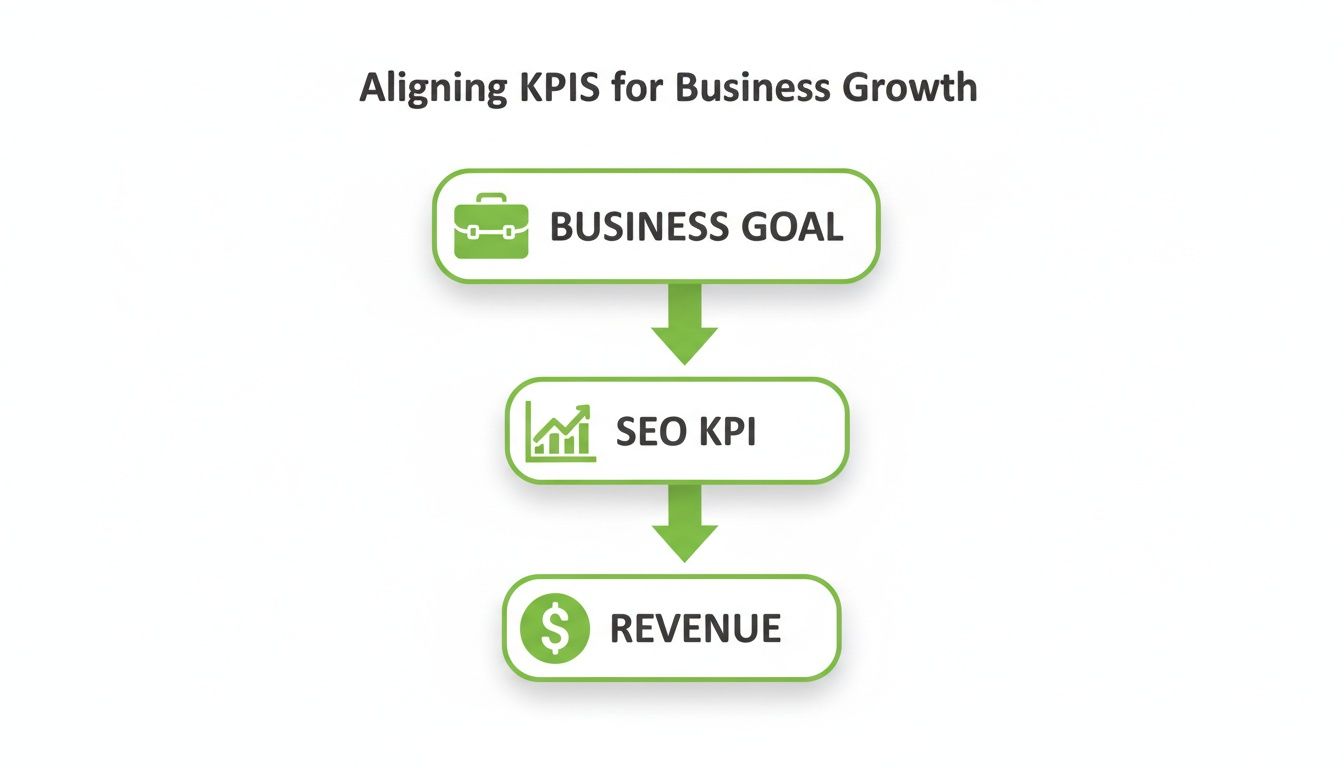
Simply put, every single metric you track should, in some way, serve the ultimate purpose of making the business more successful.
Pillar 1: Visibility and Reach
This first pillar answers the most basic question of all: How easily can people find you? Before you can get a single click, lead, or sale, your audience has to actually see you in the search results. Think of these as your foundational, top-of-funnel metrics.
- Organic Traffic: This is the big one. It’s the total number of visits you get from search engines without paying for ads. A steady increase here is the clearest sign that your overall SEO efforts are paying off.
- Keyword Rankings: This is where you stand in the search results for the queries that matter most to your business. You don't need to panic over every little daily fluctuation, but tracking your position for high-value keywords shows if you're gaining ground on the competition.
- Impressions: An impression is counted every time someone sees your website in a search result, even if they don't click. A rising number of impressions is a great early indicator that Google is starting to trust your site and show it for a wider range of queries.
These metrics are like the footfall outside your shop. They tell you how many people are walking past and glancing in the window.
Pillar 2: User Engagement
So, people have found you. Great. Now for the next crucial question: Are they actually sticking around and interacting with your content? Getting to the first page is useless if visitors hit the back button a second later. Engagement KPIs reveal whether your content is hitting the mark.
- Click-Through Rate (CTR): This is the percentage of people who see your link in the search results and actually click on it. A healthy CTR is a good sign that your page titles and meta descriptions are compelling and match what the searcher was looking for.
- Time on Page / Average Engagement Time: This tells you how long people are spending on a specific page. Generally, the longer, the better. It suggests your content is valuable and holds their attention, which is a powerful quality signal to search engines.
- Bounce Rate: This is the percentage of visitors who land on a page and then leave your site without clicking anywhere else. A high bounce rate isn't always a bad thing—sometimes people find their answer and leave satisfied. But if it's high on your key landing pages, it might mean your content isn't what they expected.
When users stick around, it sends a strong signal to search engines that your page is a great answer to their query. This creates a positive feedback loop that can boost your rankings over time.
Pillar 3: Business Conversion
This is where the rubber meets the road. SEO efforts finally connect to real business outcomes. The third pillar answers the most important question for any stakeholder: Is your traffic turning into customers? These are the bottom-of-the-funnel KPIs that get the CEO's attention.
When deciding which metrics to track, it's vital to focus on the ones that directly impact business goals. This is a core principle covered in this great overview of the Top SEO KPIs for Organic Traffic Growth.
- Conversion Rate: This is the percentage of your organic visitors who take a desired action—like making a purchase, filling out a form, or signing up for your newsletter. It’s the ultimate test of your content's effectiveness.
- Organic Revenue: For any e-commerce business, this is the money maker. It’s the total revenue generated from visitors who came directly from an organic search. There’s no clearer way to show the financial ROI of your SEO work.
- Goal Completions: Using a tool like Google Analytics, you can set up custom goals like PDF downloads, video plays, or 'request a demo' clicks. Tracking these is perfect for measuring SEO's value on non-e-commerce sites.
Tracking these metrics proves that SEO isn't just a marketing cost—it's a powerful engine for business growth.
Pillar 4: Technical Health
Last but certainly not least, our fourth pillar looks under the bonnet and asks: Is your site easy for Google to understand and for users to access? A technically solid website is the foundation that all your other SEO success is built on. If it crumbles, everything else comes down with it.
- Core Web Vitals (CWV): These are Google's metrics for user experience, focusing on speed (LCP), responsiveness (INP), and visual stability (CLS). A good score here directly impacts how users feel about your site and can give you a leg up in the rankings.
- Crawl Errors: These are problems Google's bots run into when trying to read your site. A high number of errors can stop important pages from ever getting indexed and appearing in search results.
- Indexation Rate: This is the percentage of your website's pages that are actually in Google's index. A low rate can signal serious technical issues, especially for large sites with thousands of pages built with programmatic SEO.
In the German market, Core Web Vitals have become an indispensable technical SEO KPI, directly influencing rankings as AI reshapes search. Top agencies ensure client sites achieve fast load speeds (under 2.5 seconds LCP), as pages with strong vitals can see a 20-30% uplift in organic traffic. For programmatic SEO, this means automating checks across thousands of pages, as seen when strategic optimisations lead to indexing 95% more pages by reducing crawl errors to nearly zero.
How to Track Your SEO KPIs with Free Tools
Knowing which KPIs in SEO to track is one thing, but figuring out how to track them is where the real work begins. The good news? You don't need a fancy, expensive software suite to get meaningful data. You can actually build a pretty powerful, free dashboard using two essential tools from Google that every website owner should already have.
Let’s break down the process. I'll walk you through exactly how to use Google Search Console (GSC) and Google Analytics 4 (GA4) to turn raw numbers into clear, actionable insights about your SEO performance. Think of this as your quick-start guide to measurement, no budget required.
Your Go-To Tool for Visibility KPIs: Google Search Console
Think of Google Search Console as your direct line of communication with Google. It's the place where Google tells you exactly how it sees your site, what keywords people are using to find you, and if any technical gremlins are holding you back. This is ground zero for all your Visibility and Reach KPIs.
Here’s a snapshot of what you can track in GSC:
- Impressions and Clicks: See how many times your pages showed up in search results (impressions) and how many people actually clicked through. Simple, but fundamental.
- Average Click-Through Rate (CTR): Instantly get a feel for how compelling your page titles and meta descriptions are. A low CTR on a high-ranking page is a massive opportunity for a quick win.
- Average Position: Track your average keyword rankings over time. This helps you see if your optimisation efforts are actually pushing you up the search results.
- Top Queries: Discover the exact search terms driving traffic to your site. This is gold for understanding user intent and sparking new content ideas.
Your Hub for Engagement and Conversion KPIs: Google Analytics 4
While GSC shows you what happens before a user gets to your site, Google Analytics 4 tells you everything that happens after they land. This is where you measure how people interact with your content and, most importantly, whether they're taking the actions that matter to your business.
GA4 helps you answer the crucial questions:
- Where is my organic traffic coming from? Jump into the "Traffic acquisition" report for a clean breakdown of all your sources, allowing you to isolate the "Organic Search" channel.
- Which pages are actually engaging? The "Pages and screens" report, when filtered for organic users, shows you which content keeps visitors around the longest (Average engagement time).
- Are visitors turning into customers? By setting up "Events" and marking the important ones as "Conversions," you can track everything from form submissions to e-commerce sales, tying them directly back to your SEO efforts.
The image below shows the Performance report in Google Search Console—your command centre for visibility KPIs.

This single view instantly shows you clicks, impressions, average CTR, and average ranking position. It's built for spotting trends and opportunities at a glance.
Key Takeaway: Use Google Search Console to measure how you show up in search results. Use Google Analytics 4 to measure what people do once they're on your site. Together, they give you the full story of your SEO performance.
Putting It All Together: A Simple Tracking Workflow
Don't overcomplicate this. A simple, consistent workflow is all you need to stay on top of your most important KPIs in SEO.
- Weekly Check-in (GSC): Once a week, spend 15 minutes in Google Search Console. Look for any sharp drops in impressions or clicks and check for new errors under the "Pages" report.
- Monthly Review (GA4): Once a month, dive into Google Analytics 4. Compare your organic traffic and conversions to the previous month and the same month last year. This helps you spot real trends, not just random fluctuations.
- Connect the Dots: See a page with high impressions in GSC but low traffic? That’s your signal to improve its title tag and meta description. Got a page with high traffic in GA4 but a terrible conversion rate? That's your cue to work on the page's call-to-action or content.
By using these two powerful (and free!) tools together, you can finally move beyond guesswork and start making decisions based on real data. If you're looking to expand your toolkit even further, you might find our guide on other free tools for SEO useful.
Measuring Success in Programmatic SEO and AI Search
So, how do your core SEO KPIs change when you’re not managing a few dozen pages, but thousands? And what happens when your target isn't a list of blue links anymore, but a direct mention in an AI-generated answer? This is where programmatic SEO, powered by AI, comes into play.
Let's demystify this. Programmatic SEO is simply a way to create hundreds or thousands of pages at scale by using data and templates. Think of it like a mail merge, but for creating web pages. Instead of writing each page by hand, you build a template and automatically fill it with your data—like product names, city locations, or service types.
AI supercharges this process. It helps you find data, generate unique content for each page, and ensure it's high-quality. This isn't about creating spam; it's about efficiently answering thousands of specific user questions.
A Practical, Non-Technical Guide to AI-Powered Programmatic SEO
Here's how you can do it without being a coding expert:
- Find Your Data: Start with a simple spreadsheet (like Google Sheets). Let's say you're a plumber. Your columns could be "City," "Service" (e.g., "blocked drain repair"), and "Average Cost." You're building a database of all the keyword combinations you want to target.
- Create a Page Template: Design one perfect page. This is your master blueprint. It will have placeholders where your data will go. For example, your headline might be "[Service] in [City] - Call Us Today!"
- Use AI to Write Content: Now, use an AI tool to help write unique descriptions for each page. You can give it a prompt like, "Write a 100-word paragraph about the importance of fast [Service] for homeowners in [City]." The AI will create unique text for every row in your spreadsheet.
- Automate Page Creation: Use no-code tools (like Zapier or specific website plugins) to connect your spreadsheet to your website. These tools will automatically create a new page for every single row in your sheet, populating your template with the data and AI-generated content.
- Monitor at Scale: You can't check thousands of pages one-by-one. So, you need to track KPIs that give you a high-level view of the entire system's health.
Key KPIs for Programmatic SEO
- Indexation Rate: This is your #1 metric. What percentage of your new pages are actually showing up in Google? If you create 1,000 pages and only 100 get indexed, something is wrong. A low rate often means your content is too similar or your site has technical issues.
- Crawl Budget Efficiency: Think of this as how nicely you're playing with Google's robots. Are they easily finding all your new pages, or are they getting lost? Tools like Google Search Console can show you if Google is struggling to crawl your site.
- Template-Level Performance: Instead of looking at individual pages, look at the performance of your templates. Is your "service page" template bringing in traffic across all cities? If so, great! If not, you need to improve the template, which fixes thousands of pages at once.
In programmatic SEO, success isn't just about traffic to a single page. It's about achieving a high indexation rate for thousands of intent-led pages, proving that your scaled content is both valuable and discoverable.
New Metrics for the AI Search Era
As search changes, our measurement has to change with it. Getting your content featured in an AI Overview or cited by a chatbot can drive incredible visibility and build authority, even if it doesn't lead to a direct click.
These are the emerging KPIs you need to start tracking:
- Visibility in AI Overviews: This tracks how often your content shows up in the AI-generated summaries at the top of Google's results.
- Mentions in AI Chat Responses: This measures how frequently AI chatbots like ChatGPT or Perplexity point to your website as a source for their answers.
- Attributed Clicks from AI Features: When a user clicks a link inside an AI overview that leads to your site, that’s a new kind of conversion you need to be tracking.
As the search landscape shifts, using the best AI search tracker tools is becoming essential for measuring these new KPIs effectively. These tools help you see how you’re performing in this new, dynamic environment.
You can learn more about optimising for this new reality in our guide to Generative Engine Optimization. By adapting your measurement strategy now, you can stay ahead of the curve.
Turning Your SEO Data Into Actionable Insights
Tracking your KPIs in SEO isn't about hoarding numbers in a spreadsheet. It’s about making smarter, better-informed decisions. Think of all the metrics we've discussed as little data points on a roadmap. Your real job is to read that map and steer your strategy in the right direction.
The process is actually pretty straightforward. When you see a positive trend—say, a rising organic conversion rate—you dig in to understand why it's working so you can do more of it. On the flip side, when you spot a negative trend, like a falling click-through rate on a key page, you treat it as a clear signal to jump in and fix what's broken, maybe by rewriting a stale title tag.
From Data Points to Strategic Decisions
This shift in mindset is what separates a task-doer from a genuine strategist. You stop just reacting to things and start proactively guiding the business toward its goals, using hard data as your proof. It's all about connecting every single SEO action to a measurable, meaningful outcome.
The real goal here is empowerment. When you master your data, you can confidently show exactly how your SEO efforts drive bottom-line results for the whole business. You’ll be proving your value in a language everyone understands: growth.
To get started, don't overwhelm yourself by trying to track everything at once. Pick just three to five core KPIs that tie directly to your most critical business objective. Watch them like a hawk, learn what the trends are telling you, and then take decisive action.
Of course, having a clear, visual summary of these metrics is crucial for making sense of it all. You can learn more about creating powerful visual reports in our guide to building effective SEO dashboards. This is how you turn raw data into your most powerful tool for growth.
Frequently Asked Questions About SEO KPIs
Even with a solid strategy in place, a few common questions always pop up when it's time to track SEO KPIs. Let's tackle them head-on with some quick, straightforward answers to give you more confidence in your measurement and reporting.
How Often Should I Check My SEO KPIs?
The best answer? It depends entirely on what you're looking at. Think of it like caring for a plant—you don’t sit and watch it grow minute by minute, but you do need to check in and water it regularly.
Here’s a practical cadence:
- Weekly Checks: Keep an eye on your "leading" indicators. I'm talking about things like keyword rankings and technical crawl errors. These are your early warning signs; they tell you about potential problems or new opportunities, letting you react before they snowball into something bigger.
- Monthly Reviews: This is where you analyse your "lagging" indicators—organic traffic, conversions, and especially revenue. These bigger metrics need more time to show a real trend, so a monthly review helps you see the forest for the trees without getting whiplashed by daily noise.
- Quarterly Strategy Sessions: Pull back and look at the big picture. Quarterly data is perfect for making significant strategic calls. It’s your chance to measure progress against your main business objectives and plan your next big moves.
This rhythm keeps you responsive enough to fix things on the fly but strategic enough to avoid getting lost in the weeds.
What Is the Single Most Important KPI in SEO?
Honestly, that’s a bit of a trick question. There isn't just one. The "most important" KPI is always the one that ties most directly to what your business is trying to achieve. It’s not about a textbook definition; it's about what success looks like for you.
The most important KPI is a mirror of your business goal. Define your goal first, and the right metric will become obvious.
Let’s look at a few examples:
- For an e-commerce site, the undisputed champion is almost always Organic Revenue.
- A B2B service company will probably live and die by the number of Qualified Organic Leads.
- A content publisher running on ad revenue? They'll be focused on Organic Sessions.
Just ask yourself, "What is the number one thing we need SEO to do for the business?" Your answer points directly to your most important KPI.
My Organic Traffic Dropped. What Should I Do First?
Seeing a sudden traffic drop can send anyone into a panic, but the trick is to diagnose before you prescribe. Don’t just start changing things randomly. Instead, put on your detective hat and look at the evidence.
First things first, figure out how widespread the issue is. Is the drop across your entire site, or is it just hitting a few specific pages or sections? Your free tools are your best friends here:
- Check Google Search Console: Go straight here and look for manual action penalties or a sudden spike in crawl errors. These are often the smoking guns for big, site-wide drops.
- Analyse Google Analytics 4: Dig into your reports. Can you isolate the traffic loss to certain keywords, countries, or even devices (like mobile vs. desktop)?
- Review Algorithm Updates: See what the SEO community is saying. Check monitoring tools to find out if your drop lines up with a recent, unconfirmed Google algorithm update.
Once you understand the "what" and "where," you're in a much better position to figure out the "why" and build a smart plan to fix it.
Ready to scale your SEO with confidence? At Programmatic SEO Hub, we provide the guides, templates, and free tools you need to master programmatic SEO and Generative Engine Optimization. Start building your automated content engine today.
Related Articles

Your Guide to KPI in SEO for Sustainable Business Growth
Watching your keyword rankings climb is a great feeling, but let’s be honest—it doesn’t directly pay the bills. The most important KPI in SEO is one that actually tracks real business growth, not...

A Practical Guide to SEO Key Performance Indicators
So, what exactly are SEO key performance indicators (KPIs)? Think of them as the gauges on your digital dashboard. They are the specific, measurable numbers that tell you if your search engine...

KPI for SEO: A Practical Guide to the kpi for seo That Drives Growth
Are you actually measuring what matters in your SEO? So many strategies fall flat because they're stuck on old-school metrics like keyword rankings. It's a bit like staring at your car's...