KPI for SEO: A Practical Guide to the kpi for seo That Drives Growth

Are you actually measuring what matters in your SEO? So many strategies fall flat because they're stuck on old-school metrics like keyword rankings. It's a bit like staring at your car's speedometer but ignoring the fuel gauge and the satnav—sure, you're moving, but you could be heading miles in the wrong direction.
Why Your Current SEO KPIs Are Holding You Back

For years, the SEO playbook was deceptively simple: get to the top of Google. Success was all about how high you ranked for a specific keyword. While it was easy to track, this tunnel vision creates a dangerous blind spot, especially for scalable strategies like programmatic SEO.
These traditional metrics are what we call "vanity metrics." They look fantastic on a report, but they often have zero connection to actual business growth. A number one ranking for a keyword that brings in tyre-kickers might drive clicks, but it won't find you customers. This creates a false sense of security while your competitors are busy focusing on what actually drives revenue.
The Rise of AI and the Fall of Old Metrics
The search landscape is shifting right under our feet, and with AI now integrated into search, the old rules just don't apply anymore. If you're questioning whether your KPIs are still relevant, this guide to AI search optimization does a great job of explaining why the traditional playbook is obsolete.
As AI continues to transform search, our old reliable KPIs are becoming less and less meaningful. For example, AI-powered summaries in search results are forecast to slash organic traffic by as much as 25% by 2026 in some areas. Suddenly, a metric like click-through rate doesn't tell the whole story. This new reality demands a fresh set of KPIs, like brand visibility within AI Overviews, which is absolutely vital for anyone doing programmatic SEO at scale.
Moving Beyond Rankings to Business Impact
It’s time for a smarter approach to measurement. Instead of just asking, "How high do we rank?" we need to be asking, "How much real business value did our organic presence create this month?" This isn't just a small tweak; it's a complete shift in mindset that requires a new set of KPIs.
To really succeed, you have to connect every SEO action directly to a business goal. This means looking at a much broader set of data points that tell the complete story:
- Audience Engagement: What are people actually doing once they land on your content?
- Conversion Value: Are visitors taking the actions that matter, like signing up for a trial or making a purchase?
- Content Efficiency: Are your programmatically generated pages even getting indexed and driving any meaningful traffic?
Focusing on these areas ensures every bit of optimisation you do contributes to the bottom line. It's especially crucial for understanding the true value of your content, because we all know not all traffic is created equal. To get a better handle on how search engines see your pages, it’s worth reading our guide on content quality signals. It'll help you build a measurement framework that ties your hard work directly to sustainable growth.
A Simple Framework for Modern SEO KPIs
Measuring SEO can feel like trying to drink from a fire hose. There are hundreds of metrics you could track, but drowning in data isn't a strategy. To make sense of it all, you need a simple, logical framework.
Think of it like telling a story with your data, where each chapter builds on the last. A powerful way to structure this story is by breaking your KPIs into three distinct tiers: leading, lagging, and business impact. This moves you away from a chaotic spreadsheet of numbers and towards a clear narrative that shows not just what happened, but why it happened and what it means for the business.
Leading KPIs: The Early Warning System
Leading KPIs are your proactive metrics. They’re the early warning system, giving you the first hints that your SEO strategy is starting to work—or that something is off. These are the inputs you can directly control, and they often show movement long before you see a jump in traffic.
Think of them like planting a garden. Your leading KPIs would be things like "soil is tilled" and "seeds are planted." You haven't seen any sprouts yet, but you know you’re on the right track.
Examples of important leading KPIs include:
- Indexation Rate: The percentage of your site’s pages that Google has successfully added to its index. If a page isn't indexed, it can't rank. Simple as that.
- Crawl Budget Utilisation: How efficiently search engine bots crawl your site. A wasted crawl budget on unimportant pages slows down the discovery of your key content.
- Keyword Impression Growth: An increase in how many times your pages appear in search results for target keywords. This is often the very first sign of growing visibility.
Lagging KPIs: The Proof of Your Efforts
While leading indicators show you’re doing the right things, lagging KPIs prove that those efforts are paying off. These are the outcome-focused metrics most people think of when they hear "SEO success." They’re called "lagging" because they reflect the results of your past actions.
Back to our garden analogy, lagging KPIs are the sprouts finally breaking through the soil. They are the visible proof that your initial hard work was effective. Tracking these validates your strategy and shows real, tangible progress.
Common lagging KPIs to watch are:
- Organic Traffic: The total number of visitors coming to your site from non-paid search results.
- Keyword Rankings: Your position in the search results for specific keywords. While it's not the only metric, it’s a crucial indicator of visibility.
- Organic Click-Through Rate (CTR): The percentage of people who click your link after seeing it in search results. A strong CTR means your page titles and descriptions are hitting the mark. You can learn more about how to measure and improve your organic click-through rate in our detailed guide.
A balanced SEO dashboard tells a complete story. Leading KPIs show your strategy is in motion, Lagging KPIs confirm it's working, and Business Impact KPIs prove its value to the bottom line.
Business Impact KPIs: The Bottom Line
Finally, we get to the most important tier: business impact KPIs. These metrics connect your SEO activities directly to the company's real goals, like revenue and customer growth. This is where you translate your technical wins into the only language executives truly understand—money.
In our garden, this is the harvest. It’s not just about growing flowers; it’s about selling them at the market. This tier answers the ultimate question: "So what?" It shows the real, tangible value your SEO work is delivering.
Key business impact KPIs include:
- Organic Conversions: The number of desired actions (sales, sign-ups, form submissions) completed by visitors from organic search.
- Revenue from Organic Search: The total revenue generated directly from customers who found you through search.
- Customer Lifetime Value (CLV) from Organic: The predicted profit from a customer acquired via SEO over their entire relationship with your company.
To put it all together, here's a simple way to visualise this framework.
The Three Tiers Of SEO KPIs
| KPI Tier | What It Measures | Example KPIs | Best For |
|---|---|---|---|
| Leading | SEO inputs and early signals | Indexation Rate, Crawl Budget, Impressions | Early-stage strategy validation and diagnostics |
| Lagging | SEO outputs and performance results | Organic Traffic, Keyword Rankings, CTR | Demonstrating progress and validating efforts |
| Business Impact | SEO's contribution to business goals | Conversions, Revenue from Organic, CLV | Proving ROI to stakeholders and executives |
By organising your kpi for seo into these three tiers, you create a powerful, easy-to-understand narrative. You're no longer just reporting on numbers; you're proving the strategic value of your work from the ground up.
How To Choose KPIs That Align with Business Goals
Tracking an SEO KPI without tying it back to a business goal is like counting cars on the motorway—it’s an activity, sure, but it doesn't actually get you anywhere. The real magic happens when you align your metrics with your business objectives, ensuring every number you watch is a stepping stone toward what your company needs to achieve.
A metric that’s mission-critical for one business could be a complete distraction for another. Whether you’re chasing sales-ready leads, trying to lift e-commerce revenue, or building brand awareness, the KPIs you focus on have to reflect that goal.
Start with Your Business Objective
Before you even glance at a dashboard, you need absolute clarity on your business's "North Star." What is the single most important outcome you're working towards? Your SEO KPIs must flow directly from that answer.
Let's walk through a few common scenarios:
- For a B2B SaaS Startup: The ultimate goal is almost always generating Marketing Qualified Leads (MQLs). Here, raw organic traffic is far less important than Organic MQLs and the Conversion Rate from an organic visitor to a trial sign-up. Your whole SEO strategy is judged on its ability to produce leads, not just clicks.
- For an E-commerce Store: It’s all about direct sales. The KPIs that matter most are Revenue from Organic Search and the Average Order Value (AOV) of customers arriving from search. You don’t just want traffic; you want traffic that buys, and buys big.
- For a Programmatic Content Site: When you're building a massive content hub, the initial goal is often establishing authority and visibility. Relevant KPIs would be things like Topical Authority (which you can measure by tracking impression growth across a whole cluster of related keywords) and the total number of Indexed Pages. These prove you're building a footprint that can be monetised later.
This hierarchy diagram is a great way to visualise how your tactical, on-the-ground SEO metrics should ultimately connect to business impact.
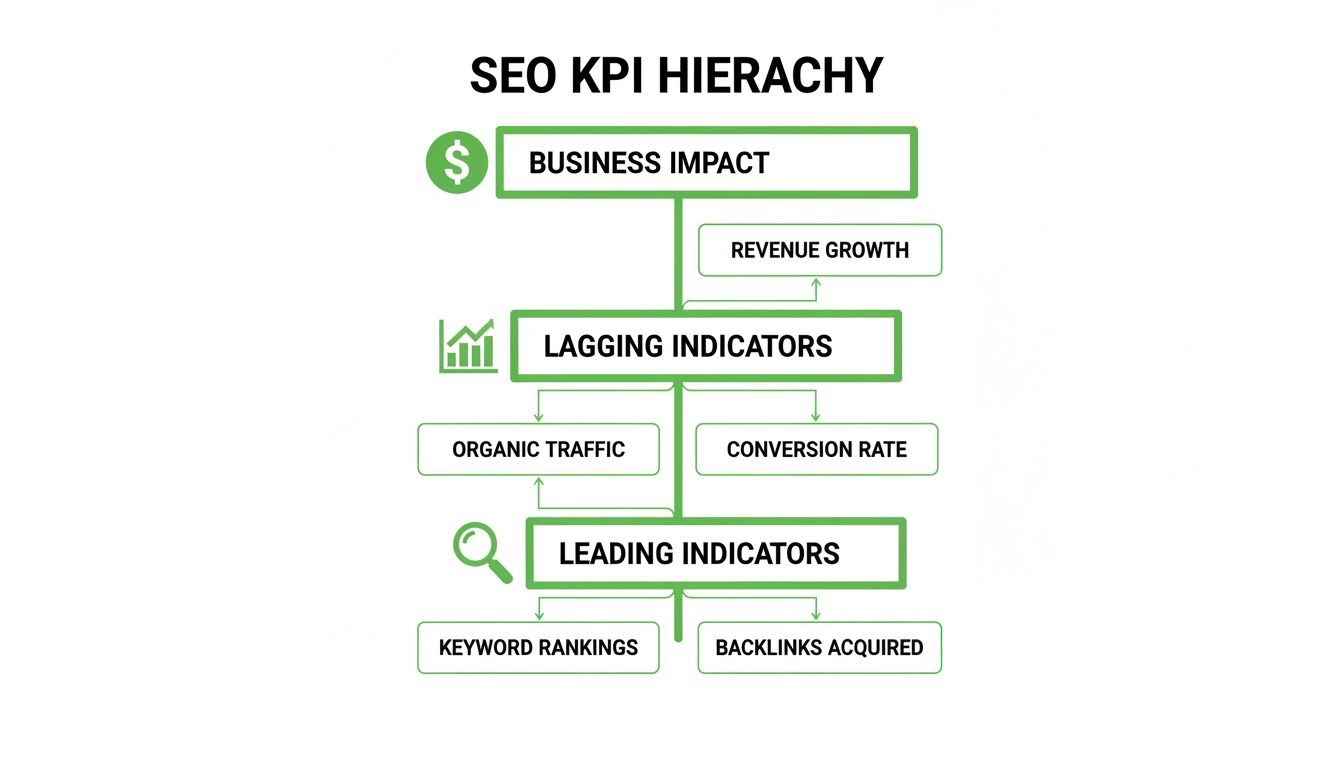
As you can see, leading indicators form the foundation, but their value is only truly realised when they translate into tangible business impact at the top of the pyramid.
Choosing Your Core Set of KPIs
Once you've nailed down your primary business goal, pick a small, focused set of KPIs that tell a complete story. Resist the urge to track everything. A cluttered dashboard just creates confusion, not clarity.
A powerful way to do this is to select one "North Star" metric from the Business Impact tier and support it with two or three metrics from the Leading and Lagging tiers.
Example for a B2B Startup:
- Business Impact KPI (North Star): Number of New Organic MQLs.
- Lagging KPI: Organic traffic to key "bottom-of-funnel" pages (think pricing or demo request pages).
- Leading KPI: Keyword impression growth for high-intent, non-branded terms.
This focused trio lets you see the entire chain of cause and effect. You know that growing impressions for the right keywords (leading) should drive more relevant traffic (lagging), which in turn will generate more MQLs (business impact). Each metric gives the others context.
A classic mistake is to focus only on traffic volume. But traffic that doesn't convert is just a cost to your server. It's far better to have 1,000 highly qualified visitors who convert than 100,000 who bounce immediately.
The importance of organic search can’t be overstated. In Germany’s competitive market, where Google commands over 90% market share, organic search drives a staggering 53% of all website traffic. This stat alone underscores why aligning KPIs like organic traffic to business goals is a cornerstone of success, especially for programmatic SEO strategies aiming to capture the 70% of German searches that are non-branded and intent-driven. You can explore more data on SEO trends in Germany to better understand the market.
By carefully selecting KPIs that mirror your core business objectives, you turn SEO from an isolated marketing channel into a measurable growth engine. This alignment doesn't just guide your strategy—it makes it much easier to prove the real financial return of your efforts. For a deeper look at that, check out our guide on how to perform a detailed ROI calculation for your SEO activities.
Measuring Success for Programmatic SEO and AI Search

Managing SEO for a handful of pages is one thing. But what happens when you’re dealing with thousands—or even millions—of pages created automatically? This is the world of Programmatic SEO (pSEO). Instead of writing every page by hand, you build a template and populate it with data from a spreadsheet or database. Think of how Zillow creates a unique page for every home listing—that's pSEO in action.
At this scale, standard KPIs are still important, but a new set of metrics focused on technical health and efficiency becomes critical.
How to Practically Implement Programmatic SEO with AI
You don't need to be a developer to get started. Modern tools make it surprisingly simple. Here's a practical, beginner-friendly workflow:
- Find Your Data: Start with a spreadsheet. This could be a list of cities, job titles, product features, or anything relevant to your business. This data will be the "fuel" for your pages.
- Define Your Keywords: Identify the keyword pattern you want to target. For example, if you have a list of cities, your pattern might be "[service] in [city]".
- Create a Page Template: Design a single page layout that will serve as the blueprint for all your programmatic pages. This template will have placeholders for your data (e.g.,
{{city_name}},{{local_statistic}}). - Use AI to Enrich Your Content: This is where AI makes pSEO accessible to everyone. Use a tool like ChatGPT to generate unique content for each row in your spreadsheet. For example, you can give it a prompt like: "Write a 50-word paragraph about the benefits of our service for people living in {{city_name}}." The AI will create custom text for every city in your list.
- Build and Publish: Use a tool or a simple script to merge your data and AI-generated content into your template, automatically creating hundreds or thousands of unique, optimized pages.
Key Metrics for Programmatic SEO
Since you're creating pages at scale, your main job is to ensure Google can find, understand, and index them efficiently. These KPIs, which you can track for free in Google Search Console, are your best friends:
- Indexation Rate: This is the most important KPI for pSEO. It's the percentage of your published pages that Google has actually indexed. A low rate means Google sees your pages as low-value or repetitive. Your goal is to get this as close to 100% as possible.
- Page Template Performance: Since you're using templates, you should measure their collective performance. Are pages from "Template A" getting more traffic and clicks than pages from "Template B"? This helps you optimize the template itself, which improves every page it generates.
Preparing for the AI Search Revolution
As AI Overviews become more common in search results, the goal is shifting. It's no longer just about ranking #1; it's about becoming a trusted source that the AI cites in its answers.
This means we need new KPIs to measure our influence in this AI-driven world. The good news is, you can start tracking them now.
Key Metrics for Generative Engine Optimisation (GEO)
- Visibility in AI Overviews: How often is your brand or content mentioned directly in Google's AI-generated summaries? For now, this requires manual checks for your most important keywords, but tracking it gives you a huge head start.
- Snippet Retrieval Frequency: How often does Google pull your content into featured snippets or "People Also Ask" boxes? These are the exact content pieces that AI models use as source material. An increase here is a strong signal that your content is AI-ready.
Getting comfortable with these ideas is how you stay ahead of the curve. To go deeper, our complete guide on Generative Engine Optimisation provides a framework for this new era. By combining core pSEO KPIs with these future-focused GEO metrics, you’ll build a measurement strategy that tracks today's performance at scale while getting you ready for what’s coming next.
How To Build a Simple and Effective SEO KPI Dashboard
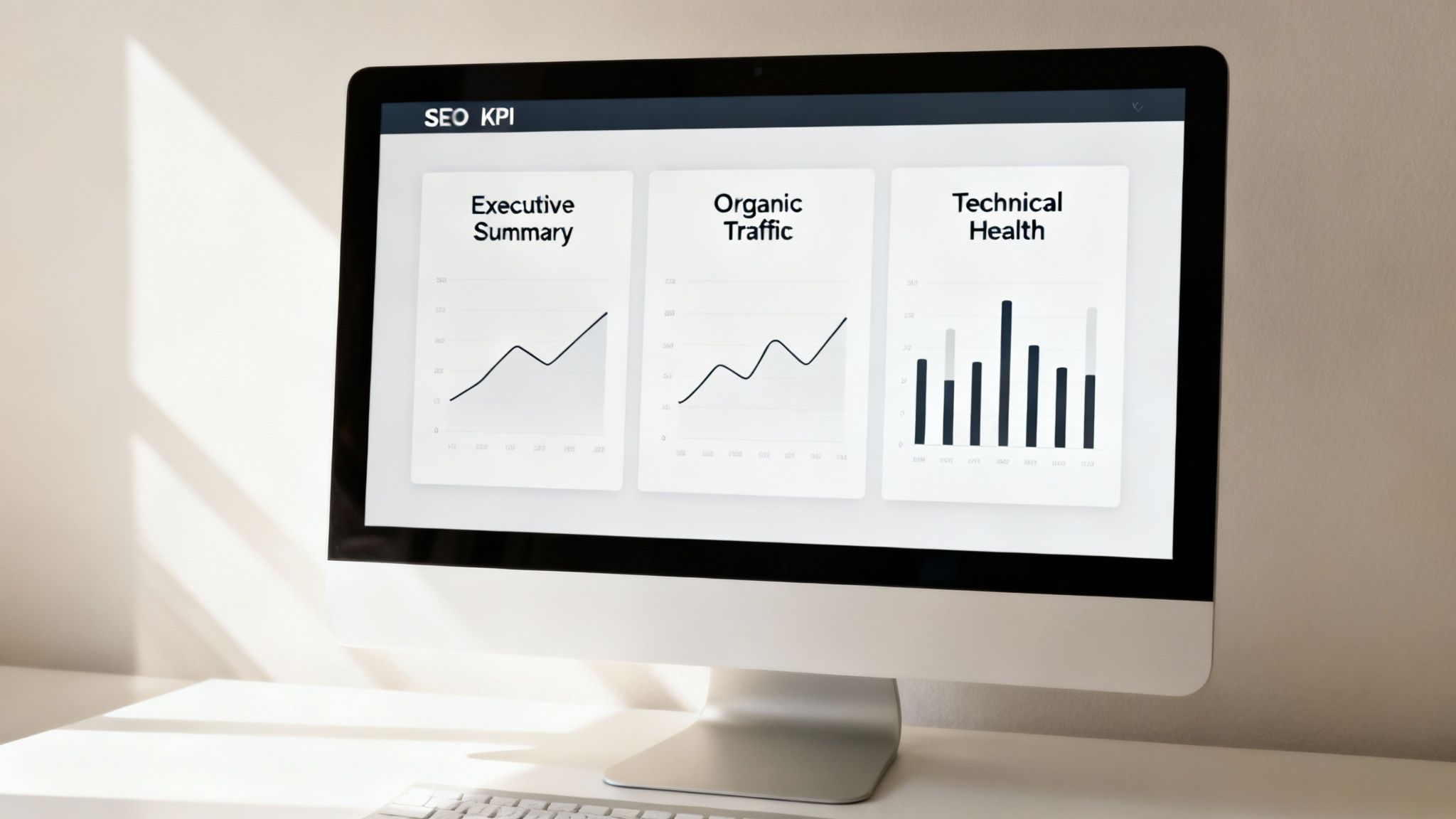
Tracking your KPIs is one thing, but showing them off in a way that makes sense is where you really prove your worth. A well-built dashboard turns a pile of raw data into a clear story, letting everyone from your team to the C-suite see the impact of your SEO work in seconds.
The goal isn't to stuff every metric you can find onto one screen. Far from it. A great dashboard organises information logically, serving up just the right details to different people. Think of it like a pyramid: a high-level summary sits at the top, a deeper performance analysis is in the middle, and all the granular technical stuff forms the base.
This structure means stakeholders see exactly what they need, without getting bogged down in data that doesn't matter to their role. The best part? You don't need fancy, expensive software for this. You can build an incredibly effective dashboard using free tools like Google Looker Studio.
The Three-Layer Dashboard Structure
To build a dashboard that communicates with absolute clarity, you need to structure it in three distinct sections. This tiered approach lets you tell the full story of your SEO performance, from top-line business results right down to the fundamental health of your site.
1. The Executive Summary (The "So What?" Layer)
This is the first thing anyone sees, so it has to be digestible in 30 seconds. It’s built for executives and stakeholders, answering the big-picture questions: Are we growing? Are we hitting our targets? Is SEO actually making the business money?
Metrics here are pulled straight from the business impact tier:
- Revenue from Organic Search: The ultimate proof that your work matters.
- Organic Conversions or MQLs: The main goal for most businesses.
- Year-over-Year Organic Traffic Growth: A simple, high-level pulse check on progress.
2. The Performance Deep-Dive (The "How?" Layer)
This section is for the marketing team. It adds the context behind the executive summary, showing the lagging and leading indicators that are driving those business results. It helps diagnose why things are moving up or down.
Focus on a mix of lagging and leading KPIs:
- Organic Traffic by Page or Template: Pinpoints which content is doing the heavy lifting.
- Impressions vs. Clicks: Visualises your visibility growth and how well you’re capturing that attention.
- Top Non-Branded Keyword Rankings: Shows your success in pulling in new audiences.
3. The Technical Health Check (The "Why?" Layer)
This part is for the SEO specialists—the ones in the trenches. It surfaces the foundational metrics that can make or break everything else. This is the engine room, showing if things are running smoothly under the bonnet.
Here, you'll focus on critical leading KPIs:
- Indexation Rate: The single most important metric for programmatic SEO, without a doubt.
- Crawl Errors: Your early warning system for technical gremlins.
- Page Speed Metrics (Core Web Vitals): A direct line to user experience and ranking potential.
Your dashboard shouldn't just report numbers; it should tell a compelling story. Start with the conclusion (business impact), then provide the supporting chapters (performance and technical health).
Building Your Dashboard in Looker Studio
Getting started is much simpler than you might think. Google Looker Studio (which used to be called Data Studio) is a free tool that hooks directly into Google Analytics and Google Search Console, pulling in your data automatically.
Here’s a simplified four-step process to get you going:
- Connect Your Data Sources: Link up your Google Analytics 4 and Google Search Console accounts.
- Create Your Three Sections: Use text boxes and shapes to clearly label your Executive Summary, Performance, and Technical sections.
- Add Your Charts: Drag and drop scorecards for single numbers (like Total Revenue) and time-series charts for trends (like Organic Traffic over time).
- Set Your Date Ranges: Add a date range controller so anyone viewing the report can compare performance month-over-month or year-over-year.
When you’re building your own, it’s always a good idea to check out some SEO dashboard example templates for lead attribution to see how others are visualising these metrics. For a more detailed guide, our deep-dive into creating effective SEO dashboards offers more inspiration and practical tips. By following this simple structure, you'll create a report that not only tracks your kpi for seo but also powerfully communicates its value.
Common Mistakes to Avoid When Tracking SEO KPIs
Knowing which KPIs to track is only half the battle. Just as important is knowing what not to do. It’s far too easy to fall into common traps that can completely derail your strategy and lead you to make some really poor decisions.
One of the biggest blunders is getting obsessed with vanity metrics. This usually looks like celebrating a number one ranking for a keyword that has almost no search volume or zero commercial intent. Sure, it feels great to be at the top, but if that position doesn't translate into valuable traffic or leads, it’s a hollow victory. Think of it like owning a beautiful shop on a street with no pedestrians—it looks impressive, but it’s not doing your business any good.
Measuring Without Context
Another frequent error is failing to segment your data. Just lumping all your traffic into one big number can hide the real story. For example, not separating branded traffic (people searching for your company name) from non-branded traffic (people searching for what you sell) is a classic mistake. A sudden spike in branded traffic might just mean your latest ad campaign worked, not that your SEO efforts are reaching new audiences.
The point of tracking SEO KPIs isn't just to hoard data; it's to find insights that tell you what to do next. If a metric doesn't help you make a better decision, it's just noise.
This lack of context also applies to your goals. If your main objective is lead generation, then only tracking keyword rankings while ignoring organic conversions is a recipe for disaster. You might be ranking for dozens of terms, but if none of them are driving sign-ups, you're optimising for the wrong thing entirely.
Drowning in Data
Finally, a lot of teams make the mistake of measuring everything. They build a dashboard cluttered with dozens of metrics, which is overwhelming and often leads to "analysis paralysis." When there’s too much noise, you can’t see the signal, and no action gets taken because the story is lost.
Here’s a quick rundown of the key mistakes to steer clear of:
- Chasing vanity metrics: Prioritising rankings for low-value keywords over metrics tied directly to business goals.
- Ignoring data segmentation: Failing to separate branded vs. non-branded traffic, or desktop vs. mobile performance.
- Lacking a "North Star" metric: Tracking a bunch of KPIs without one primary, goal-oriented metric to guide your entire strategy.
- Creating overly complex dashboards: Building reports that are so dense they fail to provide quick, clear insights.
By avoiding these common blunders, you can keep your measurement framework clean, focused, and directly aligned with what actually matters—driving sustainable growth for the business.
Your Top SEO KPI Questions, Answered
Let's quickly tackle some of the most common questions that come up when tracking SEO KPIs. Think of this as a rapid-fire round to clear up any lingering doubts and help you refine your measurement strategy.
How Often Should I Be Checking My SEO KPIs?
There’s no one-size-fits-all answer here. The right frequency really depends on what you're looking at. The trick is to think in tiers so you stay focused and don’t overreact to the natural daily fluctuations.
- Leading Indicators: Keep an eye on things like indexation status and crawl errors weekly. This is your early warning system, helping you spot technical issues before they have a chance to hurt your performance.
- Performance Metrics: For lagging KPIs like organic traffic and conversions, a monthly review is perfect. This timeframe gives you enough data to see meaningful trends emerge.
- Business Impact KPIs: Analyse metrics like revenue from organic search on a quarterly basis. This cadence aligns your SEO reporting neatly with broader business review cycles.
What Is the Single Most Important KPI for SEO?
This is a bit of a trick question. There is no single "most important" KPI because the right one is always tied directly to your business goals. The key is to pick a primary "North Star" metric that truly reflects what you're trying to achieve.
For an e-commerce site, organic revenue is the undisputed champion. But for a B2B company, the focus should be squarely on organic leads or Marketing Qualified Leads (MQLs). Your North Star KPI is the one metric that proves SEO’s value to the business, supported by a handful of other leading and lagging indicators.
Can I Track KPIs for Programmatic SEO with Free Tools?
Absolutely. You don't need to break the bank on expensive software to effectively monitor a large-scale programmatic SEO project. Google Search Console and Google Analytics 4 are incredibly powerful, and they're completely free.
With just these two tools, you can easily track all the essential programmatic KPIs—indexation rates, impressions, clicks, user engagement, and conversions—across thousands of pages. For custom analysis, just export the data into Google Sheets or pipe it into Google Looker Studio to build your own dashboards at no cost.
Ready to build a content strategy that scales and prepares you for the future of AI search? Programmatic SEO Hub provides the templates, guides, and tools you need to master programmatic SEO and Generative Engine Optimisation. Start building your high-performance content engine today at https://programmatic-seo-hub.com/en.
Related Articles

Mobile friendly test google: A Practical Guide to Master Mobile SEO
Even though Google’s standalone Mobile-Friendly Test tool is a thing of the past, the principle behind it is more critical than ever. The simple truth is that Google now overwhelmingly uses its...

A Practical Guide to Competitive Analysis Keywords
When we talk about competitive analysis keywords, we're really talking about the search terms that are already making money for your rivals. By digging into these, you uncover their entire...

Landing Pages SEO A Practical Guide to Rank and Convert
When we talk about SEO for landing pages, we're not just talking about general website optimisation. We're getting hyper-specific. This is the art of building and refining standalone pages...