Your Guide to KPI in SEO for Sustainable Business Growth

Watching your keyword rankings climb is a great feeling, but let’s be honest—it doesn’t directly pay the bills. The most important KPI in SEO is one that actually tracks real business growth, not just surface-level activity.
Focusing only on rankings is like staring at your car's speedometer. It tells you you're moving, but are you even heading in the right direction?
Moving Beyond Surface-Level SEO Metrics

It’s far too easy to get caught up in "vanity metrics." These are the numbers that look impressive in a report but don’t tell you a thing about the health of your business.
Let’s stick with the car analogy. The speed on your dashboard is a metric—a single data point. It tells you how fast you're going right now, but it offers zero context about whether you're on the right road or if you'll make it to your destination on time.
A Key Performance Indicator (KPI), on the other hand, is like your GPS’s estimated time of arrival. It’s a direct measure of your progress toward a specific goal. In this case, getting to your destination by a certain time. In SEO, a true KPI has to be directly wired to a business objective.
The Difference Between a Metric and a KPI
Confusing metrics with KPIs is one of the most common pitfalls in SEO. Simply put, a metric tracks an activity, while a KPI measures the outcome of that activity against a business goal. All KPIs are metrics, but not all metrics qualify as KPIs.
A metric becomes a KPI only when it is tied to a specific business objective. For example, 'Organic Traffic' is a metric. 'Increasing Organic Traffic to product pages by 20% to generate 50 new sales leads this quarter' turns that metric into a powerful KPI.
Getting this distinction right is critical. Chasing higher rankings for keywords that don't bring in potential customers is a huge waste of resources. It’s the equivalent of driving really fast in the completely wrong direction. You’re burning fuel, but you’re not getting any closer to where you need to be.
To learn more about attracting the right kind of visitors, check out our detailed guide on traffic analysis for programmatic SEO.
Shifting Focus to What Really Matters
To build an SEO strategy that works, you have to shift your focus from feel-good vanity metrics to actionable KPIs that reflect genuine business impact. It's about looking beyond the raw numbers and asking what they mean for your bottom line.
To make this crystal clear, here’s a quick reference guide comparing common but often misleading metrics with KPIs that provide real business insights.
Vanity Metrics vs Actionable SEO KPIs
| Vanity Metric (What it shows) | Actionable KPI (What it means for the business) |
|---|---|
| Keyword Rankings: Shows your position for a specific search term. | Organic Conversion Rate: Shows how many visitors from search are becoming customers or leads. |
| Impressions: Shows how many times your site appeared in search results. | Click-Through Rate (CTR): Measures how effectively your listing attracts clicks from potential customers. |
| Total Organic Traffic: Shows the total number of visits from search engines. | Organic-Sourced Revenue: Directly measures the income generated from your SEO efforts. |
| Domain Authority: A third-party score estimating your site's ranking potential. | Number of Qualified Leads from Search: Tracks how many potential clients SEO is delivering to your sales team. |
By focusing on these actionable KPIs, you ensure your SEO efforts are always aligned with sustainable growth. You’ll be turning your search presence from a line item on a report into a reliable engine for your business.
The Foundational KPIs for Every SEO Strategy
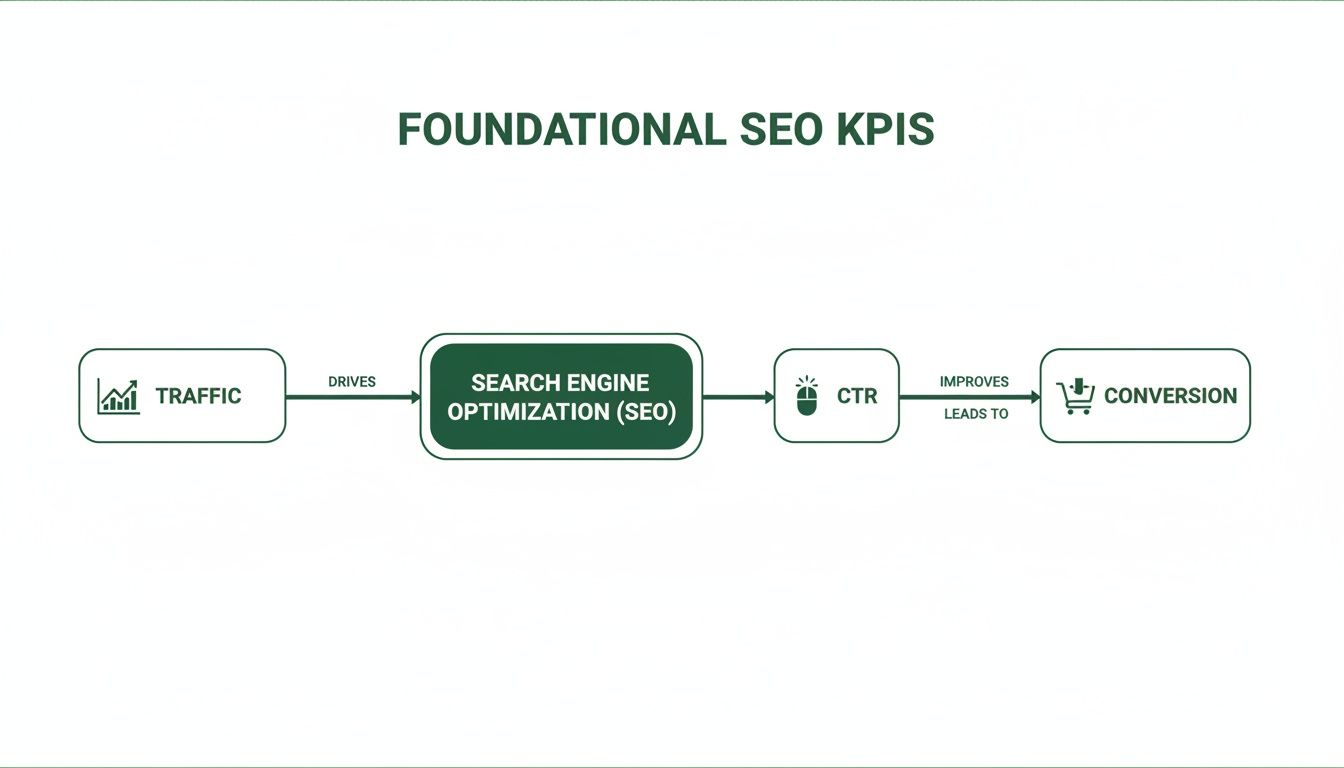
Alright, we’ve established the difference between a simple metric and a real KPI. Now it’s time to build your dashboard. A few Key Performance Indicators are so fundamental they form the bedrock of any solid SEO strategy, no matter your industry or size. Think of these as the mission-critical dials that give you an instant read on your performance.
These core KPIs help answer three simple but vital questions: Are people finding us? Do they care about what they see? And does any of this actually help the business? Let's break down the metrics that deliver these answers.
Organic Traffic: The Fuel for Your Growth
Organic Traffic is just what it sounds like: all the visitors who land on your website from a search engine like Google, without you paying for an ad. It’s the first, most obvious sign that your SEO work is paying off. If this number is climbing, it means more people are discovering you on their own terms.
But it’s not just about raw numbers. A steady rise in organic traffic is a strong signal that your content is resonating and becoming more visible to the right audience. It’s the fuel for your entire online growth engine. Without a consistent flow of visitors, you have no one to engage, convert, or impress.
Click-Through Rate: How Well You Grab Attention
Showing up in search results is half the battle; getting someone to actually click on your link is the other. That's exactly what Click-Through Rate (CTR) measures. It’s the percentage of people who see your link in the search results and choose to click it.
A healthy CTR tells you that your page titles and meta descriptions are doing their job—they’re compelling and promise a real solution to what the searcher is looking for. A low CTR, even when you rank high, is a massive red flag. It’s a sign of a major disconnect between what you're offering and what searchers want, and it’s costing you valuable traffic. To get this right, check out our guide on understanding and improving your click-through rate for programmatic SEO.
Organic Conversion Rate: Turning Visitors into Customers
This might just be the most important foundational KPI in SEO because it directly ties your efforts to business results. The Organic Conversion Rate is the percentage of visitors from search who complete a goal you care about, whether that’s buying a product, filling out a form, or signing up for a newsletter.
This KPI answers the ultimate question: are you attracting the right kind of traffic? High traffic with a low conversion rate often means you're attracting an audience whose intent doesn't align with your business. Focusing on this KPI ensures your SEO isn't just a technical exercise but a powerful driver of real revenue and leads.
Leading vs. Lagging Indicators: A Quick Guide
It helps to think of your KPIs as either 'leading' or 'lagging'.
- Leading Indicators (like CTR) are predictive. A rising CTR today suggests more traffic is coming tomorrow.
- Lagging Indicators (like Organic Conversion Rate) report on what already happened. They confirm if your strategy actually worked.
A smart SEO strategy keeps an eye on both—using leading indicators to forecast trends and lagging ones to validate past performance.
Scaling Success With Programmatic SEO KPIs
Programmatic SEO completely changes the game. Instead of optimising a handful of important pages, you're suddenly looking after thousands, or even tens of thousands. This kind of scale demands a new way of thinking about KPIs – metrics that measure the health of your entire content engine, not just how one page is doing.
Of course, the traditional KPIs still matter. But they don't give you the full picture. When you're publishing content at this volume, you first need to know if search engines can even find, crawl, and ultimately index your work. For anyone new to this approach, getting a handle on What Is Programmatic SEO is the first step to defining the right metrics.
Measuring the Health of Your Content Engine
Before you even think about business results, you have to make sure your programmatic setup is technically solid. It’s simple: if Google can't see your pages, they will never bring you a single visitor. Think of these technical KPIs as your early warning system.
- Indexation Rate: This is the percentage of pages on your website that Google has successfully added to its index. A low rate is a huge red flag, meaning a big chunk of your content is totally invisible to searchers.
- Crawl Budget Utilisation: Google only dedicates a certain amount of resources to crawling any given site. This KPI tracks how well that budget is being spent. You want to make sure Google is spending its time on your high-value pages, not getting stuck in redirect loops or wasting time on low-quality sections.
It helps to think of your website as a massive library. The Indexation Rate tells you how many of your books are actually on the shelves for people to find. Crawl Budget Utilisation, then, measures how efficiently the librarian can scan and categorise new books without getting sidetracked.
A Practical Guide: Implementing Programmatic SEO with AI
So, how do you actually do this? Here's a simple, non-technical breakdown of how to use AI to create thousands of pages, demystifying the process for beginners.
Step 1: Find a Scalable Keyword Pattern. Think in terms of templates. Instead of one keyword, find a pattern. For example:
- "[Service] in [City]" (e.g., "Plumber in London")
- "[Product A] vs [Product B]" (e.g., "iPhone 15 vs Galaxy S24")
- "Best [Product Category] for [Use Case]" (e.g., "Best running shoes for beginners")
Step 2: Build Your Database. This is your secret sauce. Gather all the unique data points for your patterns in a simple spreadsheet (like Google Sheets). For "[Service] in [City]", your columns would be "Service" and "City". For "[Product A] vs [Product B]", you'd need columns for product names, features, prices, etc.
Step 3: Write a Master Template. Create one perfect piece of content based on your keyword pattern. Write it as if it's the only page you'll ever publish on the topic. Use placeholders where your unique data will go. For example: "Finding a reliable {Service} in {City} can be tough..."
Step 4: Use AI to Generate Content at Scale. Now the magic happens. Use an AI tool (like GPT-4 via its API, or tools like Make/Zapier that connect spreadsheets to AI) to feed your database into your master template. For each row in your spreadsheet, the AI will generate a unique piece of content by filling in the placeholders. This creates thousands of unique, high-quality pages from one template.
Step 5: Publish Automatically. Set up your website (often on platforms like Webflow or a custom-built site) to automatically create a new page for each piece of content generated by the AI. This is how you go from a spreadsheet to a live, 10,000-page website.
This approach lets you create a massive amount of targeted content quickly, each page tailored to a specific user search.
Connecting Technical Health to Business Outcomes
Once you’ve confirmed your pages are visible to Google, you can shift your focus to performance. This is where programmatic SEO really shines, allowing for powerful template-level analysis.
The real power of programmatic SEO lies in optimising templates, not just individual pages. A 5% improvement to a template that governs 10,000 pages delivers a far greater impact than a 50% improvement on a single page.
This is where your KPIs need to get much more granular:
- Conversion Rate by Page Template: Don't just look at your site’s overall conversion rate. Dig deeper and analyse performance by template. You might discover that your "product vs product" pages convert at double the rate of your "alternative to" pages. That's a massive insight that tells you exactly where to focus your efforts.
- Revenue Per Thousand Visitors (RPM): This is a classic metric from the publishing world, and it’s incredibly useful here. It tells you exactly how much revenue you're generating for every 1,000 visitors to a specific group of pages. It helps you quickly spot your most valuable content types.
These are the metrics that turn your programmatic setup from a simple content factory into a predictable, revenue-driving machine. Managing these technical elements is vital, and setting up the right monitoring and alerts for programmatic SEO is key to staying on top of any issues.
How to Set SEO Goals You Can Actually Achieve
Knowing which KPIs to track is a great start, but those numbers are pretty useless without a target to aim for. A goal without a real plan is just a wish, and in the world of SEO, wishes don’t get you very far.
The secret to turning your SEO efforts into tangible business growth is setting goals that are both ambitious and grounded in reality. This is where the classic SMART framework comes into play. It’s a simple but incredibly powerful method for turning vague ideas into a concrete action plan.
Applying the SMART Framework to SEO
So, how does this actually work in practice? Let's get down to it. Instead of a fuzzy objective like "get more traffic," a SMART goal forces you to get specific and build a clear roadmap.
Here’s what each piece of the framework means for your SEO goals:
- Specific: What exactly do you want to accomplish? "Increase organic traffic" is vague. "Increase organic traffic to our new 'Compare Plans' page" is specific.
- Measurable: How will you know when you’ve succeeded? You need a hard number. For example, "Increase traffic by 2,500 visitors per month."
- Achievable: Is the goal actually realistic with your current team and budget? If your site gets 1,000 visitors a month, aiming for a million next month isn’t achievable. A 20% increase, however, probably is.
- Relevant: Does this goal truly matter to the business? Driving tons of traffic to a blog post that never converts isn't nearly as relevant as driving traffic to a page that generates sales leads.
- Time-bound: When will you hit this goal? Setting a deadline, like "by the end of Q3," creates urgency and a clear timeline for your team.
A well-defined goal transforms your work from a series of disconnected tasks into a focused campaign. A SMART goal like, "Increase the number of qualified leads from organic search by 15% over the next six months," gives your entire team a clear target to aim for.
Goal Setting for Different Business Models
Not all businesses are chasing the same outcomes, which means their most important KPI in SEO will naturally differ. A local service business, a SaaS company, and a huge online retailer all need to set goals that align with their unique models.
Take a local plumber, for instance. Their success isn't measured in millions of page views. Their most important goal is simply getting the phone to ring.
- Business Goal: Increase local service bookings.
- SMART SEO Goal: "Increase the number of 'request a quote' form submissions from organic search by 25% within the next quarter by ranking in the top 3 for 'emergency plumber in [City]'."
Now, think about a growing SaaS company. Their whole game is about acquiring users who will become long-term subscribers, making lead quality the top priority.
- Business Goal: Generate more qualified product demos.
- SMART SEO Goal: "Increase the number of organic demo sign-ups from our 'product alternatives' content cluster by 40% in the next six months."
Finally, a large e-commerce store is driven by one thing: sales. Traffic is important, but only if it leads directly to purchases.
- Business Goal: Drive more online sales.
- SMART SEO Goal: "Increase organic revenue from our 'summer dresses' category by 15% year-over-year during the second quarter."
In each case, the SEO goal is tied directly to a meaningful business outcome. Our detailed guide on goal tracking for programmatic SEO can help you set up the right measurement systems for your specific needs.
Ultimately, setting clear, realistic goals is the very first step toward building an SEO strategy that delivers predictable, sustainable growth.
Building Your SEO Performance Dashboard
Data is only useful if you can actually understand it. Let's be honest, rows and rows of numbers in a spreadsheet are where good insights go to die. The real magic happens when you bring your most important KPIs in SEO to life in a visual dashboard, turning a mess of data into a clear story about what’s working and what isn’t.
You don't need fancy, expensive software for this, either. A free tool like Google Looker Studio is more than powerful enough to create a central hub for your SEO health. It lets you pull in data from places like Google Analytics 4 and Google Search Console and blend it all into one interactive report. The whole point is to build something that helps you make smarter decisions, faster.
Connecting Your Core Data Sources
First things first, you need to pull your information together. Think of your dashboard as a command centre that gets live updates from your most critical platforms. For anyone in SEO, that almost always means starting with two non-negotiables.
- Google Search Console: This is your direct line to Google. It’s the ground truth for your visibility—how many people see your site in the results (impressions), how many click through, your average ranking position, and your Click-Through Rate (CTR).
- Google Analytics 4: This tool picks up where Search Console leaves off, telling you what happens after the click. It tracks your organic traffic, how people engage with your site, and—most importantly—the conversions and revenue that come from it.
Hooking these two up in Looker Studio gives you the complete picture, from the moment someone searches all the way to a sale or lead. You can't really measure SEO success without seeing that full journey.
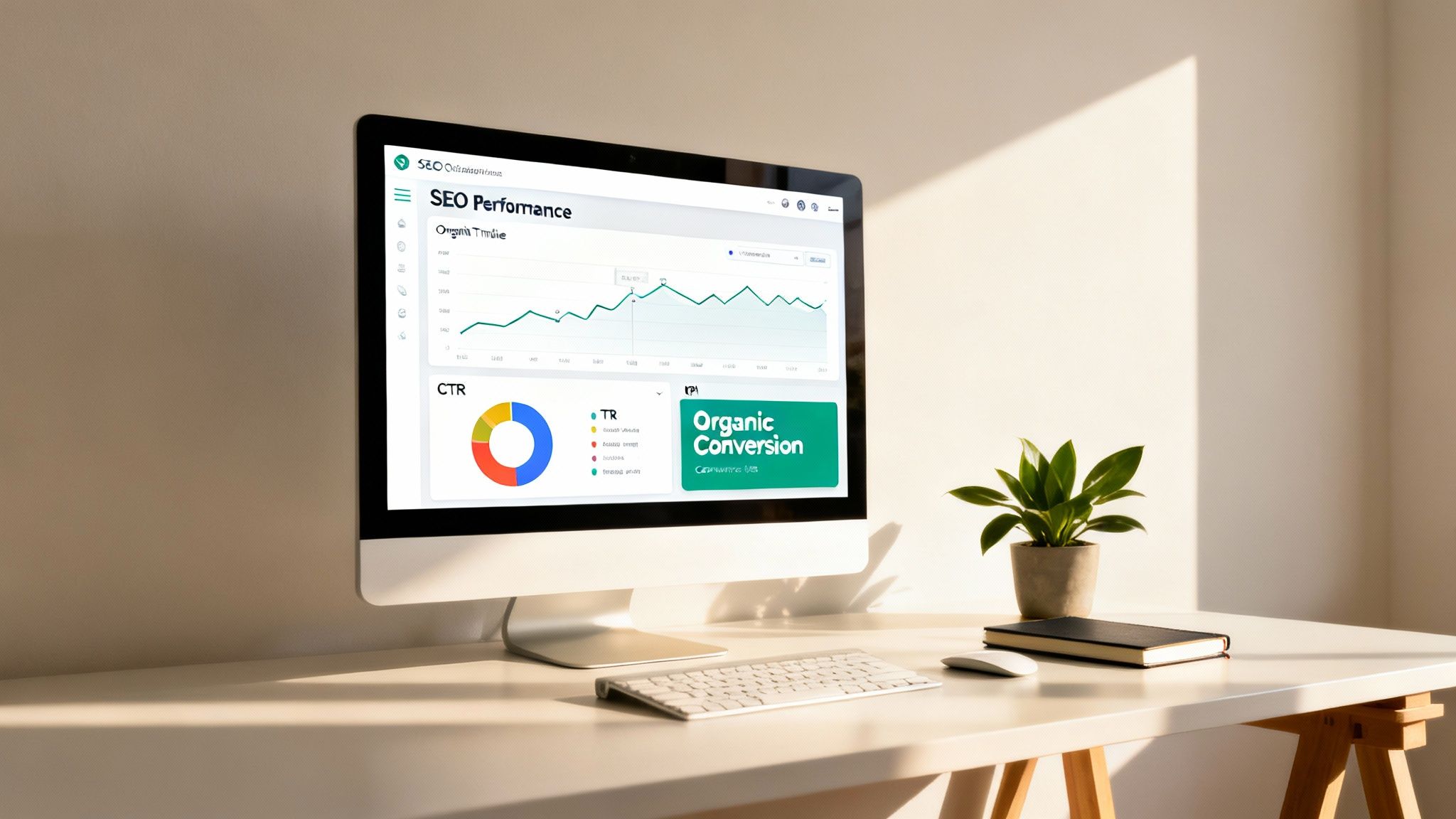
From here, you can start dragging and dropping different charts and graphs to make your key numbers pop.
Designing for Different Audiences
A great dashboard isn't one-size-fits-all. Your CEO doesn't need to see the same level of detail as your SEO team. A well-designed dashboard is tailored to give the right information to the right people, without the noise.
The most effective dashboards tell a clear story. For an executive, the story might be about high-level growth and return on investment. For an SEO practitioner, the story is about performance details, technical health, and optimisation opportunities.
I always recommend creating at least two different views:
- The Executive Summary: This is your high-level, single-page view focused purely on business impact. Stick to a handful of core KPIs like Organic Revenue, Qualified Leads from Search, and maybe month-over-month traffic growth. The goal is a quick, five-second check-in that answers, "Is SEO making us money?"
- The Practitioner's Deep Dive: This is for the team in the trenches. It should be packed with more granular data—things like CTR by page, indexation rates for your programmatic templates, and conversion rates for specific content clusters. This is the diagnostic tool you use to spot problems and find new opportunities.
It's also smart to keep an eye on what's happening outside of search. For instance, the social media platform X saw explosive growth in Germany between early 2024 and early 2025; its advertising reach shot up by 5.47 million users, a 33.9 percent surge. That kind of shift can absolutely influence search behaviour, reminding us to monitor visibility across multiple channels.
By visualising your data properly, you turn raw numbers into a powerful tool for making strategic decisions. If you want to get your hands dirty building these, check out our deep-dive guide on building effective SEO dashboards.
Common Questions About SEO KPIs
Digging into SEO analytics can feel like opening a can of worms. The moment you start trying to connect your work to actual business results, a whole new set of questions pops up. It's totally normal. This section cuts through the noise to give you clear answers to the most common questions we hear about SEO KPIs.
What Is the Single Most Important KPI in SEO?
That's a trick question. There isn't one.
The search for a single "best" KPI is exactly what sends people chasing vanity metrics. The most important KPI is always the one that ties directly back to your main business objective, and that's going to be different for every company.
So, instead of asking what the best KPI is, ask yourself what business goal your SEO strategy is supposed to support.
- Running an e-commerce store? Your most important KPI is probably Organic Revenue. Simple as that.
- A SaaS business? It’s likely Qualified Leads from Organic Search.
- A content publisher? You might be focused on Ad Impressions or Newsletter Subscriptions.
The right question isn’t, "What's the best KPI?" It's, "What business outcome does my SEO strategy need to support?" The answer to that question reveals your most important KPI.
How Often Should I Report on My SEO KPIs?
This really depends on what you're looking at. If you check everything daily, you'll drive yourself crazy reacting to normal, meaningless fluctuations. But if you only check in quarterly, you could miss a disaster in the making.
A much better approach is to match your reporting cadence to the metric itself:
- Weekly Health Checks: This is perfect for technical KPIs like Indexation Rate or Crawl Errors. A quick weekly look lets you catch and squash technical bugs before they can hurt your performance.
- Monthly Performance Reviews: This is the sweet spot for your core performance metrics like Organic Traffic, CTR, and Organic Conversions. A month gives you enough data to spot real trends without getting lost in the day-to-day noise.
- Quarterly Strategy Sessions: Save this longer timeframe for your big-picture, business-impact KPIs. Analysing Organic Revenue or Customer Lifetime Value from search quarterly gives you the high-level view you need to make smart, long-term strategic decisions.
My Organic Traffic Is Up but My Revenue Is Not. What Do I Do?
This is an incredibly common—and frustrating—problem. When this happens, it almost always points to a mismatch between the content you're creating and the intent of the audience you're attracting. It's time to put on your detective hat.
First, figure out where all that new traffic is actually going. Did you suddenly start ranking for a high-volume, informational keyword that brings in tons of curious people who were never going to buy anything? This "intent mismatch" is the number one culprit.
Next, look at how users are behaving on those high-traffic, low-converting pages. Are they bouncing right away? That could signal a poor user experience, slow page speed, or that the content just doesn't deliver on what the title and meta description promised.
The solution isn't to stop creating content. It's to either re-optimise those pages to better match a commercial intent or create new pages that specifically target people who are much, much closer to making a purchase.
What Tools Do I Need to Track SEO KPIs Effectively?
Here’s the good news: you can build an incredibly powerful measurement system using tools that are 100% free. While there are plenty of expensive platforms out there, you don't need to spend a single euro to track the KPIs that actually drive your business forward.
This is the essential, no-cost stack for effective KPI tracking:
- Google Search Console: This is your non-negotiable starting point. It's the source of truth for how you appear in Google, giving you vital data like impressions, clicks, average position, and CTR.
- Google Analytics 4: This tells you what happens after the click. It’s where you’ll track your organic traffic, user engagement, organic conversions, and revenue.
- Google Looker Studio: This is the free data visualisation tool that pulls it all together. You can connect it to both Search Console and Analytics to create a single, easy-to-read dashboard that tells your complete SEO story.
Paid tools like Semrush or Ahrefs are fantastic for deep keyword research and competitive analysis, but they aren't essential for tracking the KPIs that matter most to your bottom line. Master the free Google suite first; you'll be amazed at how much you can achieve.
At Programmatic SEO Hub, we're dedicated to helping you master the strategies and analytics needed to scale your organic growth. Explore our guides, templates, and free tools to build an SEO engine that drives real business results. Learn more at https://programmatic-seo-hub.com/en.
Related Articles

Mobile friendly test google: A Practical Guide to Master Mobile SEO
Even though Google’s standalone Mobile-Friendly Test tool is a thing of the past, the principle behind it is more critical than ever. The simple truth is that Google now overwhelmingly uses its...

A Practical Guide to Competitive Analysis Keywords
When we talk about competitive analysis keywords, we're really talking about the search terms that are already making money for your rivals. By digging into these, you uncover their entire...

Landing Pages SEO A Practical Guide to Rank and Convert
When we talk about SEO for landing pages, we're not just talking about general website optimisation. We're getting hyper-specific. This is the art of building and refining standalone pages...