Your Guide to AI and the Keyword Long Tail

So, what exactly is a long-tail keyword?
Think of it as a super-specific, multi-word search phrase. These aren't your vague, one-word "head" terms. Instead, they're the detailed questions and commands people type into a search bar when they know precisely what they're looking for and are often close to making a decision.
Demystifying The Keyword Long Tail

Let's use an analogy. Searching for a broad term like "shoes" is like casting a massive net into the open ocean. You'll get a ton of results, but most of them will be irrelevant. It’s a crowded, fiercely competitive space where the results are often too general to be useful.
A long-tail keyword, on the other hand, is like using the perfect lure in a small, well-stocked pond. A search for "best waterproof hiking boots for wide feet" isn't a casual browse. This person has a specific problem and is actively looking for a solution. They're probably ready to buy.
That specificity is the magic of the long tail. These are the detailed, conversational phrases real people use when they have a clear goal in mind.
The Power of Specificity and Intent
The real value here is the user's intent. While any single long-tail keyword gets fewer searches than a head term, the traffic it brings in is far more qualified. This is your chance to connect with potential customers at the most critical moment in their journey.
To make it even clearer, here’s a quick breakdown of how these two keyword types stack up against each other.
Head Term vs Long Tail Keyword At a Glance
| Characteristic | Head Term (e.g. 'Coffee') | Long Tail Keyword (e.g. 'best organic light roast coffee beans online') |
|---|---|---|
| Search Volume | Very High | Very Low |
| Competition | Extremely High | Low |
| Conversion Rate | Low | High |
| Search Intent | Broad, Informational | Specific, Transactional |
| Keyword Length | 1-2 words | 4+ words |
As you can see, the trade-off is simple: you sacrifice raw volume for high-quality, high-intent traffic that’s much easier to capture.
Focusing on a long-tail strategy gives you three huge advantages:
- Lower Competition: Let's be honest, far fewer websites are battling for "best organic light roast coffee beans online" than for the generic term "coffee." This gives your content a real shot at standing out and climbing to the top of the search results.
- Higher Conversion Rates: A user with such a specific query has already done their homework. They're much closer to buying, signing up, or taking action, which means this traffic is primed to convert.
- Alignment with Modern Search: With voice search and AI assistants becoming the norm, people are using longer, more natural questions. A solid long-tail strategy puts your content in the perfect position to provide the answers.
This focus on detail is especially potent in markets like Germany, where consumer search behaviour leans heavily towards precision. A remarkable 70% of Google queries there are four or more words long, proving just how vital the long tail is.
This lines up with broader data showing that nearly 95% of all keywords get 10 or fewer searches per month. This creates a massive, untapped opportunity for websites to attract valuable traffic without getting into a costly fight for a handful of high-competition head terms.
If you're looking to dig deeper into finding these hidden gems, our guide on the fundamentals of keyword research is the perfect next step.
Why Long-Tail Keywords Future-Proof Your Content
A smart strategy built around long-tail keywords does more than just help you win at SEO today—it sets up your content for the future of search. As search engines shift from being simple link directories to AI-powered answer engines, the rules are changing fast. Your content has to adapt, or it risks becoming invisible.
Hyper-specific queries are a signal of strong user intent. They bring in high-quality traffic that’s often ready to convert. Think about it: someone searching for "best project management software for remote marketing teams" isn't just window shopping. They have a specific problem and are actively looking for a solution. Answering that exact need is a powerful way to bring qualified leads right to your doorstep.
Preparing for AI-Driven Search
The real long-term win here is how this type of content feeds into AI. Think of models like ChatGPT and Google’s AI Overviews. These systems are built to find and piece together the best, most direct answers to complex questions. They don't just scan for broad keywords; they hunt for content that completely solves a user's problem.
When your content is structured around detailed, specific long-tail questions, you are essentially creating perfect training data for these AI models. You're not just giving them ingredients; you're handing them a complete, easy-to-follow recipe.
This means that by focusing on the long tail, you position your brand to become the source material for AI-generated answers. It's a huge shift from simply ranking on a results page to becoming an authoritative voice that AI systems actually trust and cite.
Building Topical Authority with Specificity
This approach is also one of the most effective ways to build deep authority on a subject. Instead of writing one massive, general-purpose article, you create a whole network of interconnected pages, each one tackling a very specific question. This structure demonstrates a comprehensive expertise that both users and search engines reward. You can learn more about how this works by exploring our guide on building topical authority for SEO.
Each piece of long-tail content acts like a building block, reinforcing your expertise across the board. For an AI, this organised web of content is highly digestible, making it much easier for it to grasp the full scope of your knowledge and recommend your content.
- Signals Expertise: Answering niche questions shows you understand a subject deeply, not just at a surface level.
- Improves Internal Linking: A cluster of related long-tail articles creates natural opportunities for internal links, helping search engines map out your site's structure.
- Satisfies Niche Audiences: You connect directly with users who have been completely ignored by competitors chasing broader, more generic terms.
Ultimately, a robust long-tail keyword strategy is your best defence against future algorithm changes and the rise of AI search. It aligns your content with how people naturally look for information and how modern search engines are designed to deliver it. By becoming the best answer to thousands of specific questions, you secure your visibility for years to come.
How to Find Thousands of Long Tail Keywords with AI
Forget the old days of manually sifting through spreadsheets for keyword ideas. That was a grind. Today, AI can help you unearth thousands of valuable long-tail opportunities in a fraction of the time.
This isn't about letting robots take over your strategy. It’s about using AI as an incredibly powerful brainstorming partner to find keyword gold at a scale that was previously impossible. The process is surprisingly straightforward and starts with a single, broad idea – your seed keyword. From there, you use AI to systematically generate hundreds, or even thousands, of specific variations that real people are searching for.
Start with a Seed Keyword and Brainstorm Modifiers
Think of your seed keyword as the core topic. If you're an accounting software company, your seed keyword might be "invoicing software." It’s a decent start, but it's way too broad and competitive to rank for on its own. The real goal is to find all the super-specific, long-tail searches that branch off from it.
This is where a tool like ChatGPT becomes your secret weapon. You can prompt it to act as an SEO expert and brainstorm different categories of modifiers—these are simply words or phrases that add specificity to your seed keyword.
Here are the kinds of modifiers you can get it to generate:
- Audience: Who is the software for? (e.g., freelancers, small businesses, construction companies)
- Feature: What specific capability are they looking for? (e.g., with time tracking, for recurring payments)
- Price: What’s their budget? (e.g., free, under €50/month, open source)
- Location: Where are they based? (e.g., for Germany, UK-based)
Nailing down these different facets of a keyword is a crucial first step. For a really structured way to do this, check out our guide on the keyword pattern discovery template, which breaks this system down even further.
Use a Simple Prompt to Generate Your Keyword List
Once you have your lists of modifiers, you can combine them to create a massive list of potential long-tail keywords. Instead of painstakingly mashing them together by hand, just give the AI a clear set of instructions.
Here’s a practical, copy-and-paste-ready prompt you can use right now with a tool like ChatGPT:
Prompt: "Act as a programmatic SEO expert. My seed keyword is 'invoicing software'. Combine it with the following modifiers to generate a comprehensive list of long-tail keywords.
Audience: freelancers, small businesses, startups, agencies
Feature: with time tracking, with payment reminders, for project management
Price: free, cheap, premiumCreate keyword combinations following patterns like '[seed] for [audience]' and '[price] [seed] with [feature]'. Present the final list in a clean, one-keyword-per-line format."
A single prompt like this can instantly spit out dozens of highly targeted phrases like "invoicing software for agencies" or "free invoicing software with time tracking." By simply expanding your modifier lists, you can easily scale this process to thousands of unique keyword long tail variations.
This workflow is the foundation of a modern, future-proofed content strategy. You start with systematic keyword research, move to content creation, and then optimise it so AI models can understand it.
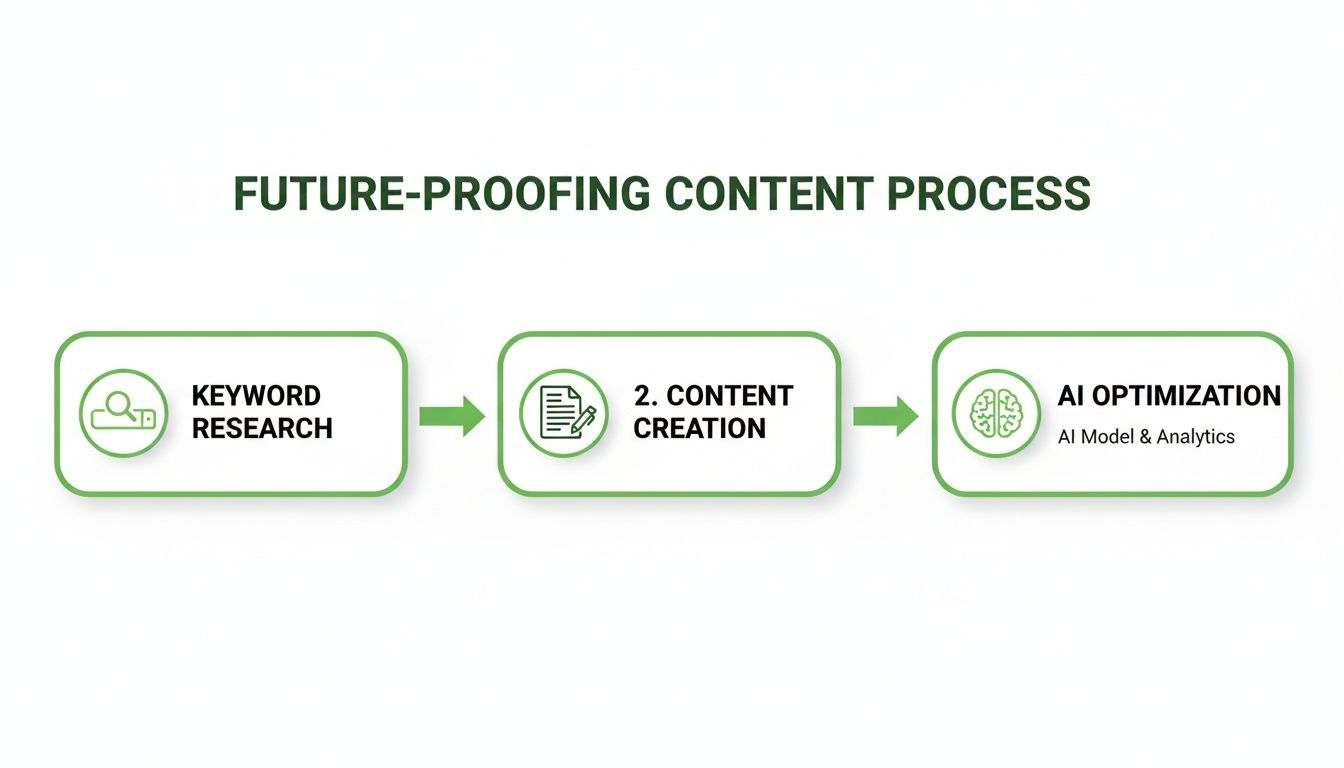
The key takeaway is that a systematic approach to keyword research is what builds the foundation for content that performs well, not just in traditional search, but in the new world of AI-driven answer engines.
Scale Your Research for Maximum Impact
This entire method is built for speed and scale. The real magic happens when you build a comprehensive content plan that targets countless low-competition, high-intent searches—all without the soul-crushing manual labour. To get this done even faster, exploring dedicated AI-powered keyword research features can seriously streamline your process.
This approach is especially powerful in markets where users already search with high specificity. Take Germany's SEO landscape, for example. Long-tail keywords are absolutely essential there, particularly now that voice search accounts for over 40% of all searches. That trend is driving huge demand for content that directly answers the natural, conversational phrases German users speak into their devices.
By automating the discovery phase, you can stop wasting time finding keywords and shift your focus to what actually matters: creating truly valuable content that perfectly answers each specific query. This is the bedrock of any successful programmatic SEO strategy.
How to Practically Create Content for Thousands of Keywords with AI
So, you've used AI to generate a huge list of long-tail keywords. Awesome. But now comes the real challenge: how do you create high-quality content for all of them without spending a year and a fortune on writers?
The answer is Programmatic SEO (pSEO). Don't let the name scare you. It’s simply a smart system for creating many pages at once by combining a template with data. Think of it like a mail merge, but for creating web pages.
If you're new to the concept, this guide on What Is Programmatic SEO and How Does It Work? is an excellent primer that breaks down the fundamentals.
Step 1: Create a Content Template
The content template is the blueprint for all your pages. It ensures every page has a consistent structure and quality. It’s not about making identical pages; it’s about creating a reliable framework.
A template has two parts:
- Static Content: These are the parts that are the same on every page, like your introduction, your "About Us" section, or a final call-to-action.
- Dynamic Placeholders: These are the empty spots you'll fill with unique information for each page. Think of them as variables like
[Industry]or[Software_Type].
For our example "best [software type] for [specific industry]," the intro and conclusion might be static, while [software type] and [specific industry] are the dynamic placeholders that make each page unique.
Step 2: Organize Your Data in a Spreadsheet
This is where your keyword list comes to life. You’ll use a simple spreadsheet (like Google Sheets) to organize the information for each page you want to create. Each row will become a page, and each column will hold the data for your dynamic placeholders.
Here’s what it could look like for our software example:
| Page Slug | H1 Title | Software_Type (Placeholder 1) | Industry (Placeholder 2) |
|---|---|---|---|
| best-crm-for-real-estate | Best CRM for Real Estate | CRM | Real Estate |
| best-accounting-for-freelancers | Best Accounting for Freelancers | Accounting Software | Freelancers |
| best-project-management-for-startups | Best Project Management for Startups | Project Management | Startups |
This spreadsheet is the fuel for your content machine. It’s your plan, neatly organized and ready to go. For a more advanced setup, you can check out detailed strategies for building a pSEO data pipeline that streamline this entire process.
Step 3: Use AI to Create Content for Your Placeholders
Now for the magic. Instead of asking AI to "write an entire article," which often results in generic content, you'll use it to create small, specific pieces of text for each placeholder in your spreadsheet.
The goal is to automate the creation of the unique parts of your content while you maintain control over the overall structure. This is how you ensure both quality and scale.
For the "best CRM for real estate" page, you would use focused prompts for each unique section:
- "Write a 100-word intro on the unique challenges real estate agencies face that a specialized CRM can solve."
- "Generate a bullet point list of the top 3 features a real estate CRM must have, with a one-sentence explanation for each."
You run these small prompts for each row in your spreadsheet, generating unique paragraphs, lists, or descriptions. You then add this AI-generated text back into new columns in your spreadsheet. Now, your spreadsheet contains everything needed to build hundreds of unique-feeling pages.
This system lets you produce content at scale that is still highly relevant to each specific keyword long tail. And the best part? You can do this without a developer, using popular no-code tools.
A Practical Walkthrough: From Keyword to Published Page
Let's make this real. It's time to stop talking theory and actually build a page. We'll walk through how to take a single keyword long tail from your spreadsheet and use AI to create a high-quality page, piece by piece.
Our target keyword for this example is: "best CRM for small real estate agencies."
The secret is breaking the page creation process into small, manageable tasks. We'll use very specific AI prompts for each section, which is the key to creating genuinely useful content at scale.

Step 1: Prompting a Targeted Introduction
First impressions are crucial. The introduction must immediately show the reader that you understand their specific problem. A generic opening won’t work.
Here’s how to prompt an AI like ChatGPT for a focused introduction:
AI Prompt: "Write a 100-word introduction for a blog post titled 'Best CRM for Small Real Estate Agencies.' Focus on the specific pain points of small agencies, like managing client relationships, tracking leads from multiple sources, and the struggle to compete with larger firms. End by promising a clear guide to the best CRM solutions."
By giving the AI this specific context—the audience, their problems, and the page's goal—you get an introduction that feels custom-written and highly relevant.
Step 2: Generating a Structured Comparison Table
People love tables because they are easy to scan and compare. AI is excellent at creating them if you provide a clear structure.
Let's ask the AI to create a comparison table for three fictional CRM tools.
AI Prompt: "Create a Markdown table comparing three CRM tools for small real estate agencies: 'AgentFlow,' 'RealtyOS,' and 'LeadLocker.' The columns should be 'Tool Name,' 'Best For,' 'Key Feature,' and 'Pricing.' Fill the table with realistic, concise information relevant to a real estate agent."
This prompt delivers a clean, structured table that adds immediate value to your page, presenting key information efficiently.
Sample AI Prompts for Programmatic Page Sections
To get the hang of this, it's helpful to have a collection of ready-to-use prompts. Think of these as your building blocks for creating different sections of your page.
Here’s a small library of prompts you can adapt for almost any project.
| Page Section | Example AI Prompt |
|---|---|
| Introduction | "Write a 100-word intro for a page about [Topic] for [Audience]. Address their main challenge: [Pain Point]." |
| Product/Service Description | "Write a 75-word paragraph for [Product Name]. Highlight its key benefit: [Unique Feature]. Mention it's ideal for [User Type]." |
| Feature Bullets | "Create a bulleted list of 3-5 key features for [Product Name]. For each, write a one-sentence benefit-driven description." |
| Comparison Table Row | "For the product [Product Name], provide concise data for these columns: 'Best For', 'Key Feature', and 'Pricing'." |
| Conclusion | "Write a short, 50-word concluding paragraph summarising why [Solution] is a great choice for [Audience] looking to solve [Pain Point]." |
Having these prompts ready saves a massive amount of time. You just swap out the placeholders and generate consistent, high-quality content for any part of your template.
Step 3: Crafting Unique Paragraphs for Each Section
Now, let's flesh out the page content. We’ll continue using our micro-tasking strategy to ensure each piece of content is unique and relevant. We can now generate descriptions for each CRM in our table.
- For AgentFlow: "Write a short, 75-word paragraph about 'AgentFlow.' Emphasise that its main benefit is its user-friendly mobile app, which allows agents to manage leads and appointments while on the go. Mention it's ideal for agents who are frequently out of the office."
- For RealtyOS: "Write a 75-word paragraph for 'RealtyOS.' Focus on its strength in automation, specifically its automated email follow-up sequences for new leads. State that it’s best for agencies wanting to save time on manual outreach."
Each prompt is a small, precise request. This level of control is what separates high-quality programmatic content from generic spam.
If you want to see a complete system of prompts, we've laid it all out in our guide on AI page content generation.
Step 4: Assembling Your Final Page
This is the easiest part. You take all the AI-generated content pieces from your spreadsheet and slot them into your master content template. The introduction goes here, the table there, and the unique paragraphs fill in the gaps.
Your final page structure will look something like this:
- H1 Title: Best CRM for Small Real Estate Agencies
- (AI-Generated Intro): The hook that addresses the agent's specific needs.
- (AI-Generated Table): A quick-scan comparison of the top tools.
- H2 Subheading: A Closer Look at Each CRM
- (AI-Generated Paragraph 1): The detailed blurb for AgentFlow.
- (AI-Generated Paragraph 2): The detailed blurb for RealtyOS.
- (Static Content): Your pre-written conclusion or call-to-action that's the same on every page.
This system—a static template combined with unique, AI-generated content for placeholders—is the engine of modern programmatic SEO. It's a repeatable process you can use today to build content that perfectly targets every single keyword long tail.
Frequently Asked Questions
As you start digging into a strategy built around the keyword long tail and programmatic SEO, you're bound to have some questions. Let's tackle the most common ones head-on to clear things up and give you the confidence to move forward.
Will Programmatic SEO Content Get Penalised by Google
This is the big one, isn't it? The short answer is no—as long as your content is genuinely useful to the reader. Google's penalties are aimed at spammy, low-quality junk, not the method you use to create your pages.
The real difference-maker here is intent.
Think of programmatic SEO as just a way to scale content production. When you design each page to answer a very specific long-tail query with a unique, helpful response, you’re doing exactly what Google wants: satisfying user intent. The goal is to use data and automation to make every single page a valuable resource, not just a thin, rehashed copy of another. You can read more on how to keep your standards high in our guide on quality and compliance for auto-generated content.
How Many Pages Should I Create Programmatically
Instead of chasing a magic number, think about the opportunity. The point isn't just to flood the internet with thousands of pages; it's to completely cover all the valuable long-tail keyword variations in your niche.
A smart way to start is with a focused content cluster of a few hundred pages targeting one specific user need. Watch their performance like a hawk, paying close attention to indexing rates and any early traffic trickling in. Once you see those positive signals, you can confidently scale up and build out new content clusters. Let the data from your first batch guide your next move.
The most successful programmatic strategies aren't about sheer volume. They are about achieving complete coverage of a specific topic, making sure you have the best answer for every possible user question in that niche.
This methodical approach keeps your risk low and makes sure you're putting your effort where it will actually pay off.
Do I Need to Be a Developer to Do This
Not anymore. It’s true that programmatic SEO used to be the exclusive playground for people with serious coding skills, but that world has completely changed. The explosion of no-code and low-code tools has thrown the doors wide open for marketers, founders, and content creators.
Platforms like Webflow or Softr can now connect to a simple data source like Google Sheets or Airtable. With automation tools like Zapier filling the gaps, you can build an incredibly powerful pSEO system without writing a single line of code. In fact, this whole guide is built around these modern, user-friendly workflows so you can build and manage your content engine yourself.
Should Each Page Target Only One Long Tail Keyword
Yes, absolutely. This is where the magic of a programmatic strategy really shines. Each page should be laser-focused on answering the user intent behind a single, specific keyword long tail.
For instance, a page dedicated to "best running shoes for flat feet" should be the most complete, helpful resource on the internet for that exact query.
This tight focus creates hyper-relevant content that makes users happy and is incredibly easy for search engines and AI models to understand. Of course, the page will naturally rank for related phrases, but its entire DNA—from the H1 title right down to the body content—should serve that one primary keyword. This precision is what allows you to win thousands of tiny, low-competition search battles at scale.
Ready to stop fighting for a few big-ticket terms and start winning thousands of high-intent searches? Programmatic SEO Hub provides the templates, systems, and hands-on guides you need to build your own content engine. Explore our free resources and start scaling your traffic at https://programmatic-seo-hub.com/en.
Related Articles
Mobile friendly test google: A Practical Guide to Master Mobile SEO
Even though Google’s standalone Mobile-Friendly Test tool is a thing of the past, the principle behind it is more critical than ever. The simple truth is that Google now overwhelmingly uses its...
A Practical Guide to Competitive Analysis Keywords
When we talk about competitive analysis keywords, we're really talking about the search terms that are already making money for your rivals. By digging into these, you uncover their entire...
Landing Pages SEO A Practical Guide to Rank and Convert
When we talk about SEO for landing pages, we're not just talking about general website optimisation. We're getting hyper-specific. This is the art of building and refining standalone pages...