Generative Engine Optimization: A Practical Guide
Generative Engine Optimization (GEO) is all about making your website a trusted source for AI assistants like ChatGPT and Google’s AI Overviews. While old-school SEO helps you rank in a list of blue links, GEO is about getting your content chosen as the go-to answer. It’s a huge shift in how search works, and understanding it is key to staying visible online.
From Search Lists to AI Conversations

For years, the goal of SEO was simple: get to the top of Google's list. But now, AI-powered search is changing the game. People are no longer just looking for a list of websites; they're asking complex questions and getting direct, summarized answers from an AI.
This means your content has a new job. It’s not enough to be interesting to human readers; it must be structured and factual enough for an AI to see it as a reliable source. Think of it less like writing a blog post and more like contributing to a super-accurate encyclopedia that an AI would confidently reference.
Why This Shift Matters for Your Traffic
This change isn't some far-off future problem—it's happening right now. People are increasingly turning to AI for answers.
The numbers are telling. Zero-click searches are on track to make up a staggering 58–60% of all searches in the U.S. and EU by March 2025. When an AI answer appears, the number of clicks to regular websites can drop by more than half, from 1.41% to just 0.64%.
For businesses that rely on traffic from "how-to" guides or comparison articles, this could mean a 50–60% loss of clicks if they aren't featured inside those AI answers.
This new world requires a new strategy. Generative Engine Optimization is about making your content so clear, factual, and well-organized that you become a primary source for the AI. Succeeding here brings big wins:
- Becoming an Authority: When an AI cites you, it’s like a powerful endorsement that builds instant trust.
- Capturing High-Intent Traffic: The people who do click through from an AI answer are often ready to buy or take action.
- Future-Proofing Your Strategy: Optimizing for AI today prepares you for when conversational search becomes the new normal.
The core goal of GEO is not just to be found, but to be cited. Your content must become a definitive, machine-readable source of truth that AI models can confidently present to their users.
To see how these two approaches differ, let’s look at a side-by-side comparison.
Comparing Traditional SEO and Generative Engine Optimisation
The table below breaks down the fundamental shift in thinking between classic SEO and the new GEO paradigm. It’s not just about different tactics; it's about a different end goal.
| Aspect | Traditional SEO | Generative Engine Optimisation (GEO) |
|---|---|---|
| Primary Goal | Rank #1 on a search engine results page (SERP). | Become a cited source in AI-generated answers. |
| Output Format | A list of blue links, featured snippets, and map packs. | A direct, conversational answer with source citations. |
| Key Metrics | Keyword rankings, organic traffic, click-through rate (CTR). | Number of citations, brand mentions in AI answers, referral traffic quality. |
| Content Focus | Well-researched, engaging articles that match search intent. | Factual, highly structured, data-rich content that is machine-readable. |
| Authority Signals | Backlinks, domain authority, user engagement signals. | Verifiable facts, clear attribution, data provenance, E-E-A-T. |
This doesn't mean traditional SEO is dead. The basics are still vital. But GEO adds a new, crucial layer on top, forcing us to think about our content as a library of facts for machines, not just articles for people.
The Role of Programmatic SEO
So, how do you become an AI's favorite source at scale? This is where a smart method like programmatic SEO becomes your secret weapon.
It’s a way to create hundreds or even thousands of highly structured pages by using templates and data. This isn't about creating spammy, low-quality content. It’s about providing high-quality, factual answers to a huge number of specific questions that people (and AI) are asking.
For a deeper dive into the evolving terminology, it's worth understanding the nuances between AI SEO, AEO, and GEO. By combining the precision of GEO with the scale of programmatic SEO, you can build a powerful content library that both users and AI will trust.
Understanding the Core Principles of GEO
Success with Generative Engine Optimisation (GEO) isn't about tricking an algorithm. It’s about building real authority that AI systems can recognize and trust.
Imagine you're building a library for an AI librarian. Each piece of content is a book—fact-checked, organized, and easy to find. The easier you make it for the AI to find and cite your 'books,' the more likely it is to feature your information. This requires a shift in how we create content, focusing on clarity and facts above all else. This comes down to four core pillars.
The Four Pillars of a Strong GEO Foundation
These four principles work together to make your content useful for people and easy for machines to understand. If you miss one, you weaken your entire effort.
Let's break them down:
- Factual Accuracy: AI models are designed to find the truth and will ignore sources that provide wrong or conflicting information. Your content must be fact-checked, with clear sources for every statistic or claim.
- Clear Content Structure: An AI doesn't 'read' like a person. It scans for signals like headings (H2s, H3s), lists, and tables to understand the information. A logical structure is essential for machines.
- Source Authority (E-E-A-T): The ideas of Experience, Expertise, Authoritativeness, and Trustworthiness are even more important for GEO. AI engines actively look for proof that your content comes from a credible expert.
- Precise Query Relevance: Your content must answer a user's question directly and completely. GEO rewards detailed and specific answers. The goal is to be the best resource for a given question, leaving no room for doubt.
Getting a handle on these areas is fundamental. You can see how they connect to broader content strategies by exploring the core concepts of programmatic SEO.
Auditing Your Content for GEO Readiness
Before creating new content, see where you stand now. A simple audit can uncover weaknesses and highlight quick wins.
The market is already adapting. By 2025, Germany is poised to become a key national market within Europe’s Generative Engine Optimisation landscape. Europe’s GEO market is projected to hit roughly USD 195 million in 2025, growing at a compound annual rate of 49.6%. This shows that businesses are already investing in GEO to get ahead.
To ensure your AI-generated content is high-quality and factual, a key technique is Retrieval-Augmented Generation (RAG). This approach helps ground AI models in verifiable facts—a must-have for building the authority GEO demands.
When you start your audit, ask one simple question for each piece of content: "Could an AI confidently cite this page as a single source of truth to answer a specific question?" If the answer is no, you've just found your starting point for improvement.
This doesn't mean rewriting everything. Often, the fix is as simple as restructuring the content, adding data points, citing sources, and sharpening the focus of each page so it answers one question perfectly.
Putting GEO Into Practice With Programmatic SEO
Let's get practical. Applying Generative Engine Optimization principles across hundreds of pages can feel overwhelming, but this is where programmatic SEO (pSEO) comes in. It’s a simple, systematic way to create highly structured content at scale.
Think of it like mail merge, but for webpages. Instead of writing every page from scratch, you create one master template and feed it data from a spreadsheet. The system then automatically generates a unique page for each row of data. This method is perfect for GEO because it produces a huge volume of factual, organized content that AI engines can easily understand.
Step 1: Find Your Scalable Keyword Patterns
The starting point is finding a repeatable keyword pattern. You're looking for "fill-in-the-blank" searches where people swap out just one or two words, but their goal is the same.
You'll see these patterns everywhere:
- Best [tool] for [industry] (e.g., "Best CRM for real estate agents")
- How to [action] in [city] (e.g., "How to register a business in Berlin")
- [Service] alternatives for [use case] (e.g., "Mailchimp alternatives for newsletters")
Once you spot a pattern with search demand, you’ve found a pSEO opportunity. The goal is to build a page for every logical combination, making your site the go-to resource for that entire category.
The process is guided by the core GEO pillars—Factual, Structured, Authority, and Relevant—as shown in the diagram below.
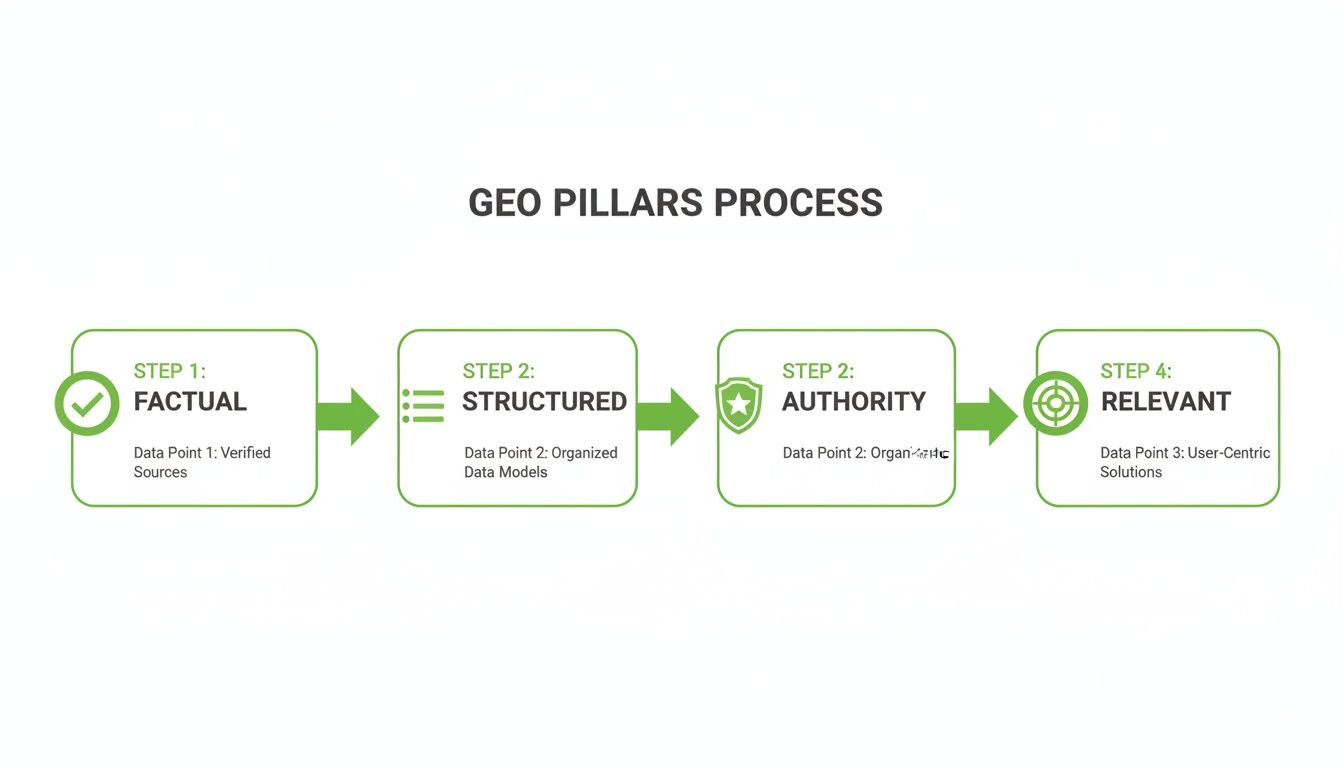
This flow shows that every step, from gathering data to structuring your content, must be done with machine readability in mind.
Step 2: Organize Your Information for AI
With a keyword pattern chosen, your next job is to gather and structure the data. This is the most important stage for GEO. Why? Because AI models consume clean, organized information. A simple spreadsheet (like Google Sheets or Excel) is your best friend here.
Each row in your sheet will become a webpage. Each column will hold a specific piece of data that gets plugged into your template.
The golden rule is one fact per cell. Don't cram long paragraphs into a single box. This clean, granular data structure allows an AI to easily parse and trust your information.
Let's say our pattern is 'Best Marketing Tools'. A well-structured data set would look like this.
Example Programmatic SEO Data Structure
Here’s a snapshot of how you might organise your data in a spreadsheet. This clean structure is the foundation for a successful pSEO campaign, making it easy for both machines and humans to understand the facts.
| Tool Name | Primary Use Case | Key Feature | Target Audience | Pricing Model |
|---|---|---|---|---|
| HubSpot | CRM & Marketing Automation | All-in-one platform | SMBs to Enterprise | Freemium, Tiered |
| Mailchimp | Email Marketing | Email templates & automation | Small Businesses | Tiered, Pay-as-you-go |
| Ahrefs | SEO Analysis | Backlink analysis | SEO Professionals | Subscription |
| Canva | Graphic Design | Drag-and-drop editor | Non-designers | Freemium, Pro |
This structured approach ensures every page you generate is built on accurate, digestible facts—exactly what generative engines look for.
Step 3: Create Your Content Template
The final piece is the content template. This is the master document that defines the layout for all the pages you generate. It’s made of static text (the parts that stay the same on every page) and placeholders that will be filled with data from your spreadsheet.
Your template must serve both human readers and AI crawlers. It should be engaging but also structured with proper headings (H2s, H3s), lists, and tables. This clear hierarchy is a roadmap for machines.
A basic template might use placeholders like these:
The Best [Tool Name] for [Primary Use Case]
[Tool Name] is a leading solution for [Target Audience] looking to improve their [Primary Use Case].
Key Features of [Tool Name]
- [Key Feature]
Connecting your template to your data is the final technical step. While that used to require a developer, many modern content management systems (like WordPress) and no-code tools make this quite easy. To dive deeper into the technical side, check out our guide on API integration for programmatic SEO.
By combining scalable keywords, clean data, and a structured template, you can build a powerful programmatic engine to drive your GEO strategy.
Creating AI-Friendly Content Templates and Prompts
Once your data is organized, it's time to create the actual content. This involves designing an effective template and writing good AI prompts, specifically with Generative Engine Optimisation (GEO) in mind.
Think of it like this: your template is the skeleton, and a precise AI prompt tells a tool like ChatGPT how to create the high-quality "flesh" to put on those bones. This system removes the guesswork and ensures every page is built for machines from the start.

Designing Your GEO Content Template
Your content template is the blueprint for a perfect page. It mixes static text (what appears on every page) and dynamic placeholders that pull in data from your spreadsheet.
For GEO, this blueprint must be built with simple, clear formatting. That just means using headings, lists, and tables correctly to create a logical information flow. This structure acts as a map for AI, telling it what each piece of information is. Getting this right is crucial if you want to be cited in AI answers.
A solid template should always include:
- H1 Title: Your main headline, usually combining a few data points (e.g.,
<h1>[Tool Name] vs [Competitor]: A Full Comparison</h1>). - H2 and H3 Subheadings: Use these to break content into logical sections. H2s are for major topics, and H3s are for sub-topics.
- Lists (Bulleted and Numbered): AI models love lists. They’re easy to scan and summarize, making them perfect for features, pros and cons, or steps.
- Tables: Nothing is clearer than a table for direct comparisons of things like pricing or features.
- Placeholders: These are the variables that make each page unique, like
[Tool Name],[Key Feature], or[Pricing Model].
A strong template doesn't just organize your data; it frames it in a way that directly answers a user's potential question. This structure is the foundation of effective generative engine optimisation.
Crafting Precise AI Prompts
With your template ready, you need to generate the text to fill it. That's where AI prompts come in. A prompt is simply an instruction you give to an AI like ChatGPT to write something for you.
The secret is to be incredibly specific. Vague prompts lead to generic, fluffy content that AI engines will ignore. But a precise prompt with lots of context produces the clear, factual content that gets cited.
Example Prompts for Programmatic SEO
Here are a few practical prompts you can use to generate high-quality text for your templates. Notice how each one specifies the format, tone, and audience.
For a Feature Summary:
- "Based on these data points:
[Tool Name],[Key Feature 1],[Key Feature 2],[Key Feature 3], write a 50-word introductory paragraph. The tone should be informative and helpful for a marketing manager."
- "Based on these data points:
For a Pros and Cons List:
- "Analyze the following features:
[Feature List]and pricing:[Pricing Model]. Generate a bulleted list of three pros and three cons for a small business owner considering this tool. Each point should be a complete sentence."
- "Analyze the following features:
For a Use Case Explanation:
- "Explain the primary use case of
[Tool Name], which is[Primary Use Case]. Write a 75-word paragraph describing who would benefit most from this ([Target Audience]) and why. Use a professional but accessible tone."
- "Explain the primary use case of
When you combine a structured template with content from sharp prompts, you create a system for producing thousands of high-quality, GEO-ready pages. If you want to dig deeper, you might find our guide on prompts for AI page content generation useful. This methodical approach ensures every page you publish is built to be understood by the next generation of search.
How to Measure GEO Success
Measuring success with Generative Engine Optimisation (GEO) requires a different mindset than traditional SEO. The old metrics we’ve relied on, like keyword rankings and traffic, don't tell the whole story anymore.
The goal has changed. It's not just about getting clicks from a list; it's about becoming a trusted source cited directly in an AI's answer. It’s about quality over quantity. A single, authoritative citation in an AI Overview can be more valuable than hundreds of low-intent clicks, positioning your brand as the definitive source.
Moving Beyond Clicks and Rankings
The first step is to accept that your traditional SEO dashboards are incomplete. To understand your impact in an AI-driven world, you need a new set of key performance indicators (KPIs). These metrics must focus on influence and authority, not just visibility.
These new KPIs help you answer the most important question: is our brand part of the AI's knowledge base?
Here are the metrics that really matter now:
- Citation Share: This is the most crucial GEO metric. It measures how often your brand is cited as a source when AI answers relevant questions.
- Brand Mention Context: This goes deeper, tracking how AI engines talk about your brand. Are the mentions positive and accurate?
- Conversion Quality: While traffic from AI answers might be lower, the user intent is often much higher. This metric tracks the conversion rate of users who click through from a citation.
Practical Ways to Track GEO Performance
You don't need a complex, expensive setup to start measuring these new KPIs. It's about combining existing tools with some simple manual checks. The key is consistent monitoring to spot trends.
Success in GEO isn't about appearing everywhere. It’s about being the definitive answer where it matters most. Your measurement strategy should reflect this intense focus on authority and high-intent engagement.
A simple place to start is to regularly test your main keywords on platforms like ChatGPT and Perplexity. Keep a simple log of where your brand appears and which competitors are being cited. This manual check provides valuable insights you can't get from a tool.
For a more scalable approach, you can adapt existing techniques. Explore guides on advanced SERP monitoring to see how you can repurpose traditional methods for this new landscape.
Here’s a simple framework to guide your tracking efforts:
| Metric | How to Track It | What It Tells You |
|---|---|---|
| Citation Frequency | Manually test target queries on AI platforms monthly. Use tools like an AI Search Grader to automate some checks. | Your overall visibility and share of voice within AI-generated answers. |
| Referral Traffic Quality | Use Google Analytics 4 to segment traffic from known AI referrers. Analyse conversion rates and on-site behaviour. | The real business impact of your GEO efforts and the quality of the audience you're attracting. |
| Contextual Accuracy | During your manual checks, read the AI's description of your brand. Note any inaccuracies or negative framing. | How well the AI actually understands your brand and if your core messaging is landing correctly. |
By adopting these new metrics, you can start to effectively measure the success of your Generative Engine Optimisation strategy.
Common Questions About Generative Engine Optimisation
As we navigate this new world of AI-powered search, it’s natural to have questions. Let's tackle the most common ones to give you a clear path forward.
Is GEO Replacing Traditional SEO?
No, GEO is not replacing SEO. It’s better to think of it as an evolution that builds on the foundations you already have.
Classic SEO gets you ranked in a list of links. GEO optimizes your content to be cited directly in an AI answer. Core principles like high-quality content and a technically sound website are still critical. GEO just adds another layer, demanding a sharper focus on factual accuracy and structured data. They work together.
How Is GEO Different from Google SGE?
This is a common point of confusion. Search Generative Experience (SGE), now called AI Overviews, is a specific product from Google. It's their feature that puts AI-generated answers into search results.
Generative Engine Optimisation (GEO), on the other hand, is the strategy you use to show up in SGE and other AI platforms like ChatGPT and Perplexity. Put simply, GEO is the 'how,' while SGE is one of the 'wheres'.
What Is the Most Important Factor for GEO Success?
If you had to pick one thing, it would be structured, factual content. Generative engines aren't looking for creative writing; they are hunting for verifiable facts organized in a way a machine can instantly understand.
This means using clear headings, bullet points, and tables. Every claim or data point needs to be accurate and backed by sources. This commitment to structure and truthfulness is the bedrock of any good GEO strategy.
Your goal is to make your content so clear and reliable that an AI model sees it as a low-risk, high-reward source to cite. The more organised and factual your information, the easier you make that decision for the AI.
Do I Need to Be a Developer to Implement GEO?
Absolutely not. While technical SEO knowledge is helpful, the heart of GEO is content strategy. Thanks to no-code platforms and user-friendly Content Management Systems (CMS), you don't need to be a programmer to implement strategies like programmatic SEO.
You can manage your data in a simple spreadsheet and use plugins to connect it to a content template. The heavy lifting has shifted from writing code to doing solid research and organizing your data well.
How Does Programmatic SEO Fit into This?
Programmatic SEO is the perfect engine for a GEO strategy. It’s a method that lets you create thousands of highly structured, data-driven pages from a single template—a perfect match for feeding AI engines the factual, organized content they love.
For instance, instead of manually writing 500 pages comparing software tools, you could:
- Gather the data into a spreadsheet with columns for features, pricing, and users.
- Create one master template with clear headings and placeholders like
[Tool Name]. - Use an AI prompt to generate concise, factual descriptions for each tool.
- Publish all 500 pages automatically, each perfectly formatted for machine readability.
This systematic approach helps you become the go-to source for a massive range of questions, dramatically increasing your chances of being cited by an AI.
What Are the First Steps to Get Started with GEO?
You don't need to do everything at once. Starting your GEO journey can begin with a few simple actions.
Here’s a practical plan to get you started:
- Audit Your Top 10 Pages: Look at your most popular content. Is it structured with clear headings and lists? Are the facts easy to find? Make a few small tweaks to improve machine readability.
- Identify a Programmatic Opportunity: Find a repeatable keyword pattern relevant to your business (e.g., "best [product] for [customer type]").
- Build a Small Data Set: Create a simple spreadsheet with 10-15 rows of clean, factual data for that pattern.
- Test and Monitor: Start manually asking questions to AI engines like ChatGPT and Perplexity. See who they cite and how those sources are structured. Use what you learn to refine your own content.
Ready to build a content engine that dominates both traditional search and AI-powered answers? Programmatic SEO Hub provides the frameworks, templates, and systems you need to scale your authority. Explore our free resources and start future-proofing your content strategy today at https://programmatic-seo-hub.com/en.
Related Articles

Mobile friendly test google: A Practical Guide to Master Mobile SEO
Even though Google’s standalone Mobile-Friendly Test tool is a thing of the past, the principle behind it is more critical than ever. The simple truth is that Google now overwhelmingly uses its...

A Practical Guide to Competitive Analysis Keywords
When we talk about competitive analysis keywords, we're really talking about the search terms that are already making money for your rivals. By digging into these, you uncover their entire...

Landing Pages SEO A Practical Guide to Rank and Convert
When we talk about SEO for landing pages, we're not just talking about general website optimisation. We're getting hyper-specific. This is the art of building and refining standalone pages...