White Hat in SEO A Practical Guide to Sustainable Growth

So, what exactly is white hat in SEO? Think of it as a simple philosophy: build your website for people first, and search engines second. It’s all about using ethical, common-sense strategies that follow Google's rules to build real authority and rankings that actually last.
Building Your SEO on a Solid Foundation

Imagine your website is a house. You could throw it together quickly on a shaky foundation, using sketchy shortcuts to get a temporary boost. That's the black hat approach. Or, you can invest the time to build it on a solid stone foundation—that’s white hat in SEO.
This isn't about following a complicated checklist. It's about a simple mindset: create genuine value for your audience. When you focus on helping people solve their problems, you naturally earn the trust of search engines like Google. It’s the smartest way to build a strong online presence that can handle any algorithm update.
Why White Hat Is the Only Path Forward
This user-first mentality is the only sustainable way to grow, especially when you’re using powerful strategies like creating content at scale. Sure, you can create thousands of pages, but their success depends entirely on how helpful those pages are. White hat principles ensure that every single one serves a real purpose.
This commitment to quality turns your website into a real business asset that grows more valuable over time. The benefits are clear:
- Long-Term Stability: Your rankings won't disappear overnight after a Google update.
- Enhanced User Trust: Visitors who find genuinely helpful content are far more likely to become loyal customers.
- Improved Brand Reputation: Ethical practices build a positive brand image and attract high-quality links from other sites naturally, without you having to chase them.
The real goal of white hat SEO is to make your website the best, most helpful, and most trustworthy answer to a user's question. It's about earning your ranking, not tricking the system.
Ultimately, this philosophy is about future-proofing your website. By focusing on core principles like Expertise, Experience, Authoritativeness, and Trustworthiness (E-E-A-T), you’re aligning your efforts with what search engines have always wanted. To see how this works in practice, you can learn more about E-E-A-T in our detailed guide.
The Three Pillars of a White Hat SEO Strategy
To make the idea of white hat SEO less abstract and more actionable, we can break it down into three core pillars. Think of these as the legs of a stool—if one is weak, the whole thing falls over. Mastering these areas creates a solid foundation for long-term, sustainable growth.

Each pillar supports the others. A technically perfect site with bad content won't rank, and amazing content on a broken site won't get seen. Together, they form a simple but powerful checklist you can use to check your own website and find areas for improvement.
Pillar 1: Technical Performance
Think of your website's technical side as the structure of a physical shop. If the doors are locked, the aisles are a mess, and it takes forever to check out, customers will leave—no matter how great your products are. Good technical SEO makes sure your site is easy to access, fast, and simple for both search engines and people to navigate.
A technically sound website isn't just a "nice-to-have"; it's a must. It’s your first signal to Google that you care about the user's experience.
Key technical elements to get right include:
- Page Speed: Your pages must load fast. Slow sites lose visitors and are ranked lower by search engines.
- Mobile-Friendliness: Most people search on their phones, so your site must work perfectly on a smartphone. No excuses.
- Crawlability: Search engines need a clear map to find and understand your content. An XML sitemap is exactly that—a roadmap for them.
Pillar 2: High-Quality Content
If technical SEO is the shop, then your content is the product on the shelves. White hat SEO demands that your content is genuinely helpful, original, and the best possible answer to whatever question a user has. This isn't about stuffing keywords into a page; it’s about solving real problems for real people.
Your goal should be to create content so valuable that people might have paid for it, but you're giving it away for free. That's the mindset that builds trust and authority over time.
Creating high-quality content means understanding what the user really wants. You have to go beyond what a user is searching for and figure out why they're searching for it, then give them a complete solution.
This is especially important for large-scale content projects. If you want to dive deeper into this concept, check out our guide on building topical authority at http://programmatic-seo-hub.com/en/programmatic-seo-fundamentals/seo-strategy/topical-authority.
Pillar 3: Earned Authority
The final pillar, earned authority, is like your shop's reputation. It’s the word-of-mouth referrals and positive reviews you get from others. In SEO, this is mainly built through high-quality backlinks—links pointing to your site from other reputable websites.
These links act as votes of confidence. A pure white hat approach means you earn these votes because your content is simply too good not to share. You're not buying them or using dodgy schemes; you're creating valuable resources like original research, free tools, or definitive guides that people want to link to.
White Hat vs. Black Hat SEO: A Clear Comparison
Sorting out the different approaches to SEO can feel complicated, but it really just boils down to a choice: are you building for the long haul or chasing risky shortcuts?
Think of it like building a house. A white hat in SEO approach means you’re laying a solid foundation, using quality materials, and following the rules. You’re constructing something that will stand strong for decades.
Black hat SEO, on the other hand, is like throwing up a building with cheap materials and skipping inspections. Sure, it goes up fast, but it's unstable. It’s only a matter of time before Google's algorithm finds the cracks and the whole thing comes crashing down. The penalties are severe, often ending with your site being completely removed from search results.
The Murky Middle Ground: Grey Hat SEO
Between these two extremes, you'll find grey hat SEO. This approach isn't as openly bad as black hat, but it operates in the fuzzy areas of Google's guidelines. These are techniques that are questionable and carry a risk that most serious businesses should avoid.
For example, a grey hat tactic might involve creating pages that push the boundaries of what's acceptable, like some forms of doorway pages. You might see a temporary boost, but you're constantly at risk of being penalized by the next algorithm update. You can learn more about doorway pages to see just how thin this line can be.
For any serious business, the choice is clear. Only a white hat strategy protects your investment and builds a reliable, valuable digital asset.
Black hat tactics chase rankings. White hat strategies earn them. The difference is sustainability; one approach builds lasting value, while the other builds a house of cards.
To make this distinction as clear as possible, the table below breaks down the core philosophy, common tactics, and the ultimate outcome you can expect from each.
White Hat vs. Black Hat vs. Grey Hat SEO at a Glance
This direct comparison highlights the fundamental differences in how each approach works, the risks involved, and the long-term results.
| Attribute | White Hat SEO | Grey Hat SEO | Black Hat SEO |
|---|---|---|---|
| Core Goal | Build sustainable, long-term authority and trust with both users and search engines. | Bend the rules to find faster ranking opportunities without being overtly manipulative. | Trick or manipulate search engine algorithms for rapid, short-term ranking gains. |
| Tactics | High-quality content, earning links naturally, great user experience, technical excellence. | Buying expired domains, creating private blog networks (PBNs), slightly thin content. | Keyword stuffing, cloaking, paid link schemes, automated low-quality content. |
| Risk Level | Very Low. Aligns with search engine goals, making it safe from penalties. | Medium to High. Constantly at risk from algorithm updates that close loopholes. | Extremely High. Actively targeted by penalties, risking total site de-indexing. |
| Outcome | Stable Growth. Creates a valuable, long-term business asset with compounding returns. | Volatile Results. Any gains are temporary and can be wiped out without warning. | Inevitable Penalty. Leads to traffic collapse and severe damage to brand reputation. |
As you can see, while grey and black hat tactics might offer the illusion of a shortcut, they ultimately lead to a dead end. White hat SEO is the only path to building a resilient, profitable online presence that grows over time.
Applying White Hat Principles to Programmatic SEO and AI
When you hear "programmatic SEO" or "AI content," it's easy to think of low-quality, automated spam. But that's a common misconception. When you approach these tools with a white-hat SEO mindset, they become powerful ways to create valuable content at a scale that would be impossible for a human team.
The trick is to think about them differently. Programmatic SEO is not about spam; it's a smart way to structure data to answer thousands of specific user questions. AI is not a content creator; it's a powerful assistant that helps you research and write faster.
This flowchart illustrates the choice every website owner faces.
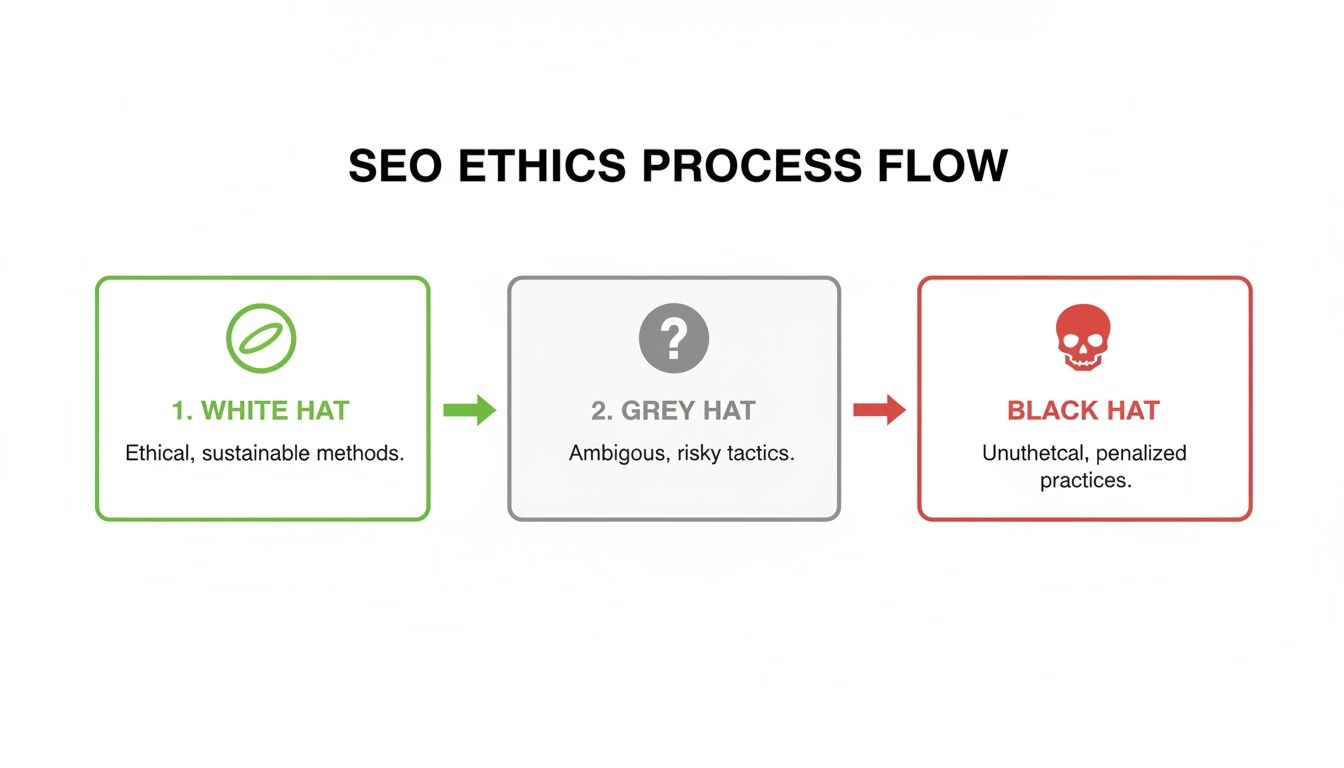
As the graphic shows, while shortcuts might seem tempting, only the green path—pure white-hat SEO—leads to sustainable growth that won't get you penalized.
A Practical, Step-by-Step Guide for Beginners
So, how does this actually work? Let's walk through a simple, practical example: creating a set of pages for "best family car for {number} kids." This approach shows how to use modern tools to scale genuinely helpful content.
Step 1: Find Real User Needs (The "Head Terms")
First, figure out what people are actually searching for. Your main topic is "best family car." This is your "head term," the starting point for your project.
Step 2: Gather Unique and Helpful Data (The "Modifiers")
This is the most important step. It’s what separates high-value content from spam. Instead of just listing cars, you need to build a dataset of useful details. These details are your "modifiers." For our car example, create a spreadsheet with columns for:
- Car Model
- Number of Seats
- Price Range
- Safety Rating (1-5 stars)
- Fuel Type (Gas/Electric/Hybrid)
- Trunk Space (in liters)
- A unique, human-written "Best For" tip (e.g., "Best for city driving with toddlers")
This structured data is your secret weapon. It allows you to generate thousands of unique pages that are much more helpful than a generic list.
Step 3: Combine and Create Pages
Now, you can combine your head term with your modifiers to create thousands of specific page titles that answer real questions, such as:
- "Best family car for 3 kids under $30,000"
- "Best electric family car with a 5-star safety rating"
- "Best hybrid SUV for 2 kids with large trunk space"
Step 4: Use AI as Your Writing Assistant
With your data and page titles ready, you can now use AI to help you write the content. You are the director, guiding the AI with clear instructions and your unique data. For more on this, check out this a practical guide to AI search engine optimization.
Here’s how to use AI the right way:
- Create a Template: Design a simple page layout. For example: a short intro, a table with the car's key data from your spreadsheet, a paragraph explaining why it's a good choice (using your "Best For" tip), and a conclusion.
- Give Clear Instructions: Ask the AI to write a paragraph for each car model, but tell it to use the specific data points you provided. For example: "Write a 100-word summary for the [Car Model], highlighting its [Number of Seats] and [Safety Rating]."
- Review and Refine: The AI's output is just a first draft. Always have a human review, edit, and add a personal touch to ensure the content is accurate, helpful, and easy to read.
The key here is that the AI works with your unique, high-quality data. It isn't just making things up; it's helping you present your valuable information in a user-friendly format, making every page distinct and useful.
This entire process is focused on the user. You're not trying to trick Google. You're using technology to systematically answer a massive number of real-world questions with better information than anyone else. That's the heart of applying white-hat SEO to modern tools.
How to Measure Your White Hat SEO Success
So, you’ve committed to the white hat path. But how do you know if it’s working? It's easy to get obsessed with checking daily rankings, but true success is measured by signs of real, sustainable business growth.
Proving your ethical strategy is paying off means tracking the right things. You’re not just trying to climb a temporary leaderboard; you're building a valuable asset. The goal is to see clear proof that your focus on user experience is being rewarded.
Key Metrics That Prove Your Strategy Works
Forget checking your rank for one keyword ten times a day. Instead, focus on metrics that show your white hat efforts are connecting with your audience and delivering real results.
Here are the main things you should be watching:
- Sustained Organic Traffic Growth: Look for a steady, upward trend in visitors from search engines over months, not days. This is the clearest sign that your content is gaining trust and authority.
- Improved User Engagement: Are people sticking around? Metrics like a lower bounce rate (fewer people leaving immediately) and longer time on a page tell you that visitors find your content genuinely useful.
- Higher Conversion Rates: This is the ultimate goal. A conversion is when a visitor takes an action you want, like signing up for a newsletter or making a purchase. An increase here shows your SEO is directly contributing to business goals.
Tracking Performance and Future-Proofing Your Site
The best places to monitor these metrics are free tools like Google Analytics and Google Search Console. Search Console, in particular, is a goldmine for understanding how your site appears in search and which queries are bringing people in. To get up to speed, you can check out our guide on essential Search Console metrics.
The core principle of measuring white hat SEO is simple: what’s good for the user is good for Google. When your metrics show that users are happy, your SEO is on the right track.
This user-first approach is also the best way to future-proof your website. In markets like Germany, where Google has over 90% market share, ethical strategies are essential. Top SEO firms there achieve stable growth by focusing on user needs, reporting that users spend 20-30% more time on their pages because the content is clear and helpful. You can read more about these insights on German SEO strategies at Obelisk Infotech.
By prioritizing what your audience wants, you align your site with Google's core mission. That makes your site much more resilient to future algorithm changes.
Common Questions About White Hat SEO
Diving into white hat SEO can bring up a few questions, especially when you're exploring long-term strategies. Let's tackle some of the most common ones to give you the clarity you need.
The goal is to demystify the process so you can get back to what matters: building a digital asset that grows and lasts.
How Long Does White Hat SEO Take to Show Results?
Think of white hat SEO as planting a tree, not flipping a switch. While you'll often see encouraging signs—like keyword rankings starting to climb and a small bump in organic traffic—within the first 3 to 6 months, the real, significant growth comes later.
The authority and trust you build over time have a compounding effect. After the 12-month mark, you should see stable, meaningful growth. It’s the difference between building a business that appreciates in value versus a website that gets a temporary spike in visitors.
Is Programmatic SEO a White Hat Technique?
Absolutely, but only when it’s done right. At its core, programmatic SEO is just a method for creating content efficiently. Whether it falls into the white hat in SEO camp depends entirely on the quality and value you deliver.
Programmatic SEO is a tool. Using that tool to generate thousands of unique, data-rich pages that solve very specific user problems? That's a brilliant white hat strategy. Using it to churn out thousands of repetitive, low-quality pages? That's black hat, plain and simple. The focus must always be on genuine user value.
The method itself is neutral. It's your strategy and commitment to quality that make it an ethical and effective approach.
Can I Still Get Fast Results with White Hat SEO?
"Fast" is a relative term in SEO, but you can definitely accelerate your results with a smart white hat strategy. You don't have to wait a year to see progress.
The secret is to be strategic:
- Target Underserved Keywords: Don't go after the most competitive keywords right away. Focus on more specific, "long-tail" keywords where there's less competition but the user's need is very clear.
- Create the Definitive Resource: For those specific searches you've targeted, aim to create the single best, most helpful page on the entire internet.
- Ensure Technical Excellence: A website that is technically sound allows your great content to be found, indexed, and ranked much more quickly.
By focusing on specific user problems and delivering a superior solution, you can earn rankings for those targeted keywords much faster than if you were chasing broad, hyper-competitive terms. It’s about being smart and earning your spot through quality.
Ready to master programmatic SEO the white hat way? The Programmatic SEO Hub offers free guides, templates, and step-by-step systems to help you scale high-quality content that users and search engines love. Future-proof your content strategy by visiting https://programmatic-seo-hub.com/en.
Related Articles
Mobile friendly test google: A Practical Guide to Master Mobile SEO
Even though Google’s standalone Mobile-Friendly Test tool is a thing of the past, the principle behind it is more critical than ever. The simple truth is that Google now overwhelmingly uses its...

A Practical Guide to URL Redirection in htaccess
Let's be honest, managing URL changes is one of those foundational SEO skills you just can't ignore. A URL redirection in htaccess is a powerful, server-level instruction that sends both...
A Practical Guide to Competitive Analysis Keywords
When we talk about competitive analysis keywords, we're really talking about the search terms that are already making money for your rivals. By digging into these, you uncover their entire...