What Is Landing Page in SEO and How It Works: A Quick Guide
An SEO landing page is a very specific type of web page, engineered from the ground up to pull in visitors directly from search engines like Google. Unlike your homepage, which has to do a bit of everything, an SEO landing page is laser-focused. Its job is to provide a complete, satisfying answer to a very specific search query, making it a powerhouse for capturing organic traffic.
The Foundation of SEO Landing Pages
Think of your website as a big department store. The homepage is the main entrance – it’s grand, welcoming, and shows people where everything generally is. An SEO landing page, on the other hand, is a dedicated side door, perfectly labelled for someone looking for one specific thing, like "waterproof hiking boots for wide feet." Its entire reason for existing is to welcome that person and show them exactly what they came for, right away.
This is a world away from the landing pages you'd build for a paid ad campaign (PPC). A PPC page is a sprinter, built for a short-term campaign with a single, aggressive goal: get the conversion. It’s often minimalist, punchy, and pushes hard on the call to action.
An SEO landing page is a marathon runner. It has to play the long game. To earn its spot at the top of Google, it needs to provide deep, genuinely valuable content that builds trust with visitors over time.
Why Do They Matter for Your Business?
SEO landing pages are so important because they align perfectly with what the user is actually trying to do – their search intent. When someone types a problem into Google, these pages act as the most relevant, helpful answer your website can possibly provide. Search engines reward this perfect match with higher rankings, which in turn leads to a steady, sustainable stream of traffic you don't have to pay for.
Getting this right is fundamental for a few huge reasons:
- Targeted Traffic: You're not just getting clicks; you're attracting highly qualified visitors who are actively looking for the solutions you offer.
- Improved User Experience: By giving people direct answers, you slash bounce rates and keep them on your site longer.
- Higher Authority: A great landing page naturally earns backlinks and sends strong signals to Google that you're an expert on the topic.
Ultimately, an effective SEO landing page creates a seamless bridge from a user's question to a valuable solution on your site. For a deeper dive into this critical concept, you can learn more about understanding search intent and how it shapes page creation.
And don't forget the foundation – the page itself needs to be fast and reliable. That means thinking about technical aspects like hosting dedicated landing pages to ensure top-notch performance.
SEO Landing Page vs Paid Ad Landing Page at a Glance
To make the distinction crystal clear, let's break down the key differences side-by-side. While both are called "landing pages," they operate in completely different universes with very different goals.
| Characteristic | SEO Landing Page | Paid Ad (PPC) Landing Page |
|---|---|---|
| Primary Goal | Inform, educate, and rank organically | Convert visitors into leads or customers, quickly |
| Traffic Source | Organic search (Google, Bing, etc.) | Paid ads (Google Ads, Facebook Ads, etc.) |
| Content Focus | Comprehensive, in-depth, valuable information | Minimalist, persuasive copy with a strong CTA |
| Time Horizon | Long-term asset, builds value over months/years | Short-term, tied to the duration of an ad campaign |
| Design Approach | Built for readability, navigation, and engagement | Designed for a single action, often removes navigation |
| Key Metric | Organic rankings, traffic, time on page, backlinks | Conversion rate, cost per acquisition (CPA) |
Understanding this table is key. Trying to make one page do both jobs is a common mistake that usually results in a page that does neither job well. They serve different masters and must be built accordingly.
The Core Components of a High-Ranking SEO Landing Page
A great SEO landing page isn’t a single, magic bullet. It’s a collection of well-organised parts all working in concert. Think of it like building with LEGOs—each brick has a job, and when you snap them together correctly, you build something strong that both people and search engines can easily understand.
When we break down these components, it demystifies how a page actually earns its spot in search results. It's less about a secret formula and more about a logical structure that delivers genuine value. Every single piece, from the title down to the last link, plays a part in answering a user's query and signalling quality to Google.
This diagram helps visualise how different traffic sources, like organic search and paid ads, lead to very different types of landing pages on a website.
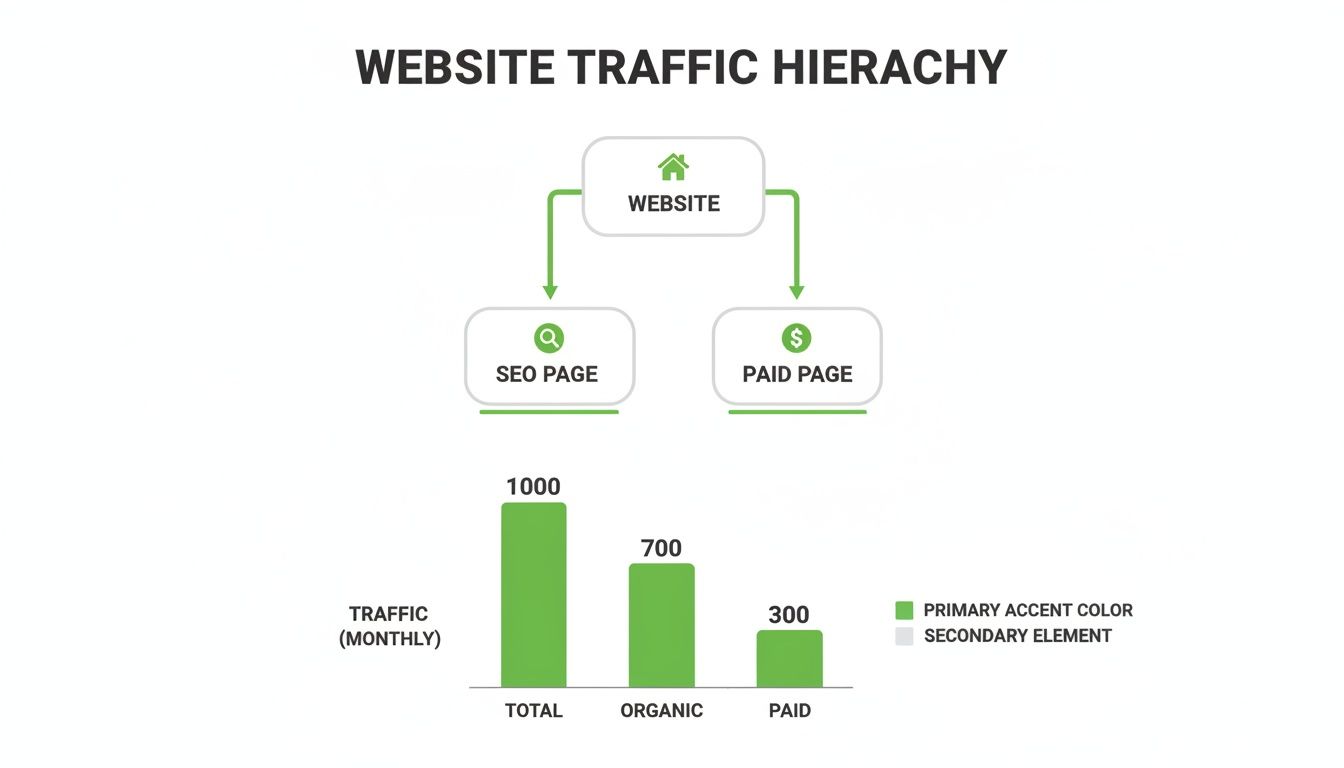
You can see the clear fork in the road. An SEO landing page is built for long-term, organic discovery, while a paid landing page is all about immediate conversions from a specific campaign.
The Title Tag: Your First Impression
The title tag is that blue, clickable headline you see in Google's search results. It’s your first and most critical chance to convince someone to click on your page instead of a competitor's. A solid title tag is clear, includes the main keyword, and gives a compelling reason to visit.
For example, a title like "Best Waterproof Tents for UK Camping | 2024 Guide" is miles more effective than just "Tents for Sale". It speaks directly to a specific need.
H1 and H2 Headings: Organising Your Content
Once someone clicks through, your headings guide their journey. The H1 tag is the main headline on the page itself. There should only be one, and it needs to clearly state what the page is about, reinforcing the promise you made in the title tag.
From there, you use H2 and H3 headings to break your content into logical, scannable sections. This makes it a breeze for readers to find the information they want and, just as importantly, helps search engines understand the structure and topics covered on your page.
A well-structured page with clear headings is a win-win. It improves user experience by making content easy to digest and boosts SEO by signalling a clear content hierarchy to search engine crawlers.
The Body Content: Answering the Question
The body content is the heart and soul of your SEO landing page. This is where you deliver the comprehensive, high-quality information that truly satisfies the user's search intent. It absolutely must be:
- Comprehensive: Cover the topic from all angles, answering any follow-up questions the reader might have.
- Easy to Read: Use short paragraphs, bullet points, and bold text to break up the text and keep people engaged.
- Unique: Offer original insights, data, or a perspective that isn't just a rehash of the top-ranking pages.
Internal Links: Sharing the Power
Internal links are simply links from your landing page to other relevant pages on your own website. They are incredibly powerful for SEO. They help Google discover other content on your site and spread "link equity" (or authority) throughout your entire domain.
For instance, on a page about programmatic SEO, you might link to a more detailed article explaining the core concepts behind effective page templates. This helps the user drill down for more info and strengthens your site's overall structure at the same time.
How to Optimize for Conversions Without Hurting SEO
An SEO landing page that pulls in thousands of visitors is a great start, but if nobody takes action, it's just a digital billboard on an empty road. The real magic happens when you blend the art of persuasion with the science of SEO. This is where you turn raw traffic into tangible results without upsetting the search engines. It's the meeting point of Conversion Rate Optimisation (CRO) and SEO.
These two disciplines aren't enemies; they actually share the same core goal: delivering a fantastic user experience. A page that loads in a flash, is a breeze to navigate, and clearly solves a visitor's problem is exactly what both users and Google want to see. Your job is to make it incredibly easy for a visitor to say "yes."
Design Clear Calls to Action
Your Call-to-Action (CTA) is the single most important element for conversions. It needs to be impossible to miss and tell people exactly what to do next. Vague, lazy buttons like "Submit" or "Click Here" are just missed opportunities.
Instead, go for action-oriented language that screams value. Phrases like "Get Your Free Quote" or "Download the Guide Now" are specific, compelling, and far more likely to get clicked. Place your CTAs strategically—right at the top (above the fold) and then again after key sections of your content.
A great user experience is a powerful ranking signal. A page that satisfies the user's need quickly and clearly is rewarded by both search engines and your bottom line.
Build Trust and Credibility
People buy from brands they trust. You can build that trust right on your landing page by weaving in social proof and other confidence-boosting signals. These elements go a long way in reassuring visitors that they’re making the right choice.
- Testimonials and Reviews: Nothing beats showcasing positive feedback from real customers. It's one of the most powerful ways to build credibility.
- Case Studies: Tell in-depth stories that show exactly how you solved a tough problem for a previous client.
- Trust Badges: Displaying security seals, industry awards, or partner logos adds a quick layer of professional validation.
Prioritise Page Speed, Especially on Mobile
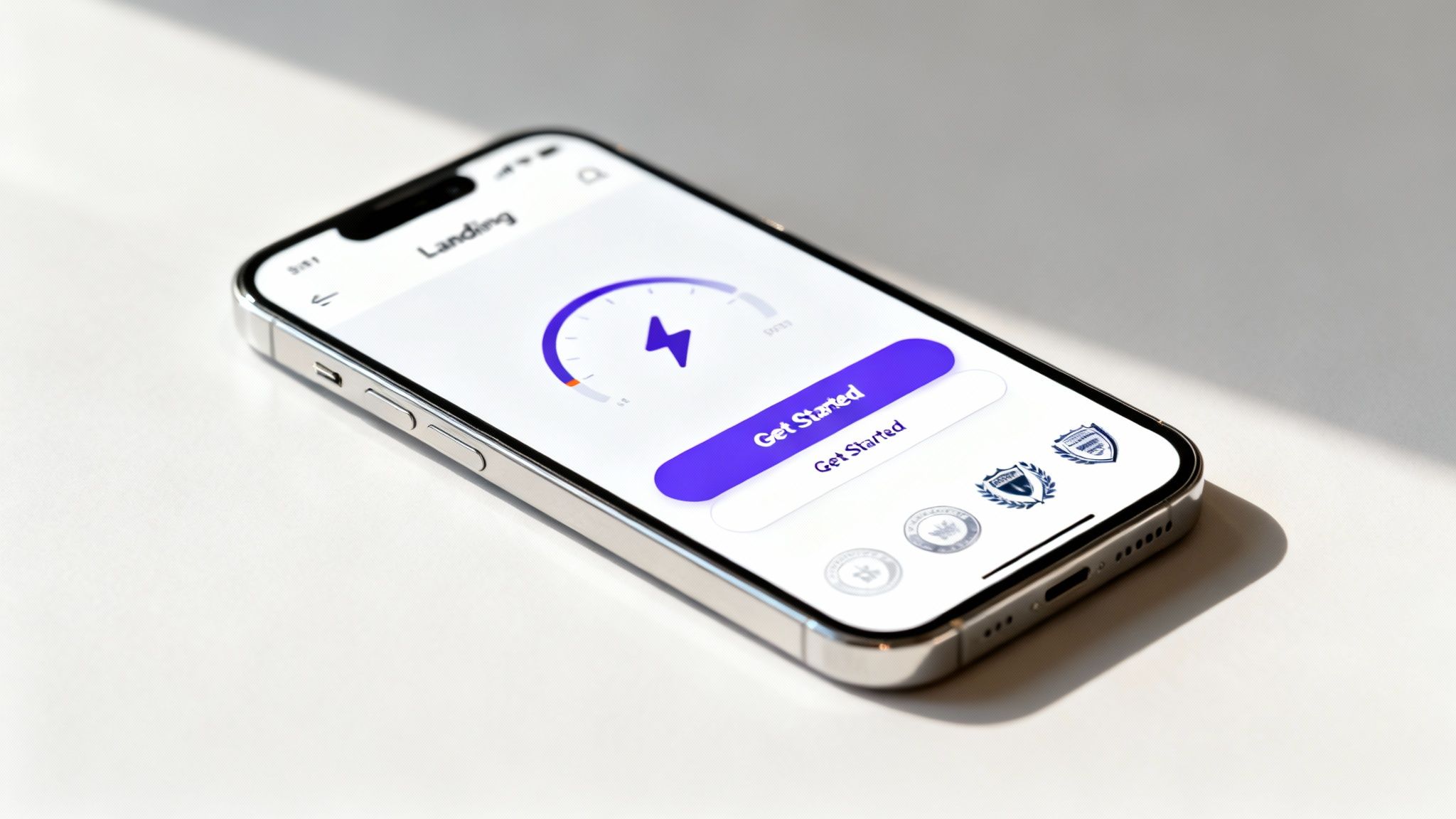
Slow pages kill conversions. It’s that simple. We’re all impatient online, and every extra second it takes for your page to load dramatically increases the odds that a visitor will just give up and leave. This is especially true on mobile, which now drives the majority of web traffic. For more on this, check out these excellent conversion rate optimization tips.
Recent data from Germany really highlights a massive opportunity here. While mobile traffic dominates visits to SEO landing pages for small and medium businesses, it converts at just 1.91%. That’s quite a bit lower than the desktop conversion rate of 2.17%. This gap tells us that while mobile gets people in the door, desktop is often where the deal gets closed, likely because the user experience is smoother.
Finding the perfect balance between compelling design and SEO performance often comes down to experimentation. To learn how to test different versions of your page and see what truly converts best, dive into our guide on A/B testing for SEO.
Measuring What Matters on Your SEO Landing Pages
Building a slick SEO landing page is a great first step, but it's only half the job. To really know if it's working, you have to dig into the numbers. You can't improve what you don't measure, and the data is what lets you turn a good page into a truly exceptional one.
The good news? You don't need a massive budget for fancy tools. Free platforms like Google Search Console and Google Analytics give you everything you need to get started. The trick is knowing which numbers actually matter.
Key Metrics to Watch
Don't get bogged down in a sea of data. A handful of key performance indicators (KPIs) can tell you almost everything you need to know about your page's health.
- Organic Traffic: This is your most direct feedback. Are more people finding your page from search engines over time? A steady upward trend is the clearest sign your SEO efforts are hitting the mark.
- Keyword Rankings: Jump into Google Search Console and see what search queries your page is actually showing up for. Keeping an eye on your position for your main target keywords tells you if you're gaining ground where it counts.
- Bounce Rate: This one shows you the percentage of people who land on your page and leave without clicking anywhere else. A high bounce rate can be a red flag, but it’s not always a disaster. If someone finds the exact answer they needed and leaves satisfied, that's still a win. Context is everything.
Measuring success isn't just about traffic; it's about understanding what people do once they arrive. Each metric is a piece of the puzzle, showing you how well your page connects with what visitors are actually looking for.
From Clicks to Conversions
At the end of the day, an SEO landing page exists to get people to do something. Tracking conversions is non-negotiable, but you also need realistic expectations.
Across Germany, for instance, a well-optimised SEO landing page sees a median conversion rate of around 6.6%. That's a huge leap compared to the average for general websites. Performance like this is tightly linked to technical details—even a one-second delay in page load speed can drop conversions by 7%. For a deeper dive into industry-specific numbers, you can explore more conversion rate statistics on rockingweb.com.au.
We can use these metrics to set meaningful goals for our landing pages. To help you get started, here’s a quick breakdown of the most important KPIs to track.
Table: Key SEO Landing Page Metrics and What They Mean
| Metric (KPI) | What It Measures | What to Look For |
|---|---|---|
| Organic Traffic | The number of visitors arriving from search engines. | A steady increase over time, indicating growing visibility and successful SEO. |
| Keyword Rankings | Your page's position in search results for specific queries. | Improvement for target keywords and discovery of new, relevant long-tail terms. |
| Conversion Rate | The percentage of visitors who complete a desired action. | A rate that meets or exceeds your industry benchmark. Consistent, even small, growth is a great sign. |
| Bounce Rate | The percentage of visitors who leave after viewing only one page. | A high rate can signal a mismatch with user intent, unless it's a single-purpose info page. |
| Click-Through Rate (CTR) | The percentage of people who see your page in search results and click on it. | A high CTR suggests your title tag and meta description are compelling and relevant. |
| Average Time on Page | How long visitors spend on your page on average. | Longer times often indicate engaging, valuable content. Short times can be fine for quick answers. |
By tracking these metrics, you move from guesswork to a clear, data-backed strategy.
Knowing your numbers allows you to tie your SEO work directly to business outcomes. It's essential to get comfortable with tracking conversions for your programmatic SEO efforts, as this is what turns abstract data into proof of growth.
How to Scale with Programmatic SEO and AI
Nailing a single, high-quality SEO landing page feels great. But trying to create hundreds or even thousands by hand is a recipe for burnout. This is where programmatic SEO (pSEO), supercharged with AI, completely changes the game. It’s not about making spammy, low-quality pages. It's a smart system for creating high-quality, targeted pages at a scale that would be impossible for a human to manage alone.
Think of it like a mail merge for web pages. You create one perfect page template and connect it to a simple database (like a spreadsheet). The system then automatically creates a unique page for every single row in your spreadsheet.
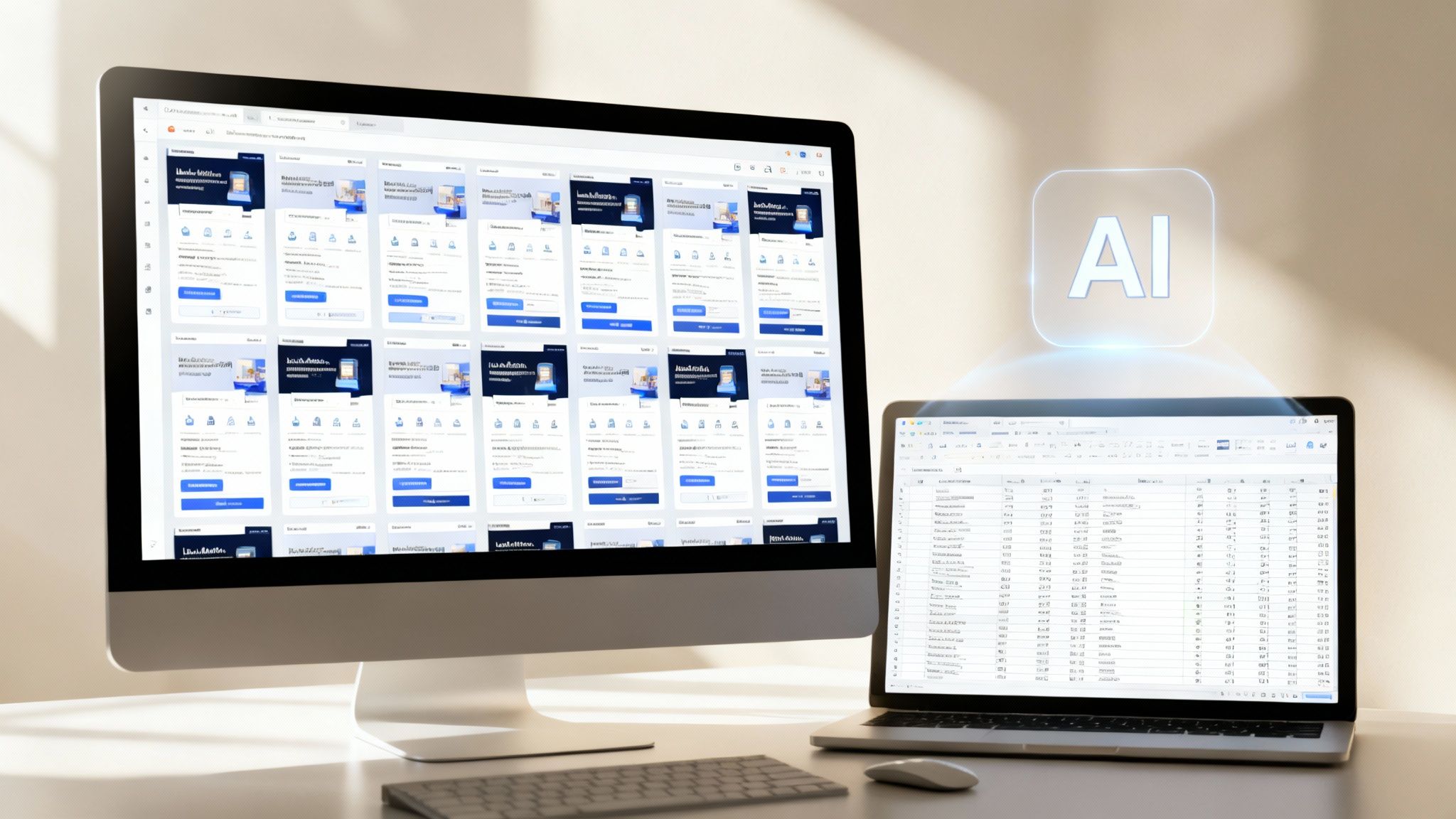
This method lets you target thousands of very specific, "long-tail" keywords (like "emergency plumber in Bristol" and "emergency plumber in Manchester") without the soul-crushing work of building each one manually.
A Practical Blueprint for Programmatic SEO with AI
Getting started is easier than it sounds, especially if you use modern tools. You don't need to be a programmer. Here’s a simple, step-by-step approach for anyone to follow.
- Find Your Keyword "Pattern": Start by identifying repeatable search queries. Think like a customer. What phrases would they use? Common patterns are
[service] in [city],best [product] for [a specific need], orhow to fix [common problem]. - Build a Simple Database: Create a spreadsheet in Google Sheets or Airtable. Each column represents a piece of information that will change on each page (e.g., City Name, Local Phone Number, Service Price). Each row represents a new page you want to create.
- Design One Master Template: In a website builder like Webflow, create a single, perfect landing page. Instead of writing "Bristol," you'll put a placeholder like
[City]. Your main headline might be:Reliable [Service] in [City]. - Use AI to Add Unique Value: This is the key to making great pages, not just duplicate ones. For each row in your spreadsheet, use an AI tool to write a unique paragraph. For example, you can ask the AI to write a short "About [City]" section, or a customer review that mentions the specific service and location. This ensures every page has unique, helpful content.
This process lets you create pages that feel custom-made for each visitor, which is what Google rewards. For a deeper dive, our guide on automating your content creation walks through more advanced techniques.
Why This Matters in a Competitive Market
Scaling your landing pages this way is a massive advantage in competitive markets, like German e-commerce. In this space, landing pages are often the main entry point for organic traffic and have a direct impact on sales for small and medium-sized businesses.
An analysis of about ten million sessions from German SME online shops found an average conversion rate of 2.01%. Programmatic SEO gives you a way to boost this by creating thousands of highly relevant doorways into your site. The study also mentioned that average session times have dropped by 50 seconds in recent years, which just goes to show how critical it is for landing pages to give people immediate, specific answers. You can find more insights about German e-commerce trends on ecommercenews.eu.
Programmatic SEO isn't about spam. It's about using technology to deliver highly relevant, personalised answers at a scale that would be impossible to achieve manually.
When you do it right, pSEO with AI lets you completely own niche search queries. You're building a wide net that captures a huge amount of targeted, long-tail traffic that your competitors are probably ignoring.
Common Questions About SEO Landing Pages
Even with a solid plan, a few questions always pop up. Let's tackle the most common ones I hear about building and managing SEO landing pages. Think of this as your quick-reference FAQ to clear up any lingering confusion before you dive in.
These are the "what ifs" and practical hurdles that come up when you start putting theory into practice.
How Many SEO Landing Pages Should I Have?
Honestly, there's no magic number. The right answer comes down to your goals and how many different search queries you want to capture.
Instead of chasing a specific quantity, your focus should always be on relevance and quality. A local plumber, for instance, might only need a dozen pages—one for each core service they offer in their city. But a national directory using programmatic SEO could easily have thousands, targeting every service in every location they cover.
The guiding principle is simple: create one unique, high-value page for each specific user intent. Start with your most important keywords and build out from there.
Can My Homepage Be an SEO Landing Page?
Not really, and it shouldn't be. While your homepage absolutely needs to be optimised for your brand name and your core value proposition, it doesn't function like a true SEO landing page.
A real SEO landing page is laser-focused on a specific, non-branded search query, like "emergency roof repair in Boston." Its job is to match that one intent perfectly.
Your homepage has a much bigger, broader role. It has to introduce your entire brand, build trust, and direct different types of visitors to the right sections of your site. It’s the central hub, not a specialised destination. For ranking on those specific, intent-driven keywords, dedicated pages will almost always outperform a generic homepage.
What Is the Difference Between a Landing Page and a Blog Post?
The key difference is their primary goal. A blog post is almost always informational. Its main job is to teach, answer a question in depth, and build your site's authority on a topic over time. It’s part of the user's research journey.
An SEO landing page, on the other hand, is much more commercially focused. Yes, it still needs to be informative, but its ultimate purpose is to persuade the visitor to take a specific action—request a quote, sign up for a trial, or buy something.
Think of it this way: a blog post is often part of the journey, educating and building trust. An SEO landing page is the final, action-oriented destination where that trust converts into a business result.
Do I Need to Be a Developer to Use Programmatic SEO?
Not anymore. It used to be that scaling content programmatically required some serious coding skills to hook up databases to website templates. But today, the rise of powerful no-code tools has completely changed the game.
Modern platforms like Webflow, Airtable, and automation tools like Zapier let you build and manage thousands of pages without writing a single line of code. When you pair these with AI for generating unique content snippets, you can run a pretty sophisticated pSEO strategy all on your own. This has really levelled the playing field.
Ready to stop building pages one by one and start scaling your traffic? At Programmatic SEO Hub, we provide the guides, templates, and systems you need to master programmatic SEO and AI-driven content. Explore our free resources and tools today.
Related Articles
Mobile friendly test google: A Practical Guide to Master Mobile SEO
Even though Google’s standalone Mobile-Friendly Test tool is a thing of the past, the principle behind it is more critical than ever. The simple truth is that Google now overwhelmingly uses its...
A Practical Guide to Competitive Analysis Keywords
When we talk about competitive analysis keywords, we're really talking about the search terms that are already making money for your rivals. By digging into these, you uncover their entire...
Landing Pages SEO A Practical Guide to Rank and Convert
When we talk about SEO for landing pages, we're not just talking about general website optimisation. We're getting hyper-specific. This is the art of building and refining standalone pages...