A Practical Guide to AI-Powered SEO for Online Shops
When people talk about SEO for online shops, they're really talking about one thing: getting found. It’s the art and science of making sure that when someone types "women's waterproof running jacket" into Google, your shop is one of the first things they see. This isn't just about traffic; it's about attracting the right kind of traffic—people actively looking to buy what you sell—without having to pay for every single click.
Building Your E-commerce SEO Foundation

Before you even think about advanced tactics or AI-driven content, you need to get the basics right. It's like building a house. You wouldn't start picking out smart thermostats before the foundation is poured and the walls are up. A solid SEO foundation gives all your future efforts a stable platform to build on, creating a seamless experience for shoppers that search engines love.
This is more than just a technical checklist. It’s about creating an intuitive journey that effortlessly guides both customers and Google's crawlers from your homepage all the way to checkout.
Structure Your Site for Success
How you organise your website—your site architecture—is a massive ranking factor. A clean, logical structure makes it incredibly easy for Google to figure out which pages are most important and how everything is related. For virtually every online shop, that means a clear hierarchy.
Picture a simple pyramid:
- Top: Your Homepage
- Middle: Category Pages (e.g., 'Men's Shoes', 'Women's Jackets')
- Base: Product Pages (e.g., 'Men's Leather Loafers Size 10')
This structure isn't just for neatness; it helps funnel "link equity" (think of it as ranking power) down through your site. Your homepage is usually your most authoritative page, and it passes some of that authority to your categories, which in turn pass it to individual products.
Getting this right starts with understanding what your customers are actually searching for. Our in-depth guide on keyword research will walk you through finding the exact terms you need to build your categories around.
Optimise Your Key Pages
Your category and product pages are where the real work gets done. They are your digital shop floor, and they need to be finely tuned to turn browsers into buyers.
This starts with product titles and descriptions. Don't just list features; sell the benefits. Answer the questions your customers have before they even ask. Instead of "Black T-Shirt," go for something like, "Men's Classic Crewneck T-Shirt in Jet Black - 100% Organic Cotton." It’s far more descriptive for users and targets the specific, long-tail keywords that people with high purchase intent use.
And don't forget your secret weapon: internal linking. On your "Running Shoes" category page, link out to specific models. Within a product description, link to a complementary product or a helpful blog post like "How to Choose the Right Running Shoe." This keeps shoppers on your site longer and helps search engines discover all your important pages.
A huge mistake I see all the time is shops using generic, copy-pasted manufacturer descriptions. This is a red flag for duplicate content and a massive missed opportunity to inject your brand's voice and personality. Always, always write your own.
Master the Technical Essentials
Let's get straight to the point: the technical health of your shop is non-negotiable. If I had to pick two things to focus on, it would be site speed and mobile-friendliness. If your site takes more than a couple of seconds to load, people are gone. If it's a pain to use on a phone, you're actively turning away customers.
This is particularly true in competitive e-commerce markets. Take Germany, for instance, where Google.de is king and 90% of the population is online. The technical bar is incredibly high. The average German online shop has a Lighthouse SEO score of 93.89, yet many of them still saw organic traffic drop by 20.5% recently.
That tells you something important: even with near-perfect technicals, the competition is so fierce that a solid foundation across the board is the only way to win. You can learn more about these market dynamics in this analysis of Germany's 2025 digital marketing landscape.
Core E-commerce SEO Checklist
Before moving on to more advanced strategies, run through this checklist. It covers the absolute must-haves for any online shop's SEO foundation.
| SEO Area | Key Action | Why It Matters for Online Shops |
|---|---|---|
| Site Architecture | Create a logical, hierarchical structure (Homepage > Categories > Products). | Helps search engines understand your site's content and distributes authority effectively. |
| Keyword Research | Identify the terms customers use to find your products. | Informs your category names, page titles, and content, ensuring you meet searcher intent. |
| On-Page SEO | Write unique, descriptive titles, meta descriptions, and product copy. | Improves click-through rates from search results and helps convert visitors. |
| Technical SEO | Ensure your site is fast, mobile-friendly, and secure (HTTPS). | Core user experience signals that directly impact rankings and sales. |
| Internal Linking | Link strategically from category pages to products and related content. | Guides users and search engine crawlers through your site, spreading link equity. |
Nailing these fundamentals ensures you're building on solid ground. It's the only way to create a sustainable, long-term channel for organic growth.
Using AI to Unlock Programmatic SEO
Programmatic SEO, or pSEO, might sound technical, but the idea is actually simple: you're using data to automatically create hundreds—or even thousands—of highly specific landing pages.
For an online shop, this is like having a secret weapon. It allows you to attract customers using the very specific, long search phrases that your bigger competitors often ignore. These are the kinds of searches that signal someone is ready to buy now.
Imagine you sell jackets. Instead of just one page for "denim jackets," pSEO lets you automatically create dedicated pages for searches like "women’s blue denim jacket size 12," "men's black leather jacket in Berlin," or "lightwash cropped denim jacket for petite women." Each page perfectly matches a shopper's exact need, which massively increases your chances of making a sale.
Step 1: Find Your Customer's Search Patterns
First, think like your customer. What words do they add to their search to be more specific? These are your "modifiers," and they are the building blocks for your strategy.
For an online store, these usually fall into a few key groups:
- Product Details: Color, size, material, style (e.g., 'red', 'large', 'cotton', 'v-neck').
- Target Audience: Who is it for? (e.g., 'for men', 'for women', 'for kids').
- The Occasion: Why are they buying it? (e.g., 'for running', 'for weddings', 'for summer').
- Location: Where are they? (e.g., 'in Berlin', 'near Munich'—especially useful if you have physical stores).
Combine a basic product with these modifiers, and you get a powerful, specific search term. A "t-shirt" becomes a "men's black cotton v-neck t-shirt for summer." That’s a customer who knows exactly what they want.
Step 2: Organize Your Data in a Spreadsheet
Now you need a place to organize this information. Don't worry, you don't need a complex database. A simple Google Sheet or an Airtable base is perfect.
Think of this spreadsheet as the blueprint for all your new pages. Each row will become a unique page, and each column will hold a piece of information for that page.
For our jacket shop, your spreadsheet columns might look like this:
| Product Type | Gender | Colour | Material | Size | Location |
|---|---|---|---|---|---|
| Denim Jacket | Women's | Blue | Cotton | 12 | Berlin |
| Leather Jacket | Men's | Black | Leather | L | Hamburg |
| Bomber Jacket | Women's | Green | Nylon | M | Munich |
This simple sheet is now the "brain" of your operation. It keeps everything neat and structured, making it easy to generate thousands of page variations without manual work.
Step 3: Use AI to Write Unique Content for Each Page
This is where the magic happens. In the past, creating pages from a database resulted in boring, repetitive content that Google didn't like. Today, with AI tools like ChatGPT, you can generate genuinely helpful and unique content for every single page.
This is the key to doing programmatic SEO correctly. You use the data in your spreadsheet as instructions for the AI.
Programmatic SEO isn't about creating spam. It's about using automation to answer very specific customer needs at a scale that's impossible to do by hand. When done right, you're creating a better experience for the shopper.
You can give the AI simple commands (prompts) to write different parts of your page. Using the data from just one row of your spreadsheet, you could ask an AI to write:
- A unique product description that uses the specific details (e.g., "This men's black leather jacket is perfect for a night out in Hamburg...").
- A list of specifications in bullet points.
- A short styling tip relevant to that specific product.
- A set of Frequently Asked Questions (FAQs) about that exact item.
This process is known as Natural Language Generation, and it’s how you create thousands of valuable pages that don't look like copies of each other. To go deeper, you can explore more about Natural Language Generation and its role in content creation in our detailed guide. By combining a simple spreadsheet with the power of AI, you can reach a huge audience of motivated buyers.
Designing Your Page Templates for Scale
Okay, you've got your data wrangled and organised. The next, and arguably most critical, move is designing your page template. Think of this as the master blueprint for every single programmatic page you're about to launch. A solid template is what makes sure each new page is not just user-friendly, but perfectly tuned for search engines. This is where your seo online shops strategy really comes to life.
This template is where the structured data from your spreadsheet collides with creative, AI-generated content. The whole point is to build a layout that can take your variables (like 'colour', 'size', or 'material') and spin them into a unique, valuable page for every possible combination. This is the bedrock of scaling quality content.
The Anatomy of a High-Performing Template
To build a template that genuinely works for you, you need to think in terms of smart, dynamic components. These aren't just static text boxes; they're content blocks designed to shift and change based on the data you feed them. For a much deeper dive into the mechanics of this, you can learn more about building effective page templates for programmatic SEO.
Here are the non-negotiable pieces your template absolutely must have:
- Dynamic H1 Heading: Your H1 is your most powerful on-page signal. The template should build it automatically using your variables. For instance,
[Gender]'s [Material] [Product Type] in [Colour]instantly becomes "Women's Leather Jacket in Black". - Clear Breadcrumbs: Essential for user navigation and helping Google map out your site structure. They should dynamically show the page's spot in the hierarchy, like
Home > Jackets > Leather Jackets > Women's Black Leather Jacket. - AI-Generated Introduction: This is a huge opportunity to inject uniqueness. You can prompt your AI to write a short, punchy intro paragraph using the page's specific variables. This simple step stops thousands of pages from all starting with the exact same sentence.
- Structured Data (Schema Markup): This is the backstage code that speaks directly to search engines. By embedding
Productschema into your template, you can feed Google the price, availability, and review ratings for every item. This is how you win those eye-catching rich snippets in the search results.
Prompting AI for Unique Content Blocks
The real magic here is creating modular content 'blocks' that AI can populate, mix, and match. Instead of asking an AI to write one monolithic piece of content, you prompt it to create smaller, highly specific sections. This hands you far more control and ensures every page feels genuinely different.
For a clothing shop, you could break it down into blocks like these:
- Styling Tips: Prompt the AI with: "Write two short styling tips for a
[Colour] [Product Type]. Keep the tone casual and helpful." - Care Instructions: A simple prompt like: "Provide brief care instructions for a garment made of
[Material]." - Unique FAQs: This is a goldmine for hoovering up long-tail keywords. You can prompt AI to: "Generate three common questions and answers about a
[Gender]'s [Product Type]." Think things like, "Is this jacket suitable for rainy weather?" or "What size should I get?".
The secret is to think like a customer. What information would make their decision easier? By breaking down the content into these logical blocks, you build pages that are genuinely helpful, not just keyword-stuffed placeholders.
Mobile-First Isn't a Suggestion, It's a Requirement
As you sketch out this template, never forget that the vast majority of your customers will see it on a mobile phone. This is especially true in markets like Germany, where the e-commerce sector is projected to smash €95.92 billion by 2025. Mobile commerce will account for a jaw-dropping 63% of that revenue.
German shoppers are also famous for their diligence; 75% demand authentic reviews before they even consider buying. This means your template has to put mobile readability first and give prime real estate to reviews and ratings—all of which can be supercharged with schema markup. You can get more fascinating insights into the thriving German e-commerce market on netguru.com.
Bottom line? A mobile-first design isn't just a "best practice" anymore. It's about survival and growth. Your template must be responsive, load lightning-fast, and present information cleanly on a small screen. No excuses.
Automating Your Workflow and Measuring Success
You've structured your data and designed your page templates. Now for the magic. This is where you bring your programmatic SEO strategy to life, turning that humble spreadsheet into hundreds—or even thousands—of unique, optimised pages without writing a single line of code.
It’s nowhere near as technical as it sounds. We’re not talking about complex development cycles here. User-friendly platforms like Webflow or specialised WordPress plugins are built specifically for this. They act as the bridge, connecting your database (that Google Sheet you prepared) directly to your page template.
Bringing Your Pages to Life with No-Code Tools
The core concept is just simple mapping. You’re essentially telling the tool, "Hey, take the 'Colour' column from my sheet and put it right here in the H1 tag." You map your 'Material' column to the product description, your 'Brand' column to another spot, and so on.
Once you’ve mapped all the fields, publishing is often just a click of a button. The tool then diligently works its way through every single row in your database, creating a new, fully-formed page for each one. This is exactly how top seo online shops scale their reach and capture a huge amount of long-tail search traffic that would be impossible to target manually.
To make sure every page is effective, your template needs a logical flow. This is the simple, three-part process I always follow when designing a scalable page template.
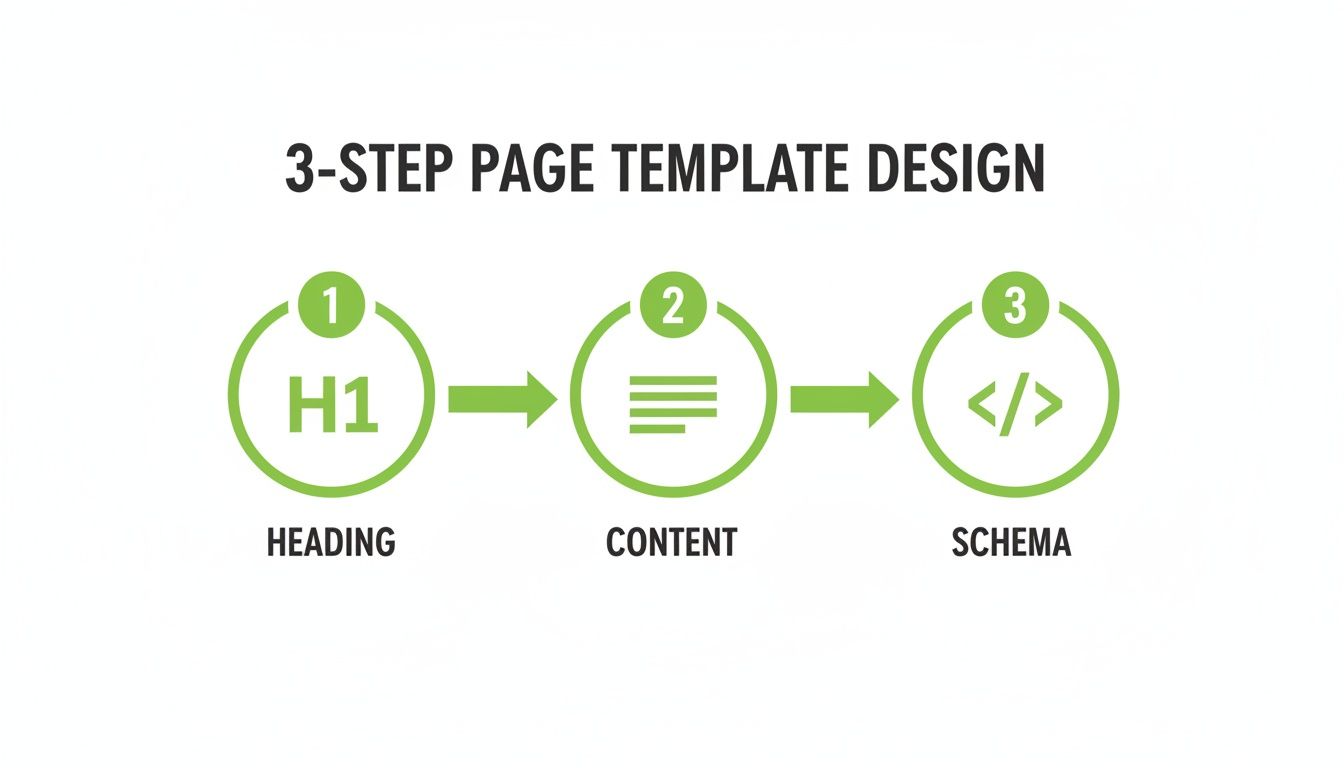
Following this structure ensures every page you generate is built for both human readability and search engine visibility, from the headline right down to the technical schema.
Picking the right tool can feel overwhelming, so I've put together a quick comparison of some popular no-code options that are great for online shop owners getting started with programmatic SEO.
No-Code pSEO Tool Comparison
| Tool | Best For | Ease of Use | Pricing Model |
|---|---|---|---|
| Whalesync | Syncing data between Airtable/Sheets and Webflow CMS. | Very High | Subscription |
| Finsweet Attributes | WordPress users who need a powerful, flexible solution. | Medium | Free/Paid |
| Softr | Building simple web apps and directories from Airtable or Google Sheets. | Very High | Freemium |
| Make/Zapier | Complex workflows connecting multiple data sources and platforms. | Medium | Freemium |
Each of these has its own strengths, but for most e-commerce projects, a tool that seamlessly connects your spreadsheet to your CMS like Whalesync or Finsweet is a fantastic starting point.
Measuring What Truly Matters
Launching a thousand pages is a great feeling, but it’s a vanity metric if you can’t tell whether it's actually working. The goal isn't just to create pages; it's to drive targeted traffic that converts into sales. That means you need to get familiar with a handful of key metrics.
Your two best friends here will be Google Search Console and Google Analytics. They tell you two different parts of the same story: how Google sees your pages and how users interact with them.
Here's what you need to keep a close eye on:
- Indexation Rate (Search Console): First things first, is Google even adding your new pages to its index? The 'Pages' report in GSC tells you exactly how many of your submitted URLs have been crawled and indexed. If this number is low, it’s a red flag that something might be wrong with your template or site structure.
- Organic Impressions & Clicks (Search Console): Are your pages showing up in search results? The Performance report reveals how many impressions and clicks your new pages are getting for those long-tail keywords you targeted. This is your earliest sign that the strategy is working.
- Organic Traffic to New Pages (Google Analytics): Are real people visiting these pages from search? In GA, you can create a segment to isolate traffic hitting only your programmatically generated URLs. This shows you precisely how much new organic traffic your pSEO efforts are delivering.
A quick word of advice: Programmatic SEO is a long game. It can take weeks, sometimes months, for Google to crawl, index, and properly rank a large batch of new pages. Be patient and focus on these leading indicators—if they're heading in the right direction, you're on track.
Ultimately, it all comes back to the bottom line. You have to connect this new traffic to actual revenue. For a deeper dive, our guide on setting up conversion tracking for programmatic SEO walks you through the process step-by-step. By tracking sales from these specific pages, you can calculate a real return on investment and prove the business value of your work. That's the only metric that truly counts.
Optimising for AI Search and Driving Conversions
With your automated system running, you’re doing more than just chasing today’s search rankings; you're future-proofing your online shop. The next frontier is already here: AI-driven search, like Google's AI Overviews. And this is exactly where your high-quality, structured programmatic pages give you a massive edge.
AI models thrive on clear, factual, and well-organised information to build their summaries. By creating pages that are laser-focused and packed with structured data, you’re essentially spoon-feeding these generative engines the perfect source material. This move positions you as a trusted authority and dramatically increases the chances of your content getting featured.
Becoming a Go-To Source for AI Engines
The core idea here is surprisingly simple. To appeal to an AI, you need to create content that is undeniably helpful and crystal clear to a human. These AI engines are built to find the most direct, accurate answers to a user's question, and your programmatic pages can deliver those answers at an incredible scale.
This really boils down to focusing on:
- Factual Language: Keep it straight. Stick to clear, objective descriptions of your products. State the material, size, colour, and intended use without burying it in marketing fluff.
- Robust Schema Markup: As we covered earlier,
Productschema is non-negotiable. It feeds AI engines the price, stock status, and ratings in a language they understand instantly. - Answering Questions Directly: The FAQs you generate for each page are a goldmine. They anticipate what users are asking in a simple Q&A format that AI models love to reference and cite.
Think of each programmatic page as a miniature fact sheet for a specific product variation. The more structured and factual your information is, the easier it is for an AI to trust it and use it as a source.
Connecting AI Optimisation to Real-World Conversions
Now for the best part. The very same strategies that make your content attractive to AI are the ones that convince human visitors to hit "Add to Basket." Clarity, value, and trust are universal principles that drive both rankings and revenue. This is the heart of Conversion Rate Optimisation (CRO).
A visitor landing on a page for "women's size 14 waterproof hiking trousers" wants to see exactly that. They expect clear specs, helpful sizing guides, and real reviews—all things that both users and AI value. Your programmatic template is the perfect testing ground to dial these elements in and watch your sales climb.
The beauty of programmatic SEO is that it lets you test conversion improvements across your entire template. A single successful tweak to a call-to-action button or headline can instantly lift the conversion rate on thousands of pages at once.
Even in tough markets, this focus on quality pays off. For instance, recent data on the fastest-growing German e-commerce stores revealed that while they saw a 20.5% dip in organic traffic, their overall SERP visibility actually grew by 2.7%. This shows that even when traffic fluctuates, SEO is still the most critical channel. A massive 401.4% surge in domain authority proves that quality content and backlink strategies are working, but there's always room to improve. You can find more insights into the German e-commerce landscape at getecommerceleads.com.
Practical A/B Testing Ideas for Your Templates
You don't need a complicated CRO platform to get started. Simple A/B tests on your master page template can lead to some serious revenue gains.
Here are a few practical ideas to get the ball rolling:
- Test Your Call-to-Action (CTA) Button: Try changing the text from "Buy Now" to "Add to Basket" or "Get Yours Today." Test different colours, too—a vibrant green often beats a standard blue, but only your data will tell you for sure.
- Experiment with Headlines: Your dynamic H1 is a powerful tool. Try tweaking its structure. Does
[Gender]'s [Product] in [Colour]convert better than[Colour] [Product] for [Gender]? - Vary Your Product Image Placement: See if showing a lifestyle image first, followed by clean studio shots, results in more sales than the other way around.
- Add Trust Signals: Try placing a small icon or banner near the CTA that mentions "Free Shipping" or "Easy Returns." These little assurances can make a big difference in a customer's decision to buy.
By constantly testing and refining your page template, you create a powerful feedback loop. The traffic you get from optimising for AI search flows to pages that are becoming more and more effective at turning visitors into customers. That’s how you drive real, sustainable growth for your business.
Common Questions About AI and E-commerce SEO
Jumping into AI and programmatic methods can feel like a big step, often sparking more questions than answers. Let's tackle some of the most common concerns I hear from online shop owners when they're looking to scale their SEO.
The goal here is clarity, not complexity.
Can AI-Generated Content Actually Rank on Google?
Yes, absolutely. Google has been very clear on this: their systems care about the quality and helpfulness of the content, not who—or what—created it. The real question is how you use the technology.
If you just churn out generic, low-effort pages, you'll struggle. It's that simple. But when you use AI as a tool to produce unique, user-focused content at scale, you’re actually creating valuable resources that align perfectly with what Google wants to see. For a deeper dive, it’s worth getting familiar with Google's policies on automatically generated content.
Is Programmatic SEO Considered Spammy?
This is a huge misconception, and the answer always comes down to your intent and execution.
Programmatic SEO gets a bad rap when it's used to flood the internet with thin, worthless pages that serve no real purpose other than to occupy search space. That’s not a sustainable strategy for any serious seo online shop.
When you use programmatic methods to create hyper-specific pages that solve a distinct user need—like a page for 'size 8 running shoes for women in blue'—you aren't spamming. You're creating a better, more relevant user experience. That's precisely what search engines are built to reward.
How Much Technical Skill Do I Need to Start?
You need far less technical expertise than you might think. Honestly, the days of needing a developer to build out these systems are over.
Thanks to the rise of incredible no-code tools, the entire process has become much more accessible.
Platforms like Webflow, Airtable, and automation services like Zapier allow you to build a complete programmatic SEO system without writing a single line of code. Your job is to focus on the quality of your data and the strategic design of your page templates, not the technical back-end. The tools are there to handle the heavy lifting for you.
At Programmatic SEO Hub, we provide the guides, templates, and systems to help you master these techniques. Discover how to scale your content and future-proof your strategy at https://programmatic-seo-hub.com/en.
Related Articles
Mobile friendly test google: A Practical Guide to Master Mobile SEO
Even though Google’s standalone Mobile-Friendly Test tool is a thing of the past, the principle behind it is more critical than ever. The simple truth is that Google now overwhelmingly uses its...
A Practical Guide to Competitive Analysis Keywords
When we talk about competitive analysis keywords, we're really talking about the search terms that are already making money for your rivals. By digging into these, you uncover their entire...
Landing Pages SEO A Practical Guide to Rank and Convert
When we talk about SEO for landing pages, we're not just talking about general website optimisation. We're getting hyper-specific. This is the art of building and refining standalone pages...