Seo in blogs: A Practical Guide to AI-Driven Growth

Blog SEO is all about tuning your articles to rank higher in search results, driving a steady stream of the right kind of visitors to your site. It’s more than just getting views; it's about building an automated system that brings potential customers directly to you.
Why SEO in Blogs Is Your Ultimate Growth Engine

Let's get straight to the point. A smart blog SEO strategy is no longer about slow, manual work. The game has changed. Today, it’s about creating high-impact content at a scale that was once impossible. This guide will skip the jargon and give you a simple roadmap to turn your blog into a growth machine.
This new playbook is built on two simple but powerful ideas: Programmatic SEO (pSEO) and Generative Engine Optimisation (GEO).
The New Playbook for Blog Growth
Think of Programmatic SEO as your content scaling system. Instead of writing one article at a time, you create a flexible template and use data to generate hundreds—or even thousands—of hyper-specific pages. It’s how you can efficiently target countless specific searches like "best accounting software for small cafes" and "best accounting software for freelance designers" without writing each one from scratch.
Generative Engine Optimisation, on the other hand, is about preparing your content for the future of search. It means structuring your articles so they can be easily understood and used by AI search tools like Google's AI Overviews. By creating clear, factual content, you position your blog as a trusted source for the next generation of search.
The real power here lies in building a massive content footprint. You're not just trying to rank for a few big keywords; you're casting a wide net that captures very specific user questions. This results in far more qualified http://programmatic-seo-hub.com/en/programmatic-seo-fundamentals/core-concepts/organic-traffic.
To give you a clearer picture, here’s a quick breakdown of how these concepts fit together.
The Core Pillars of a Modern Blog SEO Strategy
This table offers a quick snapshot of the key concepts we're about to explore, giving you a simple framework to understand how everything connects.
| Pillar | What It Means for Your Blog | Why It Matters for Growth |
|---|---|---|
| Keyword Intent Mapping | Understanding the why behind a search to create content that perfectly matches their need. | Delivers solutions, not just answers, leading to higher engagement and conversions. |
| Strategic Post Structure | Designing templates that are easy for both people and search engines to read. | Improves readability, boosts time-on-page, and makes your content easier to rank. |
| Technical & Blog Architecture | Ensuring your site is technically sound, fast, and easy for search engines to navigate. | A strong foundation is essential for visibility and a good user experience. |
| Programmatic Scaling | Using data and templates to create targeted content at scale, powered by AI. | Allows you to dominate niche search terms that your competitors can't touch. |
| Generative Engine Optimisation (GEO) | Structuring content to be a primary source for AI-driven search answers. | Future-proofs your blog and establishes it as an authority for next-gen search. |
Each pillar builds on the last, creating a comprehensive system for sustainable growth.
Why This Matters Right Now
This shift towards quality content at scale is more critical than ever. In Germany, for example, internet users now prefer search engines for discovering brands above all else. A recent study revealed that 37.1% of them find new brands through organic search, beating out TV ads (35.3%) and even personal recommendations (31.8%).
This data makes it crystal clear: a well-optimised blog is a key battleground for winning new customers.
Ultimately, mastering modern blog SEO isn't about endlessly chasing algorithm updates. It’s about building a sustainable system for growth that keeps working for you, even if you have a small team or a tight budget. Of course, a huge part of this is knowing how to write SEO articles that consistently rank. This guide will give you the practical roadmap you need to get there.
Finding Keywords That Actually Drive Traffic
Let's cut through the noise. Forget complex tools and overwhelming spreadsheets for a moment. At its core, great seo in blogs is about finding the 'golden keywords' that connect you with people who are actively searching for what you offer.
It’s about moving beyond those generic, high-competition phrases and uncovering the actual words people type into Google when they need a solution.
The real secret is to think about the 'why' behind a search, not just the 'what'. This is what we call search intent. For example, someone searching for "best hiking boots for wide feet" has a very specific, immediate problem. They're looking to buy something soon.
That's a completely different world from a search like "hiking boot brands." That person is just browsing, still in the early stages of gathering ideas. Matching your content to the user's specific intent is how you stop chasing clicks and start attracting traffic that converts.
Understanding the User's Journey
To find these valuable keywords, put yourself in your audience's shoes. Think about their journey, from first realizing they have a problem to finally making a decision. What questions are they asking at each stage?
Awareness Stage: They know they have a problem but aren't sure about the solution. They’re searching for things like "why do my feet hurt when hiking?" or "how to choose hiking boots."
Consideration Stage: Now they're weighing their options. Their searches get more specific: "lightweight hiking boots vs. heavy-duty boots" or "reviews of [Brand X] boots."
Decision Stage: They're ready to buy. Searches become highly targeted: "buy [Brand X Model Y] boots online" or "[Brand X] boots discount code."
When you brainstorm questions for each stage, you begin building a 'keyword universe'. This becomes a massive collection of related topics and phrases that can fuel hundreds of blog posts, each one perfectly tuned to a specific user's need.
The goal isn't just to rank for keywords; it's to become the go-to resource for your audience at every point in their journey. When you consistently provide valuable answers, you build trust and authority, which are powerful SEO signals.
Finding Long-Tail Keywords
Often, the most valuable phrases you'll find are long-tail keywords. These are longer, more specific search queries—usually three words or more. They might have lower search volume, but they have much higher conversion rates.
Think back to "best hiking boots for wide feet"—a perfect example.
Fewer people might search for that exact phrase, but those who do are incredibly qualified leads. For them, you're not just a random search result; you're the direct answer to their specific problem. Targeting these is a cornerstone of effective blog SEO. To really nail this, you have to understand how to choose keywords for SEO that genuinely bring the right people to your site.
How to Build Your Keyword Universe
So, where do you find these keyword gems? You don’t need expensive software to get started. Just use these simple, practical methods:
Google Autocomplete & 'People Also Ask': Type a broad keyword into Google and see what it suggests. Then, scroll down to the 'People Also Ask' section. These are real questions people are asking—pure gold for blog post ideas.
Online Forums and Communities: Go where your audience hangs out. Places like Reddit or Quora are treasure troves. Pay attention to the exact language people use to describe their problems and the questions they ask. These are your next blog post titles.
Analyse Your Competitors: Look at the blogs that already rank for your main topics. What long-tail keywords are they targeting in their headlines and subheadings? You can often spot content gaps they’ve missed that you can fill.
By focusing on user intent and long-tail phrases, you shift your entire strategy. You stop chasing vanity metrics and start building an engaged audience. If you want to dive deeper, check out our detailed guide on the power of long-tail keywords. This approach lays the foundation for a blog that doesn't just get traffic—it builds a loyal following and drives real results.
How to Structure a Blog Post for Humans and Google

A great content structure is where powerful seo in blogs meets a fantastic reader experience. Think of it as the blueprint for your article, guiding both search engines and human readers through your ideas in a logical way.
Without a clear structure, even the best content becomes a confusing wall of text that makes visitors leave. A well-structured post, on the other hand, is scannable, engaging, and easy for Google to understand. It creates a seamless flow that keeps people on your page longer—a huge signal to search engines that your content is valuable.
The Anatomy of a High-Ranking Article
At the top of your blueprint is the headline, your H1 tag. This is your article's main title and your single best chance to grab a reader's attention while clearly stating what the post is about. Make it compelling, and make sure it includes your primary keyword naturally.
Next are your subheadings (H2s, H3s, etc.). These are the signposts that break your content into digestible sections. They make it easy for readers to skim and find what they're looking for, which is how most of us read online. For search engines, these headings provide crucial context about the topics you’re covering.
The real magic happens when you use subheadings to tell a story. Each H2 should introduce a main idea, with the H3s underneath exploring the supporting details. This creates a logical hierarchy that pleases both algorithms and human brains.
A great structure doesn't just look good; it actively boosts your SEO performance by making your content easier for Google to index and understand.
Weaving Keywords in Naturally
One of the biggest mistakes people make with seo in blogs is "keyword stuffing"—jamming their target phrase into the text over and over. It sounds unnatural and can actually hurt your rankings.
Instead, your primary keyword should appear in a few key places:
- Your H1 Title: This is a must.
- The First Paragraph: Introduce your topic and keyword early on.
- A Few Subheadings (H2s or H3s): Only where it makes genuine sense.
- The Content Body: Sprinkle it in a couple of times, along with related phrases.
Modern search engines are smart. They understand context and synonyms, so you don't need to repeat the exact keyword endlessly. Focus on writing genuinely helpful content first, and the keywords will fit in naturally.
On-Page Essentials That Make a Difference
Beyond headlines and keywords, a few other on-page elements are critical for a well-structured post. These small details add up to a much better user experience and stronger SEO signals.
For example, Germany offers a fascinating case study. Google holds a 92.3% market share there, but in a twist, 57.63% of German web traffic comes from desktops. This means blogs targeting this market have to prioritise desktop-friendly layouts with clear navigation and detailed content blocks to make the most of that bigger screen space. You can explore more insights on SEO optimisation in Germany to get a handle on these regional quirks.
Making Your Content Scannable and Engaging
Never underestimate the power of formatting. Short paragraphs, bullet points, and numbered lists are your best friends. They break up long blocks of text and make your content feel inviting.
Here are a few other formatting essentials to nail every time:
- Image Alt Text: This is a short, descriptive text for your images. It helps search engines "see" what your images are about and makes your content accessible to users with screen readers.
- Internal Links: Linking to other relevant articles on your blog is a win-win. It helps readers discover more of your content and keeps them on your site longer. You can learn more about this by exploring our guide on creating effective content templates.
- Bold Text: Use bolding to make key terms or takeaways pop. This draws the reader's eye to the most important information.
By following this simple blueprint, you take the guesswork out of formatting. You'll create content that is consistently optimised, user-friendly, and built to rank.
A Practical Guide to Programmatic SEO with AI
Scaling your blog from one article to hundreds sounds like a task for a huge company, right? It's not. This is where we demystify Programmatic SEO (pSEO) and show you how to supercharge it with AI, even if you're a beginner.
At its core, programmatic SEO is just a clever way of creating many pages from a single template and a list of data. It’s a system, not a one-off task. Once you set it up, you can efficiently target thousands of specific search terms that would be impossible to tackle one by one.
The Core Idea of Programmatic SEO
Imagine you have a blog about local restaurants. Writing a separate review for every "best [Cuisine Type] in [City Name]" would take forever.
- "Best Italian restaurants in New York"
- "Best Italian restaurants in Chicago"
- "Best Mexican restaurants in New York"
- "Best Mexican restaurants in Chicago"
Instead of writing each article from scratch, pSEO lets you build a system. You create one master template and feed it your data (cuisine types and city names) to generate unique, helpful pages for each combination. This is how you can create pages for [Cuisine Type] in [City Name] at an incredible scale.
Let's break down how you can actually do this.
Step 1: Gather Your Data in a Simple Spreadsheet
First, you need to collect the data you want to combine. For our restaurant example, this would be a list of cuisine types and a list of city names.
This can be as simple as opening a spreadsheet.
- Column A (Cuisine): Italian, Mexican, Thai, Indian
- Column B (City): New York, Chicago, Los Angeles, Houston
The key is to think like your reader. What are they searching for? The more specific your data, the better you can target those long-tail keywords. This spreadsheet becomes the engine for your entire content operation.
For a deeper look into the mechanics, you can learn more about what programmatic SEO is in our detailed guide.
Step 2: Build Your Content Template
With your data ready, the next step is creating your content template. This is the blueprint for all your future pages. Think of it like a mail merge, but for your blog. You’ll write a single article structure and use placeholders that will be filled with your data.
A simple template might look like this:
H1 Title: The Best {{Cuisine}} Restaurants in {{City}}
Introduction: Looking for the top {{Cuisine}} spots in {{City}}? You're in the right place. We've rounded up the must-try restaurants for an authentic taste.
H2: What Makes {{Cuisine}} Food in {{City}} Special?
{{AI_Generated_Paragraph_1}}
H2: Top 3 {{Cuisine}} Restaurants to Visit in {{City}}
{{AI_Generated_Paragraph_2}}
The {{placeholders}} are where your data from the spreadsheet will slot in. But you'll notice the {{AI_Generated_Paragraph}} placeholders—this is where AI comes in to make each page unique and valuable.
Step 3: Use AI to Create Unique Content for Each Page
The biggest mistake with old-school pSEO was creating thousands of pages that were nearly identical, which Google dislikes. This is where AI becomes your most valuable assistant. Instead of just swapping out names, you use AI to write unique, helpful paragraphs for every single page.
You don't need to be a tech expert for this. Many user-friendly tools can connect your spreadsheet to an AI model like GPT-4. The process involves giving the AI a very specific instruction, or "prompt," for each page you want to generate.
The secret to high-quality output is a great prompt. A vague instruction gets you generic content. A detailed prompt acts as a creative brief for your AI assistant, telling it exactly what to write.
Here’s a simple, effective prompt you could use for our restaurant example to generate {{AI_Generated_Paragraph_1}}:
"You are a local food blogger. Write a short, engaging paragraph (around 75 words) about what makes the {{Cuisine}} food scene in {{City}} so unique. Mention 1-2 signature dishes or local flavors. Maintain a friendly and enthusiastic tone."
By running this prompt for every row in your spreadsheet, you'll get a unique paragraph for "Italian food in New York" and a completely different one for "Thai food in Los Angeles." The AI adds the crucial variation and detail that makes each page genuinely useful. This combination of structured data and dynamic AI-generated content is the key to doing seo in blogs programmatically without sacrificing quality.
The difference in efficiency is incredible. Just look at the numbers.
Manual vs. AI-Powered Programmatic SEO
| Task | Manual Approach (10 Articles) | Programmatic AI Approach (1000+ Articles) |
|---|---|---|
| Research | 10-20 hours | 5-10 hours (focused on data gathering) |
| Outlining | 5-10 hours | 1-2 hours (for a single master template) |
| Writing & Editing | 40-80 hours | 2-4 hours (prompt engineering & AI generation) |
| Publishing | 5 hours | Automated (minutes to hours) |
| Total Time | 60-115 hours | 8-16 hours |
The shift is clear. You move from being a manual content creator to a system builder. This approach allows a small team, or even a single person, to create a massive library of high-quality, targeted content that systematically captures valuable search traffic.
Getting Your Content Ready For AI Search
The way we find information is changing. It's not just about humans reading your blog anymore. With tools like Google's AI Overviews, your content is now being read by artificial intelligence. This has led to a new way of thinking: Generative Engine Optimisation (GEO).
Don't worry, GEO isn't another complicated thing to learn. It’s simple: structure your content with such clarity that AI-powered search engines choose your blog as the best source to answer a user's question. You want your content to be the foundation for the direct answers these new search experiences provide.
Making Your Content AI-Friendly
The great news? If you're already creating well-structured content, you're 90% of the way there. Now, it's just about fine-tuning your approach to make your information as direct and clear as possible.
AI models are literal. They love clarity. They need content that gets straight to the point, answers questions directly, and presents facts in an organised way. This is where you can get a serious advantage.
The core idea is simple: write content that an AI can easily understand and use in a helpful summary. When you make your blog the clearest, most factual source on a topic, you're optimising for both human readers and AI assistants at the same time.
Think about it this way: if you were teaching a new concept to a very smart student who took everything literally, how would you explain it? You'd probably use simple language, define key terms, and give clear examples. That's the exact mindset you need for AI search.
Practical Steps For GEO Success
You don't need a complete strategy overhaul. Just start weaving these simple habits into your content creation to give your SEO in blogs a serious edge in an AI-first world.
- Embrace a Q&A Format: Structure parts of your articles to directly answer common questions. Use subheadings like "What Is Programmatic SEO?" or "How Does Keyword Intent Work?" This makes it incredibly easy for an AI to find and use your answer.
- Use Direct Language: Cut the fluff. Avoid overly complex sentences. For instance, instead of "The utilisation of this methodology could potentially result in...," just write "This method helps you..." It’s clearer for everyone, including AI.
- Cite Your Sources: Back up your claims by linking to authoritative studies or official sources. This builds credibility and gives AI a way to verify your information, boosting your site's trustworthiness.
By putting these tactics into practice, you’re not just optimising for today's search engines—you’re future-proofing your content for the next evolution of search. To really dive deep into this, check out our complete guide on Generative Engine Optimisation.
This flowchart shows the programmatic workflow, which is the engine that creates structured, GEO-ready content at scale.
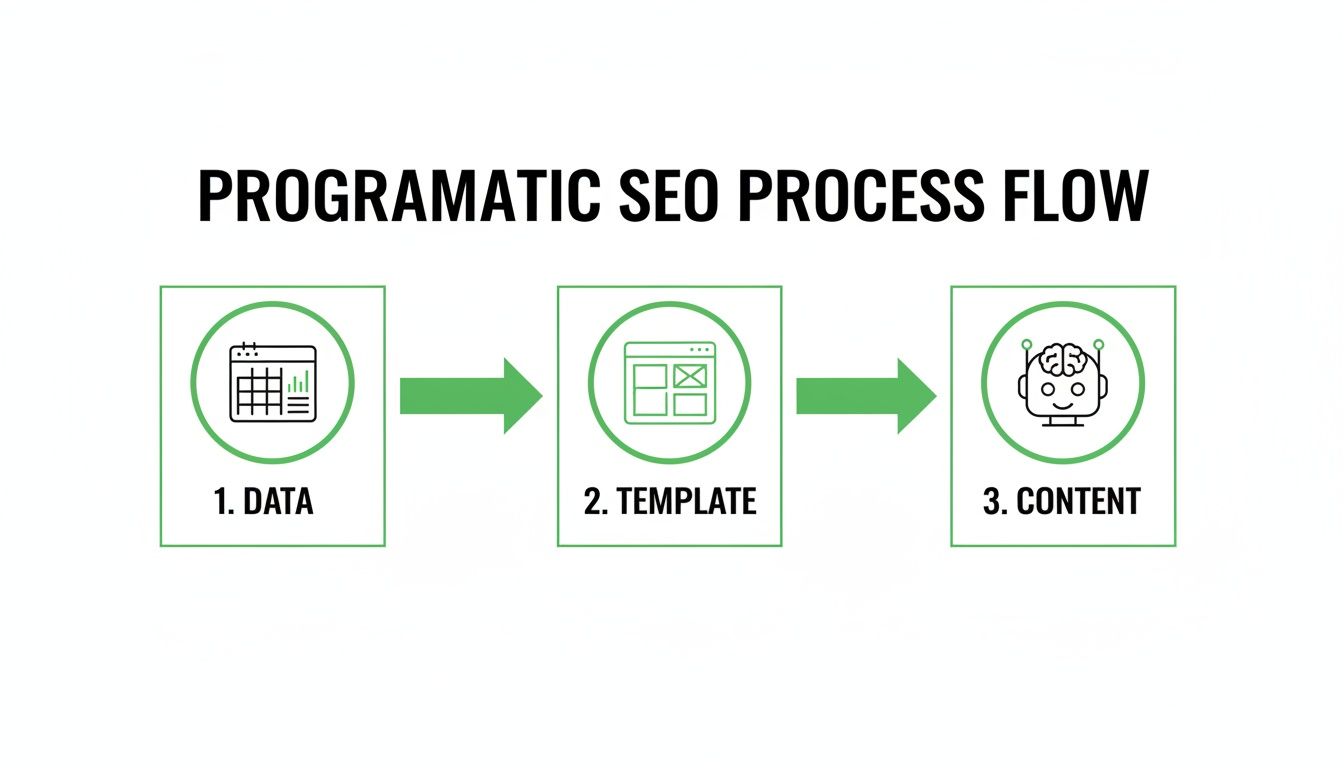
This flow—from structured data, to a flexible template, and finally to AI-driven content generation—is precisely the system that lets you create AI-friendly content efficiently.
Why Your Programmatic Efforts Align Perfectly
At its heart, programmatic SEO is all about structure. You take raw data, run it through a consistent template, and generate thousands of organized pages. This systematic approach is exactly what AI models need to understand your content.
Every page you create programmatically is a neatly packaged piece of information on a very specific topic. This turns your site into a rich, well-organized library for AI to learn from. While your competitors are busy hand-crafting one-off articles, you're building an entire knowledge base that is perfectly formatted to become a primary source for AI search results. It's a massive strategic advantage that will only grow as search continues to evolve.
Your Top Questions About Blog SEO Answered
Even the most solid strategy hits a few bumps when you start putting it into practice. Here are some clear, no-nonsense answers to the questions that come up most often when you’re in the trenches with blog SEO.
How Long Until I Actually See Results From My Blog SEO?
Let’s be real: SEO is a long game. Generally speaking, you should expect to wait anywhere from 3 to 6 months before you see any meaningful traffic from new blog content.
If your blog is brand new, that timeline can easily stretch closer to 6-12 months. You're not just writing content; you're building authority from scratch. Many factors play into this, like how competitive your topic is, the quality of your content, and the technical health of your site.
A programmatic approach can sometimes speed this up. By targeting a massive volume of less competitive long-tail keywords all at once, you can often start ranking for some of them much faster.
Can I Just Use AI to Write My Entire Blog Post?
Think of AI as your super-powered assistant, not the boss. It’s fantastic for brainstorming, creating an outline, writing a first draft, or generating unique variations for your programmatic pages.
But the human touch is non-negotiable. You are the expert who needs to fact-check, add your brand's unique voice, and share personal insights that build trust. Your job is to ensure the final piece actually helps a real person. The winning formula is combining AI’s speed with your human expertise. To make sure you’re playing by the rules, check out our guide on handling Google's policies on auto-generated content.
What’s the Difference Between Regular and Programmatic SEO?
The main difference is your method and the scale of what you’re creating.
- Regular Blog SEO: This is the traditional, one-by-one approach. You pick a few keywords and craft a detailed article for each one.
- Programmatic SEO (pSEO): This is about building a content-creation system. You create one template and use a dataset (like a list of cities, products, or job titles) to generate hundreds or thousands of unique pages automatically.
pSEO is your secret weapon for capturing a massive volume of super-specific, long-tail search queries. It’s a strategy that would be impossible to execute manually. You’re not just writing articles; you're building a content engine.
How Do I Know If My Blog SEO Is Actually Working?
It's easy to get lost in data. To stay focused, just track a few key metrics that show you're making a real impact.
First, keep an eye on organic traffic in a tool like Google Analytics. Are more people finding you through search? Next, track your keyword rankings in a platform like Ahrefs or Semrush to see if you’re climbing the search results for the terms you care about.
You can also look at metrics like time on page. This can be a good clue as to whether your content is engaging. But the most important thing is to track business-focused goals: leads, email sign-ups, or sales that came directly from your blog's organic traffic. That’s the ultimate proof your SEO efforts are delivering real results.
Ready to build a content engine that drives real growth? Programmatic SEO Hub provides the playbooks, templates, and tools you need to master programmatic SEO and GEO. Start building your scalable content strategy today at https://programmatic-seo-hub.com/en.
Related Articles
Mobile friendly test google: A Practical Guide to Master Mobile SEO
Even though Google’s standalone Mobile-Friendly Test tool is a thing of the past, the principle behind it is more critical than ever. The simple truth is that Google now overwhelmingly uses its...
A Practical Guide to Competitive Analysis Keywords
When we talk about competitive analysis keywords, we're really talking about the search terms that are already making money for your rivals. By digging into these, you uncover their entire...
Landing Pages SEO A Practical Guide to Rank and Convert
When we talk about SEO for landing pages, we're not just talking about general website optimisation. We're getting hyper-specific. This is the art of building and refining standalone pages...