A Practical Guide to SEO for Ecommerce Using AI
SEO for ecommerce is all about making your online shop more visible when people search on engines like Google. When a potential customer looks for a product you sell, a good SEO strategy gets you closer to the top of that list. The goal? Drive more traffic and generate more sales—without paying for every single click.
Building Your Ecommerce SEO Foundation
Think of your website's architecture as the floor plan for a brick-and-mortar shop. If the aisles are cluttered, the signs are confusing, and products are buried in the back, shoppers will just give up and leave. It’s the same online. A well-organised digital storefront makes shopping a breeze for your customers and for the search engine bots that decide how to rank your site.

At its heart, ecommerce SEO is about maximising what is organic search traffic—the unpaid visitors who find you naturally. And that process always starts with building a rock-solid foundation.
To get a clearer picture, let's look at the three pillars that hold up any successful ecommerce SEO strategy.
Core SEO Pillars for Ecommerce Success
This table breaks down the three essential pillars of ecommerce SEO, explaining the goal and key actions for each.
| SEO Pillar | Primary Goal | Key Actions for Beginners |
|---|---|---|
| Technical SEO | Ensure search engines can easily crawl, understand, and index your entire website without issues. | Fix broken links, create a clear XML sitemap, use descriptive URLs, and improve site speed. |
| On-Page SEO | Optimise individual pages to rank for specific keywords and satisfy user intent. | Craft compelling title tags and meta descriptions, write unique product descriptions, and strategically use internal links. |
| Off-Page SEO | Build authority and trust by earning links and mentions from other reputable websites. | Guest post on relevant industry blogs, get featured in product roundups, and encourage customer reviews. |
Nailing these fundamentals sets the stage for everything else. Without a strong technical base, even the best content can go unnoticed.
What Is Site Architecture?
Site architecture is just a fancy term for how your website’s pages are organised and connected. For an ecommerce store, a logical structure isn't just nice—it's essential.
Let’s say you sell clothing. A clean, intuitive architecture would flow naturally:
- Homepage: Your main entrance.
- Category Pages: Broad buckets like 'Men's', 'Women's', 'Kids'.
- Sub-Category Pages: More specific collections like 'T-Shirts', 'Trousers', 'Jackets'.
- Product Pages: The individual items themselves.
This kind of clear hierarchy lets a shopper get from your homepage to a specific pair of trousers in just a few clicks. Search engines love that simplicity, too. A shallow, logical structure helps them "crawl" and make sense of your site efficiently, which is a huge factor in ranking well.
Why Crawlability Matters
Crawlability is simply how easily search engine bots can navigate and index your site's content. If the bots can't find a page, that page might as well not exist in search results. Think of them as delivery drivers who need clear roads and street signs to find an address.
Clean, descriptive URLs are your digital street signs. For instance, a URL like yourstore.com/mens/trousers/slim-fit-chino is miles better than yourstore.com/prod?id=123. The first one tells both users and search engines exactly what the page is about before they even get there.
A strong technical foundation isn't just a 'nice-to-have'; it's the bedrock of scalable growth. Without it, even the most advanced content strategies will fail to deliver their full potential.
Getting these fundamentals right is proven to work. A recent analysis found that German e-commerce stores saw a massive 401.4% surge in domain authority, mostly by mastering these foundational practices. Their average Google Lighthouse SEO Score of 93.89 out of 100 proves their commitment to technical excellence. This shows that a solid base allows for more advanced strategies, like programmatic SEO, to truly shine.
Creating a Clear Path to Purchase
Every decision you make about your site's foundation should be focused on one thing: creating the clearest possible path to your products. When you prioritise the user, you naturally align with what search engines want to see.
A logical structure also helps you target different kinds of searches. Your broad category pages can rank for general terms like "men's jackets," while your product pages can go after highly specific queries. We'll dig into this more later, but you can get a head start by learning about long-tail keywords. This layered approach ensures you capture customers at every stage of their journey, turning your store into an efficient, easy-to-navigate marketplace.
Crafting Content That Converts and Ranks
Think of your product and category pages as your best salespeople, working 24/7. If their pitch is weak, generic, or just plain confusing, shoppers will bounce. The real secret to powerful seo for ecommerce is writing content that not only makes Google happy but also speaks directly to your customers, answering their questions and convincing them to buy.
It’s time to move beyond bland, manufacturer-supplied descriptions. Your goal is to turn these key pages into indispensable resources that build trust, answer questions, and ultimately, drive sales.
Uncovering What Customers Truly Want
Great content starts with understanding the exact words your ideal customers type into a search bar when they're ready to pull out their wallets. This isn't just about finding keywords; it's about identifying high-intent queries that scream "I'm ready to buy!"
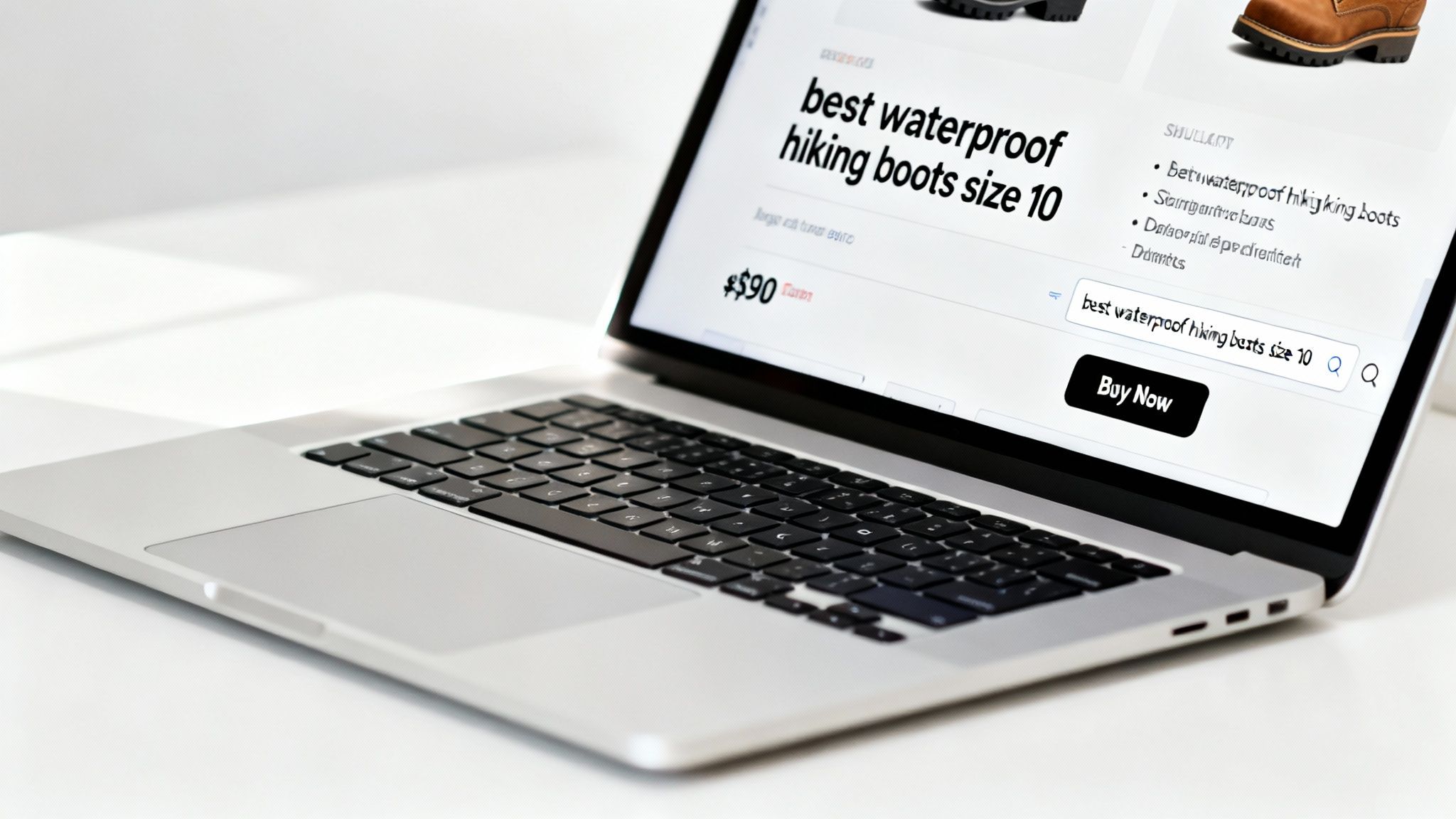
Consider the difference between a vague search like "running shoes" and a super-specific one like "women's stability running shoes for flat feet size 38". The second search comes from someone who knows exactly what they need. These specific, multi-word phrases are called long-tail keywords, and for any ecommerce store, they're pure gold. Why? Because they typically face less competition and convert at a much higher rate.
You don't need fancy tools to start finding these gems. Try these simple tricks:
- Google Autocomplete: Type a product name into Google and watch what it suggests. Those are real searches from real people.
- Amazon Search: Do the same thing on Amazon. The suggestions are often laser-focused on product features and customer needs.
- "People Also Ask" Box: Look at the questions Google shows in the search results. They are a direct line into your customers' minds.
By targeting these more specific keywords, you’re not just optimising a page; you're perfectly aligning it with a customer's specific need, which massively boosts your chance of making the sale.
Writing Product Descriptions That Actually Sell
Here’s a classic mistake I see all the time: stores just copy and paste the generic product descriptions from the manufacturer. This is an SEO disaster. It creates duplicate content across the web, giving Google very little reason to rank your page.
Your descriptions must be unique.
But don't just list features—sell the benefits. Instead of saying "waterproof material," explain what that means for the customer: "Your feet will stay bone-dry even in a torrential downpour." Think about the questions a shopper would have and answer them right there. What are the dimensions? How do I clean it? Who is this product perfect for?
Your product page should be the single best resource on the entire internet for that specific item. When you provide comprehensive, unique, and genuinely helpful information, you give both customers and search engines a compelling reason to choose you.
Transforming Category Pages into Buying Guides
Your category pages are much more than just a grid of products. They are massive opportunities to capture people searching for broader terms and guide them toward the right purchase. A simple way to do this is by adding a couple of unique paragraphs at the top or bottom of the page.
For example, on a "Men's Winter Jackets" page, you could add a short guide explaining the difference between down, synthetic, and wool insulation. This is incredibly valuable for a shopper who isn't sure what they need, and it gives Google a ton of relevant text to understand and rank your page for searches like "best winter jackets for men." To take this even further, look into data-driven ecommerce content marketing strategies to find new angles for growth.
This approach is especially powerful in competitive markets. Take Germany, where the ecommerce market hit €88.8 billion and is expected to reach €92.4 billion. In a crowded space like that, a smart, targeted content strategy is how you carve out your own profitable niche.
When you invest the time to create unique, customer-centric content, you're not just doing SEO. You're building a powerful, long-term asset that attracts the right kind of traffic and turns casual visitors into loyal customers.
Getting to Grips with Technical SEO
The phrase "technical SEO" often sounds way more complicated than it is. You don't need a degree in computer science to handle it. At its core, it's simply about making sure your online shop's foundation is solid so search engines like Google can easily find, crawl, and understand your pages.
Think of it like organising the stockroom of a physical shop. If everything is a mess in the back, it’s going to be hard to get the right products out onto the shop floor for customers. Technical SEO is just tidying up that stockroom so Google (and your shoppers) can find exactly what they’re looking for. It's a foundational piece of any solid seo for ecommerce strategy.
What on Earth is Structured Data (or Schema)?
Imagine if every product on your site had a special digital label that Google could read instantly. This isn't just a price tag; it's a super-label that details the product's name, brand, how many are in stock, and even what customers think of it. That’s precisely what structured data, also known as schema markup, does.
It's a specific "vocabulary" you add to your site's code to translate your human-readable content into a standardised format that search engines understand perfectly. Instead of leaving it to Google to guess what your page is about, you’re telling it directly: "Hey, this is a product, here's the price, and here are the customer reviews."
The big payoff for this extra bit of clarity? You can earn rich snippets. These are the jazzed-up search results you see with star ratings, prices, and availability information baked right into the Google results page. They make your listings impossible to ignore and dramatically increase the chances someone clicks on your link over a competitor's.
And the best part? Implementing this is easier than you think. Platforms like Shopify often have apps or built-in features that take care of the heavy lifting for you. Your job is mainly to check that the most important details are being marked up correctly.
The Most Important Schema Types for Ecommerce
You don't need to memorise the entire schema dictionary. For an online shop, just focusing on a handful of key types will get you 80% of the results.
- Product Schema: This is your bread and butter. It communicates all the essential details about your products—name, brand, description, images, price, you name it.
- Review Schema: This is what powers those little gold stars in the search results. It’s an instant trust signal that can make a huge difference to your click-through rate.
- Availability Schema: This simply tells Google if a product is in stock, out of stock, or on pre-order. It's a great way to avoid frustrating customers who click through only to find they can't buy what they want.
- Organisation Schema: Think of this as your business card for Google. It helps clarify your official business name, logo, and contact information, strengthening your brand's identity in search results.
Want to go deeper on how to implement this? We've got a full guide on using schema markup for programmatic SEO.
Beyond Schema: A Couple of Other Technical Must-Haves
While schema is a game-changer, there are a couple of other technical bits and pieces that are simply non-negotiable for a modern ecommerce site. The good news is, they're also pretty straightforward.
First up is site speed. We live in an impatient world. If your page takes more than a couple of seconds to load, a huge chunk of your potential customers will just leave. Compressing your product images is one of the quickest and most effective wins for speeding things up.
Second is mobile-friendliness. It’s no secret that more people shop on their phones than on desktops these days. Your store absolutely must provide a flawless experience on a small screen. Most modern themes are "responsive" right out of the box, but you should always double-check how your site feels and functions on your own phone.
Nailing these technical SEO pillars means you stop losing sales to simple, easily fixed problems. It's all about building a shop that’s fast, reliable, and crystal clear for both your customers and the search engines that bring them to you.
How to Scale Content with AI and Programmatic SEO
If you have a large product catalog, writing unique content for every single page feels impossible. This is where a smart, modern approach called Programmatic SEO comes in, and it's easier to use than ever thanks to AI. Don't let the name intimidate you; it's a practical way to create hundreds or even thousands of highly specific pages automatically.
Think of it as a mail merge for your website. You take a spreadsheet full of product details (your data), create one perfect page layout (your template), and then use a tool to automatically generate a unique page for every row in your spreadsheet. This lets you target super-specific customer searches like "waterproof hiking boots for wide feet size 10" at a massive scale—searches your competitors are probably ignoring.
The Simple Idea Behind Programmatic SEO
The concept is simple. All you need are two things:
- A Spreadsheet of Data: This is your source of truth. For an online store, it's a list of your products with columns for every possible detail:
Product Name,Brand,Color,Size,Material,Best Use, etc. - A Page Template: This is a single, well-designed page in your store that acts as a blueprint. It has special placeholders like
{{Product Name}}or{{Color}}where the data from your spreadsheet will go.
When you combine the spreadsheet and the template, a new page is created for every row. So, one product that comes in 5 colors and 10 sizes can instantly become 50 unique pages, each targeting a very specific search.
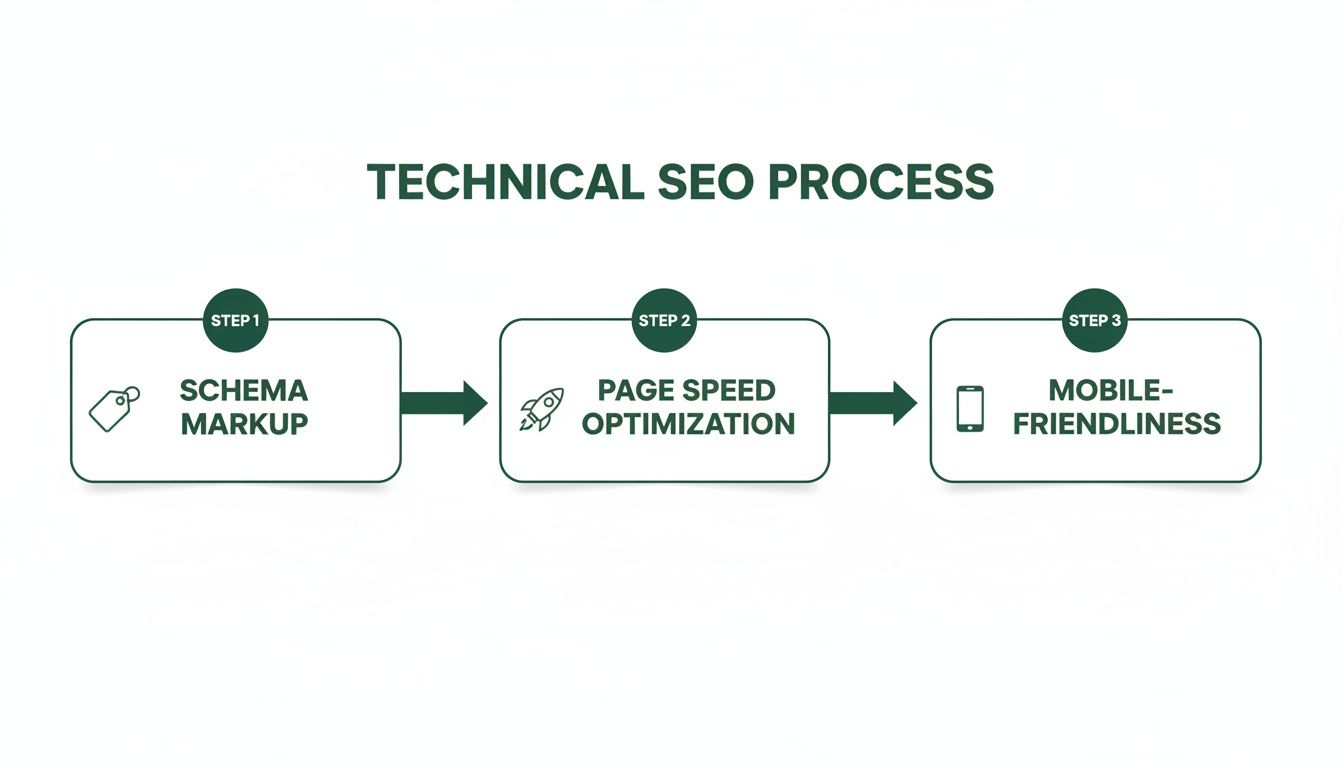
Of course, for this to work, your site's technical foundation—like site speed and mobile-friendliness—must be solid. Each of these new pages needs to be a good experience for the user from the moment they land on it.
A Practical 5-Step Guide to Using AI for Programmatic SEO
You don't need to be a programmer to do this. Here’s a step-by-step plan for your first project using simple tools.
| Step | Action | Practical Tip | Example for a Shoe Store |
|---|---|---|---|
| 1. Find the Pattern | Identify how customers search for your products. Look for combinations of product features, uses, and types. | Use Google's search suggestions. Type in "running shoes for..." and see what it suggests. | People search for [gender]'s [type] running shoes for [surface]. |
| 2. Build Your Spreadsheet | Create a simple spreadsheet (like Google Sheets) with columns for each part of your pattern. Fill it with your product data. | Each row should represent one unique product combination you want a page for. | Columns: Gender, Type, Surface. Row: "Men's", "Trail", "Rocky Paths". |
| 3. Use AI to Write Content | Now for the magic. Use an AI tool to write unique descriptions for each row in your spreadsheet. | Get an add-on like "GPT for Sheets." In a new column, use a formula to ask the AI to write content based on the other columns in that row. | The prompt could be: "Write a 50-word description for {{Gender}}'s {{Type}} running shoes, perfect for {{Surface}}." |
| 4. Create Your Template | In your ecommerce platform (like Shopify or WordPress), design a single page. Instead of real text, use placeholders for your spreadsheet columns. | These placeholders are often called "merge tags" or "variables." | Your page title could be: Shop for {{Gender}}'s {{Type}} Running Shoes for {{Surface}}. |
| 5. Connect and Publish | Use a no-code tool to connect your spreadsheet to your website and publish all the pages automatically. | Tools like Zapier or Whalesync can connect Google Sheets to platforms like Webflow or Shopify. | The tool will read each row from your sheet and create a new, fully filled-out page on your site. |
By following this practical workflow, you shift from manually creating pages one by one to building a system that can generate hundreds of useful, specific pages for you. This turns your seo for ecommerce strategy into a powerful, scalable engine for growth.
For a deeper dive into the tools and techniques, check out this guide on automating content creation.
Advanced Strategies to Build Authority
Once you've got a solid foundation and a content engine that can scale, it's time to build some real, lasting authority. This is what separates the good e-commerce stores from the truly great ones. The strategies here are powerful but surprisingly straightforward, designed to future-proof your site and cement your status as a leader in your niche.
First, we'll get into the art of internal linking, turning your website into a powerful, interconnected web. Then, we’ll look at how to get your content ready for the new world of AI-driven search.
Weaving a Web of Relevance with Internal Links
Internal linking is just what it sounds like: linking from one page on your site to another. Think of it as creating a network of pathways inside your own store. Every link you add is a signpost, telling both your customers and search engines which pages really matter.
When a high-traffic blog post links to a specific product page, it passes on some of its authority—what SEOs often call "link juice." This one simple action can give your key product and category pages a serious lift in the search rankings, helping them compete for those high-value keywords.
A smart internal linking strategy doesn't just help search engines map out your site; it guides real people on a natural journey of discovery, keeping them engaged and moving them closer to a purchase.
The goal here is to create a logical flow. A blog post on "How to Choose the Right Hiking Boots" should absolutely link to your "Men's Hiking Boots" and "Women's Hiking Boots" category pages. This is a fundamental part of building topical authority, which you can dive deeper into in our detailed guide on the subject. By consistently linking related content together, you're sending a strong signal to Google that you're an expert on that topic.
Preparing Your Content for AI Search Engines
The way people find information is changing fast. Instead of just seeing a list of blue links, users are now getting direct answers from AI models like ChatGPT and Google’s AI Overviews. This big shift calls for a new approach: Generative Engine Optimisation (GEO).
GEO is all about creating content that's so clear, well-structured, and authoritative that AI models choose your information to build their answers. When an AI cites your store as the source, it's a huge vote of confidence that builds trust and drives incredibly qualified traffic your way.
To get your content ready, you need to focus on:
- Answering Questions Directly: Structure your content to give clear, concise answers to the questions your customers are asking. Use headings that are actual questions, followed by a direct answer.
- Using Factual Data: Back up your claims with hard numbers, specs, and verifiable data. AI models love facts.
- Demonstrating Real Expertise: Go deep. Create comprehensive guides, detailed comparisons, and how-to articles that truly showcase your knowledge of the products you sell.
This isn't just a future-proofing tactic; it's becoming essential right now. Take social commerce, for example, which has exploded in the German e-commerce market. Revenue hit $7.1 billion and is still climbing. This trend means your SEO efforts have to work for traditional search engines and the AI-powered algorithms driving discovery on social platforms.
Taming Your Product Filters
Faceted navigation—those handy filters on your category pages that let customers sort by size, colour, brand, or price—is brilliant for users. But for SEO, it can quickly become a nightmare. Every single combination of filters can create a new, unique URL (like .../t-shirts?color=blue&size=medium).
If you don't manage this properly, your store can accidentally spawn millions of these thin, low-value pages. This wastes Google's "crawl budget" (the resources it allocates to crawling your site) and dilutes your overall authority.
The fix is to tell Google which filter combinations matter and which ones to ignore. The most common tool for this job is the canonical tag. This small bit of code points all those filtered URL variations back to the main category page (e.g., /t-shirts). It essentially tells search engines, "Hey, these are all just different views of the same main page." This cleans up your site architecture and focuses all your ranking power right where you want it.
Your Top Ecommerce SEO Questions, Answered
Jumping into the world of SEO for ecommerce can feel like you've been handed a puzzle with a thousand moving pieces. It's totally normal to have a lot of questions. Let's tackle some of the most common ones I hear from store owners, with clear, no-fluff answers to help you get moving.
How Long Does Ecommerce SEO Take to Show Results?
This is always the first question, and for good reason. The honest-to-goodness answer? SEO is a long game. Think of it like planting a tree. You have to give it time to grow strong roots before you see any real height. It’s an investment, not an overnight trick.
While you might spot some early green shoots—like new pages getting picked up by Google within the first 1-3 months—you should really be looking at the 6 to 12-month mark for significant, steady organic traffic. Of course, that timeline can shift based on a few things.
- How Tough is Your Niche? Ranking for "handmade leather wallets" will likely happen a lot faster than trying to break into a crowded space like "women's running shoes."
- What's Your Starting Point? A brand-new website with zero history is starting from scratch. An established store with some existing authority has a head start.
- Are You Consistent? SEO rewards steady, focused work. A little bit of effort spread over 12 months will always beat a frantic one-month push followed by radio silence.
Programmatic SEO can sometimes give you a boost by quickly targeting thousands of less competitive, long-tail keywords. But building the real authority needed for those big, juicy head terms still takes patience.
Can I Do Ecommerce SEO Myself Without an Agency?
Yes, one hundred percent. While a great agency brings a ton of expertise to the table, a motivated store owner can get incredible results by nailing the fundamentals we've covered here. The good news is that most modern ecommerce platforms have a lot of the technical SEO basics already baked in, which removes a massive headache right from the start.
The real key is knowing where to focus your energy. This guide is your roadmap:
- Start with a clean, logical site structure. If a human can't find it easily, a search engine can't either.
- Create genuinely helpful, unique content for your key pages. Think about what your customers are asking and answer those questions directly on the page.
- Use accessible AI and no-code tools to scale your content. You don’t need to be a developer to make programmatic methods work for you.
Start small, focus on the things that actually help your customers, and learn as you go. You know your products and your customers better than any agency ever will—that’s your secret weapon.
What Is the Biggest SEO Mistake Ecommerce Stores Make?
This one's easy. By far, the most common and damaging mistake is copy-pasting the generic, manufacturer-provided product descriptions. It’s a tempting shortcut when you’ve got hundreds of products to list, but it creates a massive duplicate content problem all over the internet.
When your product page looks identical to ten of your competitors', you give search engines absolutely no reason to rank your page over theirs. It's a race to the bottom that you can't win.
The second biggest mistake is a confusing or ridiculously deep site structure that buries products five or six clicks from the homepage. If a customer gets lost trying to find something, you can bet a search engine crawler will, too.
Taking the time to write unique, helpful, benefit-focused content for your product and category pages is one of the highest-impact things you can do for your store's SEO. Period.
Is Programmatic SEO Considered Spam by Google?
Nope. The technique itself isn't spam—it's all about the quality and intent behind what you create. Programmatic SEO got a bad rap in its early days when people used it to churn out thousands of thin, nonsensical pages stuffed with keywords. That’s not what we’re doing here.
Google cares about one thing above all else: the user's experience.
- The Spammy Way: Pumping out thousands of nearly identical, low-value pages that offer nothing new and just frustrate people.
- The Value-Driven Way: Using programmatic SEO to create super-specific, useful pages that serve a clear purpose—like a dedicated page for a "women's waterproof running jacket in size medium."
Your goal is to make sure every single page you generate is helpful, provides a great experience, and answers a specific search query better than anyone else. When you use it to add real value and serve niche audiences at scale, it's an incredibly powerful and completely legitimate strategy.
At Programmatic SEO Hub, our whole mission is to demystify these concepts and give you the tools you need to win. Check out our resources to build a scalable, future-proof content strategy for your store. You can learn more about mastering AI-powered SEO at https://programmatic-seo-hub.com/en.
Related Articles
Mobile friendly test google: A Practical Guide to Master Mobile SEO
Even though Google’s standalone Mobile-Friendly Test tool is a thing of the past, the principle behind it is more critical than ever. The simple truth is that Google now overwhelmingly uses its...
A Practical Guide to Competitive Analysis Keywords
When we talk about competitive analysis keywords, we're really talking about the search terms that are already making money for your rivals. By digging into these, you uncover their entire...
Landing Pages SEO A Practical Guide to Rank and Convert
When we talk about SEO for landing pages, we're not just talking about general website optimisation. We're getting hyper-specific. This is the art of building and refining standalone pages...