A Practical Guide to SEO for E-commerce
At its heart, e-commerce SEO is all about making your online store more visible on search engines like Google. The goal is simple: help customers find your products organically, without you having to pay for every single click. When you get it right, it means more traffic, more trust, and ultimately, more sales.
Building Your E-commerce SEO Foundation

Diving into SEO for your online store can feel overwhelming, but the core idea is pretty straightforward. Just think of your website as a physical retail shop. For it to succeed, people need to find it easily, browse without getting lost, and trust what you're selling.
E-commerce SEO really boils down to three fundamental pillars that all work together, much like running a successful brick-and-mortar store.
The Three Pillars of E-commerce SEO
First up is Technical SEO. This is the solid foundation of your shop—the building itself, the electrical wiring, and the clear, wide aisles. It’s all about making sure search engines can easily "crawl" your site to discover all your products without hitting dead ends or confusing paths. If this foundation is shaky, everything else you build on top will struggle.
Next, we have On-Page SEO. Imagine this as your in-store merchandising. It’s your eye-catching product displays, the helpful signage, and the detailed labels on every item. This pillar focuses on optimising individual pages—your product descriptions, category pages, images, and titles—to be as clear and compelling as possible for both shoppers and search engines.
Finally, there’s Off-Page SEO. This is your store's reputation around town. Think word-of-mouth referrals, positive reviews in local publications, and the general trust you build within the community. In the digital world, this translates to earning backlinks—links from other reputable websites—which act as a powerful signal to Google that your store is a trustworthy authority.
A well-structured e-commerce site guides both search engine crawlers and human visitors seamlessly from a search query to a final purchase. The goal is to remove friction at every step.
To truly build a strong foundation, you need a powerful SEO content strategy woven throughout these pillars. This isn't just about keywords; it's about planning and creating content that genuinely helps your customers make informed decisions.
Connecting the Pillars for Growth
These three elements aren't just a checklist of separate tasks; they're interconnected parts of a single, fluid strategy. A technically sound site makes all your on-page efforts far more effective. Great on-page content, in turn, makes it easier to naturally earn those valuable off-page backlinks.
A strong backlink profile then boosts the authority of your entire domain, lifting all your pages higher in search results. You can learn more about finding the right terms to target in our detailed guide on http://programmatic-seo-hub.com/en/programmatic-seo-fundamentals/seo-strategy/keyword-research.
By focusing on how these core areas work together, you create a powerful system that consistently attracts the right shoppers and guides them smoothly from a search result to your checkout page. That’s how you turn organic visibility into sustainable revenue.
Mastering Technical SEO for Online Stores

Technical SEO is the invisible engine that powers your online store. You can’t see it, but if it starts to sputter, your search rankings and sales will feel it immediately. Think of it as the plumbing and wiring of your website—it has to be flawless for everything else to work properly.
This area of seo for e-commerce is all about ensuring search engines can find, crawl, and understand your store's pages without a hitch. Get this wrong, and even the most brilliant products and marketing campaigns will never reach their true potential.
Build a Logical Site Architecture
Ever walked into a massive shop where products are scattered randomly with no signs? You’d get frustrated and walk straight out. That’s exactly what a messy website structure does to both your shoppers and search engine crawlers.
A logical site architecture organises your content so it’s predictable and easy to follow. The best structure usually looks like a pyramid: your homepage sits at the top, followed by broad categories, then more specific subcategories, and finally, your individual product pages form the base.
This clean hierarchy does two things well. It helps distribute "link equity"—or SEO authority—naturally throughout your site. It also makes your store ridiculously easy for customers to browse, which means a better user experience and, ultimately, more sales. Simplicity almost always wins here.
Make Your Pages Stand Out with Schema Markup
Schema markup is a bit of code you add to your website that gives search engines more detailed information about your products. While that sounds technical, its effect is purely visual and incredibly powerful. It’s like adding a bright, descriptive price tag to your products right on Google's search results page.
This extra information helps create what we call rich snippets—those beefed-up search results that can display things like:
- Price: Show the cost right in the search results.
- Availability: Let shoppers know instantly if an item is in stock.
- Reviews and Ratings: Display those glowing five-star ratings to build immediate trust.
Rich snippets can make a huge difference to your click-through rates. When a search result gives more useful info at a glance, people are far more likely to click on it over a standard blue link.
By using schema, you make your listings far more attractive and informative, giving you a competitive edge before a user even lands on your site.
Solve the Duplicate Content Puzzle
E-commerce stores have a unique and often frustrating problem with duplicate content. This happens when the same—or very similar—content shows up on multiple URLs. A classic culprit is product variations. A single t-shirt available in five colours and four sizes could easily generate dozens of slightly different URLs.
To search engines, these look like separate pages with identical content, which dilutes your SEO authority and confuses them about which page to actually rank. It's a critical issue to fix in any serious seo for e-commerce strategy.
The solution is the canonical tag. This small piece of code essentially tells search engines, "Hey, all these similar pages are just variations of one main page. Please direct all SEO credit to that one."
This simple tag ensures all the authority you build is concentrated on a single, primary product page instead of being split across countless minor variations. Another tricky area where duplicate content loves to appear is through faceted navigation. For a deeper dive, check out our guide on how to manage faceted navigation, which is a must-read for larger stores.
By getting a handle on site architecture, schema markup, and canonical tags, you build a rock-solid technical foundation that helps search engines favour your store and shoppers find exactly what they’re looking for.
Optimising Product and Category Pages That Convert
Think of your product and category pages as your digital shop floor. This is where the magic happens—where a casual browser decides to become a customer. Simply listing product specs just doesn't cut it anymore. These pages need to be meticulously engineered to win over both search engines and shoppers.
A foundational concept in e-commerce SEO is recognising that product and category pages play different roles. Category pages are your net for broader, "I'm just looking" searches. Product pages, on the other hand, have to catch those specific, "I'm ready to buy" queries. Nailing this intent alignment is how you turn clicks into cash.
This simple flowchart breaks down the core process for tuning up your most important e-commerce pages.
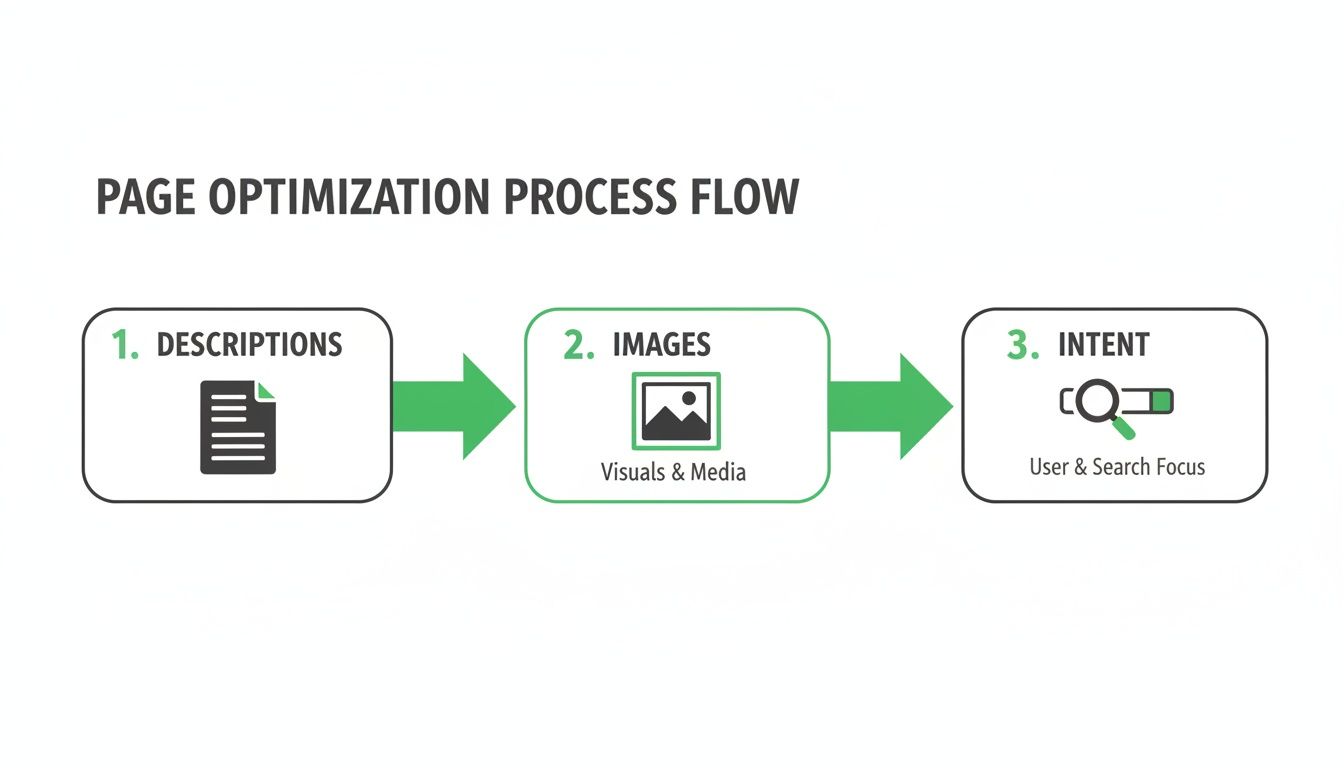
As the graphic shows, great page optimisation is a balancing act between compelling copy, engaging visuals, and a laser focus on what the user actually wants.
Writing Product Descriptions That Sell
Far too many online shops just copy and paste the generic, manufacturer-supplied descriptions. This is a massive missed opportunity. Writing unique descriptions not only sidesteps duplicate content penalties but also gives you a chance to tell a story that truly connects with your ideal buyer.
Shift your focus from features to benefits. Don't just state that a backpack is "made from water-resistant nylon." Instead, paint a picture: explain how it "keeps your laptop safe and dry during an unexpected downpour." This benefit-driven approach directly answers the customer's silent question: "What's in it for me?"
Your product description is your 24/7 salesperson. It needs to be persuasive, easy to scan, and answer every question a customer might have before they even think to ask it.
To make your descriptions pop, use short paragraphs and bullet points for key specs. Throw in some bold text to make the most important benefits stand out. This makes your content scannable for shoppers who are rapidly comparing their options.
Optimising Images for Visual Search
Let's be honest, product images often make or break an online sale. High-quality photos from multiple angles, especially "in-use" shots, build trust and erase doubt. But your work doesn't end with a good photoshoot.
Search engines can't "see" your images like we do. They rely on alt text (alternative text) to make sense of the visuals. Writing descriptive alt text is a simple, yet incredibly powerful, SEO tactic.
So instead of a lazy alt text like "running shoe," get specific: "Men's bright blue Nike Pegasus trail running shoe on a rocky path." This accomplishes two critical things:
- Improves Accessibility: It helps visually impaired users understand what's on the page.
- Boosts Image Search Rankings: It helps your products show up in Google Images, which is a surprisingly large source of e-commerce traffic.
Making Category Pages Rank Higher
Your category pages are absolute powerhouses for attracting broader search traffic. We're talking about terms like "women's summer dresses" or "leather hiking boots." But to get these pages to rank, they need to be more than just a grid of products.
Adding a short, well-crafted introductory paragraph at the top of the page gives crucial context to both search engines and shoppers. This content should briefly explain what the category is all about and maybe offer some helpful buying tips, all while naturally weaving in your target keywords.
For example, on a "Men's Winter Jackets" page, you could add a quick intro discussing different types of insulation or waterproofing. Suddenly, a simple product list becomes a helpful resource, boosting its authority and ranking potential. When you enrich these pages with useful information, including details enhanced with schema markup, you create a better user experience that search engines are bound to reward. You can learn more about using structured data in our guide on how to properly implement schema markup.
How to Scale Content with Programmatic SEO and AI

Manually creating a unique, helpful page for every single product or service combination is impossible for most online stores. This is where programmatic SEO (pSEO), powered by AI, changes the game. It allows you to create hundreds or thousands of high-quality pages automatically.
Think of it like a smart mail merge for your website. You combine a list of data (like product features or locations) with a page template. AI then writes unique, helpful content for every single combination. This strategy lets you target thousands of very specific, "ready-to-buy" search queries you could never reach by hand, like "waterproof hiking boots for men in Colorado" or "organic cotton t-shirts for toddlers with sensitive skin."
Your Practical Guide to Implementing Programmatic SEO with AI
Don't let the name intimidate you. The process is straightforward and can be broken down into three simple, practical steps. Let's walk through how an online store selling running shoes could do it.
Step 1: Gather Your Data (The Ingredients)
First, collect all the key details about your products. This is the information that makes each product unique. Put it all into a simple spreadsheet (like Google Sheets or Excel). Each column is a different feature.
For our running shoe store, the spreadsheet columns would be:
Shoe Model(e.g., Cloud Stratus 3)Best For(e.g., long-distance running)Surface(e.g., road, trail)Foot Type(e.g., flat feet, high arches)
Step 2: Create a Page Template (The Recipe)
Next, design a single "master page" that will serve as the blueprint for all the pages you'll create. This template will have static text that stays the same on every page (like your brand message) and dynamic placeholders that will be filled in with data from your spreadsheet.
The placeholders look like this: [Column Name].
- Page Title:
The Best Running Shoe for [Foot Type]: [Shoe Model] - Headline (H1):
Why the [Shoe Model] is Perfect for [Surface] Runners with [Foot Type] - Intro Paragraph: "Finding the right shoe for
[long-distance running]can be a challenge, especially if you have[flat feet]. The[Cloud Stratus 3]is engineered to provide the support and cushioning you need on the[road]."
Step 3: Generate Content with AI (The Chef)
This is where the magic happens. Instead of just plugging in data, you use an AI tool (like ChatGPT or a specialized pSEO platform) to write unique content for each row in your spreadsheet. You give the AI a "prompt" or instruction, telling it exactly what to write using the placeholders.
Here's a sample AI prompt for our shoe store:
"Write a 200-word product description for the
[Shoe Model]. Explain why it is the ideal choice for runners with[Foot Type]who do[Best For]on[Surface]. Focus on the benefits of comfort and injury prevention. Use a friendly and encouraging tone."
The AI will then create a unique, natural-sounding description for every single shoe and foot type combination in your spreadsheet. Repeat this process for different sections of your page, like FAQs or key features. Once done, you use a tool or plugin to automatically publish all these new, unique pages to your website.
The goal of programmatic SEO isn't to create spammy, thin pages. It's to create thousands of genuinely useful pages that perfectly match a very specific search. Each page should feel like it was written by hand for that one specific customer.
This approach transforms your existing product data into a powerful engine for attracting highly qualified traffic.
This kind of strategic content scaling is becoming essential. For instance, a recent analysis of German e-commerce stores uncovered a critical challenge: despite strong technical foundations, with an average Google Lighthouse SEO score of 93.89 out of 100, these stores saw a 20.5% decline in organic search traffic. It’s a stark reminder that technical excellence alone isn’t enough; you need a robust content strategy to turn visibility into actual traffic.
By automating this process, you create hyper-relevant pages that precisely match specific customer needs. If you want to dive deeper, our guide on automating your content creation offers more insights into the tools and workflows. This method turns your existing product data into a powerful asset for driving targeted organic traffic.
Building Authority with Links and Content Marketing
A solid e-commerce SEO strategy doesn’t stop at your own website; it’s about building a rock-solid reputation across the web. Think of it this way: in Google's eyes, links from other reputable websites are like votes of confidence. Each one signals that your store is a credible, authoritative source, which directly helps you rank higher.
This whole process, often called link building, isn't about just grabbing as many links as you can. Today, effective link building is the natural result of excellent content marketing. The real goal is to create stuff so genuinely useful that other people—journalists, bloggers, and industry experts—actually want to share it and link back to you.
Create Link-Worthy Content Assets
The secret to earning high-quality backlinks is creating content that does more than just sell. Your product pages are there to convert customers, sure, but your content marketing assets are what attract links and build your authority.
Put yourself in your audience's shoes. What would be genuinely helpful for them or interesting enough for an industry publication to pick up?
Here are a few ideas that just plain work:
- In-Depth Buying Guides: Go all out and create the definitive guide for choosing a product in your niche. If you sell coffee gear, an "Ultimate Guide to Choosing Your First Espresso Machine" is the kind of resource people will reference for years.
- Interactive Tools: Build a simple calculator or quiz that solves a real problem. A skincare brand could create a "Personalised Skincare Routine Builder" that suggests products based on a user's answers.
- Original Research or Data: Package industry data into a report that tells a story. A fashion retailer could analyse search trends to release a "Top 10 Sustainable Fashion Trends for 2025" report. Journalists love citing fresh data.
When your content becomes a go-to resource, links follow naturally. You stop chasing links and start attracting them because you've created something truly valuable for the community.
These assets give other websites a compelling reason to link to you. You’re no longer just a seller; you’re a helpful expert.
Build Relationships with Influencers and Media
Once you've created a genuinely valuable piece of content, the next step is getting it in front of the right people. This is where a bit of strategic outreach comes in. Find the bloggers, journalists, and influencers who cover your niche and have an audience that would actually benefit from what you’ve made.
The key here is to build real relationships, not just blast out spammy emails. Start by engaging with their work, sharing their articles, and leaving thoughtful comments. By the time you reach out, it’s a warm introduction, not a cold pitch. Frame your request around how your guide or tool could bring value to their specific audience. To really get this right, it's essential to understand and implement powerful SEO link building strategies that deliver actual results.
For e-commerce stores, product roundups are a golden opportunity. Connect with influencers and offer them a product to review for an upcoming "Best Of" list. This move is brilliant because it not only earns a relevant backlink but also drives warm referral traffic from a source people already trust. We cover how links act as trust signals in more detail in our guide on understanding backlinks in SEO.
Why Organic Authority Matters More Than Ever
Investing in building authority through content and links isn't just a "nice-to-have" anymore—it’s a strategic must. The world of digital advertising is getting incredibly crowded and eye-wateringly expensive.
Just look at Germany, where search engine advertising is the top digital marketing channel. The economics are shifting dramatically. In a recent study, German e-commerce stores saw their Google Paid Traffic drop by a massive 48% in 2025, while their ad costs skyrocketed by an unbelievable 1,767.1%.
These numbers paint a clear picture: relying only on paid ads is not a sustainable path for long-term growth. As the cost of buying attention goes up, a strong organic presence built on genuine authority becomes your most reliable—and cost-effective—engine for growth.
How to Measure Your E-commerce SEO Success
Putting time and money into SEO for e-commerce is a complete waste if you can't tell whether it's actually working. Real success isn't about chasing vanity metrics like a bigger traffic number; it’s about connecting your SEO efforts directly to business growth.
You can't improve what you don't measure. The goal is to shift from just seeing more visitors to understanding how many of them are pulling out their wallets. That means zeroing in on the metrics that tell the real story of your return on investment.
Key Metrics That Actually Matter
To get a clear picture of your SEO performance, you need to look at the data that reflects actual business results. You can gather all the insights you need—without spending a penny—using free tools like Google Search Console and Google Analytics 4.
Here are the essential KPIs every e-commerce store owner should be obsessed with:
- Organic Revenue: This is the big one. It shows you exactly how much money your organic search traffic is generating. No ambiguity, just pure financial impact.
- Organic Conversion Rate: This tells you the percentage of visitors from search engines who actually make a purchase. A high conversion rate is a sign that your SEO is attracting qualified, ready-to-buy shoppers, not just window-shoppers.
- Keyword Rankings for Commercial Terms: Are you moving up the rankings for high-intent keywords like "buy men's leather boots"? Tracking your position for these money-making terms shows if you're gaining visibility where it counts.
The ultimate test of your e-commerce SEO strategy is its ability to generate profitable growth. If your organic revenue is climbing, you're on the right track.
Finding Actionable Insights in Your Data
Once you start tracking these KPIs, you can begin asking the right questions to sharpen your strategy. Your analytics aren't just numbers; they're the roadmap for what to do next.
For instance, you can dive into your data to figure out:
- Which product categories are bringing in the most organic sales? This tells you exactly where to double down.
- Are those pages you built with programmatic SEO driving traffic that converts? This is how you validate your scaling efforts.
- Which blog posts or buying guides are actually contributing to your bottom line? This will shape your future content plans.
This focus on measurement is especially critical in large and growing markets. Take Germany, for example, where e-commerce revenue reached $107.85 billion in 2025 and is projected to hit $142.04 billion by 2029. With market penetration expected to reach 70.61% of the population, organic visibility becomes a primary battlefield for capturing market share. Discover more insights about the German e-commerce market on awisee.com.
By tying your SEO activities to tangible outcomes like revenue and conversions, you transform SEO from a marketing expense into a predictable and powerful growth engine for your online store.
Frequently Asked Questions
How Long Does E-commerce SEO Take to Show Results?
Let's be realistic: SEO is a marathon, not a sprint. While you might spot minor upticks from small technical fixes within a few weeks, the real, meaningful growth in organic traffic and sales typically takes 4 to 6 months to materialise.
This timeline isn't set in stone, of course. It depends on your site's history, how fierce the competition is in your niche, and how consistently you stick to your strategy. Think of it like cultivating a garden – you have to put in the work long before you see the full harvest.
Can I Do SEO for My Shopify Store Myself?
Absolutely. Platforms like Shopify, BigCommerce, and WooCommerce come with solid built-in SEO features and app stores that empower you to handle the fundamentals on your own. This guide gives you the strategic framework you need for the most critical tasks.
As your business grows, you might decide to bring in an expert for advanced link building or huge projects, but you can definitely get the ball rolling yourself.
The core principles of e-commerce SEO apply to any platform. The key is understanding the strategy behind the tools and applying it consistently.
Is Programmatic SEO Considered Spam by Google?
No, not when it's done right. Google penalises low-quality, auto-generated fluff that offers zero value to the user.
High-quality programmatic SEO is the exact opposite. It uses data to create highly specific and genuinely useful pages at scale. The goal isn't just to make pages, but to perfectly answer a user's very specific search query—a mission that aligns perfectly with what Google wants to do. Your focus must always be on user value, not just page count.
Ready to scale your content and master the strategies that drive real organic growth? At Programmatic SEO Hub, we provide the educational resources, tools, and frameworks you need to succeed. Explore our guides and start building your future-proof SEO strategy today at https://programmatic-seo-hub.com/en.
Related Articles
Mobile friendly test google: A Practical Guide to Master Mobile SEO
Even though Google’s standalone Mobile-Friendly Test tool is a thing of the past, the principle behind it is more critical than ever. The simple truth is that Google now overwhelmingly uses its...
A Practical Guide to Competitive Analysis Keywords
When we talk about competitive analysis keywords, we're really talking about the search terms that are already making money for your rivals. By digging into these, you uncover their entire...
Landing Pages SEO A Practical Guide to Rank and Convert
When we talk about SEO for landing pages, we're not just talking about general website optimisation. We're getting hyper-specific. This is the art of building and refining standalone pages...