Grow with seo for content marketing: A Practical Guide to Scale Your Content
So, what exactly is SEO for content marketing? Think of it as creating and sharing genuinely useful content that attracts people from search engines like Google, with the ultimate goal of turning them into loyal customers.
It’s the art of blending user-focused content with smart technical search optimisation to bring in a steady flow of organic traffic and build real authority. Forget seeing them as separate jobs; they are two sides of the same coin.
Marrying SEO and Content for Modern Search

For far too long, content marketing and SEO have been stuck in different departments. A team would write an article, then toss it over to an SEO expert to "sprinkle in some keywords." That whole approach is a recipe for failure in today's much smarter search landscape.
The hard truth? Content created without SEO from the very start is practically invisible.
This isn't just a hunch; the data tells a pretty blunt story. With European SEO markets projected to surge from $19.02 billion in 2025 to a massive $43.66 billion by 2034, German brands are doubling down on intent-led content. This is a direct response to the brutal reality that 90.63% of web pages get zero organic traffic from Google. That number alone shows just how fierce the competition is in the DACH region and beyond.
Even though organic search still drives a whopping 46.98% of all web traffic, simply hitting 'publish' isn't nearly enough to claim your slice of the pie. You can get more details on the latest trends from these content marketing statistics.
A New Mindset for Content Success
To actually get results, we need a complete shift in perspective. Modern SEO for content marketing isn't about tweaking individual articles after they’re written. It's about building a systematic engine that serves what users are looking for, at scale.
Imagine you're building a library. You wouldn't just throw books on shelves randomly, would you? No, you'd want every single book to be exactly what a visitor needs, perfectly categorised, and dead simple to find. That's the goal here.
When you get this synergy right, the benefits are huge:
- Sustainable Growth: You stop relying on the expensive rollercoaster of paid ads and build a consistent, predictable stream of organic visitors.
- Builds Authority: When you consistently answer your audience's questions, you become the go-to, trusted resource in your field.
- Future-Proofs Your Strategy: This integrated approach gets your content ready for what's next in search, from AI Overviews to conversational queries.
Practical Tools, Not Just Buzzwords
Throughout this guide, we're going to break down exactly how to build this engine. We’ll focus on practical, actionable methods like programmatic SEO, which lets you create hundreds of high-quality, targeted pages from a single template.
This isn’t about spammy, low-effort automation.
It’s about using data and AI as powerful assistants to make your content both search-friendly and genuinely valuable to your audience. This systematic approach ensures every piece of content you produce has a clear purpose and a direct path to being discovered.
Decoding Your Audience and Their Search Intent
Before you even think about writing a single word, you have to know who you're writing for. It’s the most critical first step in blending SEO with content marketing.
Imagine you're a helpful shopkeeper. You wouldn't just start recommending products without first listening to what a customer actually needs, right? The same logic applies here. Creating content without this deep understanding is like shouting into a void. So, a foundational step is learning how to find your target audience and getting to grips with what they truly need. This isn't about guesswork; it's about uncovering the real problems and questions your audience is typing into search engines.
The Three Flavours of Search Intent
Every time someone types a phrase into Google, they have a goal in mind. We call this search intent. If you can understand that goal, you can create content that gives them exactly what they want, making you the most helpful result on the page.
There are three primary types of intent you need to master:
- Informational Intent: The user wants to learn something. They're looking for answers, explanations, or how-to guides. A search like "how to fix a leaky tap" is a crystal-clear signal that they need a step-by-step tutorial.
- Navigational Intent: The user already knows where they want to go and is just using the search engine as a shortcut. Someone searching for "Programmatic SEO Hub blog" isn't looking for alternatives; they just want a direct path to our content.
- Transactional Intent: The user is ready to buy something or take a specific action. Searches like "buy noise-cancelling headphones" or "best project management software deals" tell you they're at the very end of their buying journey.
By aligning your content with one of these intents, you ensure it serves a clear purpose, which is a massive factor in how search engines rank pages. If you want to dive deeper, check out our detailed guide on understanding search intent for SEO.
Uncovering What Your Audience Really Wants
So, how do you find these all-important questions and problems? You don't need a bunch of expensive tools to get started. The answers are often hiding in plain sight, on the very platforms your audience uses every single day.
The goal is to move beyond a simple list of keywords and build a content roadmap based on genuine user needs. This ensures that every piece of content you create has a clear purpose and a built-in audience waiting for it.
Start exploring these free resources:
- Google's 'People Also Ask' (PAA) Box: Type a broad topic into Google and look at the questions that pop up. This is a goldmine of related queries and long-tail keyword ideas, coming straight from real users.
- Forums like Reddit and Quora: Search for subreddits or topics related to your industry. Pay close attention to the language people use, the frustrations they describe, and the solutions they're looking for. This is unfiltered, authentic customer research.
This foundational work is more important than ever. Europe's content marketing market is expected to hit €229.293 billion in 2025, with Germany leading the charge at 22.90%. Yet, a staggering 74% of keywords get ten or fewer searches per month, which points to a massive opportunity in those niche, long-tail topics.
And with Gartner forecasting that 25% of search volume will shift to AI agents by 2026, this granular understanding of conversational queries becomes even more critical for success.
Building Your Content Engine with Programmatic SEO
Alright, you've figured out who your audience is and what they're searching for. Now, how do you actually create enough content to meet all that demand without hiring an army of writers?
This is where we roll up our sleeves and get into programmatic SEO (pSEO). It’s a seriously powerful way to generate hundreds—or even thousands—of highly targeted pages from a single, smart template.
And don't worry, this isn't some black-hat trick or overly technical nightmare. The idea behind it is refreshingly simple and incredibly effective when you do it right.
Think of it like sending out wedding invitations. You wouldn't handwrite 500 unique invitations from scratch, would you? Of course not. You’d design one beautiful template, then use your guest list (your data) to automatically populate each one with the right name and details. Programmatic SEO is the exact same principle, but for web pages.
The flow below nails this concept perfectly. It shows how everything starts with solid audience research, which then informs a content roadmap—the ideal launchpad for any pSEO project.
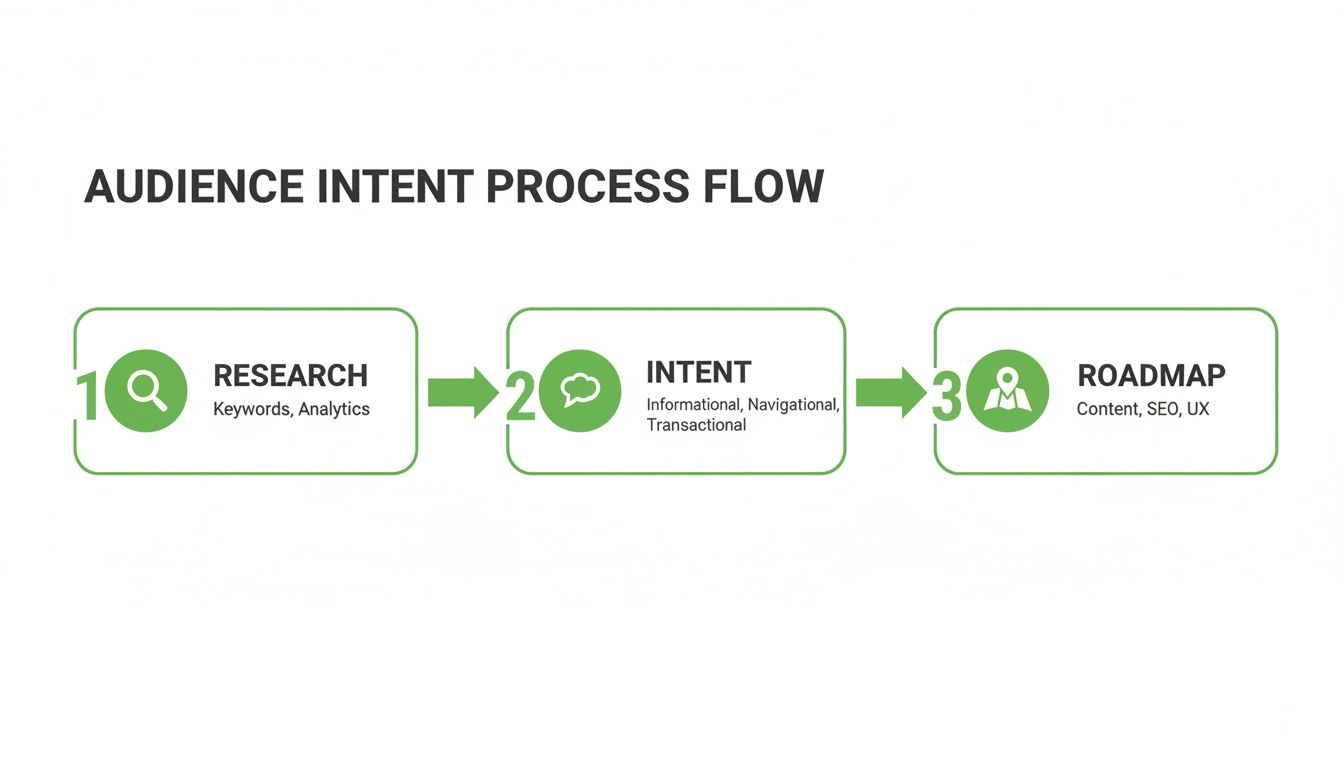
This just goes to show that great pSEO isn't about firing a content shotgun and hoping something hits. It's a structured system built on a real understanding of what your users actually need.
How to Spot Your Programmatic SEO Opportunity
First things first: you need to find patterns in how people are searching for things in your niche. You're hunting for repeatable search queries where only one or two little things change. In SEO-speak, these are often called "head terms" and "modifiers."
You’ve definitely seen these patterns in the wild:
- [Service] in [City]: Like "plumbers in Berlin" or "electricians in Hamburg."
- [Product A] vs [Product B]: Think "iPhone 15 vs Samsung S24."
- Best [Product Type] for [Use Case]: For example, "best running shoes for flat feet."
- [Software] integrations: Such as "Slack integrations" or "Asana integrations."
Once you find a pattern like this with decent, consistent search traffic, you’ve struck gold. You now have a blueprint to build a system that can answer every single variation of that search.
The Power of a Simple Spreadsheet
That "guest list" for your content invitations? It’s just a spreadsheet. This is the heart and soul of your pSEO project, and you absolutely do not need a complicated database to get going. A simple Google Sheet or an Airtable base is more than enough.
Let's stick with the "[Service] in [City]" example. Your spreadsheet would just need columns for each piece of information that makes your pages unique and valuable.
Here’s a practical look at how you might structure that data for your first pSEO project.
Programmatic SEO Project Quick-Start Checklist
| Phase | Action Item | Key Question to Answer |
|---|---|---|
| 1. Ideation | Identify a repeatable search pattern. | What do my users search for where only one variable changes (e.g., location, product, feature)? |
| 2. Data | Gather or create a dataset. | Do I have at least 10-20 rows of unique data to test my concept? |
| 3. Template | Design a basic page template. | What essential information must every page have to be genuinely helpful to a searcher? |
| 4. Validation | Manually create 1-2 example pages. | If I built this page by hand, would it actually be useful and answer the user's question? |
This simple checklist keeps you focused on creating real value, not just pumping out pages for the sake of it.
The magic formula is beautifully simple: one template + one data source = hundreds of unique pages. This shifts content creation from a slow, manual chore into a scalable, repeatable system. It’s an absolute game-changer for capturing all those long-tail keywords that are impossible to target one blog post at a time.
Designing a Killer Content Template
The final piece of the puzzle is the "invitation" itself—your content template. This is just a webpage layout with special placeholders for the data in your spreadsheet. Think of it as a Mad Libs game for your website.
A basic template might look something like this:
- Page Title: The Best [{Service}] in [{City}]
- Introduction: Finding a trustworthy [{Service}] in [{City}] is tough. Here’s what you need to know, from typical costs to local advice.
- Main Content: The average hourly rate for [{Service}] in [{City}] is around [{Average Cost}]. When you call them at [{Contact Number}], don't forget this local tip: [{Unique Tip}].
When your system combines your spreadsheet data with this template, it instantly spits out pages like "The Best Plumbing in Berlin" and "The Best Electrical Services in Hamburg." Each one feels custom-made for a very specific search, delivering genuine value.
If you want to go deeper, you can learn more about the fundamentals of content automation in pSEO. Mastering this is the secret to truly scaling your SEO for content marketing efforts.
How to Power Your Content Engine with AI

You have your repeatable search pattern and a spreadsheet of data. Now it's time to make each page unique and valuable using Artificial Intelligence. This isn’t about hitting a button and having AI write everything for you. It's about using AI smartly to enrich the data you already have.
Think of AI as the ultimate research assistant. Its job is to take your simple data points (like a city name) and add unique, helpful details to them. This makes every page you create much more useful than a basic template ever could be.
The goal is a "human-in-the-loop" system. You guide the strategy and check the final quality, while the AI does the heavy lifting of generating specific pieces of content.
The Practical AI-Powered Workflow
This system is simple and powerful. Instead of you manually writing hundreds of unique tips or descriptions, you let AI generate them based on your data. This saves a huge amount of time and makes every page you publish more distinct and helpful.
Here’s how it works in three simple steps:
- You provide the data: You've already done this by creating your spreadsheet (e.g., a list of cities and services).
- AI enriches the data: You give an AI tool (like ChatGPT or Claude) a clear instruction to create new, unique information for each row in your spreadsheet.
- You are the editor: You review the AI-generated content, checking it for quality and making sure it fits your brand's voice.
This blend of human strategy and machine efficiency is the key to scaling high-quality content. For more advanced setups, exploring different web data use cases for SEO AI pipelines is key to feeding these intelligent systems the right kind of information.
Generating Unique Content with Simple Instructions
The secret to getting great results from AI is learning how to give it clear instructions, known as "prompts."
Let's go back to our "[Service] in [City]" example. Your spreadsheet has columns for Service and City. We want to add a new column called Unique Tip to make each page more valuable. Instead of writing hundreds of these tips yourself, you can use AI.
You’d give the AI a prompt like this for each row:
"I am creating a webpage about finding a {Service} in {City}. Act as a local expert and write a short, helpful tip (max 25 words) for someone hiring this service there. The tone should be friendly and practical. For example, for a plumber in Berlin, you might write: 'Ask if they are familiar with Altbau plumbing, as the old pipes can be tricky.'"
You can then run this prompt for every city in your spreadsheet, instantly generating a unique, localised tip for each page. It's a simple step that adds real value and helps your pages stand out.
Practical AI Tasks for Your Programmatic Project
Beyond generating tips, AI can handle many other small but important tasks, making your programmatic content much richer and more search-friendly.
Here are a few high-impact tasks you can give your AI assistant:
- Writing Meta Descriptions: Craft unique meta descriptions for hundreds of pages in minutes. A good prompt is: "Write a meta description under 155 characters for a page about finding the best {Service} in {City}. Include a call to action."
- Creating Unique Introductions: Generate varied opening paragraphs to avoid having identical text at the start of every page.
- Generating FAQ Sections: Ask the AI to create 3-5 relevant questions and answers based on the page's main topic (e.g., "FAQs about hiring electricians in Hamburg").
- Structuring Data for Schema Markup: Tell the AI to format your information into structured data (like JSON-LD) for things like a LocalBusiness or an FAQPage. This can help you earn more visible results in Google Search.
This AI-driven approach is quickly becoming the norm. In Germany, AI-generated content now appears in 17.3% of the top-20 Google results—a huge jump from just 2.3% in 2020. It's no surprise that 67% of marketers there are already using AI and reporting an average 68% return on their investment.
By weaving these techniques into your workflow, you move beyond basic pSEO and start building genuinely helpful resources at an incredible scale. You can also dig deeper into the mechanics by reading our guide on Natural Language Generation for SEO.
Building Authority and Measuring What Truly Matters
Churning out hundreds of pages is just the first lap of the race. For your content engine to actually win, you need to prove its worth—both to search engines and to your balance sheet. This boils down to two critical jobs: building real authority for your new content and measuring the things that actually move the needle.
Just hitting 'publish' isn't enough in the world of SEO for content marketing. Without authority, even the most brilliant content gets buried in the noise.
Building Your Content's Reputation
Search engines like Google need to see that other credible websites trust what you're saying. This trust is mainly demonstrated through backlinks (when other sites link to you) and a rock-solid internal linking structure.
When you use programmatic SEO to create a massive cluster of related pages, you're not just answering a single question—you're building the definitive resource on a topic. This naturally makes your content a magnet for backlinks from others who want to reference a truly comprehensive guide.
But you can't just wait for others to notice. You have to signal the importance of these new pages to Google yourself. That's where internal linking becomes your superpower.
- Link from your heavy hitters: Go find your strongest, most authoritative blog posts and add links from them to your new programmatic content cluster.
- Create a hub page: Build a central pillar page that acts as a table of contents, summarising the topic and linking out to all the individual pages you've generated.
- Interlink within the cluster: Make sure your new pages point to each other wherever it’s relevant. This shows search engines how they're all connected and helps spread authority across the entire topic.
This kind of organised structure is fundamental to establishing expertise. You can dive deeper into this concept in our guide on how to build topical authority.
Measuring Real Business Impact
It’s incredibly easy to get distracted by flashy numbers that feel good but mean nothing for your bottom line. To properly measure your content's success, you have to look past these "vanity metrics" and zero in on KPIs that show a real business impact.
The goal isn't just to get clicks; it's to attract the right kind of traffic. You want visitors who are likely to become customers, and that means tracking metrics that tie your content directly to business outcomes.
To help you focus on what's important, let's compare the metrics that just look good with the ones that actually tell you something useful.
Choosing Your Key Performance Indicators (KPIs)
| Metric Type | Example | Why It Matters (or Doesn't) |
|---|---|---|
| Vanity Metric | Total Page Views | This can be easily inflated by irrelevant traffic. It doesn't tell you if the right people are engaging or if your content is driving results. |
| Actionable Metric | Organic Traffic to a Content Cluster | This shows that a specific group of pages, built for a specific audience, is successfully pulling in visitors from search engines. |
| Vanity Metric | Social Media Likes | While it's nice to see engagement, likes rarely have any correlation with meaningful business goals like leads or sales from organic search. |
| Actionable Metric | Keyword Ranking Improvements | Tracking your target keywords shows that you're gaining visibility for the exact phrases your potential customers are searching for. It's direct feedback. |
| Vanity Metric | Bounce Rate | A high bounce rate isn't automatically bad. A visitor might land, get their answer instantly, and leave happy—a great signal for Google! |
| Actionable Metric | Conversions from Organic Traffic | This is the ultimate proof. Tracking how many visitors from search complete a goal (like signing up for a demo or buying something) shows direct ROI. |
Focusing on actionable metrics allows you to understand the true performance of your content and make smarter decisions about what to do next.
You don't need a complicated, expensive toolkit to get started. A free tool like Google Search Console is the perfect place to begin. It shows you exactly which pages are bringing in organic traffic, what keywords they’re ranking for, and how many clicks you’re getting. When you connect that data to your business goals, you can finally see the real-world impact of your content marketing.
Your Simple Toolkit and Go-Live Checklist
Alright, let's pull all this theory together and make it real. Knowing the what and why is one thing, but turning that knowledge into clicks, traffic, and actual business growth is what really matters. This is your game plan—a simple toolkit and a go-live checklist to get your first SEO-driven content project out the door.
Think of this as the final blueprint before you start building. It’s designed to cut through any last-minute hesitation and give you a clear path forward.
Your Budget-Friendly Starter Toolkit
You really don't need a huge budget to kick things off. Plenty of fantastic tools have free or very affordable plans that are more than enough to get your seo for content marketing engine running.
- Keyword & Idea Research: Jump into Google Keyword Planner (it’s free with a Google account) for search volumes and use AnswerThePublic to see the exact questions people are typing into search engines.
- Data Organisation: A simple Google Sheet or a free account on Airtable is all you need to structure the data for your first programmatic project. Seriously, that's it.
- AI Content Generation: The free version of ChatGPT or Claude is perfect for generating unique content snippets, meta descriptions, and those all-important FAQs for your templates.
- Performance Tracking: Google Search Console is non-negotiable. It’s free and tells you exactly what’s working, showing you which keywords are driving traffic and which pages are hitting the mark.
This minimalist toolkit is proof you can get big results without splashing out on expensive software. What really counts isn't the cost of your tools, but the smarts behind your strategy and your consistency in executing it.
Your Pre-Launch Go-Live Checklist
Before you hit "publish" on that first batch of programmatically generated pages, just run through this final checklist. It’s a simple safety net to make sure you’ve nailed all the essentials for a smooth launch.
Is Your Data Clean and Accurate? Give your spreadsheet one last look. Check for typos, weird inconsistencies, or missing info. Clean data is the bedrock of quality content.
Is Your Template Genuinely Helpful? Take a moment to manually review a few generated page previews. Does the page actually solve a problem for the user? Is it providing real value?
Have You Set Up Internal Links? You need a plan to link to your new content cluster from existing, relevant pages on your site. This is how you tell search engines these new pages are important and help them get discovered faster.
Is Performance Tracking in Place? Make sure Google Search Console is properly set up for your domain. You can’t improve what you don’t measure.
Do You Have a Quality Review Process? Before everything goes live, spot-check a random sample of pages. This human touch is crucial for catching odd mistakes and keeping your quality high.
Once you’ve ticked these boxes, you’re good to go. If you want a more detailed, step-by-step guide, check out our piece on how to launch your first pSEO project. Think of this checklist as your starting line for turning systematic content into sustainable organic growth.
Got Questions? We've Got Answers
Diving into content marketing with SEO, especially when you start throwing around terms like "programmatic" and "AI," can feel a bit daunting. Let's clear up some of the most common questions that pop up.
The goal here is to show you that these strategies aren't some dark art. They're accessible, incredibly effective, and you can absolutely get started with them.
Is Programmatic SEO Just Spam in Google’s Eyes?
Not at all. The idea that programmatic SEO is spam comes from a misunderstanding of what it is. Google penalises low-effort, auto-generated junk that offers zero value. A smart pSEO strategy is the complete opposite of that.
You're using data and templates to create thousands of genuinely useful and unique pages that answer very specific questions. The whole thing hinges on the quality of your data and the thoughtfulness of your template. If each page you generate actually helps someone, it's not just legitimate—it's brilliant SEO.
How Much of a Tech Whiz Do I Need to Be?
You’d be surprised. You can get a programmatic project off the ground with very little technical expertise. Thanks to modern no-code tools, a simple spreadsheet in Google Sheets or a database in Airtable is often all you need to get started.
Sure, a developer is handy for massive, complex projects, but a beginner can see fantastic results just by focusing on a clean data structure and a well-designed content template. In fact, this whole guide is built for the non-technical marketer.
Can I Just Get AI to Write the Whole Article for Me?
You could, but you probably shouldn't. The most powerful way to use AI right now is with a "human-in-the-loop" approach. Think of it as your super-powered assistant, not your replacement.
Use AI to handle the grunt work: brainstorming, structuring data, or drafting specific sections like meta descriptions or product comparisons at scale. But your strategic oversight, editing, and fact-checking are what guarantee quality, accuracy, and a consistent brand voice. It's the human touch that makes it great.
How Long Until I Actually See Results?
Patience is a virtue in SEO. This is a long-term play, not a get-rich-quick scheme. Some of your newly published pages might get picked up and ranked surprisingly fast, but it generally takes a good 3-6 months to see a meaningful lift in organic traffic from a new programmatic project.
Consistency is your best friend here. Keep publishing high-quality content, build out your internal links, and earn some backlinks along the way. Do that, and you'll build a sustainable engine for organic growth that will pay off for years to come.
Ready to build your own content engine? At Programmatic SEO Hub, we provide the guides, templates, and tools you need to master scalable content strategies and future-proof your growth. Start learning for free today.
Related Articles
Mobile friendly test google: A Practical Guide to Master Mobile SEO
Even though Google’s standalone Mobile-Friendly Test tool is a thing of the past, the principle behind it is more critical than ever. The simple truth is that Google now overwhelmingly uses its...
A Practical Guide to Competitive Analysis Keywords
When we talk about competitive analysis keywords, we're really talking about the search terms that are already making money for your rivals. By digging into these, you uncover their entire...
Landing Pages SEO A Practical Guide to Rank and Convert
When we talk about SEO for landing pages, we're not just talking about general website optimisation. We're getting hyper-specific. This is the art of building and refining standalone pages...