A Modern Guide to AI-Powered SEO Content Marketing
At its heart, SEO content marketing is all about becoming the best, most helpful answer to the questions your ideal customers are typing into Google. It's the art of creating and sharing genuinely useful content that pulls in the right audience, builds trust, and naturally climbs the search rankings.
What SEO Content Marketing Looks Like in the Age of AI

Think of SEO content marketing as the bridge connecting what people need to know with what your business does best. Instead of a hard sell, you’re creating articles, in-depth guides, and practical resources that solve real-world problems. When someone searches for a solution, your content shows up, positioning your brand as the go-to expert.
This isn’t a one-off trick; it’s a powerful, self-sustaining cycle. Great content earns top spots on Google, which drives a steady stream of organic traffic to your site. This constant flow of genuinely interested visitors becomes a growth engine that doesn’t depend on a constant ad spend.
Why It Matters Now More Than Ever
Not too long ago, SEO felt like a technical checklist of keywords and backlinks. That game is over. Today, it’s all about creating real value. Search engines have gotten incredibly smart, and they now prioritise content that actually satisfies a person's query.
This is where AI becomes an incredible co-pilot, not a replacement for human skill. AI tools can help us analyse search behaviour at a massive scale, spot content gaps in the market, and even get a first draft on the page. But the strategy—and the final product—still relies on human expertise to deliver content that’s accurate, insightful, and truly trustworthy. The aim isn't just to rank; it’s to become the definitive answer.
SEO content marketing is no longer just about being found. It’s about being chosen—by people and by the AI systems guiding them—as the most authoritative and helpful resource.
The data backs this up. In the German market, for example, a massive 68% of all online journeys kick off with a search engine. If you’re not visible there, you’re missing the starting gun.
The Core Pillars of Modern SEO Content Marketing
Before diving into tactics, it's essential to understand the foundation. A successful SEO content marketing strategy stands on three core pillars that work in tandem to attract, engage, and convert your audience. Getting these right is the first step toward building a content machine that consistently delivers results.
Here’s a simple breakdown of what each pillar involves and why it’s so critical.
| Pillar | What It Means in Simple Terms | Why It's Critical for Success |
|---|---|---|
| Audience Insight | Going beyond keywords to truly understand the questions, pain points, and goals of your target customers. | You can't be the best answer if you don't know the real question being asked. |
| High-Value Content | Creating well-researched, engaging, and genuinely useful content that directly addresses those customer needs. | This is what builds trust, establishes authority, and makes people (and Google) come back for more. |
| Technical Optimisation | Making sure search engines can easily find, understand, and index your content so it appears to the right people. | The greatest content in the world is useless if no one can find it. This ensures your hard work gets seen. |
Mastering these three areas creates a powerful feedback loop. Deep audience insight fuels the creation of high-value content, which, when technically optimised, gets discovered by more of your audience.
As search continues to evolve with AI-driven features like Google's AI Overviews, the need for well-structured, authoritative content is only going to intensify. To get ahead of the curve, it’s worth understanding the principles behind Generative Engine Optimisation.
Building Your Strategy Around User Intent
To create content that actually gets results, you have to get inside your customer's head and understand the why behind their search. This is what we call user intent, and it's the absolute cornerstone of any effective SEO content plan. It’s the difference between a casual question and a credit card waiting to be used.
Think of it like this: if you run a plumbing service, someone searching "how to fix a leaky faucet" is in a completely different headspace than someone searching "plumbers near me now." The first person wants information; the second needs immediate, professional help. Your content strategy has to serve both, but with entirely different approaches.
Ignoring intent is like trying to sell a new boiler to someone who just wants to know how to relight their pilot light. It's a total mismatch. When you align your content with intent, you give the right answer at the perfect moment, building trust and naturally guiding people towards your solution.
The Four Main Types of Search Intent
Pretty much every search query can be bucketed into one of four categories. Getting a handle on these is how you start to organise your content ideas and map them directly to what a user actually needs.
Informational Intent: The user is hunting for an answer. They want to learn something. These are all your "how," "what," "why," and "best way to" questions. Think "what is SEO content marketing?" or "how to clean white trainers."
Navigational Intent: The user knows exactly where they want to go and is just using the search engine as a shortcut. It's like searching "LinkedIn login" instead of typing the full URL.
Transactional Intent: This is the money-maker. The user is ready to pull the trigger and make a purchase or take a specific action. Their searches are direct and product-focused, like "buy Nike Air Max" or "sign up for a free trial."
Commercial Investigation: The user is on the brink of buying but is doing their final homework. They're comparing options, looking for reviews, and trying to make the smartest choice. Searches here look like "best SEO tools" or "Outrank vs SurferSEO."
To really nail this, check out our complete guide on search intent mapping for some more advanced techniques.
From Keywords to Topic Clusters
Once you've got a grip on intent, you can graduate from chasing individual keywords and start thinking in topic clusters. This is a much smarter, more organised way to build your content strategy.
A topic cluster is simple: it has one big "pillar page" and several smaller "cluster pages" that all link back to it.
Pillar Page: This is your comprehensive, deep-dive guide on a broad topic (e.g., "The Ultimate Guide to Digital Marketing"). It targets a general, high-volume keyword.
Cluster Pages: These are more focused articles that explore specific sub-topics in greater detail (e.g., "How to Build a Social Media Calendar" or "Email Marketing Best Practices"). They target more niche, long-tail keywords.
This structure is powerful for two main reasons. First, it creates an amazing user experience, making it dead simple for visitors to find everything they need on a subject without leaving your site. Second, it screams authority to search engines. By logically interlinking all this related content, you're telling Google that you're the expert on this topic.
When you map keywords to intent and then organise them into clusters, you're not just writing random articles anymore. You're building a strategic, interconnected library of resources where every single piece has a clear purpose. It's a system that both users and search engines love.
Using AI for Programmatic SEO to Unlock Scale
Imagine you run a pet grooming service and want to attract customers from every single town in your region. Creating a unique, helpful page for "dog groomers in Springfield," another for "dog groomers in Shelbyville," and another for every other town would take months of boring, manual work. This is exactly where programmatic SEO, especially when supercharged with AI, completely changes the game.
Think of programmatic SEO (pSEO) as a clever "mail merge" for your website. You design one master page template, connect it to a simple database (like a spreadsheet), and the system automatically generates hundreds or even thousands of unique, highly targeted pages from your data. It's the ultimate way to scale your seo content marketing without having to write every single page by hand.
This isn't about churning out low-quality, spammy content. It’s about meeting incredibly specific user needs on a massive scale. When someone searches for something very precise, like "poodle grooming services near Springfield Park," you can have a page waiting for them.
The diagram below shows how different user needs—or intents—can be targeted with specific types of content. This is a core principle that programmatic SEO helps you execute at scale.
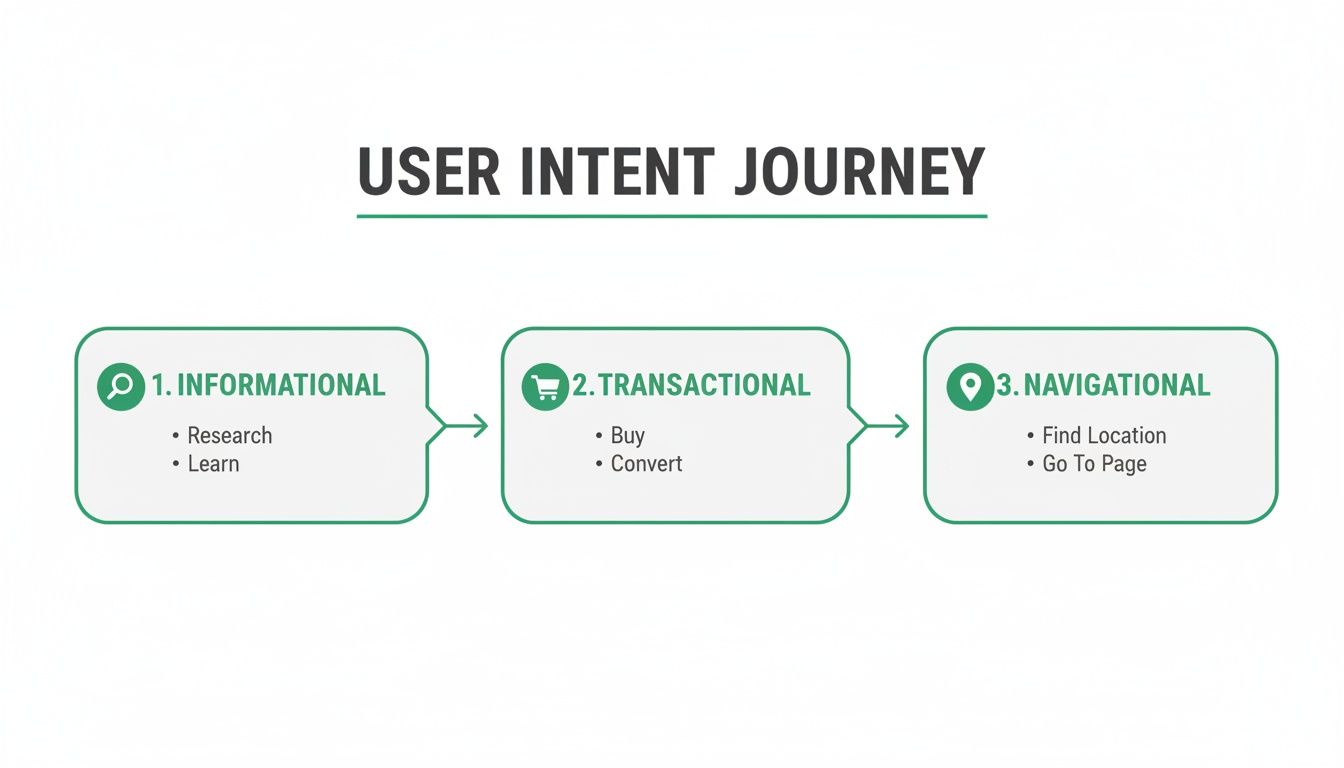
As you can see, understanding whether a user is just looking for information, is ready to buy, or is trying to find a specific location allows you to create perfectly tailored content for each stage of their journey.
A Practical Walkthrough: Your First AI-Powered pSEO Project
Let's demystify this with a simple, step-by-step example. We'll build out location-specific service pages for our fictional pet grooming company. No coding required.
Step 1: Build Your Database (Your Spreadsheet)
This is the foundation of your entire project. Don't worry, it's just a spreadsheet. Google Sheets or Excel will work perfectly.
- Start by creating columns for your variables—the bits of information that change for each page. For our grooming company, this might look like:
TownName(e.g., Springfield, Shelbyville, Ogdenville)FamousLandmark(e.g., the Monorail, the Lemon Tree, the Tire Fire)LocalContact(e.g., "Jane Doe at 555-1234")StartingPrice(e.g., "from €45")
Step 2: Design Your Master Template
Next, you’ll create a single page layout that acts as the blueprint for all your generated pages. This template will use placeholders (like [TownName]) that match up with your spreadsheet columns.
- Your page title could be:
Expert Dog Grooming in [TownName] - A sentence in your intro might read:
We offer top-notch grooming services near [FamousLandmark], with packages starting [StartingPrice]. - Your call to action could say:
To book an appointment in [TownName], call [LocalContact] today!
Step 3: Use AI to Generate Unique Content Snippets
This is where AI does the heavy lifting, making each page feel unique and valuable. Instead of just plugging in data, we can use AI to create unique descriptions for each town.
- Add a new column to your spreadsheet called
UniqueDescription. - Go to a tool like ChatGPT and use a simple prompt for each town on your list:
Simple AI Prompt Example: "Write a friendly, 2-sentence description for a dog grooming service in [TownName]. Mention that the town is known for [FamousLandmark]. The tone should be welcoming for local pet owners."
Copy and paste the AI's response into the UniqueDescription column for each town. Now, every page will have a custom, localised paragraph that makes it feel much less robotic.
From Spreadsheet to Live Pages
With your data-filled spreadsheet and your template designed, you need a tool to connect them and publish the pages. This used to be complex, but now there are plenty of user-friendly, no-code solutions.
- For WordPress users: Plugins like WP All Import are great for taking your spreadsheet and automatically creating posts or pages based on your template.
- No-Code platforms: Tools like Webflow can connect directly to data sources like Google Sheets or Airtable to build and publish these pages automatically.
By combining a structured data approach with the creative power of AI, you can move beyond writing one article at a time. You start building an entire ecosystem of content that targets thousands of specific search queries and drives highly qualified traffic. For those ready to go deeper, you can learn more about the specifics of automating your content generation and take your process to the next level.
Future-Proofing Your Content for AI Search Engines
The way people find information is fundamentally changing. With the rise of tools like Google's AI Overviews, search is becoming less about a list of links and more about a direct, conversational answer. Instead of just showing you where to find information, AI-powered search aims to deliver the single best answer right at the top of the page.
This is a massive shift for seo content marketing.
This new reality calls for a new approach: Generative Engine Optimisation (GEO). Put simply, GEO is all about structuring your content so that AI models see it as the most reliable, clear, and authoritative source out there. Your goal is no longer just to rank on a results page, but to be the answer the AI chooses to feature.
Luckily, this doesn't mean you have to tear up your entire strategy. In fact, many of the core principles of good content marketing—clarity, accuracy, and solid organisation—are exactly what these AI engines are looking for. It’s about fine-tuning your tactics to make your content as "AI-friendly" as possible.
Making Your Content Speak AI's Language
To position your content as the go-to source for generative AI, you need to make it incredibly easy for these systems to understand and process. Think of an AI model as a brilliant but very literal researcher. It wants facts, clear structure, and unambiguous data.
Here are a few practical ways to adapt your content right now:
Structure Content in a Q&A Format: Frame your headings and subheadings as direct questions your audience would actually ask. Immediately follow them up with a concise, factual answer. This directly mimics how AI overviews are built, making it dead simple for the AI to extract the key info.
Use Clean Data Formats: AI loves organised data. Whenever you're presenting statistics, comparisons, or features, use clean tables with clear headers. Use bulleted and numbered lists to break down processes or key points. This kind of structured data is far easier for an AI to parse than dense paragraphs of text.
Implement Schema Markup: This is like adding hidden "labels" to your content that only search engines can see. Schema markup explicitly tells Google what your content is about—whether it’s a recipe, a product review, an event, or an FAQ. This removes any guesswork and helps the AI understand the context of your information with absolute certainty.
Why Programmatic SEO Is Perfectly Suited for the AI Era
This is where the power of programmatic SEO really comes into its own. A well-executed programmatic site is already built on the very principles that AI search engines value. Because pSEO relies on structured data and consistent templates, it naturally produces content that is highly organised and easy for machines to interpret.
A programmatic SEO approach doesn't just create pages at scale; it creates a structured knowledge base. This makes your entire website a high-quality dataset that AI models can use to learn from and reference in their answers.
Think about it: each programmatic page is a self-contained, highly specific answer to a long-tail query. When you have thousands of these pages, all neatly organised and internally linked, you’re essentially building the perfect training library for an AI. You're not just optimising one article; you're optimising your entire domain to be an authoritative source.
This structured approach is a huge advantage. While others are scrambling to manually update old blog posts, a site built with programmatic principles is already designed to feed AI systems the clean, reliable information they crave. If you have concerns about AI's impact on content quality, you can learn more about how Google views auto-generated content and how to stay compliant.
By focusing on creating genuinely helpful, well-structured content—whether you do it manually or programmatically—you position yourself to win in this new era of search.
Your Workflow and Tool Stack for Scalable Content

Theory is one thing, but a repeatable system is what actually gets results. If you want to build a true content engine, you need a crystal-clear workflow and the right tools for the job. This is how you turn the big idea of programmatic SEO into a series of simple, manageable steps that take you from raw data to hundreds of published pages.
Let's walk through a practical workflow you can start using right away. By standardising your process, you get rid of the guesswork and create a genuine production line for your seo content marketing. This ensures every single piece of content is built for performance from the ground up.
The Four Stages of a Programmatic SEO Project
Every successful pSEO project I've seen boils down to a core four-step process. To produce and optimise content efficiently, a well-defined content creation workflow is non-negotiable, and this model provides the perfect structure.
- Gather Your Data: This is the foundation. Here, you collect all the unique variables that will make each page different—think city names, product specs, or service types.
- Design Your Template: Next, you create a master blueprint for your pages. This template includes the static content that stays the same across every page, along with placeholders where your variables will go.
- Generate with AI: This is where you use AI prompts to create unique, high-quality snippets of content for your dataset. It's a critical step that adds real context and helps you avoid those dreaded duplicate content penalties.
- Publish and Optimise: Finally, you use a no-code tool or plugin to merge your data with your template, automatically generating all your pages. Once they're live, you start monitoring performance and tweaking as you go.
The real magic of this system isn't just speed; it's consistency. A solid workflow guarantees that every page you generate meets a baseline quality standard for both your users and the search engines.
Choosing Your Tool Stack
You don't need a huge budget to get started here. The beauty of programmatic SEO is its flexibility. You can rig up a perfectly effective system using free, everyday tools and then scale up to more powerful platforms once you've proven the model.
This approach lets you test the waters and generate an initial ROI before you commit to more expensive software. To get a head start on the generation phase, you can grab a ready-to-use AI prompt for creating high-quality page content that works with any AI model.
The right tool stack makes executing this workflow much smoother. Below is a sample setup for your first project, with options for bootstrapping on a budget or jumping straight to a professional-grade solution.
Sample Tool Stack for Your First Programmatic SEO Project
| Workflow Stage | Budget-Friendly Option | Advanced/Professional Option | Key Feature to Look For |
|---|---|---|---|
| Data Collection | Google Sheets | Airtable | Easy data entry and filtering capabilities. |
| Content Generation | ChatGPT (Free Version) | GPT-4 API / Claude | Ability to follow complex instructions and produce varied outputs. |
| Publishing Platform | WordPress + WP All Import | Webflow / Framer | Direct integration with your data source for seamless publishing. |
| Monitoring | Google Search Console | Ahrefs / Semrush | Accurate rank tracking and page indexation reports. |
At the end of the day, the specific tools are less important than the process itself. Start simple, master the workflow, and then upgrade your toolkit as you scale. This methodical approach is the secret to building a content engine that lasts.
How to Measure Content Marketing Success
Look, creating the content is only half the job. Knowing if it’s actually working is what separates the pros from the amateurs and drives real growth. Measuring the success of your SEO content marketing isn't about chasing feel-good numbers like social shares. It’s about drawing a straight line from your content to tangible business results—traffic, leads, and sales.
The great news is you don’t need some ridiculously complex, expensive software to get started. Two incredibly powerful (and free) tools from Google are all you need: Google Analytics 4 and Google Search Console. They give you everything required to measure what matters and prove your return on investment.
Core Metrics for All Content
Whether you've written a single killer blog post or are launching a thousand programmatic pages, a few key performance indicators (KPIs) are non-negotiable. These are the numbers that tell you if people are finding your content in the first place, and if they actually find it valuable when they get there.
You absolutely need to be tracking these essentials:
- Organic Traffic: This is simply the number of people who land on your site from a search engine. In Google Analytics 4, you can drill down to specific pages to see which articles are pulling in the most visitors.
- Keyword Rankings: This shows you exactly where your content pops up in search results for your target phrases. Seeing your rank climb in Google Search Console is the clearest sign your optimisation efforts are paying off.
- Conversions: This is the big one. A conversion is any meaningful action a user takes—signing up for a newsletter, downloading a whitepaper, or, of course, making a purchase. Tracking conversions proves your content isn't just attracting eyeballs; it's attracting customers.
Special KPIs for Programmatic SEO
When you start creating content at scale with programmatic SEO, you need to add a couple of specialist metrics to your dashboard. Because you're dealing with hundreds or even thousands of pages, you have to monitor the overall health of the entire system, not just individual posts.
For programmatic SEO, success isn't just about how one page performs. It's about the health and efficiency of the entire content ecosystem. It’s about how well your system gets pages in front of Google and users, at scale.
Here are the critical metrics to keep a close eye on:
- Indexation Rate: This is the percentage of your generated pages that Google has actually found and added to its search index. You can check this right in Google Search Console's "Pages" report. If this number is low, it’s a red flag—it means you have a technical problem making your content invisible to searchers.
- Percentage of Pages Driving Traffic: Let's be realistic: not every single programmatic page is going to be a smash hit. A healthy target to aim for is having 10-20% of your generated pages bringing in at least some organic traffic. Hitting this benchmark tells you that your overall strategy and data targeting are on the right track.
By tracking both these core and programmatic-specific metrics, you stop guessing and start knowing. You get the data-backed insights needed to tweak your templates, enrich your data, and make smarter decisions that directly grow your business.
Frequently Asked Questions
As you start to explore AI-driven SEO and content marketing, it’s natural for a few questions to come up. Let’s tackle some of the most common ones head-on so you can build your strategy with clarity and confidence.
Can AI Completely Replace Human Content Creators?
No, not even close. Think of AI as an incredibly powerful assistant, not a replacement for human talent. While AI tools are fantastic at generating text, churning through research, and analysing data at a speed we can't match, they’re missing a few key ingredients: genuine expertise, real creativity, and strategic foresight.
The smartest SEO content marketing strategies use AI for the heavy lifting. Let it bang out first drafts for programmatic pages or summarise dense research documents. This frees up your human experts to do what they do best: edit, fact-check, and infuse the content with the unique insights and stories that actually build authority and trust with your audience.
Is Programmatic SEO Just Creating Spam?
Absolutely not—at least, not when it’s done right. The whole point of high-quality programmatic SEO is to answer very specific, long-tail search queries with genuinely useful pages. It's about providing a precise solution to a precise problem, but on a massive scale.
Spam is low-value, irrelevant fluff designed purely to trick search engines. Quality programmatic SEO is the exact opposite. It's a structured system for delivering targeted value to niche audiences. A real estate site with a dedicated page for every single neighbourhood, packed with local data? That’s incredibly helpful, not spam.
How Much Technical Skill Is Needed for Programmatic SEO?
It used to be that you needed to be a developer to even think about this stuff. Not anymore. Today, the barrier to entry has dropped dramatically, thanks to a new wave of no-code tools. If you can handle a spreadsheet and find your way around a modern website builder like Webflow or a WordPress plugin, you already have the core skills.
The whole process has become much more straightforward:
- Organise your data in something like Google Sheets or Airtable.
- Design a page template in your website builder of choice.
- Use a plugin or integration to magically connect your data to your template.
Sure, coding knowledge can help you tackle more complex, custom projects down the line. But you can launch your first pSEO project without writing a single line of code. It’s become far more about smart, strategic thinking than hardcore technical chops.
Ready to stop writing one-off articles and start building a true content engine? The Programmatic SEO Hub provides the templates, workflows, and expert guidance you need to scale your traffic and future-proof your strategy. Explore our free resources and get started today.
Related Articles
Mobile friendly test google: A Practical Guide to Master Mobile SEO
Even though Google’s standalone Mobile-Friendly Test tool is a thing of the past, the principle behind it is more critical than ever. The simple truth is that Google now overwhelmingly uses its...
A Practical Guide to Competitive Analysis Keywords
When we talk about competitive analysis keywords, we're really talking about the search terms that are already making money for your rivals. By digging into these, you uncover their entire...
Landing Pages SEO A Practical Guide to Rank and Convert
When we talk about SEO for landing pages, we're not just talking about general website optimisation. We're getting hyper-specific. This is the art of building and refining standalone pages...