Unlock the Power of SEO and Content for Higher Rankings

Think of your content as the engine that powers your business. It's what drives you forward. But without SEO, that powerful engine is just spinning its wheels. SEO is the navigation system, giving your content direction and making sure it actually reaches its destination.
Without that guidance, even the most brilliant content ends up going nowhere, lost and unable to connect with the very people who need it.
The Unbeatable Partnership of SEO and Content

When you boil it down, the relationship between SEO and content is beautifully simple. Search engines like Google have a single mission: give people the best possible answers to their questions. Your content’s job is to be that best answer.
This isn't about tricking algorithms or stuffing keywords where they don’t belong. It’s a straightforward deal: when a person is looking for a solution, Google scans the web for content that is genuinely helpful, trustworthy, and solves the user's problem.
Thinking Like a Search Engine
To win, you have to start thinking like a search engine, and that means putting your audience first. What problems are they trying to solve? What questions are they typing into that search bar? Your entire content strategy should flow from the answers to these questions.
Every article, every guide, every video you create needs to serve a real purpose for a real person. SEO provides the data that tells you what people need.
"SEO without content marketing is like a body without a soul." – Joe Pulizzi, Founder, Content Marketing Institute
This means SEO isn't an afterthought—a quick checklist you run through before hitting 'publish'. It’s the blueprint. It’s the architectural plan you consult before you even lay the first brick. SEO tells you what topics to cover, which specific questions to answer, and what format will be most useful to your audience.
How Quality Content Fuels SEO
High-quality content is the rocket fuel for your SEO efforts. Without it, all your technical optimisations are just a well-built rocket ship with an empty tank. Here’s how they work together:
- Content gives keywords a home: SEO uncovers the exact phrases your audience uses. Your content provides the natural, valuable context where those terms belong.
- Quality attracts authority: Truly helpful, insightful content is what gets shared and linked to. These backlinks are a huge vote of confidence in Google’s eyes, telling it your site is a credible source and pushing your rankings up.
- It builds trust and expertise: When you consistently publish killer content on a subject, you establish yourself as an authority. To really get a grip on this, our guide on building topical authority breaks down how this directly supercharges your SEO performance.
At the end of the day, Google rewards websites that genuinely help people. By creating content that solves real-world problems and using SEO to ensure it gets found, you create a powerful, self-sustaining loop. Great content earns higher rankings, which drives more traffic. That traffic signals to Google that your content is valuable, which in turn solidifies your top positions. That synergy is the absolute core of any winning online strategy.
Matching Your Content to What People Actually Want
Ever poured your heart and soul into a piece of content, hit publish, and then... crickets? If it’s not getting any traction, the most common culprit is a mismatch with search intent—the real reason someone typed that query into Google in the first place.
Getting this right is what separates page one from page ten. It's about meeting your audience exactly where they are, not where you hope they'll be. Nail the intent, and you create a smooth journey that keeps both your reader and the search engines happy.
Decoding the Four Types of Search Intent
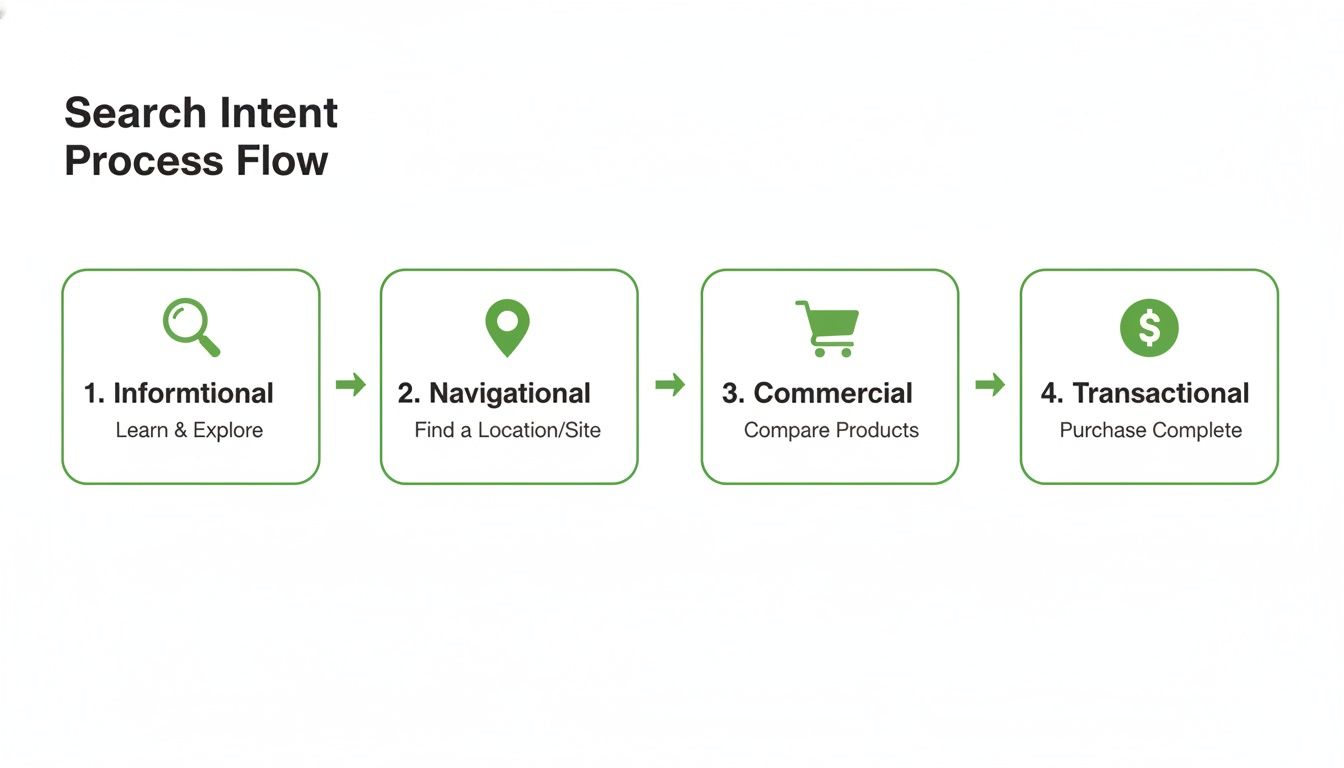
Think of it like a customer walking into a shop. Some are just window shopping, others are comparing two different models, and some are standing at the till with their credit card out. Each one needs a different kind of help from you. In the same way, nearly every Google search falls into one of four main intent categories.
- Informational Intent: The searcher is looking for an answer. Their queries are full of questions like "how to," "what is," or "why does." They are purely in research mode, hunting for clear guides, tutorials, or a quick definition.
- Navigational Intent: The searcher already knows their destination. They're just using Google as a shortcut to a specific website or brand, like typing "YouTube" or "Programmatic SEO Hub blog" instead of the full URL.
- Commercial Intent: The searcher is getting ready to buy, but they're still kicking the tyres. They use keywords like "best," "review," "comparison," or "alternative." Their goal is to weigh their options before making a final decision.
- Transactional Intent: The searcher is ready to act right now. Their queries are direct and include words like "buy," "price," "discount," or a specific product name. They want to land on a product page, see a pricing table, or fill out a sign-up form.
Understanding intent is like listening to what your customer is asking for. If they ask for directions to the shoe department (navigational), you don't start reading them the product manual for a specific pair of trainers (informational).
Giving people the right content for their specific stage isn't just a good idea—it's the foundation of modern SEO.
How to See What Google Already Knows
The best way to figure out the intent behind a keyword is surprisingly straightforward: just Google it yourself. The search engine results page (SERP) is a treasure map showing you exactly what Google’s algorithm has already determined that users want.
Take a look at the top-ranking results for your target keyword. What kind of pages are showing up?
- Are they long, in-depth blog posts and how-to guides? The intent is almost certainly informational.
- Is it the official homepage for a specific brand? That’s a dead giveaway for navigational intent.
- Do you see a bunch of review round-ups and "top 10" lists? This screams commercial intent.
- Are the results flooded with e-commerce product pages? You're looking at transactional intent.
By simply analysing what’s already winning, you get a clear blueprint for the type of content you need to create. Trying to rank a product page for an informational keyword is an uphill battle you'll probably lose, because you're fundamentally not giving the searcher what they're looking for.
To go deeper on this, our guide on search intent mapping provides a practical framework for connecting your keywords to the perfect content format. This strategic alignment is non-negotiable if you want your content to perform.
How to Practically Use AI for Programmatic SEO
Imagine creating hundreds of targeted, high-quality pages without needing a massive content team. This isn't a fantasy; it's the reality of programmatic SEO, and AI has made it easier than ever for anyone to get started.
Don't let the technical-sounding name scare you. At its heart, programmatic SEO is like using a mail merge for web pages. You create one master template and then feed it data—like a list of cities, services, or job titles—to automatically generate unique pages at a massive scale. It's the simplest way to target thousands of specific, low-competition keywords.
Step 1: Find a Repeatable Keyword Pattern
The journey starts by finding a keyword pattern you can repeat over and over. This is the simple formula that will be the foundation for every page you create. Think about how your customers search for what you offer and look for a common structure.
A simple and powerful pattern is combining what you do with a variable, like a location or a specific user type. This gives you an instant framework for scaling.
Here are a few practical examples:
- [Service] for [Industry] (e.g., "CRM software for real estate agents")
- [Product] vs [Competitor] (e.g., "OurBrand vs CompetitorX")
- [Job Title] jobs in [City] (e.g., "Marketing manager jobs in Berlin")
- Best [Service Type] in [Neighborhood] (e.g., "Best pizza in Friedrichshain")
The goal is to find a formula where you can swap out one part to create dozens or hundreds of unique search terms. Once you have your pattern, it’s time to gather your data.
Step 2: Build Your Dataset in a Spreadsheet
Your data is the fuel for your programmatic engine, and a simple spreadsheet (like Google Sheets) is all you need to organize it. This is where you'll list all the variables for your chosen pattern.
Let's use the "Best pizza in [Neighborhood]" example for Berlin. Your spreadsheet would have a column called "Neighborhood." Each row would be a different Berlin neighborhood: Mitte, Kreuzberg, Prenzlauer Berg, etc.
But to make each page unique and truly helpful, you need more than just one variable. Add more columns with specific details for each row. This data will be used by the AI to write unique, relevant content for every page.
A simple dataset for our pizza example might look like this:
| Neighborhood | Unique Selling Point | Famous Pizzeria Name | Signature Pizza |
|---|---|---|---|
| Friedrichshain | Famous for its sourdough crusts and vegan options. | Pizza Heaven | The Vegan Supreme |
| Kreuzberg | Known for its authentic Neapolitan style and wood-fired ovens. | Napoli's Best | Margherita D.O.C. |
| Prenzlauer Berg | A family-friendly area with gourmet, kid-friendly choices. | Family Slice | The Four Cheese Delight |
This structured data is the key. It ensures your AI-generated content is specific and useful, not generic and repetitive.
Step 3: Create Your Master Page Template
Now, build your master template. This is the blueprint for every single page you will generate. It should be designed to perfectly match the search intent of your keyword pattern. For our pizza example, people are looking for recommendations before buying, so the intent is commercial.
Your template will use simple placeholders that match your spreadsheet columns. For example, where the neighborhood name should go, you’ll use a placeholder like {{Neighborhood}}.
A strong template doesn't just display data; it tells a story. It should guide the reader, answer their key questions, and include a clear call to action, turning raw information into a helpful user experience.
Your template must include all the standard SEO elements, using your placeholders to make them unique for each page. For example:
- Title Tag: Best Pizza in
{{Neighborhood}}| Our 2024 Guide - H1 Heading: Finding the Best Pizza in
{{Neighborhood}}
This approach ensures every generated page is perfectly optimized for its unique keyword from the very beginning.
Step 4: Use AI to Write Content for Each Page
This is where AI becomes your superpower. Instead of you manually writing hundreds of pages, AI will generate the unique text for you.
You’ll create a simple instruction, or "prompt," for an AI model like ChatGPT. This prompt will tell the AI to write a specific paragraph using the data from one row of your spreadsheet at a time.
For our pizza example, a prompt could be: "Write a 50-word introduction about the pizza scene in {{Neighborhood}}, highlighting that it's {{Unique Selling Point}}."
When this prompt is run for the "Friedrichshain" row, the AI uses that specific data to write a unique paragraph about Friedrichshain's sourdough and vegan pizza. This process is repeated for every row in your spreadsheet, creating unique content for each page. To dig into the specific workflows, our guide to content automation explains this in more detail.
Finally, you combine everything: your template, your data, and your AI-generated text. Using a simple no-code tool or a basic script, you merge it all to automatically publish hundreds of optimized and helpful pages. This practical, step-by-step process is what makes programmatic SEO with AI so powerful for scaling your visibility.
How to Measure Your Content Success
Look, creating fantastic content is only half the job. If you aren't measuring its performance, you’re basically driving with your eyes closed and just hoping you end up somewhere useful. To make the relationship between SEO and content truly powerful, you need data to tell you what's hitting the mark and what’s falling flat.
This isn’t about drowning in a sea of confusing charts. It's about zeroing in on a few key metrics that directly tie your content efforts to real business outcomes. You have to move beyond simple page views to grasp the actual impact of your work.
Focusing on Traffic That Matters
The first and most obvious metric is organic traffic. This simply shows you how many people are finding your site through a search engine like Google. It’s a direct pulse check on your content’s visibility.
But let’s be clear: not all traffic is good traffic. You need to see a steady rise in visitors who are actually part of your target audience. A sudden spike in traffic from some random, irrelevant keyword might look great in a report, but it does absolutely nothing for your bottom line.
This is why you also need to keep a close eye on keyword rankings. Are you actually climbing the search results for the terms you’re aiming for? A free tool like Google Search Console is perfect for this, showing you exactly which queries are bringing people to your site and where you rank for them.
From Clicks to Conversions
High traffic and top rankings feel great, but they don't pay the bills. The metric that truly matters is conversions. A conversion is any meaningful action a visitor takes—signing up for a newsletter, downloading a whitepaper, or, of course, making a purchase.
This is where you draw a straight line from your content to business growth. You have to define what a "conversion" means for every piece of content. Is its job to generate a lead right now? Or is it meant to educate a potential customer before they ever talk to your sales team?
Measuring conversions is what turns your content from a cost centre into a revenue generator. It’s the hard proof that your investment is delivering a real, tangible return.
Just think about the bigger picture. In Germany, the digital advertising market—which runs on strong SEO and content—has swelled to €63.65 billion. Search engine advertising makes up a massive 35.4% of that. Businesses that get this right see a significant return, generating about €2.50 for every €1 invested. This shows how a well-measured content strategy is a direct economic engine. You can dig into more data on the German digital marketing landscape if you're interested.
Turning Data into Actionable Insights
Your measurement process needs to create a feedback loop. You gather data, analyse it, and then use those insights to make your next piece of content even stronger.
Let's say you have a blog post that ranks well and gets a ton of traffic, but it generates zero leads. This is a classic problem, and it usually boils down to a few things:
- Intent Mismatch: The content might be attracting people looking for information when you need people ready to buy.
- Weak Call-to-Action (CTA): Maybe your CTA is unclear, unappealing, or just buried at the very bottom of a long page.
- Poor User Experience: The page could be slow, clunky, or unreadable on a phone, causing people to leave before they ever get a chance to convert.
Once you diagnose the problem, you can make targeted fixes. You could sharpen the CTA, add more commercially-focused language, or clean up the page layout. To get a better handle on the specific data points to watch, check out our guide on the key Search Console metrics for content performance.
This constant cycle—measure, learn, improve—is how you build a content engine that actually drives sustainable growth.
Your Essential SEO and Content Toolkit

Having the right tools can be the difference between an organised, effective workflow and complete overwhelm. A solid toolkit doesn't just save you time; it arms you with the data you need to make genuinely smart decisions.
Think of it like building a workshop. You don’t need every tool ever made, just the essentials for each core job. If you're just starting out, the goal is to piece together a budget-friendly stack that covers everything from the first spark of an idea to the final performance analysis.
Tools for Finding Your Keywords
Keyword research is the absolute bedrock of any decent content strategy. It's how you figure out what your audience is actually searching for, so you can create content that meets their needs head-on. If you skip this, you’re just guessing.
Paid Powerhouses (Ahrefs, Semrush): These are the all-in-one platforms for anyone serious about SEO. They go way beyond finding keywords – they analyse your competitors, track your rankings, and audit your site’s technical health. Their real value is the deep, reliable data that helps you pinpoint the opportunities with the highest potential. When you’re ready to invest, these are worth every penny. We've got a detailed breakdown comparing Ahrefs vs Semrush if you want to see which fits you best.
Free and Effective Alternatives (Google Keyword Planner, AnswerThePublic): You don't need a huge budget to get started. Google’s own Keyword Planner is a solid free option for finding keyword ideas and seeing search volumes. AnswerThePublic is brilliant for digging into the specific questions people ask around your topic, giving you a goldmine of long-tail keyword ideas for blog posts.
The core problem these tools solve is uncertainty. Instead of creating content you think people want, they show you what people are actually looking for. This eliminates guesswork and focuses your energy on topics with proven demand.
Tools for Creating Content with AI
Once you have your keywords, it's time to create the content. AI has quickly become an indispensable assistant here, helping you draft, outline, and scale your production far more efficiently than ever before.
The key is to use AI as a collaborator, not a replacement. Tools like ChatGPT or Jasper are fantastic for generating initial outlines, smashing through writer's block, or creating a first draft that you can then polish and infuse with your own expertise. Their primary benefit is speed and scale. For programmatic SEO projects, they're practically essential for generating the unique content blocks needed for hundreds of pages.
Tools for Measuring Performance
Publishing content without tracking it is like shouting into the void. You need to know what’s working so you can do more of it. These free tools from Google are completely non-negotiable for any website owner.
Google Search Console (GSC): This is your direct line to Google. It shows you which keywords are bringing people to your site, where you rank for them, and if any technical gremlins are holding you back. GSC answers the question: "How does Google see my website?"
Google Analytics (GA4): This tool tells you what happens after someone lands on your site. You can track how many people visit, which pages are most popular, how long they stick around, and whether they complete important actions (like filling out a form). GA4 answers the question: "What are visitors doing on my website?"
Together, GSC and GA4 give you the full story of your content's journey, from a search ranking all the way to on-site engagement. This data is the feedback loop that drives continuous improvement, allowing you to fine-tune your strategy and prove the value of your work.
Your Questions About SEO and Content, Answered
When you're trying to get SEO and content to work together, a lot of questions pop up. It’s easy to get tangled in myths or just feel unsure about where to even begin. This section is here to cut through the noise and give you straight answers to the queries we hear all the time.
Think of this as your go-to guide for clearing up those common sticking points. We'll talk about realistic timelines, the constant battle between creating new stuff versus updating old posts, and what role AI actually plays in all of this. Let's get these doubts sorted so you can move forward.
How Long Does This Stuff Actually Take to Work?
This is always the first question, and the honest-to-goodness answer is: it takes time. You might spot a few small, positive shifts in a couple of weeks, but a proper content and SEO strategy usually needs a solid four to six months before you see significant, bankable results like a real jump in traffic and leads.
SEO is a marathon, not a sprint. Every piece of high-quality, intent-focused content you publish is like laying another brick in your foundation. You're building authority and trust with search engines, and consistency is the name of the game. Trying to rush it is a surefire way to get frustrated.
"SEO is a long-term investment. Think of it like planting a tree. You won't get shade the day after you plant the seed, but with consistent care, it will grow into a massive asset that provides value for years to come."
Patience and a steady publishing rhythm are your best friends here. Just focus on the process of creating genuinely helpful stuff, and the results will eventually catch up.
Should I Make New Content or Just Update Old Posts?
A smart, healthy content strategy needs both. You can't just pick one and ignore the other; they play different, equally critical roles in your overall SEO game plan.
Think of it as a two-pronged attack:
- Create New "Pillar" Content: Start by building out new, comprehensive pieces for your most important target keywords. These are the cornerstones that will attract fresh audiences and establish your authority on core topics. This is how you expand your footprint and get into new conversations.
- Refresh and Update Existing Content: Make it a habit to audit your older content. Finding posts that are lingering on page two or have started to lose traffic is a massive opportunity. Updating these with fresh info, better examples, and sharper keyword targeting is a super-efficient way to get a ranking boost with way less effort than starting from scratch.
A good rule of thumb is the 80/20 principle. If your site is relatively new and needs to build its presence, spend 80% of your time creating new content. As your site matures and has a good base of articles, you can shift that balance closer to 50/50, spending just as much time improving what you already have.
Is AI-Generated Content Bad for SEO?
Nope, AI-generated content isn't automatically bad for SEO. Google's been crystal clear about this: they care about the quality and helpfulness of the content, not how it was made. Whether a human wrote it from scratch or an AI assistant helped out is irrelevant to them.
The real question isn't "Was AI used?" but "Does this content actually help anyone?"
AI is a tool, plain and simple, just like your keyword research platform or grammar checker. The trick is to use it to speed up your workflow, not to replace your brain. Here’s how to use it right:
- For Outlines and Drafts: Use AI to quickly structure an article or spit out a rough first draft. It's a great way to blast through writer's block.
- For Scaling Programmatic Content: As we covered earlier, AI is a game-changer for generating unique paragraphs at scale for programmatic SEO projects.
- For Research Help: Ask an AI to summarise a complicated topic or give you different angles you hadn't thought of.
The non-negotiable rule is this: you must always have a human in the loop. An expert has to review, edit, and inject their own unique insights, personal stories, and real-world examples. AI can't fake experience. Content that's just a raw AI dump—unedited, generic, and obviously robotic—will fail because it isn't helpful, not because an AI was involved.
Ready to scale your content and master the techniques that will define the future of search? At Programmatic SEO Hub, we provide the guides, templates, and systems you need to build a powerful, AI-assisted content engine. Explore our resources and future-proof your strategy at https://programmatic-seo-hub.com/en.
Related Articles
Mobile friendly test google: A Practical Guide to Master Mobile SEO
Even though Google’s standalone Mobile-Friendly Test tool is a thing of the past, the principle behind it is more critical than ever. The simple truth is that Google now overwhelmingly uses its...
A Practical Guide to Competitive Analysis Keywords
When we talk about competitive analysis keywords, we're really talking about the search terms that are already making money for your rivals. By digging into these, you uncover their entire...
Landing Pages SEO A Practical Guide to Rank and Convert
When we talk about SEO for landing pages, we're not just talking about general website optimisation. We're getting hyper-specific. This is the art of building and refining standalone pages...