Mastering SEO and Blogging with AI Content Automation

SEO and blogging aren't just related; they're two sides of the same coin. Think of it this way: strategic blogging is the very engine that powers modern SEO. Your main website pages are great for establishing your brand, but it’s your blog that consistently pulls in new visitors and builds real authority with search engines.
The Unbreakable Link Between SEO and Blogging

Let’s use an analogy. Imagine your website is a library. The main pages—your homepage, your services page—are the big, permanent sections like 'History' or 'Science'. They’re essential, but they don't change much.
Your blog posts, on the other hand, are the thousands of individual books on the shelves, each covering a specific topic. They're what draw people into the library in the first place.
Every new post you publish adds another valuable book to your library's collection. This sends a powerful signal to search engines like Google: your website is a living, breathing resource that’s constantly expanding its expertise. Consistent, high-quality blogging is far more than a content marketing chore; it's a core part of a potent growth strategy.
How Blogging Fuels Your SEO Engine
Blogging directly feeds search engines exactly what they're looking for. It provides fresh, relevant content that answers the specific questions people are typing into the search bar, building a powerful foundation for higher rankings and more organic traffic.
Here's how that connection works in practice:
- Answering Specific Questions: Every blog post is a new, targeted opportunity to rank. Your articles can go after niche questions and long-tail keywords that your broader service pages simply can't.
- Building Topical Authority: When you consistently write about a subject, you prove you're an expert. Google rewards sites that demonstrate deep knowledge in one area, making it easier for all of your related pages to rank well.
- Creating Internal Linking Opportunities: A healthy blog gives you a rich network of pages to link between. This is crucial for helping search engines understand your site's structure and for passing authority from one post to another.
- Attracting Natural Backlinks: Genuinely helpful, insightful, or data-driven blog posts are exactly what other websites want to link to. These backlinks are one of the most important ranking factors out there.
Focusing on User Intent
At its heart, the relationship between SEO and blogging comes down to one thing: solving problems for people. Your blog posts should be the best answers to the questions your audience is asking.
A great blog post doesn't just target a keyword. It completely satisfies the intent behind that keyword. It aims to be the single best, most comprehensive answer on the web, making it the obvious choice for search engines to recommend.
This is especially critical in competitive markets. In Germany, for example, Google has a staggering 90% market share. This dominance means millions of German companies are fighting for visibility, and a strategic blog is one of their most effective weapons.
By focusing your blog on long-tail keywords—those longer, more specific search phrases—you can capture traffic from users who are much closer to making a decision. These are people with a clear need, and your content becomes the perfect solution. When you view your blog through this lens, it stops being just another marketing channel and becomes your most powerful tool for sustainable organic growth.
Why Manual Blogging Alone Cannot Keep Up

While quality is the absolute bedrock of any good SEO and blogging strategy, the sheer volume of content now needed to compete has become a huge hurdle. The old-school, one-by-one approach to writing blog posts just can't keep pace with what's required to dominate search results today.
Think of it like an artisan baker who crafts one perfect, beautiful cake at a time. The quality is undeniable, but there's no way that one person can supply an entire city. To meet that kind of demand, they need a modern bakery—a system with the right tools and processes to replicate that same quality at scale.
In this picture, manual blogging is the single artisan cake. Programmatic SEO is the modern bakery. It’s the system that lets you produce high-quality content at a volume that was once unimaginable, sidestepping the natural limits of a purely manual workflow.
The Problem of Scale
Here’s the thing: your audience is searching for thousands of very specific, long-tail keywords. Trying to write a unique article for every single one is like trying to empty the ocean with a bucket. It's a noble effort, but it's wildly inefficient and burns through your resources.
You'll quickly run into some familiar roadblocks with a manual-only approach:
- Resource Drain: A single high-quality article takes serious time—research, writing, editing, you name it. This makes scaling your content output incredibly slow and expensive.
- Missed Opportunities: Your team can only realistically produce a handful of articles each week. This leaves thousands of valuable, low-competition keywords completely untouched, essentially handing that traffic over to your competitors.
- Inconsistent Output: Relying on manual creation often leads to sporadic publishing. Search engines favour sites that consistently put out fresh, relevant content, and it's tough to maintain that rhythm by hand.
The Silent Killer: Content Decay
There's another major challenge that often gets overlooked: content decay. This is the natural process where your once-popular blog posts slowly lose traffic and rankings. Information goes out of date, new competitors publish something better, and what people are searching for simply changes.
Without a system to create new content at a steady pace, your organic traffic will inevitably plateau and then decline. You end up spending all your time just updating old articles to tread water, with no resources left to actually grow.
This is precisely where a more strategic, system-driven approach becomes essential. The goal isn’t to sacrifice quality for quantity, but to build a framework that delivers both. To really get into the nuts and bolts, you can learn more about how content automation systems work and see how they are built to solve this exact problem.
This change in mindset opens the door to a smarter, more sustainable approach to SEO and blogging—one that lets you meet modern content demands without ever compromising on the quality your audience expects.
Scaling Your Content with Programmatic SEO
After hitting the wall with a purely manual approach, the big question becomes: how can you possibly create high-quality content at the scale needed to actually compete? The answer isn't just working harder. It’s about working smarter with a system-driven strategy called programmatic SEO (pSEO).
Don't let the name intimidate you. At its core, programmatic SEO is a simple but powerful idea: creating tons of useful pages by combining a template with a list of data. It's a method for creating content at scale, not some scary technical monster.
What Is Programmatic SEO in Simple Terms?
Imagine you want to send personalized invitations to 100 friends. You wouldn't write each one from scratch. You'd create one great invitation template and use a list of names to automatically fill in the "Dear [Friend's Name]" part for each person.
Programmatic SEO is the exact same concept, but for web pages.
- You create a page template (the invitation).
- You gather a dataset (the list of friends' names).
- You use a system to automatically combine them, creating hundreds or thousands of unique pages.
This lets you create a specific page for every topic your audience is searching for, like "best coffee shops in Berlin," "best coffee shops in Hamburg," and so on, without writing each one by hand. If you're new to the idea, this guide on what is programmatic SEO offers a great starting point.
The Core Components of a pSEO System
Instead of thinking in terms of one-off articles, pSEO forces you to think in systems. To get your first project off the ground, you really only need three core components.
- A Quality Dataset: This is your "spreadsheet" of information. It could be a list of cities, job titles, product models, or business types—anything your audience might search for.
- A Flexible Content Template: This is your master page layout. It's a well-designed article with special placeholders where your data will go. For instance, a headline might be "The Best Coffee Shops in {City}."
- A System to Publish: This is the tool that puts everything together. Modern website builders and simple automation tools make this accessible to everyone, no coding required.
Programmatic SEO isn't about creating spam. It’s about identifying what your users are repeatedly searching for and building a smart, scalable way to answer all of those questions.
Take a real estate website like Zillow. It would be impossible to manually write a unique page for every single neighbourhood. Instead, they use pSEO. They have one template for a "neighbourhood page" and a dataset filled with information for each area (population, average home price, local schools). By combining them, they generate thousands of highly relevant pages that people are actively searching for.
How AI Transforms Programmatic SEO
This is where things get really exciting. A traditional challenge with pSEO was making sure each generated page felt truly unique, not just a carbon copy with one word swapped out. AI completely changes the game here.
Instead of just replacing {City} in your template, you can now use AI to write unique, high-quality paragraphs for every single page. Think of AI as a creative assistant who can write thousands of variations for you, instantly.
For example, you could give an AI a simple instruction like:
"Write a short, welcoming paragraph about the unique coffee culture in {City}, mentioning one local landmark."
The AI will then generate a custom paragraph for Berlin, another for Hamburg, and so on, making each page feel personal and genuinely useful. You're moving far beyond a simple find-and-replace. AI acts as a powerful engine for creating variation at scale, ensuring your programmatic pages are not only numerous but also valuable. To dig a bit deeper, you can find more great resources that explain what programmatic SEO truly is and how to put it into action.
Your First Programmatic SEO Project Using AI
Theory is one thing, but the best way to understand programmatic SEO with AI is to build a simple project. Let's walk through a practical example from start to finish. This will demystify the process and show you that it's much easier than it sounds.
We'll use a classic example: creating location-specific service pages. Imagine you run an "Emergency Plumbing" business and want a unique page for every major city in Germany. Writing hundreds of these by hand is impossible. With a programmatic approach, it's totally achievable.
The game plan is simple: get your data, create your template, and let the system build the pages. This diagram shows how the pieces fit together.
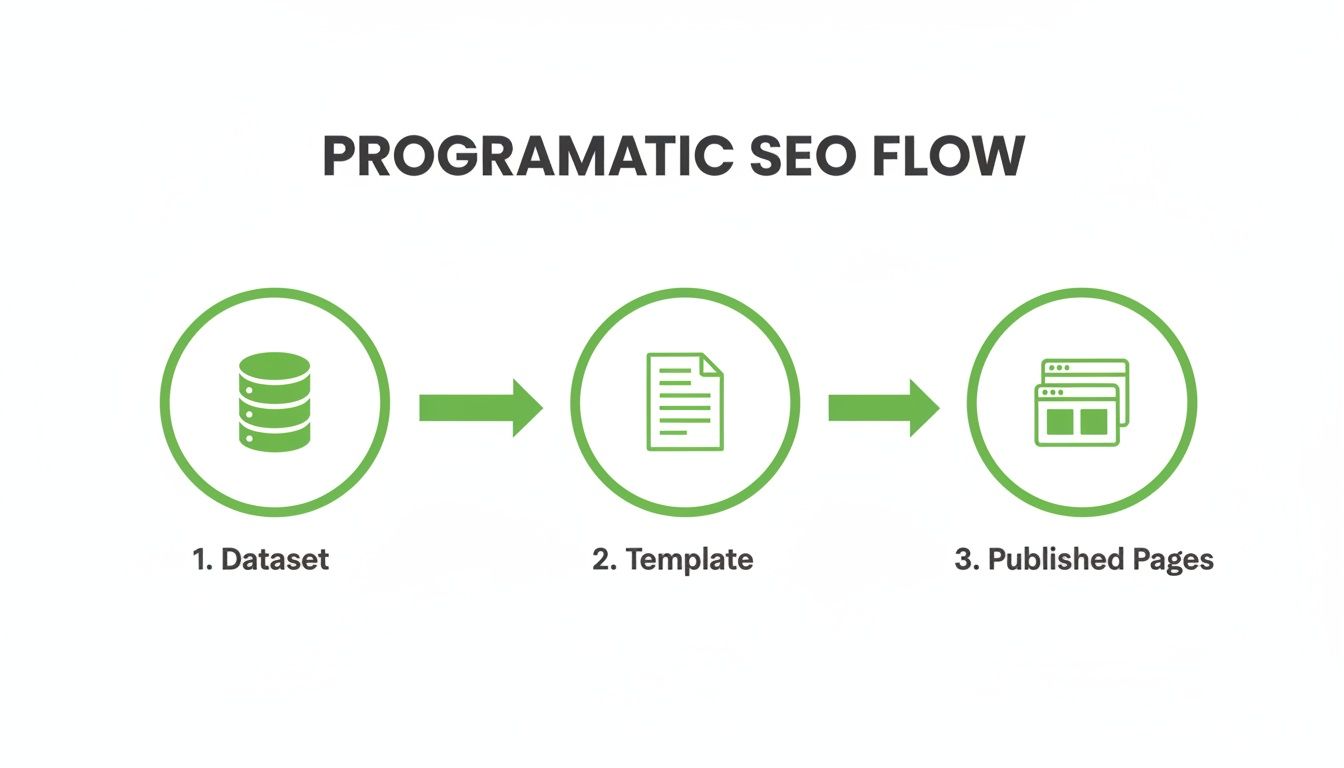
As you can see, a structured dataset is fed into a reusable template to produce a large number of unique pages. Let's break it down into four simple stages.
Stage 1: Get Your Data
Every pSEO project starts with data. For our plumbing example, all we need is a list of German cities. You don't need to be a data expert to find this.
- Where to find data? Public sources like Wikipedia are perfect. You can find a table of "Cities in Germany," copy it, and paste it into a simple spreadsheet like Google Sheets or Airtable.
- What should it look like? Just a single column labeled "City" with a list of cities: Berlin, Hamburg, Munich, etc. That's it. Your dataset is ready.
Stage 2: Design Your Page Template
Next, create your master page layout. This is where you decide what information will be on each city's page. Think of it as a blueprint with placeholders where your data will go. We'll use curly braces {} for our placeholders.
Here’s what our plumbing service template might look like:
- SEO Title: Fast Emergency Plumbing Services in
{City} - H1 Heading: 24/7 Emergency Plumber in
{City} - Introduction: "When you have a burst pipe in
{City}, you need help fast. Our certified team offers reliable emergency plumbing solutions across the entire{City}area." - Body Content: Here you can have sections on services, pricing, and why customers in
{City}should choose you.
The goal is to design a template that is genuinely useful to someone searching for that service in a specific city.
Stage 3: Generate Unique Content with AI
This is where the magic happens. To avoid creating hundreds of nearly identical pages, we'll use AI to write unique content for each one. This helps your pages feel fresh and valuable to both users and Google.
The trick is to write simple instructions (prompts) for an AI tool like ChatGPT that include your {City} placeholder.
Pro Tip: Understanding a little about how AI content is viewed by search engines can give you an edge. Learning about ChatGPT ranking factors can help you write prompts that produce content Google is more likely to rank.
Here are a few example prompts you could use for every city in your spreadsheet:
- For the Introduction: "Write a 50-word introduction for a webpage about emergency plumbing services in {City}. Mention the stress of a plumbing emergency and reassure the reader that local help is available."
- For a "Common Problems" Section: "Generate a bulleted list of three common plumbing emergencies specific to older buildings found in {City}. Keep each point brief and helpful."
- For the Conclusion: "Write a 100-word concluding paragraph for our {City} plumbing page. Summarise the services offered and include a strong call to action to contact our local {City} team."
You would run these prompts for every city in your list. The AI will generate unique, locally-flavored text for each page, adding real value and originality.
Stage 4: Assemble and Publish
Now it's time to put it all together. Your spreadsheet should now have your original "City" column, plus new columns filled with the unique AI-generated content for your introduction, conclusion, etc.
The final step is to merge this data with your template and publish the pages on your website. You don't need to be a developer to do this. There are plenty of easy-to-use tools available:
- CMS Plugins: Platforms like WordPress have plugins that can import your spreadsheet and automatically generate all the pages for you.
- No-Code Tools: Website builders like Webflow and automation tools like Zapier can create workflows to turn each row in your spreadsheet into a new, live webpage.
The market for these tools is heating up. Germany's SEO industry is on track for steady growth, with a predicted CAGR of 6.5% through 2030. For SEOs and content strategists in DE, this makes programmatic SEO a golden opportunity. With 71% of bloggers globally calling SEO their top traffic source and 77% of German consumers using Google for local info, mixing blogging with pSEO is a knockout local strategy.
Once you’ve chosen your tool and pushed the button, your website will have hundreds of new, relevant, and unique pages ready for Google to find. For a more detailed walkthrough, check out our tutorial to launch your first pSEO project.
Common Pitfalls in Programmatic SEO and How to Avoid Them
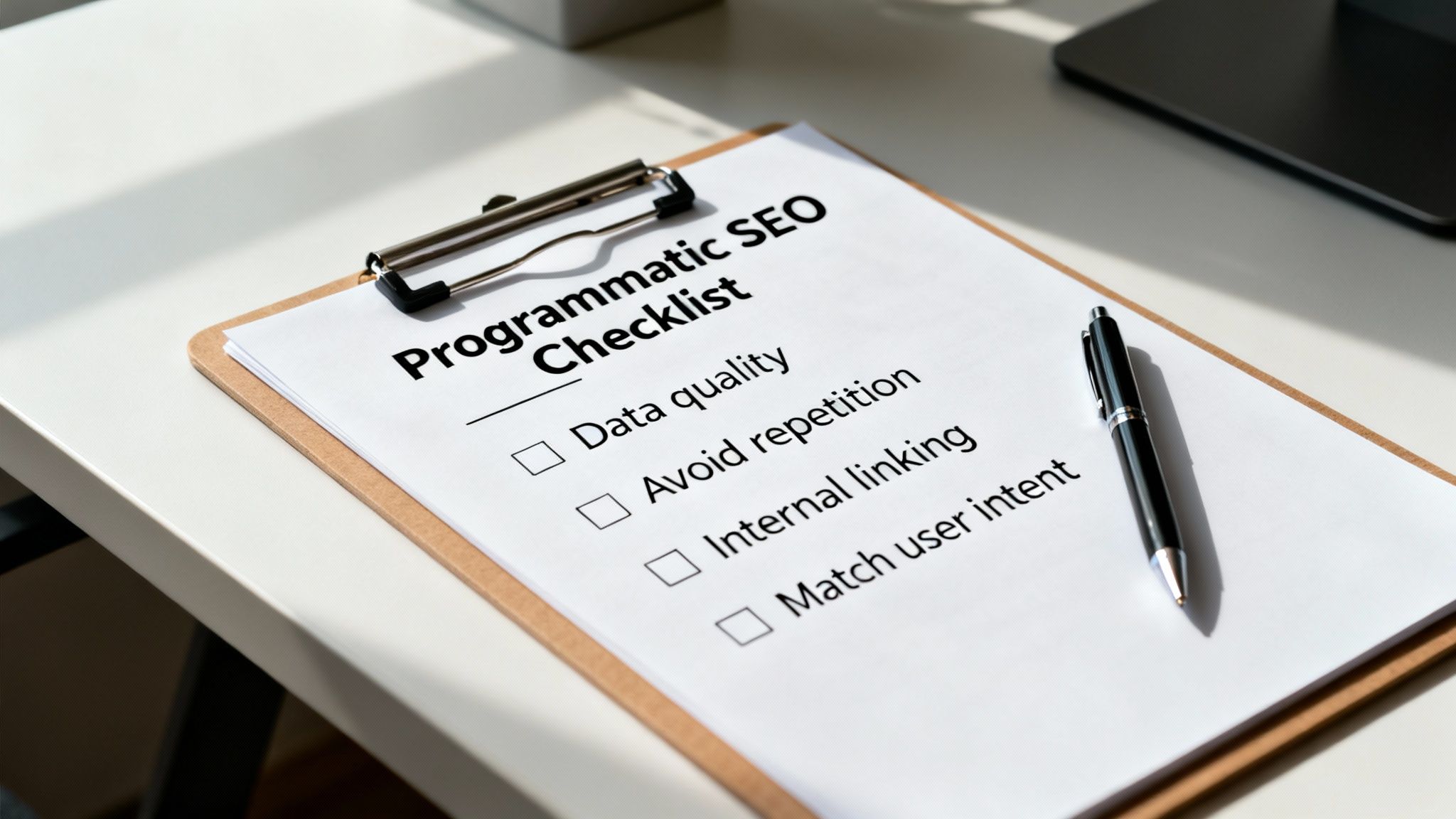
Jumping into a programmatic SEO project is exciting, but a few common missteps can quickly bring things to a halt. If you know what these challenges are from the get-go, you can build a far more resilient and successful content scaling strategy. Think of this as your pre-flight checklist, helping you sidestep the traps that catch so many people out.
The biggest mistake is often the very first one you make. It’s easy to get carried away by the sheer volume of pages you can create and lose sight of the actual value each page is supposed to provide.
Let's break down the four most critical pitfalls and, more importantly, how to get around them.
The Problem of Poor Data Quality
Programmatic SEO lives and dies by its data. The old saying ‘garbage in, garbage out’ has never been more true. If you use a dataset that’s incomplete, inaccurate, or just messy, you’re guaranteed to produce low-quality pages that won't rank and could even damage your site’s reputation.
Imagine trying to create pages for "Best Plumbers in {City}" but your city list is riddled with spelling mistakes or includes towns that don't even exist. Those errors instantly create thin, useless content and a terrible user experience.
Success Checklist Item 1: Data Integrity Before you even dream of touching a template, you have to rigorously clean your dataset. This means standardising formats, correcting errors, and getting rid of anything irrelevant. A clean dataset is the absolute foundation of a high-quality programmatic project.
Creating Overly Repetitive Templates
A massive red flag for search engines is a site with thousands of pages that look almost identical, apart from one or two swapped-out keywords. This is what happens when a content template is too rigid; it creates a footprint that looks like spam and offers zero unique value from one page to the next.
This is where AI becomes an invaluable partner. Instead of relying on one static template, you can use AI prompts to generate unique variations for key sections of your content.
- Vary Introductions: Prompt your AI to write five completely different opening paragraphs for your template.
- Generate Unique FAQs: Ask the AI to create a unique set of frequently asked questions for each data point (e.g., "FAQs about plumbing issues in {CityName}").
- Create Dynamic Conclusions: Use prompts to write distinct summaries and calls to action that feel fresh.
Doing this ensures each page delivers genuinely different and helpful information, which is a massive factor in modern SEO and blogging. You can find detailed advice on managing AI-driven content generation responsibly by exploring insights on auto-generated content policies to make sure you stay on the right side of search engine guidelines.
Neglecting Internal Linking
Publishing thousands of pages is only half the battle. If these new pages aren't connected to the rest of your website through internal links, they become "orphaned pages." Search engine crawlers will struggle to find them, and no authority will pass to them from your stronger pages, making it almost impossible for them to rank.
A successful programmatic project has to include a smart internal linking strategy right from the start.
- Link from Existing Content: Find your high-authority blog posts and add relevant links from them to your new programmatic pages.
- Create Hub Pages: Build out summary or category pages that act as a hub, linking out to clusters of your newly generated content.
- Link Between Programmatic Pages: Implement logic that links related programmatic pages to each other. For example, a page about Berlin could naturally link to one about nearby Potsdam.
Ignoring User Intent
Finally, the most critical pitfall of all is forgetting about the human on the other side of the screen. It's not enough to just generate a page for a keyword; that page has to actually satisfy the reason someone is searching. If a user looks for an "emergency plumber in Hamburg," they need a phone number, service details, and trust signals—not a generic article about the history of plumbing.
Your template must be designed from the ground up to solve the user's problem, and fast. This means your content has to be actionable, clear, and focused on delivering the answer they're looking for. Always ask yourself, "Does this page give the searcher exactly what they need?" If the answer is no, it's back to the drawing board with your template.
Your Top Questions About AI and Programmatic SEO
Whenever you mix SEO, blogging, and AI, questions are bound to come up. It's a new frontier for many. So, let’s clear the air and tackle some of the most common concerns I hear. My goal here is to give you direct, no-nonsense answers so you can move forward with confidence.
Is Programmatic SEO Just Google Spam?
No, not if you do it right. This is probably the most critical distinction to get your head around.
Google penalises low-quality, auto-generated junk that offers zero value. We’ve all seen it – those old-school sites that just spun articles into gibberish to try and game the system. That’s not what we’re talking about here.
High-quality programmatic SEO is the polar opposite. It’s a smart, legitimate way to create genuinely helpful pages at a massive scale. Think of a site like Zillow. They create a unique, data-packed page for every single neighbourhood. The whole point is to serve what the user is looking for with valuable information, not just churn out pages for the sake of it.
Do I Need to Be a Developer to Do This?
Absolutely not. It might have been true years ago, but that time has passed. While developers can definitely build incredibly complex, custom pSEO systems, the strategy is no longer their exclusive domain.
The boom in no-code and low-code tools has thrown the doors wide open for marketers, founders, and content creators.
You can get your first project off the ground without writing a single line of code, likely using tools you already know:
- Spreadsheets: Google Sheets or Airtable can be your database.
- Automation Tools: Services like Zapier can bridge the gap between your data and your website.
- CMS Platforms: Content management systems like Webflow and WordPress have plugins and integrations built specifically for this.
The barrier to entry has never been lower. The methods we’ve walked through are designed for non-technical folks.
How Does AI Fit Into Programmatic SEO?
AI is the turbocharger. It takes a solid programmatic SEO setup and kicks it into high gear.
In the past, one of the biggest challenges with pSEO was avoiding repetitive, cookie-cutter pages. You might swap out a city name, but 99% of the content would be identical across hundreds of pages. That’s a red flag for quality.
AI completely solves this "template repetition" problem by adding meaningful variation at scale. Instead of just replacing a single variable, you can use AI to:
- Write a unique opening paragraph for every page.
- Generate relevant, localised tips or FAQs.
- Create custom descriptions based on specific data points.
AI transforms a basic "find and replace" job into a sophisticated content generation engine. It ensures every page is more unique, more valuable, and ultimately, far more likely to rank.
This is where the magic happens. The synergy between SEO and blogging at scale is what makes this combination so powerful. You're not just creating more content; you're creating better, more relevant content for thousands of specific searches.
How Do I Know If My Programmatic Project Is Working?
You measure a programmatic project the same way you’d measure any other SEO initiative, with one small twist: you focus on the performance of cohorts of pages, not just individual articles. It’s all about the collective power of the group.
Start by tracking the organic traffic and keyword rankings for the entire set of generated pages. For instance, you’d monitor the combined performance of all pages under a URL structure like /services/in/[city].
In tools like Google Search Console and Google Analytics, keep a close eye on these key metrics for your page cohort:
- Impressions: Are your new pages even showing up in search results?
- Clicks: Are people actually clicking through?
- Average Position: Is your ranking for your target keywords trending up over time?
- Conversions: Most importantly, are these pages driving leads, sign-ups, or sales?
You’re looking for upward trends across the entire set. Of course, some pages will be rockstars and others will be duds, but success is measured by the group's overall impact on your visibility and business goals.
Ready to build your own content scaling engine? The Programmatic SEO Hub offers the templates, tools, and step-by-step guides you need to master programmatic SEO and future-proof your content strategy. Explore our free resources and start your journey today at https://programmatic-seo-hub.com/en.
Related Articles
Mobile friendly test google: A Practical Guide to Master Mobile SEO
Even though Google’s standalone Mobile-Friendly Test tool is a thing of the past, the principle behind it is more critical than ever. The simple truth is that Google now overwhelmingly uses its...

A Practical Guide to Competitive Analysis Keywords
When we talk about competitive analysis keywords, we're really talking about the search terms that are already making money for your rivals. By digging into these, you uncover their entire...

Landing Pages SEO A Practical Guide to Rank and Convert
When we talk about SEO for landing pages, we're not just talking about general website optimisation. We're getting hyper-specific. This is the art of building and refining standalone pages...