Mastering Meta Tags in SEO: A Practical Guide to Boosting Growth
Think of meta tags as your website's digital storefront sign. They're small bits of code, hidden from view on the page itself, but they’re the first thing people see on Google. They act as a preview in the search results, making or breaking a user’s decision to click on your link.
Getting a handle on the title tag and meta description is your first real step to getting noticed.
Your Website's First Impression with Meta Tags
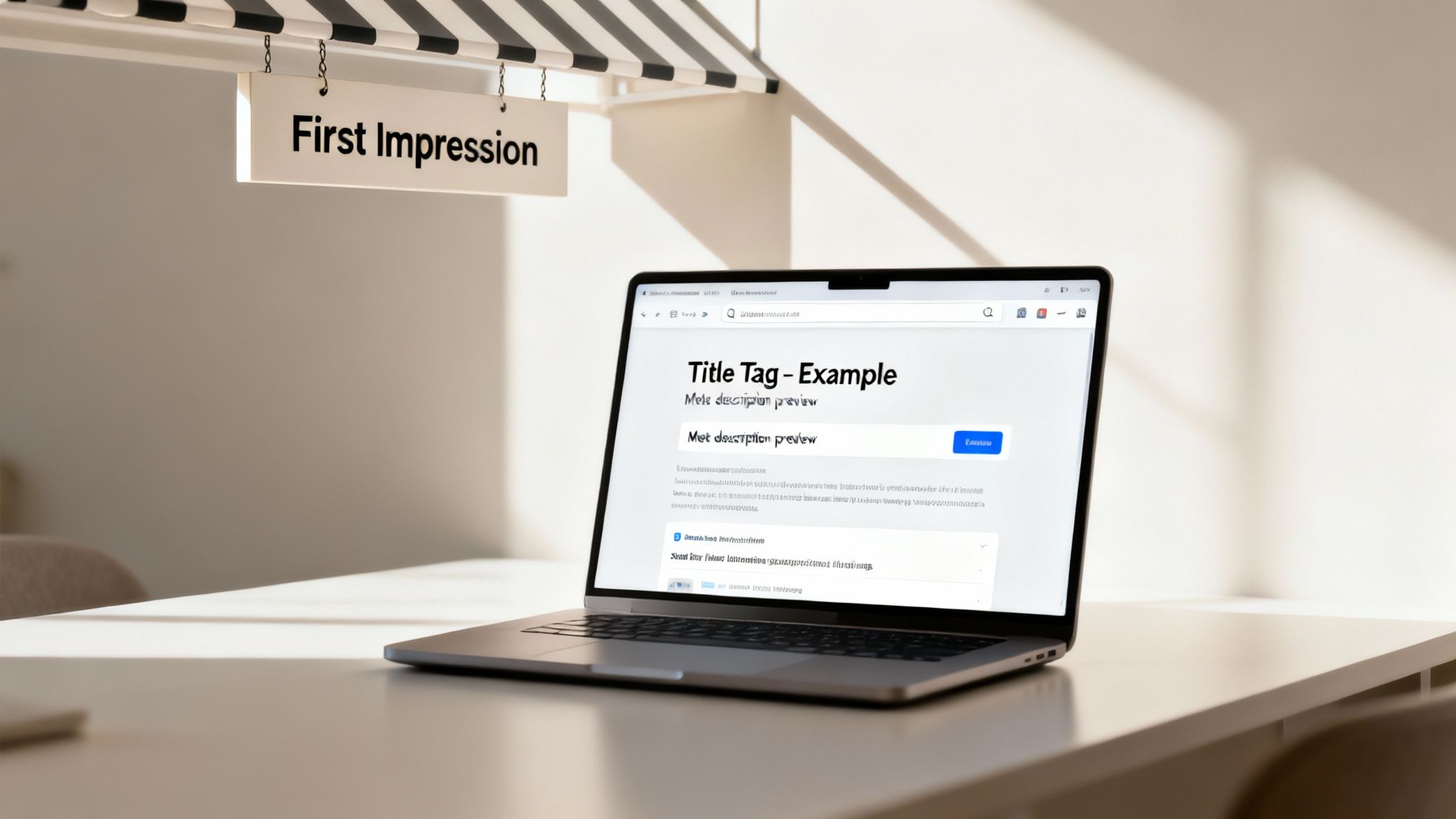
Imagine your website is a shop on a busy street. Your meta tags are the sign above the door and the display in the window. They're the very first handshake a potential visitor has with your brand in the search results.
While they live in your site's code, their impact is front and center on Google's results page. These tiny snippets are your first—and often only—chance to convince someone to visit your page instead of a competitor's. They pull double duty: telling search engines what your page is about and persuading actual humans that you have the answers they're looking for.
The Two Most Important Players
When it comes to meta tags in SEO, two elements do most of the heavy lifting. They work as a team to grab attention and pull in traffic. Understanding what each one does is crucial.
- The Title Tag: This is your page's official headline in the search results. It’s a huge signal to Google about your page's main topic and is often the single biggest reason a user decides to click.
- The Meta Description: Think of this as your 155-character sales pitch. It's the short summary that appears under the title, giving a sneak peek of your content and a perfect spot for a compelling call to action.
A well-written meta description can make a massive difference to user engagement. If you really want to dig into that, you can learn more about how it influences a page's click-through rate in this detailed guide.
A meta tag is more than just code; it's your sales pitch to the digital world. It needs to be clear, concise, and compelling enough to turn a searcher into a visitor.
Ultimately, ignoring these basics is like building an incredible shop but forgetting to put a sign on the door. You might have the best content in the world, but if no one knows it's there, it doesn't matter. Getting your meta tags right is non-negotiable for anyone serious about their visibility online, and it lays the groundwork for more advanced tactics, like creating them automatically at scale.
Alright, let’s peel back the curtain on meta tags. Now that you know they’re basically your website’s digital handshake, it’s time to meet the key players on the team.
While there are dozens of meta tags out there, a small handful do all the heavy lifting for your SEO. The real trick is understanding the specific job of each one. Think of them as specialists—a headline writer, a copywriter, a traffic cop—all working together. When they’re in sync, search engines understand your content, and real people are far more likely to click.
The Title Tag: Your Official Headline
This one is the big kahuna. The title tag is arguably the most critical piece of the meta tag puzzle. It’s not technically a "meta" tag in the strictest sense, but it lives in the same <head> section of your page's code and functions in much the same way. More importantly, it becomes the official headline for your page in Google's search results.
The title sends a massive signal to search engines about what your page is all about. But its job doesn’t end there. It's often the very first thing a searcher reads, making it the deciding factor in whether they click on your result or a competitor’s. A great title has to pull double duty: be perfectly descriptive for Google and utterly compelling for humans.
The Meta Description: Your 160-Character Advert
If the title is the headline, the meta description is the punchy sub-heading right below it. It’s your tiny, ~160-character sales pitch that appears under the title in the search results. Its one and only job is to pique curiosity and convince the searcher that your page has the answer they’re looking for.
Now, Google has been clear that meta descriptions aren't a direct ranking factor. But don’t let that fool you—their indirect impact is huge. A well-crafted description drives a higher click-through rate (CTR), which is a powerful signal to Google that users are finding your result relevant. Over time, that positive user engagement can absolutely influence your rankings.
A great meta description bridges the gap between what a search engine shows and what a user wants. It’s your chance to answer the unspoken question, "Why should I click this link?"
To get the most out of these foundational elements, it's worth exploring the specifics of their technical setup. You can find a deeper dive into the nuances in our guide on the technical implementation of meta tags.
The Robots Tag: Your Digital Traffic Cop
Here’s a secret: not every page on your site should be indexed by search engines. The robots meta tag acts like a digital traffic cop, giving direct instructions to the search engine crawlers that visit your site. You can use it to tell them to "index this page," but more often, you’ll use it to say "do not index this page" (noindex).
This is incredibly useful for things like internal search result pages, thank-you pages after a form submission, or any thin content that doesn't offer unique value. Using the noindex value stops these pages from cluttering up Google's index and helps the crawlers focus their limited resources on your most important content.
To help you keep track, here’s a quick rundown of the essential tags and their jobs.
Essential Meta Tags and Their SEO Functions
| Meta Tag Type | Primary Function | Direct SEO Impact |
|---|---|---|
| Title Tag | Sets the page's clickable headline in search results. | High. A primary ranking factor. |
| Meta Description | Provides a short summary to entice clicks from SERPs. | Indirect. Influences CTR, a key user signal. |
| Robots Meta Tag | Instructs search engines on indexing and crawling. | High. Directly controls a page's visibility in search. |
| Open Graph / Twitter | Customises how content appears when shared on social media. | Indirect. Boosts social media engagement and traffic. |
| Canonical Tag | Specifies the "master" version of a page to avoid duplicate content. | High. Prevents duplicate content issues and consolidates link equity. |
These are the tags you'll be working with day in and day out. Mastering them is non-negotiable for serious SEO.
Social Media Tags for Sharable Content
Ever wondered how a plain link transforms into a beautiful, clickable card when you share it on Facebook, X (formerly Twitter), or LinkedIn? That magic is controlled by social media meta tags, primarily Open Graph (for Facebook, LinkedIn, etc.) and Twitter Cards.
These tags let you define exactly which image, title, and description should be used for the preview. This turns a boring old URL into a visually appealing and informative post, which can dramatically increase engagement and click-throughs from your social channels. They are absolutely essential for controlling how your brand and content are presented across the social web.
For instance, the German SEO industry places immense importance on technical precision, especially when it comes to meta tags and handling special German characters like Ä, Ü, and ß. While Google is smart enough to interpret these correctly most of the time, German SEO professionals insist on proper encoding as a non-negotiable best practice. You can learn more about how SEO in Germany addresses these unique challenges on delante.co.
How to Write Meta Tags That People Actually Click
Knowing what meta tags are is one thing. Crafting them to actually win clicks? That's a completely different ball game.
Think of your title tag and meta description as your one-two punch in the search results. They’re your digital billboard, and writing them well is an art that perfectly balances keyword relevance with pure, simple human appeal.
Let's move from theory to practice. I'll show you how to write for people first, while still giving search engines exactly what they need. It’s all about creating a clear value proposition that turns a casual searcher into an actual visitor.
This visual breaks down the core components into a simple hierarchy.
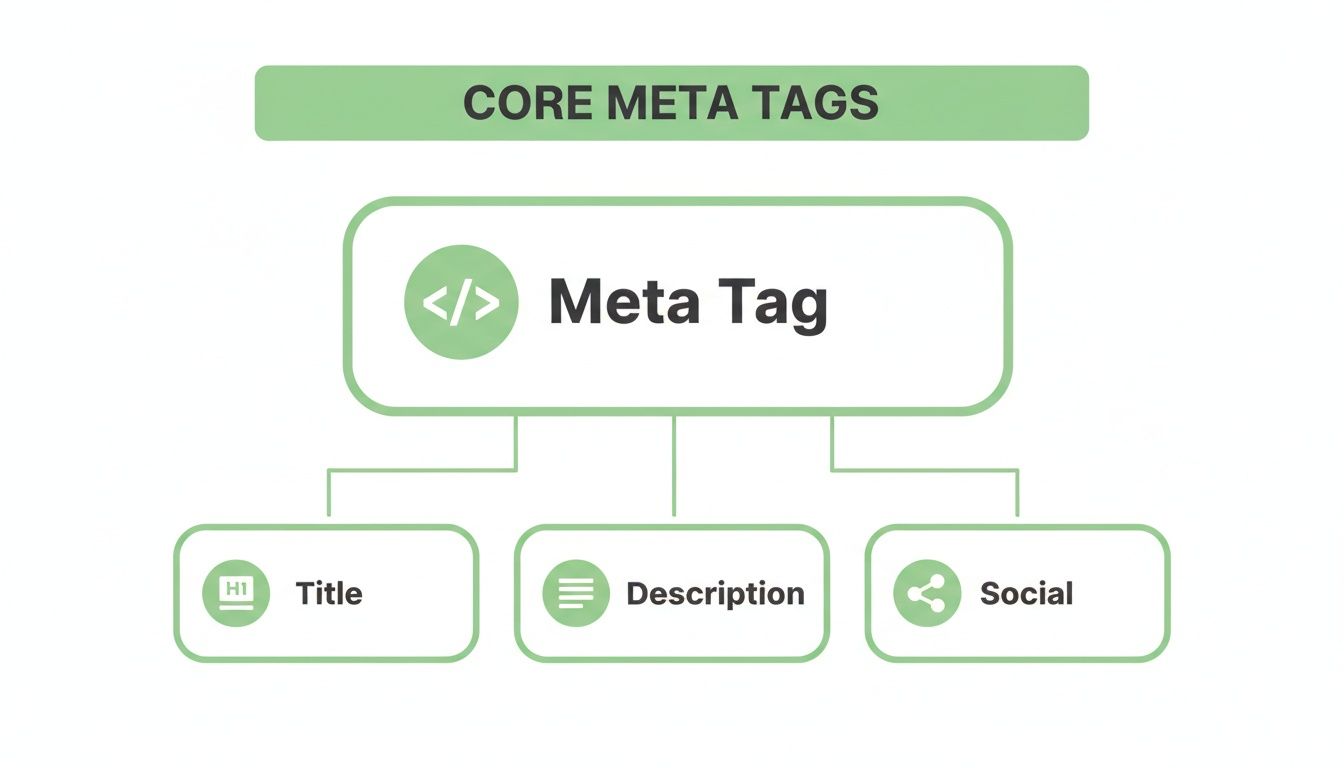
As you can see, the main meta tag concept branches out into the key elements you control: the Title, the Description, and the Social tags. Together, these shape how your page appears not just in search, but across social media, too.
Crafting the Perfect Title Tag
Your title tag is the headline of your search result, and it carries an enormous amount of weight. The goal here is to be descriptive, concise, and compelling—all within a very tight character limit.
Sticking to an optimal length of 50-60 characters is absolutely crucial. Go any longer, and your carefully crafted title gets unceremoniously chopped off with an ellipsis (...), completely killing its impact.
Beyond just knowing the basics, mastering how to write title tags is paramount for attracting clicks. To really level up your skills, dive into this comprehensive guide on crafting effective meta titles and learn some of the more advanced techniques.
Here’s a simple checklist for a strong title tag:
- Lead with your primary keyword: Place your most important term right near the beginning for maximum punch.
- Be descriptive and accurate: The title has to reflect what’s on the page. If it doesn't, people will just bounce straight off.
- Add a touch of intrigue: Use power words, numbers, or even questions to spark curiosity and stand out from a sea of boring results.
Writing Meta Descriptions Like a Copywriter
Your meta description is your mini-advertisement on the SERP. While it isn't a direct ranking factor, a compelling description has a massive influence on your click-through rate (CTR). And CTR is a powerful user signal that Google pays close attention to.
Think like a copywriter. Treat this small space as your chance to sell the click. Use an active voice, speak directly to what the user needs, and make it crystal clear what they'll get by visiting your page.
Unfortunately, meta descriptions are one of the most neglected parts of SEO. Research shows that a staggering 72.9% of websites are missing them entirely, while many others are either far too short or way too long. This is a huge missed opportunity.
Your meta description should directly answer the user's unspoken question: "Why should I click on this result instead of all the others?"
To make your description work harder for you, just follow these principles:
- Answer the User’s Question: Get straight to the point and address the search intent. If someone is looking for "how to fix a leaky tap," your description should promise a clear, step-by-step solution.
- Include a Clear Call-to-Action (CTA): Gently nudge the user to take the next step. Simple phrases like "Learn more," "Discover how," or "Shop now" can make a surprising difference.
- Use an Active Voice: Write in a direct, engaging way. Instead of a passive phrase like "Information can be found here," try "Find all the information you need." It’s a subtle shift, but it makes your text feel much more dynamic and actionable.
When you combine a keyword-focused title with a benefit-driven description, you create a powerful synergy. This one-two punch not only helps your meta tag in SEO performance but also ensures you're connecting with your audience on a truly human level. And for those looking to do this at scale, our meta description generator prompt offers a fantastic starting point.
Common Meta Tag Mistakes That Sabotage SEO
Even tiny errors in your meta tags can quietly sabotage all your hard work. Think of it like a beautiful shop sign with a glaring spelling mistake – it instantly undermines credibility and makes potential customers walk right on by. This section is your field guide to finding and fixing the most common pitfalls that are quietly killing your SEO.
Many of these mistakes feel small, but they create friction for both search engines and users. By catching and correcting them, you clear the path for better rankings and more clicks. Let's start with the most damaging error of them all.
The Problem with Duplicate Content
One of the most frequent and harmful mistakes is using the same title tags and meta descriptions across multiple pages. Imagine walking down a street where every single shop has the exact same sign. You’d have no clue what makes each one special. That's exactly how Google feels when it crawls duplicate meta tags.
This shortcut is surprisingly common. A major issue for German websites is that 50% of them use duplicate meta descriptions, and an incredible 54% have duplicate title tags. This redundancy completely confuses search engines. It forces them to guess which page is most relevant for a query, severely watering down the ranking power of all the pages involved. It's a massive missed opportunity to signal the unique value of each page. You can find more details on these widespread SEO issues on seranking.com.
Duplicate meta tags are a huge red flag for search engines. They suggest your content might be low-effort or thin, forcing Google to choose between pages and often ranking none of them well.
Every page on your site has a unique job to do. Its meta tags need to reflect that. Making them unique isn't just a best practice; it's a fundamental principle of good SEO.
Other Common Meta Tag Errors
Beyond duplicates, a few other common slip-ups can hold your site back. These usually come down to a lack of attention to detail, but thankfully, they're pretty easy to fix once you know what to look for.
A classic mistake is writing meta descriptions that are too long. When your description goes over the ~155-character limit, Google just chops it off with an ellipsis (...). This often happens right in the middle of your key message or call to action, which looks unprofessional and weakens your pitch to the user.
Here are a few more mistakes to keep an eye out for:
- Keyword Stuffing: Jamming your title or description with keywords is an ancient tactic that search engines now penalise. It reads terribly to a human and screams "low quality" to Google.
- Mismatched Content: Your meta tags are a promise. If a user clicks through and the page content doesn't deliver on that promise, they'll bounce immediately. A high bounce rate is a negative signal that can hurt your rankings over time.
- Missing Tags Entirely: Forgetting to write a title tag or meta description is like not showing up for a job interview. You're leaving it up to Google to pull a snippet from your page, and the result is almost never as compelling as what you could have written yourself.
Auditing your site for these common errors—duplicates, overly long text, keyword stuffing, and content mismatch—is the first step. Fixing these foundational issues can stop the silent sabotage and get your SEO back on track.
How to Create Meta Tags at Scale with AI
Writing unique meta tags for ten pages is easy. But what about a thousand? Or ten thousand? Whether you run an e-commerce store with countless products or a real estate site with thousands of listings, writing meta tags manually is impossible. This is where automation, powered by AI, becomes your secret weapon.
Instead of tackling each page one by one, you can create a smart system that does the heavy lifting for you. This approach is often called programmatic SEO. Don't let the name scare you—it's simply about using data and templates to create content at scale. Let’s demystify it.
The Simple Idea: Using Data and Templates
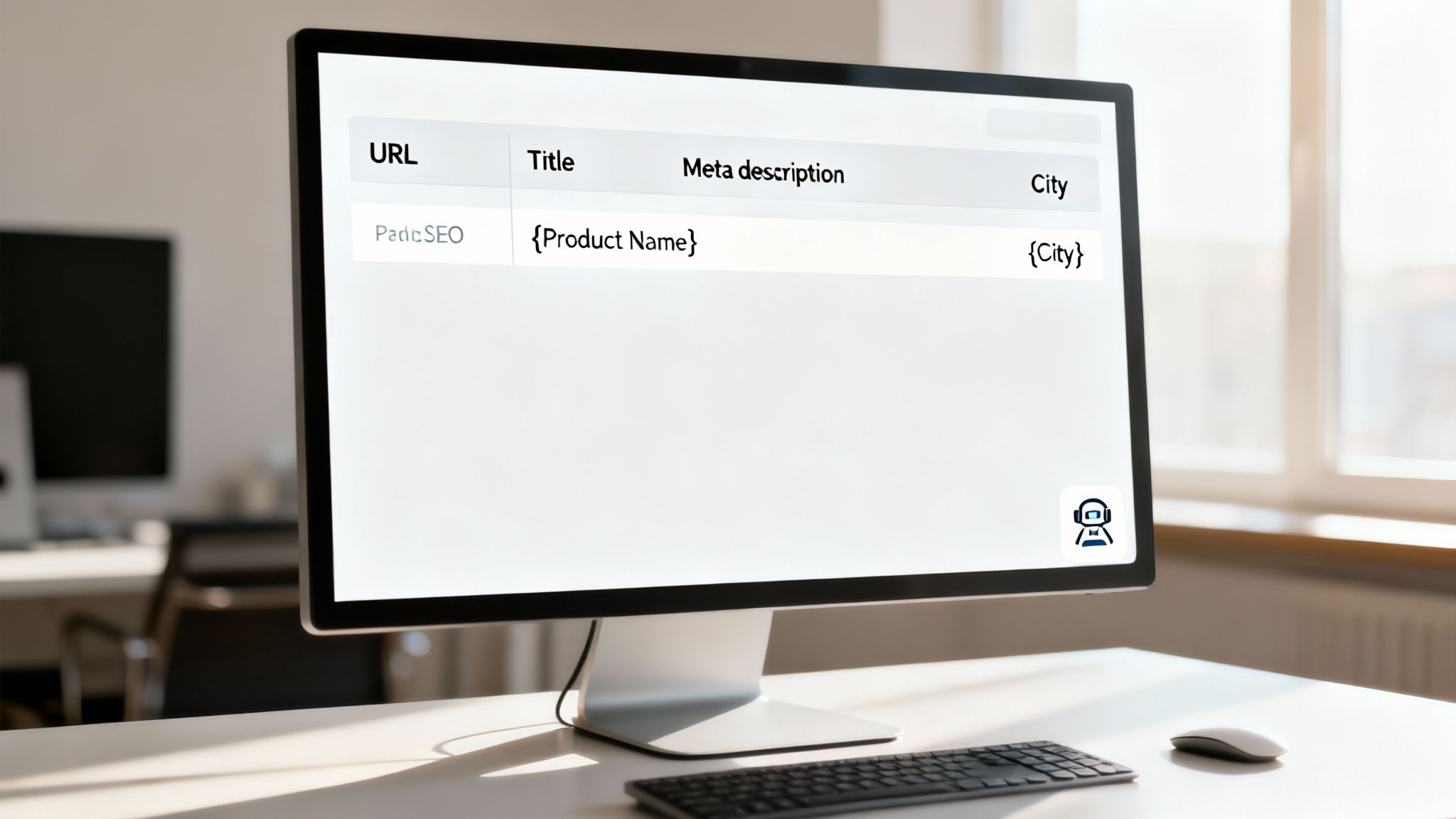
At its core, programmatic SEO works like a mail merge for your website. You start with a spreadsheet or database filled with your key information—like product names, city locations, service types, or key features. Then, you create a template for your title and meta description.
Think of a template as a sentence with blanks. The blanks (or "variables") get filled in by the data from your spreadsheet.
For a local business, your title template might look like this:
Title Template: {Service Name} in {City} | Fast & Reliable | {Brand Name}
Now, your spreadsheet just needs columns for Service Name, City, and Brand Name. The system automatically combines them to create thousands of unique titles:
- "Emergency Plumbing in Berlin | Fast & Reliable | PlumbFix"
- "Boiler Repair in Munich | Fast & Reliable | PlumbFix"
This simple process solves the duplicate content problem and ensures every page gets a relevant, targeted title.
Programmatic SEO isn't about creating robotic content. It's about using smart systems to deliver highly specific and useful information to users at a scale that's impossible to manage by hand.
It's a practical way to give every single one of your pages the SEO attention it deserves.
Making Your Templates Smarter with AI
Templates are great for scale, but they can sometimes sound a little stiff or repetitive. This is where AI comes in to add a human touch. Instead of just plugging data into a fixed sentence, you can ask an AI tool (like ChatGPT) to be your creative partner.
You feed the AI the same data and the same basic template, but you ask it to generate multiple variations. This adds a natural, creative flair that makes each meta tag feel unique and compelling. The key is giving the AI clear instructions, known as a "prompt."
To really get the most out of AI for meta tags, a solid grasp of prompt engineering is essential. You can dive deeper into this topic with a comprehensive guide to AI prompt engineering, which breaks down exactly how to give AI clear and effective instructions.
Manual vs. Programmatic & AI: Which is Right for You?
The best method depends on the size of your website. Manual work gives you complete control but doesn't scale. A programmatic approach with AI is built for large sites where manual updates are simply not an option.
| Aspect | Manual Approach | Programmatic & AI Approach |
|---|---|---|
| Scalability | Poor. Only works for small sites (under 50 pages). | Excellent. Can handle thousands of pages with ease. |
| Consistency | Can vary. Depends on the writer. | High. Ensures a consistent structure across all pages. |
| Efficiency | Very slow and time-consuming. | Extremely fast. Frees up your team for strategy work. |
| Uniqueness | High. Every tag is handcrafted. | High. AI can generate unique variations for every page. |
| Maintenance | Difficult. Requires editing pages one by one. | Easy. Update one template to change thousands of tags. |
| Cost | High in terms of man-hours. | Lower long-term after initial setup. |
For any website with hundreds of pages or more, a programmatic and AI-assisted strategy isn't just nice to have—it's essential for staying competitive.
A Practical AI Prompt You Can Use Today
The secret to great AI output is a great prompt. A good prompt is specific, gives context, and sets clear rules.
Here’s a simple, powerful prompt you can copy, paste, and adapt. Just replace the text in {} with your own data from your spreadsheet.
Example AI Prompt:
Act as an expert SEO copywriter. I need 3 unique meta descriptions for a webpage. Each description must be under 155 characters. The page is about '{Service Name}' in '{Location}'. Emphasize our main benefit, which is '{Unique Selling Point}', and end with a call-to-action.
Let’s plug in some data:
- {Service Name}:
Bicycle Repair - {Location}:
Hamburg - {Unique Selling Point}:
Same-day service
The AI will now give you several creative, ready-to-use options that sound far more natural than a simple template. This powerful combination of data, templates, and AI is explained further in our guide on Natural Language Generation in programmatic SEO.
Your Meta Tag Optimisation Action Plan
Alright, let's turn all this theory into a practical, no-nonsense plan. This roadmap is designed to help you put everything we've discussed about the meta tag in SEO into action, making sure your site is optimised for both search engines and the people using them.
The core ideas are simple. Every page needs its own unique meta tags. You have to respect character limits to avoid getting cut off in the SERPs. And most importantly, your copy has to speak directly to what the user is looking for.
When you nail these fundamentals and pair them with some smart automation, you can manage your meta tags effectively, no matter how big your site gets.
Your Step-by-Step Checklist
Ready to dive in? This two-phase process will help you audit what you currently have and build a solid system for everything new you create. It's all about fixing past mistakes while preventing future ones.
Run a Full Site Audit: First things first, you need to know what you're up against. Fire up an SEO crawler to hunt down common problems like missing title tags, duplicate meta descriptions, or descriptions that are way too long. Pay close attention to pages with decent traffic but a low click-through rate—their meta tags are almost always the culprit.
Prioritise and Fix Your Key Pages: Don't try to boil the ocean. Start with the pages that matter most: your homepage, main service pages, and top-performing articles. Rewrite their meta tags by hand. Make them compelling, unique, and perfectly aligned with user intent.
Create Programmatic Templates: For any site with a lot of pages (think e-commerce stores or business directories), templates are your best friend. Build a solid structure using variables like
{Product Name}or{City}to automatically generate unique, relevant tags for thousands of pages at once.Layer in AI for Variety: Give your programmatic templates a human touch. Use AI prompts to add some creative flair and avoid sounding like a broken record. This helps your tags feel natural and engaging, even when they're generated at scale.
Test, Refine, Repeat: SEO is never a "set it and forget it" game. You need to constantly monitor how your updated tags are performing. To really level up, learn the principles of A/B testing for SEO and use data to prove which meta tag variations actually drive more clicks.
Following this plan transforms meta tag optimisation from a tedious, reactive chore into a powerful, proactive strategy. You're not just fixing tags; you're building a system that gives every single page the best possible chance to win the click.
This checklist hammers home our main point: well-crafted meta tags are a cornerstone of great SEO. With the right system in place, you can manage them efficiently, no matter the size of your website.
Your Top Meta Tag Questions, Answered
Even with a solid grasp of the basics, a few tricky questions always pop up when you start getting your hands dirty with meta tag optimisation. Let's tackle some of the most common ones head-on to clear up any confusion.
Are Meta Keywords Tags Still Relevant for SEO?
Nope, the meta keywords tag is a ghost of SEO past. Major search engines like Google and Bing stopped factoring it into their rankings years ago, mostly because it was so easy to spam with "keyword stuffing."
Your time is far better spent crafting a killer title tag and a meta description that actually makes people want to click. Modern SEO is all about relevance and user experience, not stuffing outdated tags with keywords.
How Long Does It Take for Google to Recognise New Meta Tags?
There’s no magic number here. After you've updated your meta tags, Google might notice the changes in a few hours, or it could take a couple of weeks.
The speed really depends on your site's authority and its "crawl budget"—basically, how often Googlebots swing by to check for updates. If you're in a hurry, you can give Google a nudge by requesting a re-index for a specific URL using the 'URL Inspection' tool in Google Search Console.
Can I Use Emojis in My Title Tags and Meta Descriptions?
Yes, you absolutely can! And when used well, they can make your listing pop in a sea of text-only results, potentially giving your click-through rate a nice little boost. But, and this is a big but, you need to be smart about it.
Use emojis sparingly and only when they genuinely fit your content and audience. Throwing them in everywhere can look spammy or unprofessional, and remember, Google has the final say on whether they actually get displayed.
A good rule of thumb is to test them out. See how they perform for a few pages and check if your audience responds well before you go all-in.
What Happens If I Do Not Write a Meta Description?
If you skip writing a meta description, Google won’t just leave a blank space. It will pull a snippet directly from your page's content that it thinks best matches the user's search.
While that’s better than nothing, the auto-generated snippet is often a clunky, out-of-context sentence that does a terrible job of selling your page. By not writing your own, you’re missing a huge opportunity to control your message and convince someone to click on your result instead of your competitor's. Always write a unique description for every page that matters.
At Programmatic SEO Hub, we provide the guides, templates, and systems you need to scale your content and SEO efforts effectively. Explore our resources to master programmatic SEO and future-proof your strategy. Learn more at Programmatic SEO Hub.
Related Articles
Mobile friendly test google: A Practical Guide to Master Mobile SEO
Even though Google’s standalone Mobile-Friendly Test tool is a thing of the past, the principle behind it is more critical than ever. The simple truth is that Google now overwhelmingly uses its...
A Practical Guide to Competitive Analysis Keywords
When we talk about competitive analysis keywords, we're really talking about the search terms that are already making money for your rivals. By digging into these, you uncover their entire...
Landing Pages SEO A Practical Guide to Rank and Convert
When we talk about SEO for landing pages, we're not just talking about general website optimisation. We're getting hyper-specific. This is the art of building and refining standalone pages...