How to Use a Long Tail Keyword Strategy to Actually Get Traffic

Let's get one thing straight: long tail keywords aren't just longer search terms. They are highly specific phrases, usually three or more words, that reveal exactly what a user is looking for.
Forget broad, vague terms like "shoes". That's a needle-in-a-haystack search. A long tail keyword is more like "men's waterproof hiking boots size 10". It captures someone who isn't just browsing—they're ready to buy.
What Exactly Is a Long Tail Keyword and Why Should You Care?

Picture yourself in a huge department store. Yelling "shoes!" is a bit like using a head keyword in search. It's a broad request with massive volume, but the intent is fuzzy, and you’re competing with everyone else on the floor.
Now, imagine walking up to an employee and asking for "men's waterproof hiking boots in a size 10". That's a long tail keyword in action. It’s a conversational, specific query that gets you exactly what you need, fast.
Sure, any single long tail keyword gets far fewer searches than its shorter, broader cousin. But here's the magic: together, they make up the vast majority of all searches online. This creates a massive opening for businesses smart enough to target these hyper-specific needs. Our complete guide on long tail keywords digs deeper into why they're so fundamental to modern SEO.
Head Keywords vs Long Tail Keywords at a Glance
To make the distinction crystal clear, here’s a quick side-by-side comparison. It really highlights how these two keyword types serve completely different purposes in an SEO strategy.
| Characteristic | Head Keyword (e.g., 'SEO software') | Long Tail Keyword (e.g., 'best seo software for small business budget') |
|---|---|---|
| Search Volume | Very high | Low |
| Competition | Extremely high | Low |
| Conversion Rate | Low | High |
| User Intent | Broad, informational, vague | Specific, transactional, clear |
The takeaway is simple: head keywords are for broad awareness, but long tail keywords are where the real, tangible business results happen.
The Core Benefits of a Long Tail Strategy
Zeroing in on these ultra-specific phrases gives you a serious competitive advantage. You're not just throwing content out there; you're creating the perfect solution for users who know exactly what they're looking for.
Here’s why a long tail approach just works:
- Less Competition: Let's be real. It's much easier to rank for "best seo software for small business budget" than it is for the giant term "SEO software." This gives smaller players a genuine shot at hitting page one.
- Higher Conversion Rates: Specificity is a huge buying signal. Someone searching a long tail phrase is usually deep into their research and much closer to converting into a customer, subscriber, or lead.
- Perfect for Voice Search: People don't talk to their smart speakers in keywords. They ask real questions, which are naturally long tail. In Germany, for example, over 41.2% of all searches are now by voice, fuelling demand for content that answers conversational queries like, 'beste italienische Restaurants in Berlin Mitte heute Abend'.
By answering very specific questions, your content doesn't just solve an immediate problem. It builds trust and positions your brand as a true authority. It’s a strategy that deliberately chooses high-quality, high-intent traffic over empty volume.
How to Find High-Value Long Tail Keywords

Finding the exact phrases your audience uses is less about fancy tools and more about smart observation. The best long-tail keywords aren't buried in some secret database; they're hiding in plain sight, scattered across the very places your customers go for answers.
The real key is to shift your mindset. Stop guessing what people search for and start listening to what they actually ask.
And here's the good news: you don't need a massive budget to get started. By tapping into free, accessible resources, you can build a powerful list of long-tail opportunities that speak directly to user needs and pull in highly qualified traffic.
Start With Simple Manual Discovery
Before you even think about paid tools, you can unearth dozens of keyword ideas just by using Google the way your audience does. These manual methods are surprisingly powerful because they reflect real-time search behaviour and genuine curiosity.
Here are a few simple techniques to try right now:
- Google Autocomplete: Open up Google and start typing a broad term related to your business. The suggestions that pop up are a direct feed from popular, real searches. For example, typing "best CRM for..." might reveal gems like "...small businesses," "...real estate agents," or "...startups."
- People Also Ask (PAA) Boxes: After you search for a term, scan the results for the "People Also Ask" section. This is an absolute goldmine of question-based long-tail keywords. Better yet, each question you click on reveals even more related queries, letting you map out entire topic clusters in minutes.
- Related Searches: Scroll to the bottom of any search results page, and you'll find the "Related searches" list. This shows you other common paths people take when researching a topic, often uncovering valuable long-tail variations you would've missed.
These methods work so well because they tap directly into Google's own understanding of user intent. You're getting a foundational list of phrases straight from the source.
Mine Community Forums for Real Questions
Want to find the exact language your customers use? Go where they have conversations. Forums and Q&A sites are filled with people asking for advice, solving problems, and discussing products in their own unfiltered words.
Think of sites like Reddit and Quora as focus groups that are running 24/7. The questions and problems people post are raw insights into their pain points, which are the foundation of every great long-tail keyword.
Searching a term like "MBA programs" on Reddit might uncover threads where users ask, "is an online MBA worth it for a career change?" or "MBA application tips for low GPA." These aren't just keywords; they are content ideas that precisely match a user's specific need and emotional state. For a deeper look at this, you can learn how to find long tail keywords that actually convert.
Use SEO Tools to Filter and Validate
Once you've built a solid list from your manual research, then it's time to bring in the SEO tools. Instead of starting from scratch in a tool, you use it to add data to your human-first discoveries. The main goal here is to check the search volume and competition level of the keywords you've already found.
This is what a typical keyword overview looks like in a tool like Ahrefs, showing metrics like keyword difficulty and search volume.
The trick is to look for phrases with a lower Keyword Difficulty (KD) score. This signals less competition and gives you an easier path to ranking.
This structured approach—human insight first, data validation second—is incredibly effective. You can explore even more methods in our detailed guide to modern keyword research strategy. By blending these techniques, you create a repeatable system for finding valuable long-tail keywords that connect with your ideal audience and deliver real results.
Scaling Your Content with AI and Programmatic SEO
What if you could create hundreds, or even thousands, of hyper-targeted pages, each answering a specific long-tail query, without having to write every single one by hand? That's the magic of programmatic SEO (pSEO). It sounds complicated, but the idea behind it is surprisingly simple and incredibly powerful for scaling your reach.
Think of it like a mail merge, but for your website. You design one master page template, then feed it data from a spreadsheet—things like different cities, specific services, or product models. The system then automatically generates a unique page for every single row in your spreadsheet.
This is how you turn a massive list of long-tail keyword variations into a genuine traffic-generating engine. Instead of just one page for "best plumber," you can effortlessly create pages for "best plumber in Berlin," "emergency plumber in Hamburg," and "certified plumber for boiler repair in Munich."
Demystifying Programmatic SEO for Beginners
Let’s break down programmatic SEO (pSEO) into simple, non-technical steps. At its core, it's about finding a repeatable pattern in how people search and using technology to create pages for every variation. It’s all about working smarter, not harder.
The process has three main ingredients:
- A Data Source: This is just a spreadsheet (like Google Sheets or Airtable). Each row represents a future webpage. Each column holds a piece of unique information, like a
City Name, aService Type, or aPrice. - A Page Template: This is the design of your page, built in a system like WordPress or Webflow. Instead of hard-coding text, you use simple placeholders like
[City Name]that match the column names in your spreadsheet. - A Connection: A plugin or a no-code tool connects your spreadsheet to your template. It goes through each row, grabs the data, plugs it into the placeholders, and publishes a new page. One row equals one page. That’s it.
This simple workflow is how businesses create thousands of highly relevant pages that attract tons of long-tail search traffic.
How AI Changes the pSEO Game
This is where it gets really interesting. For a long time, the biggest hurdle in pSEO was creating genuinely unique, valuable content for each page. Without it, you risked Google seeing your pages as thin or duplicate content. AI completely shatters that barrier, making pSEO faster, better, and more accessible than ever.
Instead of just swapping out a city name and calling it a day, AI can generate entirely unique paragraphs, FAQs, and detailed descriptions for every single page. By feeding an AI model the data points from your spreadsheet, you can prompt it to write customized content for each variation. This turns a simple data merge into a powerful content creation engine. For more on this, see how AI search engine optimization is changing the game.
This combination of structured data, smart templates, and AI allows you to produce content that is both scalable and truly helpful to the user. For a much deeper look into the mechanics, our guide on natural language generation in pSEO breaks down the technology in more detail.
Programmatic SEO with AI isn't about creating spam. It's about systematically answering thousands of specific user questions with relevant, data-driven content—a feat that would be physically impossible to achieve manually.
A Simple AI-Powered Programmatic SEO Workflow
Let's put it all together. Here’s a step-by-step plan you can follow for your first project. This workflow shows exactly where AI does the heavy lifting, making the entire process manageable even for beginners.
A 5-Step pSEO Workflow for Anyone
This table breaks down the process, from finding your pattern to hitting "publish."
| Step | Action | Practical Example | How AI Helps |
|---|---|---|---|
| 1. Find the Pattern | Identify a repeatable search phrase. | Your audience searches for "[service] for [business type]". | Brainstorming hundreds of variations of services and business types. |
| 2. Build Your Spreadsheet | Gather your data into columns and rows. | Create columns for Service, Business_Type, Avg_Cost. |
Researching and generating unique data points, like "common problems for [Business_Type]". |
| 3. Design Your Template | Create one master page with placeholders. | Build a page with the H1: "Expert [Service] for a [Business_Type]". | Suggesting a page layout proven to convert visitors. |
| 4. Generate Unique Content | Use AI to write the text for each page. | Use the prompt: "Write a 50-word intro about our [Service] for a [Business_Type]". | Writing unique introductions, FAQs, and benefit lists for every single page. |
| 5. Publish & Link | Connect your data and template to create the pages. | Use a simple plugin to import the spreadsheet and publish all pages at once. | Suggesting smart ways to internally link your new pages together. |
Following this process transforms a monumental task—creating hundreds of pages—into a manageable, system-driven project. By organizing your long-tail ambitions into a clean data structure and letting AI handle the content creation, you can achieve a level of scale that was once reserved for massive enterprise companies.
Building Your First Long-Tail Campaign with pSEO
Right, let's move from theory to practice. This is your crash course in building a programmatic SEO (pSEO) project from the ground up, using a simple, real-world example that anyone can grasp.
Imagine we're running a local cleaning service. We'll walk through the exact steps to find a keyword pattern, organize the data, create a content template, and use AI to spin up unique content for hundreds of pages. By the end, you'll have a clear, repeatable plan, even if you have zero technical background.
Step 1: Identify Your Core Keyword Pattern
The heart of any pSEO project is finding a repeatable search pattern. This is the formula your customers are typing into Google when they need your help. For our cleaning company, a classic pattern is “[service type] in [city]”.
This simple structure is a goldmine for long-tail keyword variations.
deep cleaning services in Berlinend of tenancy cleaning in Hamburgweekly office cleaning in Munichsofa steam cleaning in Cologne
Your job is to find a reliable formula just like this. Once you have it, you can start gathering the variables—the different services and locations—to fill in the blanks.
Step 2: Create a Simple Data Spreadsheet
You don't need a fancy database to get started. A basic spreadsheet in Google Sheets or Excel is all it takes to organize your project. Just think of each row as a future webpage and each column as a unique piece of information for that page.
For our cleaning service, the spreadsheet might look something like this:
| City | Service | Price_per_hour | Unique_Selling_Point |
|---|---|---|---|
| Berlin | Deep Cleaning | 45€ | Eco-friendly products used |
| Hamburg | End of Tenancy Cleaning | 55€ | 48-hour satisfaction guarantee |
| Munich | Weekly Office Cleaning | 40€ | After-hours service available |
| Cologne | Sofa Steam Cleaning | 60€ | Fast-drying in under 2 hours |
The more unique data points (columns) you add, the more valuable and distinct each page becomes. You could add columns for local landmarks, specific neighborhood names, or even customer testimonials from each area to really flesh things out.
Step 3: Design Your Page Template with Placeholders
Now it’s time to design your master page. This is the blueprint where the data from your spreadsheet will be plugged in. Instead of writing fixed text, you use placeholders that match your column headers.
Let's say you're building a page in WordPress or Webflow. Your template might include sections like:
- H1 Title: Top-Rated [Service] in [City]
- Introduction Paragraph: Looking for reliable [Service] in [City]? Our team uses [Unique_Selling_Point] to deliver exceptional results.
- Pricing Section: Our [Service] starts at just [Price_per_hour].
When the system runs, it grabs the data from the "Berlin" row and instantly generates a page with the title "Top-Rated Deep Cleaning in Berlin." Then, it does the same for every other row in your spreadsheet. Simple.
The whole programmatic SEO process really boils down to these three core stages: data, template, and content.
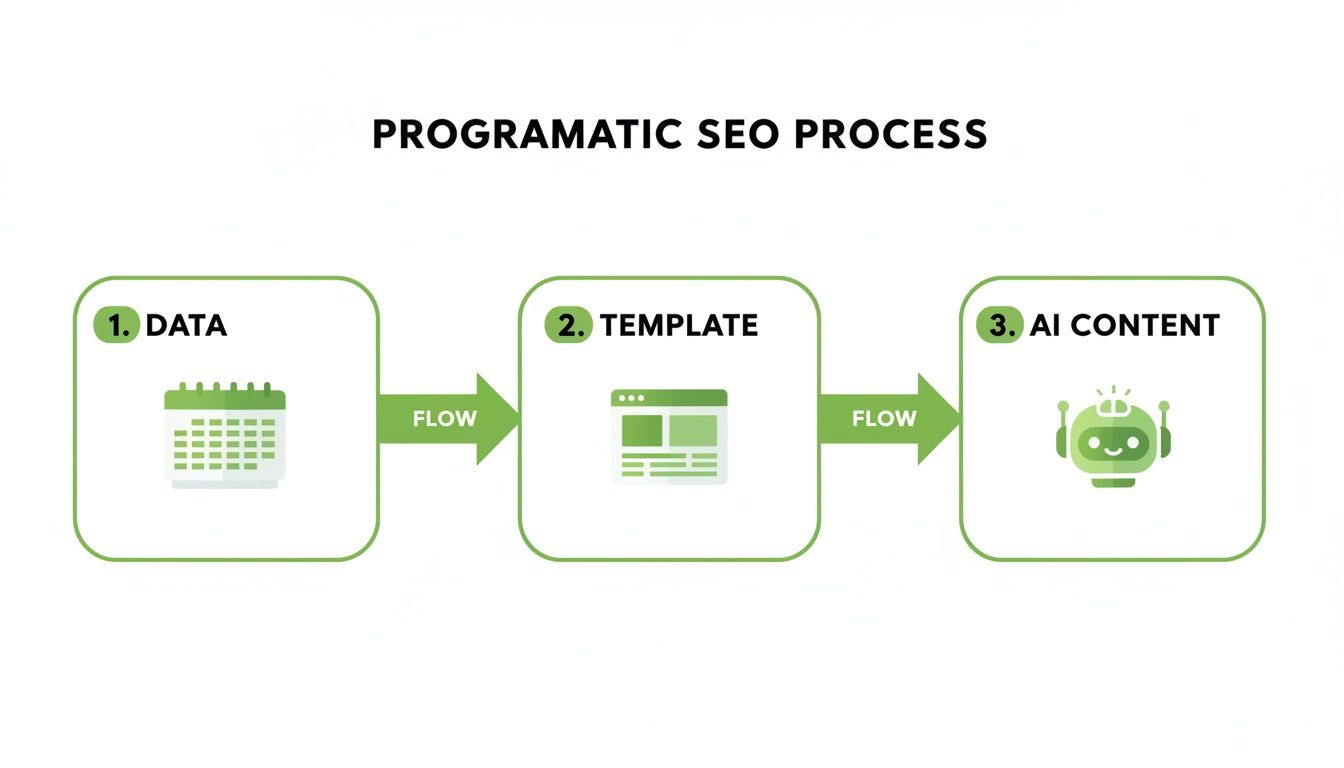
This visual shows exactly how that structured data flows from a spreadsheet into your template, which is then populated with unique content to create hundreds or thousands of pages at scale.
Step 4: Generate Unique Content with AI Prompts
This is the magic ingredient that makes modern pSEO so accessible. You can use simple, repeatable prompts to generate unique content for every single page. This helps you dodge duplicate content penalties and add genuine value for the reader.
Here are a couple of sample prompts you could use with an AI tool for our cleaning service example.
Prompt for an Introduction: "You are an expert copywriter for a local cleaning company. Write a friendly and engaging 50-word introduction for a webpage about our [Service] service offered in [City]. Mention our key benefit, which is [Unique_Selling_Point]."
Prompt for an FAQ Section: "Generate 3 frequently asked questions and their answers about [Service] in [City]. One question should be about our pricing, which starts at [Price_per_hour]."
By running these prompts for each row in your spreadsheet, you can create thousands of unique content snippets in minutes, not months. This ensures every long-tail keyword you target is supported by a genuinely helpful and distinct page. For a full walkthrough, check out our detailed guide to launch your first pSEO project and see these systems in action.
Measuring Success and Avoiding Common Pitfalls
So you've launched hundreds, maybe thousands, of pages. That feels like a huge win, but the real work is just beginning. How do you actually know if your long-tail strategy is paying off? Success here isn't about vanity metrics or how much traffic a single page gets.
Instead, you need to start thinking like a portfolio manager. Your real goal is to track the collective performance of your entire cluster of programmatic pages. A single page might only pull in five visits a month, which sounds tiny. But when you multiply that by a thousand pages, the impact suddenly becomes very significant.
Shifting Focus to the Right Metrics
For a long-tail or programmatic campaign, traditional analytics can be seriously misleading. You have to shift your focus away from single-page performance and look at the aggregate gains across the entire set of generated content. The numbers that truly matter paint a much broader picture of your campaign's health.
Here are the key metrics to obsess over:
- Total Impressions Across the Cluster: This is your earliest indicator of success. Are your new pages even showing up in search results for all those long-tail queries? A rising impression count across thousands of low-volume terms proves you're becoming relevant in your niche.
- Ranking Improvements for the Group: Forget tracking just one keyword. You need to monitor the average ranking position for all the pages within the campaign. A steady upward trend shows that Google is gaining trust in your content as a whole.
- Total Clicks and Conversions: Ultimately, this is what it's all about. Track the combined clicks and, more importantly, the conversions (leads, sales, sign-ups) generated by your programmatic pages. This is the true measure of your campaign's return on investment (ROI).
You can monitor these aggregate metrics perfectly in Google Search Console by filtering for the specific URLs that are part of your campaign.
Here’s an example of Google Search Console's performance report, which is ideal for tracking these key metrics.
This view lets you see the total clicks and impressions for a whole group of pages, helping you measure the collective impact rather than getting lost in the weeds of single-page performance.
Avoiding Common Programmatic Pitfalls
While scaling content with a long-tail keyword strategy is incredibly powerful, a few common mistakes can completely derail your efforts. Being aware of these pitfalls from the get-go will save you a massive amount of time and resources down the line.
The biggest mistake in programmatic SEO is prioritising quantity over quality. Creating thousands of pages is easy; creating thousands of pages that are genuinely helpful is the real challenge.
Here are the most critical mistakes to sidestep:
- Creating Thin or Worthless Content: Simply swapping a city name in a template isn't going to cut it. Each page must offer unique, tangible value. You need to use multiple unique data points and well-crafted AI prompts to ensure every single page is distinct and actually useful to someone searching for that specific long-tail keyword.
- Triggering Duplicate Content Issues: This is what happens when your pages are all nearly identical. To avoid it, make sure your template has enough variables and that your AI generates substantially different content for each page. Our guide on auto-generated content policies provides deeper insights into staying compliant.
- Failing to Build an Internal Linking Structure: Don't just publish your pages and hope for the best. A strong internal linking strategy is absolutely crucial. Create a "hub" page that links out to all your programmatic pages and, where it makes sense, make sure those pages link to each other. This is how you help Google discover your content and understand its topical authority.
Common Questions About Long Tail Keyword Strategy
Jumping into a long tail keyword strategy, especially with programmatic SEO, can feel like you're learning a new language. It’s completely normal to have questions as you shift from chasing big, high-volume terms to targeting thousands of super-specific phrases. This section is all about giving you clear, straightforward answers to the most common queries we see.
The idea here is to demystify the process and give you the confidence to start using these powerful techniques. We'll cover everything from the "right" length of a keyword to the risks of duplicate content, making sure you have the practical know-how to get moving.
How Many Words Should a Long Tail Keyword Have?
There's no magic number here, but a long tail keyword generally has three or more words. But honestly, the focus should never be on word count; it has to be on specificity.
A phrase like "emergency plumber for leaking pipe in east london" is gold. It’s not the number of words that makes it powerful, but the fact that it reveals a clear, urgent need. The real value of any long tail keyword is how well it signals what a user actually wants, which is directly tied to how likely they are to become a customer.
Think less about length and more about clarity. A good long tail keyword perfectly describes a single problem or need, leaving no room for ambiguity.
Is It Worth Targeting Keywords with Zero Search Volume?
Absolutely, and this is probably one of the most misunderstood parts of a scaled long tail strategy. When SEO tools show "zero search volume" for a hyper-specific term, it's usually because it isn't searched often enough to show up on their massive dashboards.
But "zero" rarely means zero. These terms often get a handful of searches every month from people who are incredibly motivated. When you use programmatic SEO to create hundreds or thousands of pages targeting these queries, that "zero volume" traffic adds up to something seriously significant.
More importantly, these are often your best potential customers. They've already done their general research and are now looking for a very specific solution, making them the most qualified and ready-to-act audience you can possibly attract.
Can Programmatic SEO Cause a Duplicate Content Penalty?
This is a valid concern, but it’s easy to avoid if you approach pSEO with the right mindset. The risk of a penalty only really comes up if your pages are basically identical copies with just a word or two changed (like swapping a city name and nothing else). That's a lazy approach that offers zero real value to the user.
The key to successful, penalty-free pSEO is making sure every single page provides unique and distinct value. You can do this in a few ways:
- Bring in Multiple Unique Data Points: Don't just change the location. Pull in local statistics, specific service details, regional testimonials, or area-specific photos.
- Use AI to Generate Unique Content: Get AI to write distinct paragraphs, create custom FAQs, and generate different opening sentences for each page.
- Vary Your Page Structure: Create a few different template variations to add another layer of uniqueness across your entire set of pages.
When every page you generate is genuinely helpful and tailored to its specific long tail keyword, search engines are far more likely to reward it, not penalise it.
How Do I Start with Programmatic SEO if I Am Not a Developer?
You absolutely do not need to be a developer to get started with programmatic SEO today. The rise of no-code tools has made this powerful strategy accessible to marketers, founders, and content creators, no matter their technical skill level.
Modern platforms like Webflow or even WordPress (with plugins like WP All Import) can connect directly to your data source, which is often just a simple Google Sheet or an Airtable base. The whole process has moved away from complex coding to a more strategic, visual workflow.
Your main tasks now are:
- Building a Smart Data Strategy: The quality and richness of your spreadsheet are everything. This is where you'll spend most of your time.
- Designing a Great Template: You'll create a well-designed master page layout in whatever platform you choose.
- Mapping Your Data: You'll visually connect the columns from your spreadsheet to the right elements in your design template.
For the content itself, user-friendly AI writing tools can do the heavy lifting of generating unique text. The focus is now firmly on smart strategy and creative execution, not writing lines of code.
At Programmatic SEO Hub, we're dedicated to helping you master these modern strategies. Our resources, templates, and guides are designed to demystify programmatic SEO and show you how to scale high-quality content that drives real results. Start exploring and build your traffic engine today at https://programmatic-seo-hub.com/en.
Related Articles

Mobile friendly test google: A Practical Guide to Master Mobile SEO
Even though Google’s standalone Mobile-Friendly Test tool is a thing of the past, the principle behind it is more critical than ever. The simple truth is that Google now overwhelmingly uses its...

A Practical Guide to Competitive Analysis Keywords
When we talk about competitive analysis keywords, we're really talking about the search terms that are already making money for your rivals. By digging into these, you uncover their entire...

Landing Pages SEO A Practical Guide to Rank and Convert
When we talk about SEO for landing pages, we're not just talking about general website optimisation. We're getting hyper-specific. This is the art of building and refining standalone pages...