A Practical Guide to Using a Landing Page in SEO That Converts
A landing page in SEO is a specialised web page built to rank high in search engines for a specific keyword. Its true purpose, however, is to convert those organic visitors into leads or customers by offering a direct, focused answer to whatever they searched for.
What Is an SEO Landing Page?

Let's clear up a common misconception. In SEO, a landing page isn't just "any page a visitor lands on." It's something much more strategic.
Think of your website as a massive department store. Your homepage is the grand entrance—welcoming everyone but not tailored to a single need. An SEO landing page, on the other hand, is like a highly specialised boutique tucked away inside. It's designed from the ground up to perfectly match one specific customer's desire.
It’s a laser-focused entry point for organic search traffic. The entire page is engineered to answer a user's query so precisely that they instantly feel they’ve found exactly what they were looking for. This singular focus is its superpower.
Why Your Homepage Isn’t Enough
Your homepage is a jack-of-all-trades. It has to introduce your brand, guide users to different sections, and cater to multiple audiences at once. This split focus makes it a terrible tool for converting a visitor with a very specific, high-intent goal.
An SEO landing page, however, has only one job. Its entire structure—from the headline and content down to the call-to-action—is built around a single topic. This approach aligns perfectly with a visitor's search intent, making it far more persuasive and effective at encouraging them to take that next step.
An SEO landing page is not just another page on your site; it's a strategic asset. It's the digital equivalent of a perfect sales pitch, delivered at the exact moment a potential customer is looking for a solution.
This focused strategy is essential in competitive markets. Take Germany's digital scene, for example. With Google holding 87.24% of the search market and nearly 80 million active internet users, businesses absolutely depend on optimised landing pages to capture relevant traffic and drive conversions.
SEO vs. PPC Landing Pages
It's also important to distinguish SEO landing pages from their paid advertising (PPC) cousins. While they share the goal of conversion, their DNA is fundamentally different. An SEO page is built for the long game. It aims to earn sustainable organic traffic by providing genuine, lasting value and becoming an authoritative resource on its topic. A PPC page is often a short-term sprinter, designed for a specific campaign.
Here’s a quick breakdown of how they differ.
SEO Landing Page vs PPC Landing Page Key Differences
| Attribute | SEO Landing Page | PPC Landing Page |
|---|---|---|
| Primary Goal | Attract organic traffic, build authority, and convert over time. | Capture leads and drive immediate conversions from paid ads. |
| Traffic Source | Search engines (e.g., Google, Bing) | Paid advertising channels (e.g., Google Ads, social media ads) |
| Content Focus | Comprehensive, in-depth, and valuable to satisfy search intent. | Concise, persuasive, and highly focused on a single offer. |
| Lifespan | Evergreen; designed to rank and attract traffic for months or years. | Temporary; often tied to a specific campaign and can be paused. |
Understanding this distinction is key. You can't just take a high-performing PPC page, publish it, and expect it to rank. The strategies required to succeed in organic search are completely different.
How to Optimise Your Landing Page for Search Engines
Getting a landing page to rank well isn't just about writing great copy. It's about speaking Google's language through deliberate on-page SEO. These are the signals you send to search engines to help them understand exactly what your page is about and why it deserves a top spot.
Think of it like organising a library. If every book has a clear title, a brief summary on the back, and is filed in the right section, finding what you need is effortless. On-page SEO does the exact same thing for your content, making it incredibly simple for search engines to categorise your page and show it to the right people.
Crafting Your Core On-Page Elements
First things first, let's nail the fundamentals. These are the non-negotiable elements every SEO landing page has to get right. They're your page's first impression, both for search engines and for the people who might click.
- Title Tag: This is your big headline in the search results and the browser tab. It absolutely must include your main target keyword and be interesting enough to make someone want to click.
- Meta Description: This is the little blurb that shows up under your title in Google. While it doesn't directly influence your ranking, a well-written description can make a massive difference to your click-through rate. It's your ad copy.
- Headings (H1, H2, H3): Your H1 is the main headline on the page and should contain your primary keyword. After that, H2s and H3s are used to break your content into logical, easy-to-read sections. This not only helps visitors scan the page but also gives search engines a clear map of your content's structure.
All these pieces work together. A great title tag and meta description are essentially your sales pitch in a crowded search results page.
Weaving in Keywords and Links Naturally
With the basic structure in place, it's time to look at the content itself. The real goal here is to integrate your keywords so smoothly that a human reader wouldn't even notice. The old days of stuffing keywords into every sentence are long gone—and doing so will actively harm your rankings now.
Your main keyword should appear naturally in your H1, pop up again in the first paragraph, and maybe a couple of other times where it makes sense. From there, you should support it with related terms, synonyms, and variations. This shows Google you have a deep, comprehensive understanding of the topic. You can explore our guide to learn more about how to find and use long-tail keywords to really cover all your bases.
Internal linking is another incredibly powerful tool. By linking from your landing page to other relevant articles and resources on your own site, you build a strong, interconnected web of content. This helps search engines discover more of your pages and signals that your landing page is a central hub of authority on the subject.
And don't forget your images. Every single image needs descriptive alt text. This text doesn't just help visually impaired users understand the image; it gives search engines another valuable clue about your page's content. It’s one more small but important layer in your optimisation strategy.
Mastering the Technical SEO Foundations of Your Landing Page

While amazing content and killer keywords get a lot of attention, it’s the technical stuff—the code and infrastructure running in the background—that truly holds everything together. Think of it like the foundation of a house. You can have the most beautiful interior design, but if the wiring is faulty and the plumbing leaks, the whole thing falls apart.
Technical SEO is that foundation. It’s what makes your landing page fast, secure, and perfectly readable for search engines.
One of the biggest culprits of poor performance is page speed. We’ve all been there—clicking a link, only to stare at a blank white screen for what feels like an eternity. Most people don't wait. They hit the back button. A slow-loading page doesn't just lose you a visitor; it tells Google your page delivers a frustrating experience.
Prioritising Mobile and Security
These days, building for mobile isn't just a good idea; it's the only way. The vast majority of searches now happen on a phone, which is why Google uses mobile-first indexing. In simple terms, Google judges your entire site based on how well it works on a mobile device. Your landing page has to be flawless on a small screen.
Just as critical is security. That little padlock you see in the browser bar comes from an HTTPS certificate, which encrypts the connection between a user and your website. It's an absolute must-have. Without it, browsers will literally warn visitors your site is "not secure," instantly destroying trust.
For a landing page in SEO, technical excellence is the price of admission. Elements like a secure connection (HTTPS) are considered a 'High' priority, especially in privacy-conscious markets like Germany, where DSGVO compliance is essential for building user trust.
This intense focus on technical precision is driving huge growth in Germany's SEO software market, which is on track to double to USD 9.8 billion by 2030. Pros are using these tools to get every last technical detail right. You can read more about Germany's booming SEO software market on Grandview Research.
Standing Out With Structured Data
Finally, to really give your landing page an edge, you can use schema markup. This is a special type of code you add to your page that gives search engines a much deeper understanding of your content. You can learn more about implementing it and other key elements in our guide on technical SEO meta tags.
What's the payoff? Earning rich snippets. These are the supercharged search results you see with star ratings, product prices, or FAQs listed right there on the results page. They take up more space, catch the user's eye, and can seriously boost your click-through rate.
Designing a Landing Page That Turns Visitors Into Customers
Getting traffic is only half the battle. The real win is turning those visitors into customers, and that’s where user experience (UX) and conversion rate optimisation (CRO) come into play. Your landing page needs to do more than just inform—it has to persuade. It must guide the visitor effortlessly towards one specific action.
Think of your landing page like a clear, well-lit path. Every single element, from the headline down to the final button, should be a signpost. It needs to gently nudge the user forward without any confusing side roads or distractions. A cluttered or unclear page creates friction, and friction makes people leave.
The Anatomy of a High-Converting Page
A powerful landing page is built from a few key components that work together in harmony. Each piece has a specific job to do, all aimed at building trust and encouraging that final click.
A Magnetic Headline: This is your first—and sometimes only—chance to grab attention. It has to instantly tell the visitor they’re in the right place by clearly stating the main benefit they're about to receive.
Persuasive Copy: Keep your text concise and focused on benefits. Don't just list features; explain how those features solve your visitor's problem. Use short paragraphs and bullet points to make the content scannable.
Trust Signals: People are naturally sceptical online. You can build credibility instantly by including customer testimonials, reviews, case studies, or the logos of well-known clients you’ve worked with.
A Single, Unmissable Call-to-Action (CTA): This is the most critical element. Your page must have one primary goal, and the CTA button has to reflect it. Use action-oriented words (like "Get Your Free Quote," not "Submit") and make the button stand out with a contrasting colour.
A landing page isn’t a brochure; it’s a focused conversation with a single goal. Every word and every image should contribute to persuading the visitor to take one specific action. Removing anything that distracts from that goal will almost always improve your conversion rate.
Focusing on these core elements creates a frictionless experience. From there, you can start experimenting with different layouts and messages through A/B testing to fine-tune your conversions. If you're managing pages at scale, exploring different landing page variants can unlock powerful insights into what truly resonates with your audience.
Here’s a simple checklist of the essential building blocks for any landing page designed to get results.
Essential Elements of a High-Converting Landing Page
| Element | Purpose | Best Practice Example |
|---|---|---|
| Headline & Sub-headline | Grab attention and clarify the core value proposition immediately. | Headline: "Build Your Website in 10 Minutes." Sub-headline: "No code required. Get started for free." |
| Hero Image or Video | Visually communicate the product or service in context. | A short video showing the software in action, or a high-quality image of the product being used. |
| Benefit-Oriented Copy | Explain how the visitor's life will improve, not just what the product does. | Instead of "Our software has a 12-core processor," use "Render your videos twice as fast." |
| Social Proof | Build trust and credibility by showing others have had success. | Customer testimonials with photos, logos of well-known clients, or star ratings from review sites. |
| Call-to-Action (CTA) | The primary button that guides the user to the conversion goal. | A bright, contrasting button with clear, action-oriented text like "Start My Free Trial" or "Download the Guide." |
| Lead Capture Form | The mechanism for collecting user information (if applicable). | A simple form asking only for essential information (e.g., name and email), not a 10-field questionnaire. |
Each of these elements works together to create a cohesive and persuasive argument, leading the user naturally from interest to action.
How to Scale Your Landing Pages With Programmatic SEO and AI
Creating one perfect landing page is great. But what if you need to create hundreds—or thousands—of pages to target very specific customer searches? Building each one by hand is impossible. This is where you move from being a craftsperson to a factory manager, using a method called Programmatic SEO (pSEO), powered by AI.
Think of pSEO as an automated assembly line for creating web pages. The idea is to build one great page template and then automatically create hundreds of unique versions of it by combining data.
It’s simpler than it sounds. You just need a core topic and a list of things to combine it with. For example, if you're a plumber:
- Your core topic (head term): "Plumbing Services"
- Your variables (modifiers): A list of cities ("in Berlin," "in Hamburg") and a list of problems ("for leaky pipes," "for clogged drains").
Programmatic SEO automatically combines these to create a unique page for every possibility, like "Plumbing Services in Berlin for Leaky Pipes." You instantly have dozens of highly specific pages ready to capture targeted search traffic.
The Practical Steps: A Beginner's Guide to pSEO with AI
In the past, the big challenge with this approach was writing unique, high-quality content for every single page. AI completely solves this problem. Here’s how you can do it yourself, step by step:
Find Your Keywords and Data: Start with a simple spreadsheet (like Google Sheets). In the first column, list your main service or product (e.g., "roof repair," "window cleaning"). In the next columns, list your modifiers, like cities, specific problems, or customer types. Each row will become a unique landing page.
Create Your Master Template: Design one perfect landing page in your website builder (like WordPress or Webflow). This template will have placeholders for your data. For example, the headline might be "Expert [Service Name] in [City Name]."
Connect AI to Your Content: Use an AI writing tool (like OpenAI's GPT models) that can read your spreadsheet. You'll write a prompt that tells the AI how to create content for each page. For example: "Write a 300-word introduction about the importance of [Service Name] for homeowners in [City Name], focusing on solving [Problem Name]."
Automate and Publish: Use a no-code tool like Zapier or Make.com to connect your spreadsheet, your AI writer, and your website. Set up a workflow that does the following for each row in your sheet:
- Sends the data to the AI with your prompt.
- Takes the unique text the AI generates.
- Automatically creates a new page on your website using your template and the new text.
This system might take a few hours to set up, but once it's running, it can create hundreds of SEO-optimised pages for you automatically.
Programmatic SEO isn't about making spammy, low-quality pages. It's about using technology to create highly relevant, helpful answers for very specific search queries at a massive scale. AI is the engine that makes this possible.
This strategic blend combines the focused precision of a hand-crafted landing page with the sheer power of automation. For a deeper dive into this process, you can find a detailed guide on effective content automation strategies on our hub.
This diagram shows the simple, three-step journey a visitor takes on any well-designed landing page, from grabbing their attention to inspiring action.
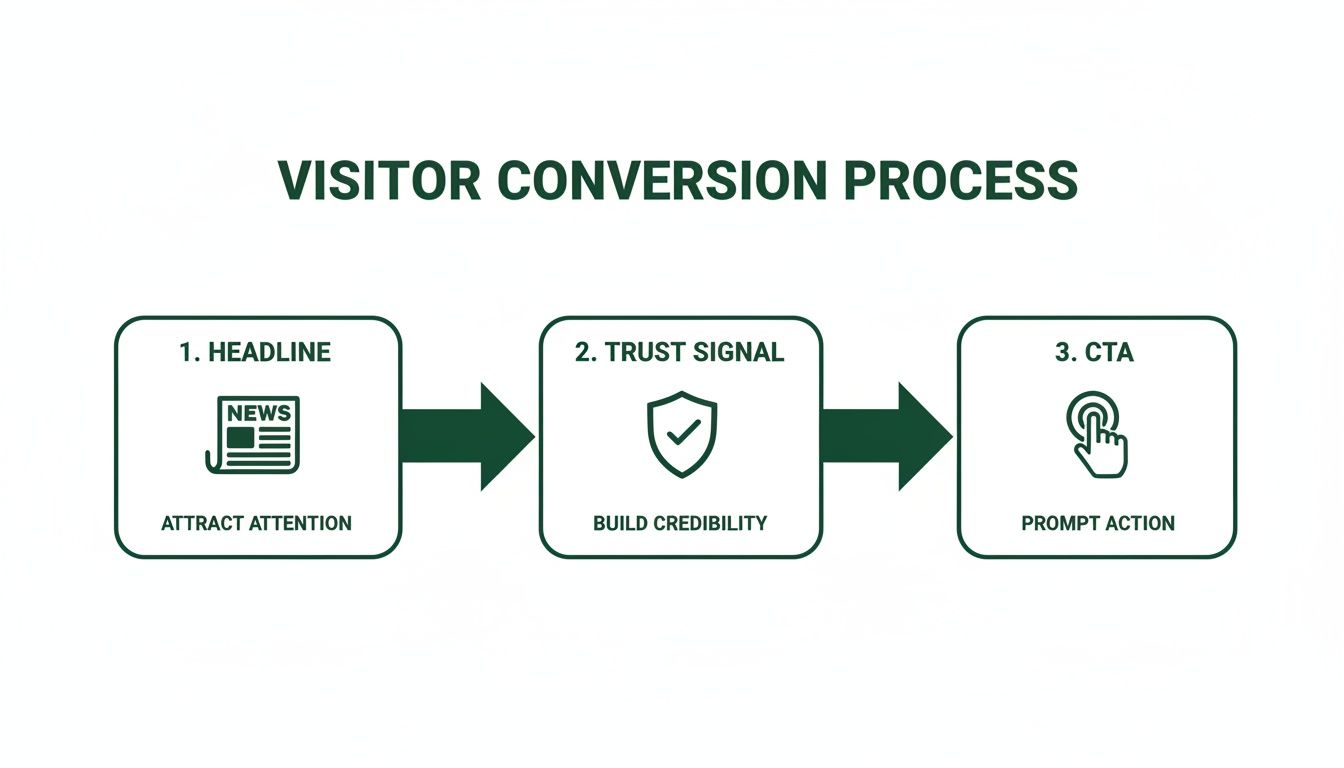
The visual flow makes it clear: a compelling headline, backed up by trust signals, is the most direct path to a successful call-to-action.
How to Measure Your Landing Page Success
Creating a landing page without tracking its performance is like driving with your eyes closed. You might be moving, but you have no idea if you’re actually heading in the right direction. Measuring success isn’t about vanity metrics; it’s about gathering real data to make smarter decisions.
To truly understand if your SEO landing page is doing its job, you need to zero in on a handful of key performance indicators (KPIs). These metrics give you a clear, honest picture of what’s working with your audience—and what’s not.
The Metrics That Truly Matter
Forget overwhelming dashboards filled with dozens of data points. To start, just focus on the numbers that directly connect your traffic to tangible results. These four metrics form the bedrock of measuring your landing page’s effectiveness.
Organic Traffic: How many people are finding your page through search engines like Google? Jump into Google Search Console to see your impressions (how often your page shows up in search) and clicks. A steady upward trend here is a great sign your SEO efforts are paying off.
Keyword Rankings: Are you actually ranking for your target keywords? Tracking your position shows if your on-page optimisation is hitting the mark. Climbing the rankings is a powerful signal that you're building authority and relevance.
Bounce Rate: This is the percentage of visitors who land on your page and then leave without doing anything else. A high bounce rate can be a red flag, often pointing to a mismatch between your meta description and your page content, or simply a poor user experience.
Conversion Rate: This is the big one. It’s the percentage of visitors who complete the goal you set—filling out a form, signing up for a newsletter, or making a purchase. A healthy conversion rate means your page is successfully persuading people to take action.
Setting up goal tracking in a tool like Google Analytics is non-negotiable. Without it, you can measure traffic all day long, but you'll never know if that traffic is actually generating any business value.
By keeping a close eye on these core metrics, you can shift from guesswork to a data-backed strategy. This process allows you to spot weaknesses, double down on what works, and constantly refine your landing page for better and better performance over time.
Frequently Asked Questions About SEO Landing Pages
As you start weaving landing pages into your SEO strategy, a few questions always pop up. Let's tackle the big ones head-on to clear up any confusion and make sure you're on the right track.
Can I Use My Homepage as an SEO Landing Page?
Technically, yes, but should you? Probably not. Your homepage has a tough job – it needs to introduce your brand, guide all sorts of visitors to different places, and speak to a really broad audience. It's a jack-of-all-trades.
A dedicated SEO landing page, on the other hand, is a specialist. It’s built with a single, sharp purpose: to perfectly match a specific search query. This laser-focus almost always leads to better engagement and, more importantly, higher conversion rates for the keywords you’re actually trying to rank for.
How Many Landing Pages Should I Create?
The simple answer? As many as you need to satisfy every distinct user intent you're targeting. The goal is to have a unique, purpose-built page for each specific keyword cluster, service, or location.
For a local business, that could mean a separate page for every service offered in every city you operate in. This is exactly where programmatic SEO becomes a game-changer. It lets you scale this approach, creating hundreds of highly relevant pages without the soul-crushing manual work.
The number of landing pages you need is directly tied to the number of specific customer problems you solve. Think of each page as a perfect, tailored answer to a single question.
What Is the Main Difference Between a Landing Page and a Blog Post?
It all comes down to their core job. A blog post is almost always informational. It’s there to educate your audience, build your authority on a topic, and attract people who are still in the research phase. Its main goal is to inform and build trust.
A landing page is all about action. It has one single-minded goal: to convince a visitor to do one specific thing, whether that's signing up for a demo, downloading an e-book, or buying a product.
A blog post says, “Let me teach you something.” A landing page says, “Do this now.”
Ready to stop building pages one by one and start scaling your traffic? The Programmatic SEO Hub offers the templates, tools, and step-by-step guides you need to master pSEO and future-proof your content strategy. Learn more at https://programmatic-seo-hub.com/en.
Related Articles
Mobile friendly test google: A Practical Guide to Master Mobile SEO
Even though Google’s standalone Mobile-Friendly Test tool is a thing of the past, the principle behind it is more critical than ever. The simple truth is that Google now overwhelmingly uses its...
A Practical Guide to Competitive Analysis Keywords
When we talk about competitive analysis keywords, we're really talking about the search terms that are already making money for your rivals. By digging into these, you uncover their entire...
Landing Pages SEO A Practical Guide to Rank and Convert
When we talk about SEO for landing pages, we're not just talking about general website optimisation. We're getting hyper-specific. This is the art of building and refining standalone pages...