A Practical Customer Journey Definition for Modern SEO
Let's unpack the customer journey. At its core, it's the complete story of a person's relationship with your business. It maps out every single interaction, from the very first time they hear your brand’s name all the way to becoming a loyal customer who buys again and again.
But here's the thing: this path is never a straight line. It’s more of a winding road filled with questions, comparisons, and moments of decision.
What Is the Customer Journey and Why It Matters

Think of it like planning a big holiday.
At first, you’re just dreaming about a destination. This is the Awareness stage. You might be searching for broad ideas like "best tropical islands" or "relaxing beach holidays". You’re not committed to anything yet; you're just exploring what’s out there.
Then, once a few places have caught your eye, you shift into the Consideration stage. Now you're comparing flights, checking out hotels, and looking at things to do. Your searches get a lot more specific: "flights to Bali vs. Phuket" or "all-inclusive resorts in the Maldives". You're actively weighing your options, hunting for the best fit.
Finally, you land on a decision and book the trip. This is the Decision stage. Your focus narrows right down to the practical details—payment options, booking confirmations, and getting everything locked in. This whole process, from a vague idea to a confirmed booking, is a perfect parallel to how a customer moves from being a total stranger to making a purchase.
The Customer Journey at a Glance
To make this even clearer, here's a quick breakdown of what's happening at each phase and what your main goal should be as a business.
| Stage | Customer's Mindset | Your Goal |
|---|---|---|
| Awareness | "I have a problem or a need, but I'm not sure what the solution is yet." | Attract their attention and educate them on the problem. |
| Consideration | "I know what I need. Now, which option is the best for me?" | Showcase your solution's value and build trust. |
| Decision | "I'm ready to buy. Why should I choose you over everyone else?" | Make it easy to buy and reinforce their choice. |
This simple framework helps you align your content and marketing efforts directly with what your customer is thinking and feeling at any given moment.
The Blueprint for Modern Content Strategy
Understanding this story is the key to creating content that actually connects. It gives you a blueprint for your entire SEO strategy, letting you meet people with the right answers at the exact moment they’re asking the question. Without it, you’re just creating content blindly and hoping it lands with the right person.
To get the full picture, you need to understand what a touchpoint in the customer journey is and how every interaction adds up. Every blog post, every ad, and every email is a "touchpoint" that guides the customer along their path.
The modern B2B journey spans self-serve and sales-led touchpoints, individual and account-level behaviours, and a mix of digital and human interactions—all scattered across different tools and teams. No two journeys are the same.
This is exactly why a journey-led approach is so powerful. By mapping these stages, you can spot repeatable patterns in what your audience is searching for. This is non-negotiable for mastering search intent mapping and creating content that serves a real user need. Better yet, it lays the perfect foundation for scaling your content production with AI and programmatic SEO, ensuring every single piece you create has a clear purpose.
The Five Key Stages of the Modern Customer Journey
To really get to grips with the customer journey, it helps to think of it as a story with five distinct chapters. In each chapter, your customer’s mindset, needs, and what they’re searching for all shift. Understanding these stages is the key to creating content that lands perfectly, right when they need it most.
Let's break down this playbook.
Stage 1: Awareness
This is where the story begins. The customer has a problem or a need, but they might not even have a name for it yet. They are miles away from thinking about specific products or brands. Right now, they’re just trying to get a handle on their pain point, asking broad questions to understand what’s going on.
Imagine someone whose houseplants keep dying. Their searches at this stage are purely informational:
- "why are my plant leaves turning yellow"
- "how much light do indoor plants need"
- "common houseplant mistakes for beginners"
Your goal here isn't to sell a thing. It’s to be the helpful expert providing clear, straightforward answers. Blog posts, simple guides, and short videos that tackle these foundational questions are perfect for attracting an audience at the very start of their journey.
Stage 2: Consideration
Once they understand the problem, they move into the solution-seeking phase. They’re now aware of potential fixes—be it products, services, or different methods—and their focus shifts to comparing them. They're weighing up their options, looking for the best fit.
Our plant owner now knows they have a lighting or watering problem. Their searches become more targeted and comparative:
- "best grow lights for low-light apartments"
- "self-watering pots vs moisture meter"
- "[Brand A] grow light reviews"
This is your moment to introduce your solution. Your content should be all about demonstrating value and building trust. Think comparison articles, detailed case studies, and product demos—they're incredibly effective here.
Stage 3: Decision
The customer is now on the brink of making a choice. They’ve done their research, narrowed down their options, and are looking for that final nudge to confirm their decision. Their searches become highly specific and often include transactional keywords that signal they’re ready to buy.
At this point, the plant owner is pulling out their wallet. They might search for:
- "[Brand A] grow light discount code"
- "where to buy [Specific Product Name]"
- "free shipping for [Brand B] plant supplies"
Your content should make it ridiculously easy to buy. This means clear pricing pages, genuine testimonials, free trial offers, and a checkout process that’s a breeze. This is where you close the loop and turn a prospect into a customer.
Stage 4: Retention
The journey doesn’t end with the purchase. In many ways, it’s just getting started. The Retention stage is all about making sure your new customer has a fantastic experience with your product or service. A happy customer is far more likely to buy from you again.
The modern digital journey is fluid. For instance, many consumers in Germany expect a seamless balance between online and in-store experiences. The e-commerce sector there shows strong resilience, with 91% of consumers ordering online, and mobile plays a huge role in the early discovery stages. This just highlights the need for brilliant post-purchase support across all channels. Your content should be supportive and educational, helping them get the most out of what they bought.
A successful retention strategy is built on proactive support. Instead of waiting for customers to have problems, anticipate their needs with helpful content that reinforces the value of their decision.
This includes things like onboarding emails, how-to video tutorials, and easy access to a comprehensive knowledge base.
Stage 5: Advocacy
The final and most powerful stage is Advocacy. This is when a satisfied customer becomes a vocal champion for your brand. They don't just stick around; they actively tell others about their positive experience, creating a potent cycle of word-of-mouth marketing. When you deliver a great experience, you create the foundation for content personalization that really connects, turning customers into your biggest fans.
Advocacy is driven by excellent service and a strong sense of community. You can encourage it by:
- Implementing a referral programme: Reward customers for bringing new people into the fold.
- Encouraging user-generated content: Feature customer photos or stories on your social media.
- Requesting reviews and testimonials: Make it easy for happy customers to share their feedback.
When you successfully guide a customer all the way to this stage, they become your most effective marketers, period.
How to Create Your First Customer Journey Map
Mapping the customer journey can sound like a huge, complicated project reserved for data science teams. But it's way more straightforward than you think. This is where we stop talking theory and start doing. You don’t need fancy, expensive tools or a PhD in marketing to build a genuinely useful map. All it takes is a willingness to see things from your customer's perspective and a few logical steps.
The point isn't to create some perfectly polished document that gets filed away and forgotten. We're building a living, practical guide. One that shows you exactly where customers get stuck and what content you need to create to help them move forward.
Start With a Clear Objective
Before you even think about drawing a single box or arrow, you need to know why you're making this map. What's the goal?
Are you trying to figure out why your shopping cart abandonment rate is so high? Maybe you want to improve the onboarding experience for new sign-ups. Or perhaps you just want to find the gaping holes in your blog content.
Pick one specific, measurable goal. This focus is critical. It stops the map from spiralling into a complex mess and makes sure it gives you real, actionable insights. For example, your objective could be: "Pinpoint the top three friction points on our website that stop users from starting a free trial."
Just by defining a clear goal, you turn this from a fuzzy marketing exercise into a focused problem-solving mission.
Identify and List All Customer Touchpoints
Next up, make a list of every single place and moment a potential customer interacts with your brand. These are your touchpoints. Don't hold back here—this is a brainstorming phase, so no touchpoint is too small or insignificant.
To get the ball rolling, think about common interaction points:
- Digital Channels: Your website, blog posts, social media profiles, online ads, and email newsletters.
- Sales Interactions: Demo calls, follow-up emails from the sales team, and face-to-face meetings.
- Customer Support: Help desk articles, live chat conversations, support tickets, and phone calls.
- Third-Party Platforms: Review sites like G2 or Capterra, online forums, and mentions in industry articles.
The best way to do this is to walk through the journey yourself. Go from discovering your brand for the first time all the way to becoming a loyal customer. What did you click on? What did you read? Who did you talk to? This process will reveal the entire path and highlight why solid data sourcing practices are so crucial for gathering this kind of information effectively.
Understand Customer Actions and Emotions
With your list of touchpoints in hand, it's time to dig a little deeper. For each one, you need to understand three key things: the customer's actions, their questions, and their feelings. This is the part that breathes life into your map and makes it truly empathetic.
This diagram helps visualise the core stages where these interactions typically happen.
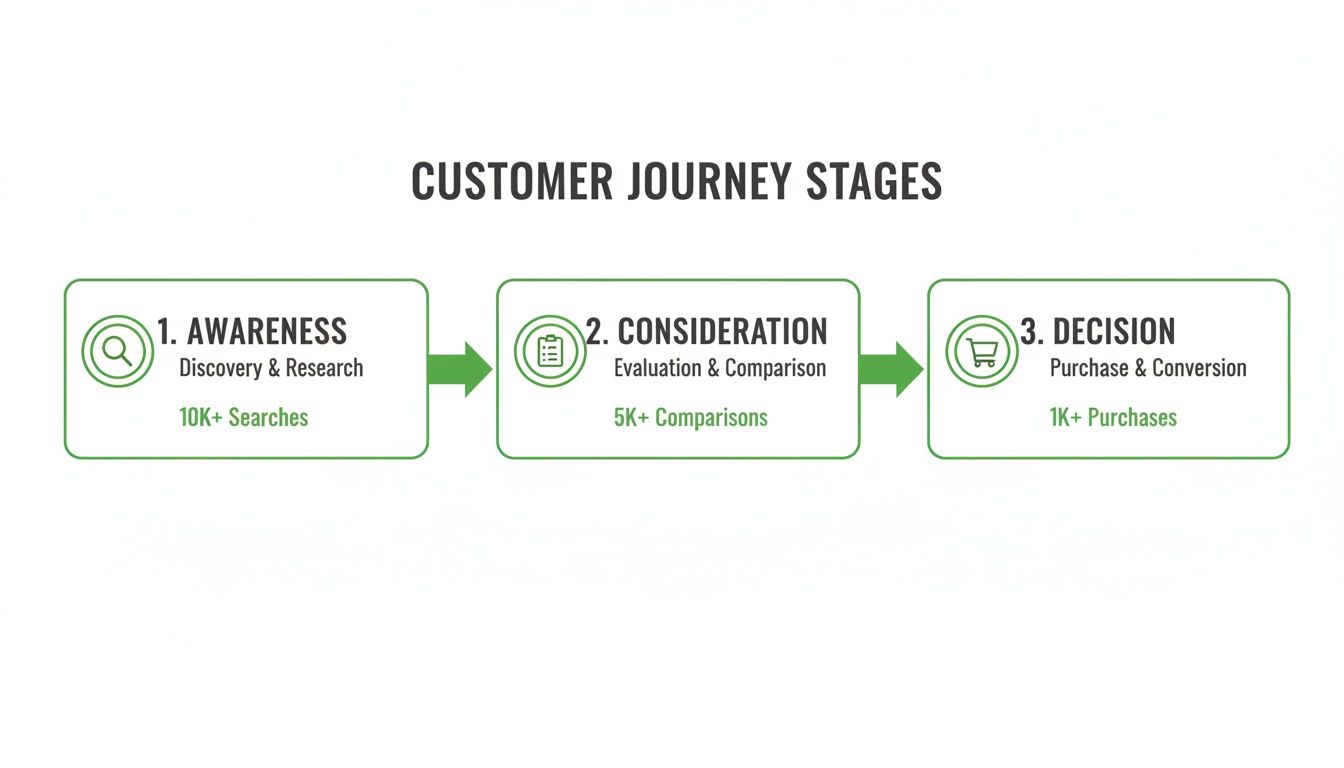
As you can see, a customer’s mindset shifts dramatically. They go from the broad, open-ended exploration in the Awareness stage to a much more focused evaluation when they reach the Decision stage.
So, how do you find this information? You don't have to guess. Use real data from tools you probably already have.
Your customer journey map must be built on evidence, not assumptions. Use Google Analytics to see where users drop off. Read support tickets to hear their frustrations in their own words. Look at customer survey responses to understand how they really feel.
Let's take the "Read a blog post" touchpoint as an example:
- Action: The customer clicks a link from a Google search and starts reading your article.
- Question: "Does this content actually solve my specific problem?"
- Feeling: Hopefully, they feel informed and helped. But if the article is confusing or misses the mark, they might feel frustrated or disappointed.
Mapping these elements out for each touchpoint shows you the emotional highs and lows of the entire experience.
Pinpoint the Pain Points and Opportunities
The final step is to step back, look at your map, and identify the pain points. These are the moments of friction, confusion, or frustration where customers either struggle or give up entirely. Maybe your pricing page is a mess, or your sign-up form asks for way too much information.
Every single pain point is a golden opportunity. It's a flashing neon sign telling you exactly what to fix or what content to create.
If people are leaving right after reading a blog post, maybe the call-to-action isn't clear enough. If they get confused during onboarding, perhaps you need a series of simple how-to videos.
By pinpointing these specific problems, your customer journey map becomes more than just a diagram. It becomes a strategic blueprint for your content and your business growth, telling you precisely where to focus your energy for the biggest impact.
How to Use AI for Programmatic SEO: A Practical Guide
Okay, you have your customer journey map. This isn't just a diagram; it’s a goldmine showing exactly what customers search for. Now, let’s turn those insights into a powerful content engine using programmatic SEO and AI.
Forget the technical jargon. This is a simple, three-step process to create high-quality content at a massive scale. It's about answering thousands of specific customer questions efficiently, making your brand the go-to authority in your niche.
Step 1: Find Your "Repeatable" Search Patterns
Your journey map will show you that customers often search using predictable formulas. They just swap out a few key words. These are your "repeatable search patterns," and they are the secret to programmatic SEO.
Look at the Consideration stage. A very common pattern is comparison. People search for things like:
- "[Your Product] vs [Competitor A]"
- "[Your Product] vs [Competitor B]"
- "[Your Product] vs [Competitor C]"
The pattern is clear: [Your Product] vs [Competitor Name]. The only thing changing is the competitor’s name. This is a perfect opportunity. You can create a page for every single competitor comparison, targeting users who are ready to make a decision.
Step 2: Create a Simple "Fill-in-the-Blanks" Content Template
A template is just a pre-built structure for your article. It’s like a recipe that ensures every page you create is consistent and genuinely helpful. You don't need special software; a simple document is fine.
For our [Product] vs [Competitor] example, a practical template would look like this:
- Headline: [Your Product] vs [Competitor Name]: Which is Right for You?
- Quick Intro: Briefly introduce both products.
- Comparison Table: A simple side-by-side table comparing key things like Price, Top Features, and Ease of Use.
- Key Differences: A few paragraphs explaining the biggest pros and cons of each.
- The Verdict: A clear recommendation: "Choose [Your Product] if you need..." and "Choose [Competitor Name] if you prefer..."
- Next Step: A clear call-to-action, like "Start Your Free Trial."
This structure isn’t fluff. It directly answers the user’s question in a clear, easy-to-digest format.
Step 3: Use AI to Write the Content (with Your Data)
Now for the magic. Instead of a human writer spending days creating 50 of these pages one by one, you use AI to do the heavy lifting in minutes.
First, you need your data. This is just a simple spreadsheet. For our example, each row would be a competitor, with columns for their name, price, top features, etc. This data, combined with your template, is all the AI needs.
The goal of using AI is not to replace you, but to make you faster. You provide the strategy (the template) and the facts (the data). The AI's job is to assemble it all into a well-written article, freeing you up to find the next big opportunity.
You feed the AI a prompt that includes your template and the data for one competitor. It then generates the full article. You can learn exactly how to write these instructions by checking out our guide on crafting the perfect AI page content generation prompt. This ensures you get high-quality results every time.
This data-driven approach is the future. The Customer Journey Analytics market in Europe, valued at USD 2,870.04 million in 2022, is projected to hit USD 12,365.34 million by 2030. This growth is fueled by the need to understand complex user paths, especially with 58% of online shoppers using mobile in 2023. By using AI to create content that mirrors these journeys, you're building a strategy for where the market is headed. You can explore the latest findings on the Europe Customer Journey Analytics market to see how data is shaping everything.
Programmatic Content Ideas for Each Journey Stage
This simple method works for every stage of the customer journey. You just need to find the right repeatable pattern.
This table gives you some concrete examples of how you can apply this thinking across the entire customer journey, turning search patterns into scalable content.
| Journey Stage | Programmatic Content Idea | Example Search Query Pattern |
|---|---|---|
| Awareness | Create pages defining key terms in your industry. | "what is [industry term]" or "[concept] explained" |
| Consideration | Build pages comparing your solution to alternatives. | "best [product category] for [specific user type]" |
| Decision | Generate pages for integrating your tool with others. | "[your product] + [another tool] integration" |
| Retention | Produce detailed tutorials for specific features. | "how to [perform a task] in [your product]" |
By systematically spotting these patterns in your journey map and applying this template-and-AI workflow, you can build a massive library of genuinely helpful content. This is how you answer thousands of niche questions, cementing your brand as the go-to resource and driving organic growth that lasts.
Essential Tools and Metrics for Journey-Led Growth

A great strategy is only as good as your ability to prove it works. Once you’ve mapped out the customer journey definition and started rolling out content, you absolutely need a way to track what’s landing and what’s falling flat. This isn’t about drowning in data; it’s about picking the right tools and, more importantly, focusing on the right metrics for each stage of the journey.
You don’t need a giant budget or a dedicated analytics team to get started. A few accessible tools can give you incredible insights into how people move through your site, where they get stuck, and what they’re actually thinking. The whole point is to make smarter, data-driven decisions that fine-tune your strategy over time.
Choosing Your Measurement Toolkit
Getting a complete picture of user behaviour means combining a few key tools. This mix gives you both the "what" and the "why" behind your numbers.
- Google Analytics 4 (GA4): This is your command centre. It shows you which pages pull people in, how long they stick around, and the paths they take through your content.
- Heatmap Tools (like Hotjar or Clarity): These are brilliant. They visually show where users click, scroll, and hover, highlighting friction points that raw analytics would never reveal.
- Simple Survey Tools (like Google Forms or Typeform): Sometimes, the best way to understand your customers is just to ask them. A quick pop-up or email survey can deliver priceless feedback.
This obsession with tracking is only growing. In Germany alone, the Customer Experience Management (CEM) market rocketed to USD 847.2 million in 2023. That’s a massive investment in tools designed to monitor every interaction. As journeys become a hybrid of online and offline touchpoints, this kind of tracking is essential to see the full picture.
Matching Metrics to Journey Stages
This is where the real magic happens. Stop obsessing over vanity metrics and start tying specific data points to each stage of the customer journey. This is how you find out if your content is actually doing the job you designed it for.
Different numbers matter at different times. An impression is fantastic for awareness, but it’s pretty meaningless at the decision stage. Context is everything.
Forget about universal KPIs. The smartest measurement strategy connects specific metrics to the goal of each journey stage. This turns a spreadsheet of data into a clear story of what’s working and what’s not.
To really get this right, especially with modern tech, looking into the 12 best AI SEO tools for 2025 is a smart move. These tools can automate much of the analysis, giving you a much deeper view into performance.
A Stage-by-Stage Measurement Plan
Let’s get practical. Here’s a breakdown of which metrics are most meaningful for each chapter of your customer’s story. This framework helps you cut through the noise.
1. Awareness Stage Metrics
The goal here is simple: reach and initial interest. Are people even finding you?
- Organic Impressions: How often your content shows up in search results.
- Keyword Rankings (for top-of-funnel terms): Your visibility for those broad, problem-focused searches.
- New Users: The number of first-time visitors hitting your site.
2. Consideration Stage Metrics
Now, we’re measuring deeper engagement. Are people sticking around to learn more and starting to trust you?
- Average Engagement Time: How long people are actively spending with your content.
- Click-Through Rate (CTR) to Product Pages: A clear sign your informational content is guiding users toward your solutions.
- Newsletter Sign-ups: A powerful indicator of genuine interest.
3. Decision Stage Metrics
This is where the rubber meets the road. Is your content converting interest into action?
- Conversion Rate: The percentage of users who take that final step (like a trial sign-up or purchase).
- Cost Per Acquisition (CPA): How much it costs, on average, to win a new customer.
- Shopping Cart Abandonment Rate: Helps you pinpoint last-minute friction before the sale.
Of course, measuring these conversions properly means knowing which touchpoints actually made a difference along the way. To get a better handle on this, it's worth digging into the fundamentals of attribution modelling.
By aligning your tools and metrics with the customer journey, you create a powerful feedback loop. You’ll know exactly what’s driving growth and where to double down on your efforts next.
Putting Your Journey-Driven Content Blueprint into Action
Alright, let's bring this all together. We’ve defined the customer journey, walked through the core stages, and even looked at how to scale content with programmatic SEO and AI. The biggest lesson? Understanding your customer's story is the single most powerful tool you have.
The key is to start small and prove the concept works. Don't try to do everything at once.
This isn't about boiling the ocean. It's about taking one focused step forward. Your first success, no matter how small, becomes the foundation for everything that follows.
This approach keeps things manageable and, more importantly, shows value quickly.
Your Launchpad for Growth
Here’s a simple, three-step plan to get you from learning to doing:
- Pick One Persona: Forget mapping the journey for every single customer type. Choose your single most important persona and put all your energy into understanding their experience first.
- Map Their Path: Trace their story from the first spark of awareness right through to their final decision. Along the way, identify the key questions they ask and the pain points they hit.
- Find One Repeatable Opportunity: Look for a single, scalable content pattern. This could be something like a product comparison or a simple "how-to" guide. Create a small test batch of pages and see what happens.
Think of this as your launchpad. By taking these first deliberate steps, you’ll build a content strategy that doesn't just meet customer needs—it anticipates them. That's how you drive sustainable, predictable growth for your business.
Frequently Asked Questions
Once we get past the theory of customer journeys and how they fit into a modern content strategy, a few practical questions always pop up. Here are some straightforward answers to help you get started.
What’s the Biggest Mistake People Make When Creating a Customer Journey Map?
The most common trap is building a map based on pure guesswork instead of real data. A journey map is only as good as the truth it reflects. If it’s based on how you think customers behave, rather than how they actually do, it’s basically useless.
You absolutely have to ground it in reality. Dig into your analytics, send out customer surveys, read through support tickets, and talk to your sales team. Another classic mistake is treating the map as a one-and-done project. Customer habits shift, so your map needs to be a living document that you revisit and tweak regularly.
How Can a Small Business with Limited Resources Actually Use These Ideas?
Start small and simple. You don’t need fancy, expensive software to get going on your customer journey definition and map. Just focus on one core customer persona and sketch out their journey. A simple spreadsheet or even a whiteboard will do the job perfectly.
When it comes to content, don't try to boil the ocean. Fire up a free tool like Google Analytics and find one high-impact, repeatable content pattern. A great place to look is the consideration stage, with queries like 'best [product] for [specific need]'. From there, create a small, manageable batch of 10-20 programmatic pages to prove the concept. Once you see it working, you can build from there.
Is Programmatic SEO Just for Big E-commerce Sites?
Not at all. While e-commerce stores are a textbook example, programmatic SEO is a powerhouse for any business that has structured data and repeatable user intent patterns. If your customers are asking similar questions with slightly different variables, programmatic SEO can help you answer all of them at scale.
We see this work across a huge range of businesses:
- Publishers (think city or event guides)
- SaaS companies (building out libraries of integration or 'alternative to' pages)
- Service businesses (generating pages for every location they serve)
- Affiliate sites (scaling out thousands of product comparisons)
Will Google Penalise Me for Using AI to Create Programmatic SEO Content?
Google's stance on this is actually pretty clear: they reward high-quality, helpful content, no matter how it’s made. The magic word here is value.
If you're using AI to churn out thin, spammy, or unhelpful pages, then yes, you’re asking for trouble. But if you're using AI as a tool to scale genuinely helpful, well-structured content that nails a specific user query—like we've been talking about—then you're perfectly aligned with Google's guidelines.
The focus should always, always be on the user's intent and the quality of the answer. When you get that right, AI is just a powerful way to serve your audience better and faster.
Ready to scale your content strategy? At Programmatic SEO Hub, we provide the templates, systems, and practical guides you need to master programmatic SEO and GEO. Explore our free resources today.
Related Articles

Mobile friendly test google: A Practical Guide to Master Mobile SEO
Even though Google’s standalone Mobile-Friendly Test tool is a thing of the past, the principle behind it is more critical than ever. The simple truth is that Google now overwhelmingly uses its...
A Practical Guide to Competitive Analysis Keywords
When we talk about competitive analysis keywords, we're really talking about the search terms that are already making money for your rivals. By digging into these, you uncover their entire...
Landing Pages SEO A Practical Guide to Rank and Convert
When we talk about SEO for landing pages, we're not just talking about general website optimisation. We're getting hyper-specific. This is the art of building and refining standalone pages...