Your Practical Guide to Content Marketing for SEO

Content marketing for SEO isn't just about stuffing keywords into a blog post. It’s the art and science of creating genuinely useful, relevant content that attracts a specific audience, ultimately helping you climb the search engine rankings.
At its core, it's about one thing: answering your audience's questions. Solve their problems, and you'll naturally earn their trust and, in turn, visibility on Google. It's about becoming the most helpful resource they can find.
Why Your SEO Depends on Great Content

Imagine your website is a specialist shop. Great content is the expert, friendly assistant working there. When a customer comes in with a problem, this assistant doesn't just point to a random product. They listen, understand what the person really needs, and offer advice that actually helps. This is what builds trust and makes your shop the go-to place.
In the same way, content marketing for SEO has three clear goals that are vital for search success:
- Attract the Right Audience: Your content acts like a magnet, pulling in people who are actively searching for the solutions you offer.
- Build Unbreakable Trust: When you consistently provide valuable information, you establish your website as an authority—a reliable source people can count on.
- Guide Users Toward Action: Helpful content doesn't need a hard sell. It naturally leads people from awareness to consideration and, eventually, to becoming a customer.
Understanding Modern Search Behaviour
In an era of AI-powered search, being that trusted guide is more critical than ever. Search engines are getting smarter, and their main job is to reward websites that satisfy a user's needs better than anyone else. That means the old tricks—thin, keyword-stuffed articles—are completely dead.
This is especially true in savvy markets. For example, a staggering 68% of all online journeys in Germany start with a search engine, and German users tend to spend more time carefully evaluating the results before they click. To meet these high expectations, your content has to be credible and engaging enough to hold their attention for at least three minutes.
The core principle is simple: If you create the best answer on the internet for a specific query, search engines will want to show it to their users. Your content becomes the solution, not just another search result.
From Keywords to Conversations
Ultimately, modern content marketing for SEO is about shifting your focus. Stop chasing keywords and start answering the questions behind the keywords. It’s about understanding what a user is trying to accomplish and creating content that helps them get it done. To really master blogging and content marketing, this mindset is everything.
This user-first approach doesn't just help you rank higher; it helps you connect with your audience in a meaningful way. When you create content that serves the user above all else, you build a powerful, sustainable foundation for long-term organic growth. A great place to start is by learning how to find the right queries in our guide on long-tail keywords.
Building Your Winning SEO Content Blueprint
Before you write a single word, you need a plan. A great content strategy is like a blueprint for a house; it ensures everything you build is strong, serves a purpose, and connects logically. For SEO, that blueprint rests on three core pillars that work together to attract and satisfy your audience.
These aren't just abstract concepts. They're the practical steps you take to give every piece of content the best possible shot at ranking, engaging, and ultimately, converting.
Pillar 1: Understand the "Why" with Search Intent
The first and most important step is getting inside your reader's head to understand the "why" behind their search. This is search intent, and it’s about playing detective to figure out what someone is really trying to do when they type a query into Google.
Think of it this way: a person searching for "best running shoes" is in a completely different frame of mind than someone searching for "how to clean running shoes." The first person is probably looking to buy, while the second just needs a quick answer.
Understanding search intent is the secret to creating content that genuinely helps. When you match your content to the user's goal, you give Google exactly what it wants: a happy, satisfied searcher.
There are four main types of search intent to keep in mind:
- Informational: The user wants to learn something (e.g., "what is programmatic SEO").
- Navigational: The user wants to get to a specific website (e.g., "Programmatic SEO Hub blog").
- Commercial: The user is doing their homework before a purchase (e.g., "Outrank vs Jasper AI").
- Transactional: The user is ready to pull out their wallet (e.g., "buy SEO content software").
To make this crystal clear, it helps to map different content types directly to what the user is trying to accomplish.
Matching Content Types to Search Intent
| Search Intent | What the User Wants | Best Content Format Examples |
|---|---|---|
| Informational | Answers, explanations, or how-to guidance. | Blog posts, "What is..." articles, tutorials, guides. |
| Navigational | To land on a specific page or brand's website. | A well-optimised homepage, an "About Us" page. |
| Commercial | Comparisons, reviews, and detailed feature breakdowns. | "Best of" lists, product comparisons, reviews, case studies. |
| Transactional | A direct path to purchase or sign-up. | Product pages, service pages, pricing pages. |
This table is your quick-reference guide. If you know the intent, you know what kind of content to create.
Pillar 2: Speak Their Language with Topic Clusters
Once you understand what your audience wants, you need to organise your knowledge in a way that makes sense to both them and the search engines. Forget just "finding keywords" and start thinking about building a complete digital library on a subject. The best way to do this is with topic clusters.
A topic cluster is a group of interlinked articles that all revolve around one central theme. You have one big "pillar page" that covers a broad topic, and then several "cluster pages" that dive deep into specific subtopics.
For example, your pillar page might be "A Complete Guide to Content Marketing." Your cluster pages could then be things like "How to Do Keyword Research," "Writing Your First Blog Post," and "Measuring Content ROI." This structure signals to search engines that you're a true authority on the entire subject. To learn more, explore our detailed breakdown of the hub-and-spoke model for organising your content.
Pillar 3: Build Your Reputation with E-E-A-T
The final pillar is all about proving you’re a source people can trust. Google uses a framework called E-E-A-T, which stands for Experience, Expertise, Authoritativeness, and Trustworthiness. This isn't just a buzzword; it’s a practical checklist for building a solid digital reputation.
In short, you need to create content that shows you know what you're talking about because you've actually done it.
Here’s how to put E-E-A-T into practice:
- Show, Don't Just Tell: Include real-world case studies, personal anecdotes, or unique data you've gathered. If you're explaining a process, show screenshots of yourself doing it.
- Credit Your Sources: Back up your claims by linking out to reputable studies, official reports, and other authoritative sites.
- Establish Author Bios: Create clear author pages that highlight the writer’s credentials and real-world experience in the subject.
- Gather Social Proof: Feature customer testimonials, reviews, and expert endorsements. Trust is built when other people vouch for you.
How to Practically Use AI for Programmatic SEO
"Programmatic SEO" might sound complex, but the idea is simple. Think of it like a mail merge, but for creating web pages instead of letters.
You start with a master template for a page, like "Best {Service} in {City}". Then, you get a spreadsheet full of data—a list of services and a list of cities. Programmatic SEO automatically combines your template and your data to create hundreds or even thousands of unique pages, like "Best Plumbers in London," "Best Electricians in Manchester," and so on.
Now, with AI, this process becomes even more powerful. Instead of just plugging in data, you can use AI to write unique, helpful paragraphs for every single page, making each one genuinely valuable.
Your 4-Step Plan for AI-Powered Programmatic SEO
This isn't a complex technical process. It's a straightforward plan that anyone can follow to create high-quality content at a massive scale.
Here are the four practical steps:
- Find Your "Repeatable" Keyword: Look for a search phrase that people use over and over, just by changing one or two words.
- Gather Your Data in a Spreadsheet: Collect the information you need to create your pages.
- Build a Smart Page Template: Design one master page layout that will work for all your variations.
- Use AI to Write the Unique Parts: Let an AI model generate the custom text for each page, saving you hundreds of hours.
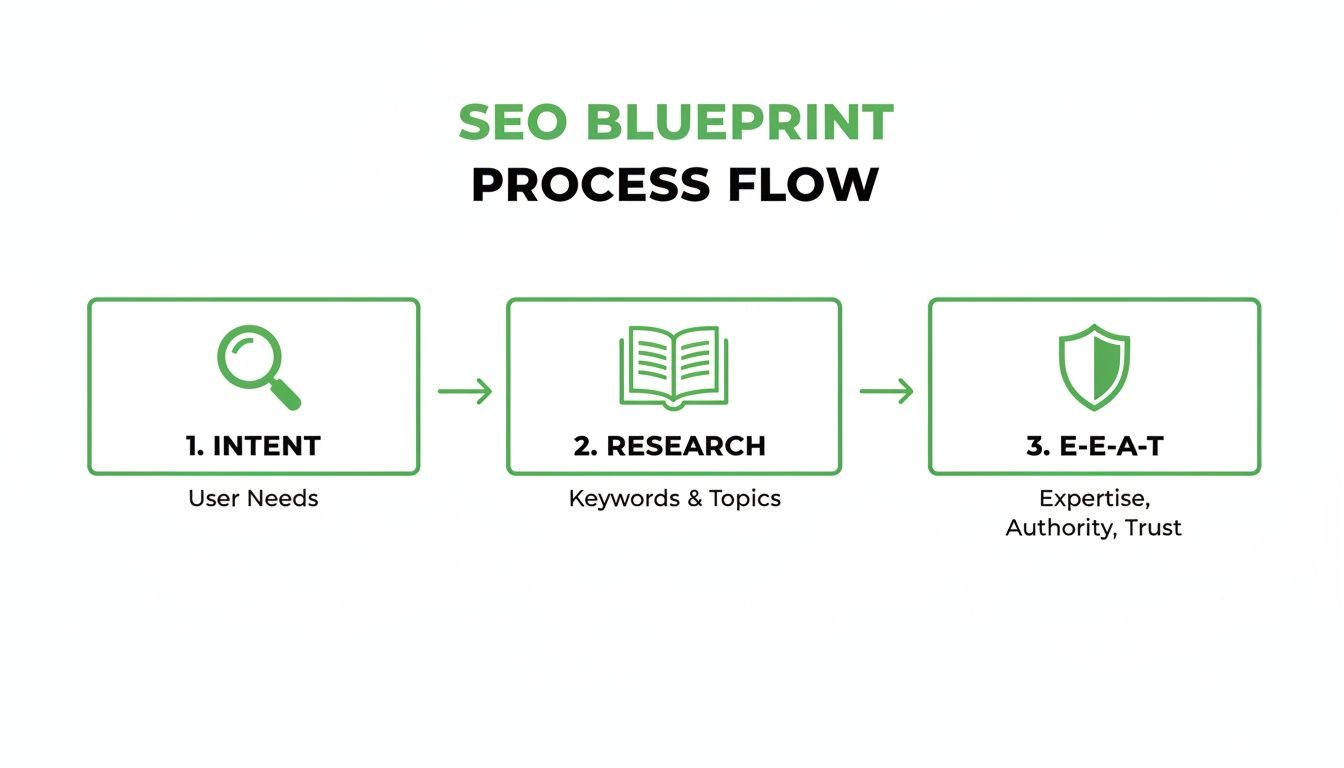
Whether you build one page or a thousand, the core principles of understanding user needs and building trust remain the same.
Step 1: Find Your "Repeatable" Keyword
The first step is to find a search pattern that your audience uses repeatedly. Think of it as a "fill-in-the-blanks" search query.
You'll see these everywhere:
best {service} in {city}(e.g., "best personal trainer in Berlin")how to integrate {software A} with {software B}(e.g., "how to integrate Slack with Google Drive"){brand} alternatives(e.g., "Mailchimp alternatives")
Your goal is to find a pattern where you can swap out the words in the {brackets} with hundreds of different options from your industry. For example, the company Zapier used the pattern "how to connect {app} and {app}" to create over 25,000 landing pages, capturing a huge amount of search traffic.
Step 2: Gather Your Data in a Spreadsheet
Once you have your keyword pattern, you need the "blanks" to fill in. This data is what makes each page unique and helpful. A simple Google Sheet or Airtable base is perfect for this.
If your pattern is "best dog parks in {city}," your spreadsheet would have columns for City, Park Name, Address, Opening Hours, and Special Features.
Where can you get this data?
- Your Own Data: If you sell products, this is your product information.
- Public Data: Government websites or public databases often have useful datasets.
- Web Scraping: Using tools to automatically pull public information from other websites.
The quality of your data is critical. The more unique and helpful your information is, the better your pages will be. Good data can be a huge advantage; learning the basics of scraping data for AI can be a game-changer.
Step 3: Build a Smart Page Template
Your template is the blueprint for all your pages. It’s a mix of static content (text that appears on every page) and dynamic placeholders where your spreadsheet data and AI-generated text will go.
A simple template for our dog park example might include:
- H1 Title:
{Park Name}- A Top-Rated Dog Park in{City} - Introduction: A standard intro paragraph about finding great dog parks.
- Park Details: Placeholders for
{Address},{Hours}, and{Rating}. - AI Description: A spot where the AI will write a unique description of the park.
- AI FAQ Section: A section where the AI generates 2-3 common questions about that specific park.
This structure ensures every page is consistent and well-organized, while the AI fills in the unique, creative parts. This hybrid approach is a key part of Generative Engine Optimisation. You can learn more about Generative Engine Optimisation in our article.
Step 4: Use AI to Write the Unique Parts
This is where you save incredible amounts of time. Instead of writing a description for thousands of dog parks by hand, you ask an AI to do it for you. You feed your data into an AI tool like ChatGPT along with a simple, clear instruction called a "prompt."
Example Prompt: "You are a helpful local guide. Write a friendly, 2-sentence description for a dog park page. The park is called
{Park Name}in{City}. Mention these unique features:{Feature 1}and{Feature 2}."
You can then automate this process to run for every single row in your spreadsheet. In minutes, you can generate thousands of unique, helpful paragraphs that would have taken a team of writers months to complete.
This AI-assisted approach is no longer a future concept. Across Europe, 67% of small businesses are already using AI for content and SEO, reporting a 68% average increase in their return on investment. They're achieving this by creating better content, faster. It’s the perfect way to combine the scale of automation with the quality that users and search engines demand.
Building Your Essential SEO Content Toolkit

A solid content marketing for SEO strategy needs more than just clever ideas. You need the right tools to bring those ideas to life. A well-chosen tech stack will sharpen your workflow, uncover opportunities you'd otherwise miss, and measure what actually matters. It’s about saving yourself countless hours of guesswork.
But the sheer number of options out there can be paralysing. The trick is to stop collecting tools and start building a system. Think about the specific "jobs-to-be-done" in your process, and find the right piece of software for each job.
Tools for Audience Understanding and Keyword Research
It all begins with knowing what your audience is actually typing into Google. These tools let you listen in on the market and pinpoint the exact phrases people use to find answers.
Google Keyword Planner (Free): This is ground zero for anyone getting started. It’s built right into Google Ads, giving you dependable search volume numbers and keyword ideas directly from the source. Perfect for that initial research phase.
Ahrefs/Semrush (Premium): These are the all-in-one powerhouses. Think of them as the professional standard. Beyond just keywords, they let you dissect your competitors' strategies, track your rankings, and spot technical SEO problems. They provide a depth of insight that free tools simply can’t match.
Tools for AI-Assisted Content Creation
AI is no longer a novelty; it's a powerful assistant for creating great content at scale. The right AI tools help you write faster, smash through writer's block, and make sure your content is optimised from the get-go.
ChatGPT or Claude (Freemium): These large language models are brilliant creative partners. Use them for brainstorming, structuring outlines, or even drafting entire sections. They're fantastic for getting those initial ideas down quickly. For more structured results, check out detailed guides on AI page content generation prompts.
Surfer SEO or Clearscope (Premium): These platforms are all about data-driven optimisation. They analyse the top-ranking content for your keyword and give you a detailed brief on what topics to cover and which terms to include. It’s like having a cheat sheet to make sure your article is comprehensive and relevant.
Platforms for Programmatic SEO Execution
When you’re ready to scale your content production, you'll need tools to manage your data and automate the creation of hundreds or thousands of pages.
Programmatic SEO tools are the assembly line for your content factory. They connect your data (the raw materials) with your template (the blueprint) to produce finished pages at scale.
Airtable or Google Sheets (Freemium): Your programmatic project is only as good as its data. These powerful spreadsheet tools are perfect for organising your datasets—be it a list of cities, products, or services. They become the central database for your entire operation.
Whalesync or Zapier (Premium): Think of these tools as the "glue" holding your system together. They automate the connection between your data and your website, taking a row from a spreadsheet and seamlessly turning it into a new, fully-populated page on your site.
Tools for Performance Tracking and Analytics
Finally, you have to measure what you’ve built. If you can’t track it, you can’t improve it. These tools give you the hard data you need to prove your content's value and fine-tune your strategy.
Google Search Console (Free): This is completely non-negotiable. It shows you precisely which search queries are bringing people to your site, how your pages are performing, and if any technical gremlins are holding you back.
Google Analytics 4 (Free): While Search Console tells you how people find you, Analytics tells you what they do once they arrive. Here, you can track user behaviour, conversions, and see which pieces of content are actually driving valuable traffic.
Measuring the SEO Metrics That Actually Matter
Creating the content is only half the job. To figure out if all that hard work is actually moving the needle, you have to measure what matters. It's incredibly easy to drown in a sea of data, but a smart content marketing for SEO strategy cuts through the noise and focuses on metrics that signal real business impact, not just empty numbers.
Let's be honest, high traffic figures can be a trap. Getting a thousand visitors who bounce immediately is far less valuable than getting a hundred who are genuinely interested in what you have to say. The goal isn't just clicks; it's getting the right clicks that prove your content is delivering on its promise.
Moving Beyond Vanity Metrics
To get a real sense of performance, we need to look past simple traffic counts. Instead, we should focus on key performance indicators (KPIs) that tell a story about genuine audience engagement and whether we’re getting closer to our goals.
These are the metrics that show whether your content is truly resonating and pushing people to take meaningful action.
Organic Traffic to Key Pages: Don't just look at sitewide traffic. Zoom in on the organic traffic hitting your most important pages—the ones that actually make you money, like service pages, product pages, or cornerstone articles. Is your new content driving qualified visitors to these critical destinations?
Keyword Rankings for High-Intent Terms: Tracking your rank for every keyword under the sun is a waste of energy. Focus on monitoring your position for keywords that signal a user is close to making a decision. Ranking on page one for something like "buy SEO content software" is infinitely more valuable than a high rank for a broad, informational term.
Engagement Signals: Simple metrics like Time on Page and Bounce Rate are direct clues about your content's quality. If people are sticking around, it’s a powerful signal to search engines that you’re providing value.
Setting Up a Simple Performance Dashboard
You don't need fancy, expensive software to get started. You can build a surprisingly powerful dashboard using the free tools Google gives you, providing all the essential data needed for smart decisions.
Google Search Console (GSC): This is your direct line to Google. Use it to see exactly which search queries bring users to your site (Impressions and Clicks) and your average ranking position for those terms. It's the ultimate source of truth for organic performance. Our guide on essential Search Console metrics takes a deeper look.
Google Analytics 4 (GA4): While GSC shows you how people find your site, GA4 tells you what they do once they land. Keep an eye on metrics like Engaged sessions (users who actually spent time on your site) and Conversions (the specific actions you want users to take, like signing up for a newsletter).
By connecting these two tools, you create a powerful feedback loop. You can see which keywords in GSC are driving the most engaged users in GA4, which allows you to double down on what’s clearly working.
This focus on quality and engagement is only getting more important. While the European SEO market is set to grow massively—forecast to hit US$43.66 billion by 2034—organic click-through rates are actually falling. The percentage of users clicking on organic results dropped to 43.5% in early 2025.
What does that mean? More competition for fewer clicks. That makes creating content that truly captures and holds attention more critical than ever. You can discover more insights about the European SEO market forecast on Vocal Media.
Common Content Marketing Mistakes to Sidestep
Learning from someone else's blunders is the best shortcut I know. Even a brilliant content marketing strategy can get bogged down by a few classic, avoidable traps. Think of this section as your field guide to the most common pitfalls that can kill your momentum before it even starts.
Dodging these mistakes isn't just about saving a bit of time or money; it's about building an organic growth engine that actually lasts. Sometimes, knowing what not to do is just as powerful as knowing what to do.
Prioritising Quantity Over Quality
With AI tools making it easier than ever to pump out articles, the temptation to go for volume is huge. But let me be clear: flooding the internet with hundreds of mediocre, unhelpful posts is one of the fastest ways to lose trust with both your audience and the search engines.
One truly exceptional, deeply researched article will always, always outperform ten thin, generic ones.
Your goal isn't to be the loudest voice in the room. It's to be the most trusted one. Quality is what builds authority and attracts high-value backlinks naturally—a foundation that sheer quantity can never replicate.
Ignoring Audience and Search Intent
Another massive pitfall is creating content based on what you assume your audience wants, rather than what they're actually typing into Google. Writing a masterpiece on a topic nobody is looking for is like opening a beautiful shop on a street no one ever walks down.
Your starting point should always be keyword research and a serious look at search intent. Get in the user's head and ask:
- What specific problem are they trying to solve with this search query?
- What format would be the most helpful for them? A checklist? A how-to guide? A video?
- Does my content answer their question so completely that they don't need to hit the "back" button?
Believing "If You Build It, They Will Come"
Hitting "publish" and then just hoping for the best is a strategy for failure. Content promotion isn't an afterthought you tack on at the end; it's a core part of the entire process. Without a solid distribution plan, even the most incredible content will just sit there, unseen.
Start thinking about promotion before you even write the first word. Your plan might involve sharing it across your social channels, sending it to your email list, or doing targeted outreach to get backlinks from other relevant sites.
Lacking Patience and Realistic Expectations
This might be the biggest mistake of all: giving up too soon. SEO is a marathon, not a sprint. It simply takes time for search engines to crawl, index, and start to understand the value of your content. You might spot some encouraging signs within a few months, but significant, stable results often take a good 6–12 months to materialise.
Set realistic expectations from day one. Track your progress, celebrate the small wins like ranking for a new keyword, and just stay consistent. Patience truly is the secret ingredient that transforms good content into a long-term, traffic-driving asset.
A Few Common Questions About Content Marketing and SEO
Once you get past the fundamentals, a few practical questions always seem to pop up. Let's tackle some of the most common ones head-on with clear, straightforward answers.
How Long Does SEO Content Take to Work?
Patience is probably the most underrated skill in SEO. You might spot some encouraging early signs—like a jump in impressions or a few keywords starting to rank—within 2-3 months. But for the kind of significant, traffic-driving results you’re really after, you should plan for a 6 to 12-month timeline.
What makes that timeline shorter or longer? A few things:
- Competition: Trying to rank in a packed, competitive niche is always going to take longer than finding a less crowded space.
- Website Authority: An established site with a healthy backlink profile has a head start and will see results faster than a brand-new domain.
- Content Quality: Genuinely fantastic content that nails the search intent can definitely speed things up.
Can I Do Content Marketing for SEO on a Small Budget?
Absolutely. You don't need a massive budget to make a real impact with content marketing for SEO. The trick is to be smart and resourceful with what you've got.
Instead of trying to be everything to everyone, focus your energy on a very specific niche to cut down on the competition. Lean on free tools like Google Keyword Planner and Google Search Console for your research and tracking. And rather than churning out a high volume of average articles, pour everything you have into creating a handful of truly exceptional, comprehensive pieces that are hands-down better than what's currently ranking.
Is AI-Generated Content Bad for SEO?
This is a big one right now. The short answer is no—AI-generated content isn't inherently bad for SEO. The problem isn't the tool; it's how you use it. Google doesn't penalise content just because an AI helped create it. It penalises low-quality, unhelpful content, no matter if a human or a machine wrote it.
Think of AI as a powerful assistant, not a replacement for genuine human expertise. It's brilliant for brainstorming ideas, structuring outlines, or getting a first draft down. But then, a human expert must step in to review, edit, and weave in unique insights, real-world experience, and an authentic voice. That hybrid approach is how you produce helpful, high-quality content at scale that both your readers and search engines will appreciate.
Ready to scale your content strategy with confidence? At Programmatic SEO Hub, we provide the guides, templates, and systems you need to master programmatic SEO and Generative Engine Optimisation. Explore our free resources and start building your organic growth engine today.
Related Articles
Mobile friendly test google: A Practical Guide to Master Mobile SEO
Even though Google’s standalone Mobile-Friendly Test tool is a thing of the past, the principle behind it is more critical than ever. The simple truth is that Google now overwhelmingly uses its...
A Practical Guide to Competitive Analysis Keywords
When we talk about competitive analysis keywords, we're really talking about the search terms that are already making money for your rivals. By digging into these, you uncover their entire...
Landing Pages SEO A Practical Guide to Rank and Convert
When we talk about SEO for landing pages, we're not just talking about general website optimisation. We're getting hyper-specific. This is the art of building and refining standalone pages...