Content in seo: Master Strategies to Rank Higher
When we talk about content in SEO, we’re talking about the very heart of your website. It's the articles, the product descriptions, the guides—all the information you strategically create and organise to show up in search results. The goal is simple: answer people's questions so well that search engines like Google can't help but send organic traffic your way.
The Role of Content as a Search Engine Signal

Think of your website as a library. Google is the librarian, and a search query is a person asking for help. The librarian’s job is to find the single best book that answers their question. Your content? That's your collection of books. If your library is full of thin, irrelevant pamphlets, the librarian has nothing good to recommend.
In that sense, content is the fuel for your entire search strategy. It’s how you tell search engines what you're an expert in. Every article or landing page you publish is another signal to Google, another chance to prove you have the answers its users are looking for.
More Than Just Words on a Page
Great content is far more than just filler. It acts as the critical bridge between what your audience is searching for and the solutions you offer. Without it, search engines have no real context for what your site is about, making it almost impossible to rank for the keywords that matter.
This is why a solid content strategy is non-negotiable. It’s the foundation upon which all other SEO efforts, like link building and technical fixes, are built. After all, what do people link to? Compelling content. And backlinks are one of the most powerful trust signals you can get.
At its core, great content proves your expertise. It demonstrates to both users and search engines that you have deep knowledge in your field, building the trust required to earn top rankings.
What Does Quality Content Achieve?
A well-thought-out content plan directly boosts your visibility and helps you hit your business goals. When you get it right, your content starts working for you.
- Attract the Right Audience: By targeting the right keywords, you pull in people who are already looking for what you offer.
- Build Topical Authority: Consistently publishing high-quality content on a subject establishes your site as the go-to resource in your niche.
- Drive Business Actions: Good content doesn't just inform; it persuades. It guides users toward that next step, whether it’s a newsletter sign-up, a demo request, or a purchase.
Ultimately, every single piece of content you create is another door for potential customers to find you. To see how this works in more advanced strategies, check out our guide on data-driven content creation. Each page is another opportunity to get discovered.
Matching Content Types to Search Intent

Creating great content in SEO isn't about throwing things at the wall and seeing what sticks. It's about getting inside your user's head to understand the why behind their search. We call this ‘why’ search intent, and it’s your single most valuable clue for crafting content that actually helps someone.
Think about it. When someone types “best running shoes” into Google, what are they really looking for? Are they just browsing, or do they have their credit card out, ready to buy? The difference is everything. When your content gives them exactly what they need in that moment, your page becomes the perfect answer.
The Four Main Types of Search Intent
To do this right, you need to understand the different mindsets a searcher might have. Every single search query fits into one of four main categories, and each one demands a totally different kind of content from you. Nail this alignment, and you’re on your way to creating pages that search engines love to rank.
- Informational Intent: The user is looking for knowledge. They want answers, tutorials, or a clear explanation of a topic. Pure and simple, they want to learn something.
- Navigational Intent: The user already knows their destination. They're just using Google as a quick way to get to a specific site or page, like searching "YouTube" instead of typing the full URL.
- Transactional Intent: This user wants to do something—and that usually means making a purchase. They are primed to buy, sign up, or download.
- Commercial Intent: This person is in the final stages of research before buying. They’re comparing products, hunting for reviews, or figuring out the best option for their needs.
Getting a handle on these categories is what separates generic, low-performing articles from pages built with a laser-focused purpose.
Choosing the Right Content Format
Once you've diagnosed the intent behind a keyword, picking the right content format is a piece of cake. A massive, in-depth guide is useless for someone ready to buy, just as a simple product page will frustrate someone looking for a detailed how-to.
Let's look at a few practical examples of matching the format to the intent:
- For Informational searches like "how to fix a leaky tap," you need to provide a complete solution. A step-by-step blog post, a detailed guide with pictures, or a video tutorial are perfect here.
- For Commercial searches like "best noise-cancelling headphones," the user is weighing their options. Deliver detailed product reviews, a "best of" listicle, or a side-by-side comparison table that breaks down features and pricing.
- For Transactional searches like "buy nike air max 90," the user is ready to pull the trigger. Give them a clean, easy-to-use product page with clear pricing, a big "Add to Cart" button, and a frictionless checkout.
When you perfectly align your content format with user intent, you're removing friction. You're giving them what they came for, which sends a massive quality signal to Google that your page is a top-tier result.
To make this crystal clear, here’s a table that connects the dots between what a user wants and the content you should create.
Matching Content Formats to User Search Intent
| User Intent | User Goal (What they want) | Effective Content Formats | Example Keyword |
|---|---|---|---|
| Informational | To learn or find an answer. | Blog posts, how-to guides, tutorials, videos, infographics. | "how to bake sourdough bread" |
| Navigational | To find a specific website. | Homepage, contact page, login page. | "facebook login" |
| Commercial | To research before a purchase. | Product reviews, comparison articles, "best of" listicles. | "best electric cars 2024" |
| Transactional | To complete a specific action. | Product pages, category pages, pricing pages, sign-up forms. | "buy iphone 15 pro" |
With this framework, you can stop guessing and start creating content with a clear, strategic purpose that meets users exactly where they are.
From Diagnosis to Creation
Let's put this into practice. Imagine you run a website about home gardening.
A user searches for "when to plant tomatoes." This is a classic informational query. Your job is to create the single most helpful resource on the internet for this question. Maybe that's a blog post called "A Gardener's Complete Timeline for Planting Tomatoes," covering timing, soil prep, and ongoing care.
Then, another user searches "buy tomato seeds online." This is purely transactional. The best response isn't an article; it's a well-organised product category page showcasing all the tomato seeds you sell, complete with sharp images, prices, and a simple way to buy. To go even deeper, you can learn more about how to define user goals in our deep dive into the nuances of search intent.
By consistently diagnosing intent first, you build a site that serves your audience at every point in their journey. This approach ensures your content in SEO stops being about just stuffing keywords and starts being about delivering real, tangible value.
Optimising Content for Maximum Impact

Once you’ve figured out what a user wants and picked the right content format, the next job is to actually build the page. You have to structure it for both human readers and search engines. Effective content in SEO isn't just about the words you choose; it's about how you organise them.
This goes way beyond the old-school advice of just stuffing keywords everywhere. Today, it’s about creating a logical path that guides the user from one idea to the next. Think of it like building with LEGOs—every heading, paragraph, and list is a block that connects to the others to create a solid, understandable structure.
Crafting a Clear and Logical Structure
A well-organised page is a dream for both people and search engines. Humans can scan it quickly, and Google can crawl it efficiently. This all starts with your headings and subheadings (H2s and H3s). These aren’t just for making things look pretty; they build a clear hierarchy that breaks down complex topics into bite-sized chunks.
Internal links are another crucial piece of the puzzle. When used correctly, they act like a roadmap for your website, connecting related articles and building a web of expertise. Every time you link from one page to another relevant one, you’re basically telling Google, "Hey, I have even more great info on this subject right over here." This helps spread authority across your site and keeps people clicking around longer.
Our guide on understanding content quality signals dives deeper into how these structural elements signal quality and contribute to higher rankings.
Moving Beyond Keywords with Semantic SEO
The real secret to building authority today lies in semantic SEO. Don't let the fancy name put you off. It’s a simple idea: instead of just collecting individual keywords (the puzzle pieces), your job is to show the entire picture.
Semantic SEO means covering a subject so comprehensively that your expertise is undeniable. It’s about answering the user’s next question before they even think to ask it.
This means your content needs to cover all the related concepts, sub-topics, and common questions. For instance, if you're writing about "sourdough baking for beginners," a semantically rich piece would naturally also cover:
- What is a sourdough starter?
- How do you feed and maintain a starter?
- What basic equipment do you need?
- What are the most common beginner mistakes?
By covering the entire topic cluster, you signal to Google that your page is a definitive resource—the only page a user will need. This is how you build genuine topical authority that lasts.
Creating Comprehensive and Authoritative Content
Authority is built on depth. While short, snappy content has its place, the data is clear: search engines reward thoroughness. In the competitive German market, for example, the average content length on the first page of Google is around 1,890 words. That tells you something important.
Longer, well-researched articles are simply more likely to satisfy a user's query completely, leaving them with no reason to go back to the search results.
Ultimately, Google’s most important ranking factors come down to links, content, and its AI system, RankBrain. Content is the one thing you have 100% control over. To keep improving your search performance, using dedicated content optimization features can give you a serious edge. When you focus on creating the most helpful, well-organised, and complete resource on a topic, you're building a powerful asset that will earn its rankings over time.
How to Use AI for Programmatic SEO
If you’ve ever used a mail merge to send personalized invitations, you already understand the core idea of programmatic SEO (pSEO). You don’t write each invitation from scratch. Instead, you create one master template and use a spreadsheet to automatically fill in unique details like names.
Programmatic SEO applies that same logic to creating website pages. It lets you generate hundreds, or even thousands, of unique pages from a single template and a dataset. It’s a powerful way to capture huge amounts of search traffic, and with modern AI, you don’t need to be a developer to make it happen.
The Basic Recipe for Programmatic SEO
The process is surprisingly simple when you break it down into four practical steps. Let’s use an example: creating pages for the keyword pattern "best digital marketing agency in [city]".
- Find a Scalable Keyword Pattern: Your first job is to find a search query people use with different variables. This is your template idea. Think of patterns like "cost of living in [city]", "[product name] for [use case]", or "[service] near [location]".
- Gather Your Unique Data: This is the spreadsheet part. For our example, this would be a list of cities. For another project, it might be product features, job titles, or local ZIP codes. This data is what makes each page unique.
- Build a Master Content Template: This is your master document. You write the core content just once, leaving placeholders where your unique data will go. For our agency example, you’d create placeholders like
[city_name]or[local_landmark]. - Generate and Publish the Pages: This is where you combine everything. You use a simple tool or script to merge your data with your template, automatically creating a brand-new page for every row in your spreadsheet.
This simple combination—a repeatable pattern plus a unique dataset—is the engine that drives programmatic SEO.
A Practical Step-by-Step Walkthrough with AI
Let's make this real. Here’s a simple, low-tech way to launch a pSEO project for "best digital marketing agency in [city]".
Step 1: Find and Validate Your Keyword Pattern
First, confirm people are actually searching for your pattern. Use a keyword tool to check the search volume for a few variations, like "best digital marketing agency in Berlin" and "best digital marketing agency in Hamburg". If there's consistent demand, you have a winner.
Step 2: Build Your Data Spreadsheet
Next, build your spreadsheet. A basic version would just have one column: city_name.
But to create truly useful content, add more columns. Think about what information a user would find helpful.
city_name(e.g., Berlin)population(e.g., 3.6 million)main_industry(e.g., tech startups)local_landmark(e.g., Brandenburg Gate)
The more unique data points you add, the more valuable and distinct your final pages will be.
Here’s a great example of what the data structure for a pSEO project can look like.
This spreadsheet from Zapier shows how they organise different data points (like name, job title, and company) into clean columns, ready to be merged into a content template.
Step 3: Create Your Master Content Template
Now, draft your master article, using placeholders for each column header from your spreadsheet.
For example, a heading could be:## Finding the Top Digital Marketing Agency in [city_name]
And a paragraph might look like this:With a bustling economy driven by its famous [main_industry] scene, [city_name] is a seriously competitive market. Choosing the right digital marketing partner is absolutely crucial for standing out. We've analysed the top agencies in the area to help you find the perfect fit for your business.
The template provides the structure, while your data provides the specific details that make each page feel relevant.
Step 4: Use AI to Create Unique Content at Scale
This is where AI makes everything easier. Instead of just plugging your data into the template, you can use AI to rewrite sections for every single page, adding unique flavor.
Here's a practical prompt you could use with an AI tool like ChatGPT:
Prompt: "Write a 100-word introduction for a blog post titled 'Finding the Best Digital Marketing Agency in [city_name]'. Use the following data points to make it unique: City Name = [city_name], Main Industry = [main_industry]. Here is the data: City Name = Berlin, Main Industry = tech startups."
By running a similar prompt for every city in your spreadsheet, you can generate hundreds of unique introductions. This helps ensure your pages are distinct, valuable, and avoid looking like spam. This is how you create content in SEO that is both scalable and genuinely high-quality. You can learn more about the technical side by exploring using natural language generation for pSEO.
The growth in this space is impossible to ignore. For instance, Germany's SEO software market is valued at USD 4.7 billion in 2024 and is projected to more than double to USD 9.8 billion by 2030. This explosive growth shows just how vital scalable, tech-driven content strategies like pSEO are becoming for businesses that want to compete. You can check out more insights on the German SEO software market on Grand View Research.
By following this straightforward approach, you can prove the power of programmatic SEO for yourself and start scaling your content—all without needing a dedicated team of developers.
Measuring Your Content Performance and ROI
Creating mountains of content without measuring its impact is like shouting into the wind. You're making a lot of noise, but you have no idea if anyone is actually listening. Effective content in SEO isn't a one-way street; it needs a clear feedback loop so you know what's working, what's a dud, and where to double down.
The good news? You don't need a suite of expensive, complicated tools to get started. Free platforms like Google Search Console and Google Analytics give you all the raw data you need to make smart, evidence-based calls on your content strategy.
Moving Beyond Vanity Metrics
It’s tempting to get caught up in metrics that look good on a chart but don’t actually move the needle for your business. Page views are nice, but they don't pay the bills. Instead, you need to zero in on the Key Performance Indicators (KPIs) that directly map back to your content's success in search.
Here are the core metrics you should be living and breathing:
- Organic Traffic Growth: Are more people finding your site through search engines over time? This is the most fundamental sign that you're doing something right.
- Keyword Ranking Improvements: Are your pages climbing the SERPs for their target keywords? This shows your content is building authority and relevance.
- Conversion Rates: Is your content actually prompting people to take action, like signing up for a newsletter or buying a product? This is where you connect content directly to revenue.
To really get a grip on your content's impact, you have to understand how to track Google rankings. This skill lets you connect specific content pieces to valuable search positions and the traffic they drive.
Measuring Programmatic SEO at Scale
When you're running a programmatic SEO play with hundreds or even thousands of pages, tracking individual keyword rankings is a fool's errand. It's just not practical. You need to zoom out and measure success at a macro level.
With programmatic SEO, your North Star metric is the overall organic traffic lift across the entire group of generated pages. You're not looking for one massive home run; you're aiming for hundreds of base hits that add up to a huge win.
Another critical KPI for pSEO is the indexing rate. You can check this right in Google Search Console by seeing how many of your submitted URLs have actually made it into Google's index. A high indexing rate is a strong signal that Google sees your generated pages as unique and valuable, not just spam.
This flowchart breaks down the fundamental workflow for a programmatic SEO project, from spotting a pattern to generating the final content.
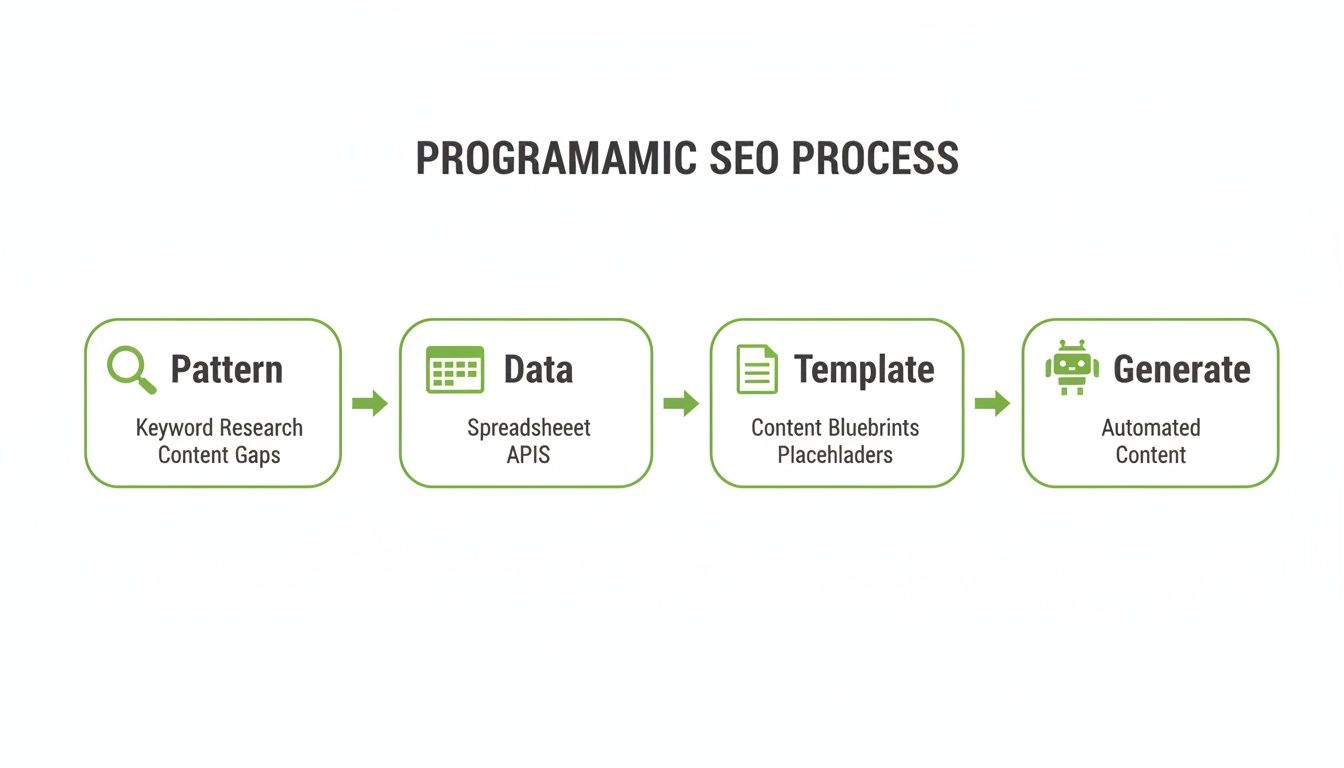
As you can see, a structured approach that combines a solid data source with a well-designed template is the key to creating quality content at scale.
Justifying Your Investment in Content
Ultimately, tracking performance is about proving the return on investment (ROI). Hard data is what justifies continued—and increased—investment in your content and SEO efforts. This isn't just theory; it's reflected in major market trends.
For instance, a whopping 88% of marketers who already invest in SEO planned to either maintain or increase their budgets in 2023. With nearly half (47%) planning to boost their spending, it's clear that businesses with the data see the undeniable value of organic search.
This market confidence shows that budgets are there for smart, scalable content strategies. By tracking the right KPIs, you can build an undeniable business case for your work. For a more detailed breakdown, you might find our guide on how to calculate programmatic SEO ROI useful.
Future-Proofing Your Content for AI Search
With all the buzz around AI search and things like Google’s AI Overviews, it’s easy to think the rulebook for SEO is being completely rewritten. But it’s not. In fact, the fundamentals of creating high-quality, structured content in SEO are more critical than ever.
Think of it this way: AI models are like hyper-intelligent students cramming for an exam. They need the best textbooks to learn from, and your website is one of those textbooks. If your content is clear, factual, and logically organised, you're essentially handing them perfect study material, making it a no-brainer for them to cite you in their answers. The same principles that help you rank today will make your website a trusted source for tomorrow’s AI.
Structuring Content for AI Consumption
Making your content easy for an AI to “read” isn’t some dark art. It’s about clarity and structure. Honestly, if a human can quickly scan your page and find what they need, an AI crawler can too. That's the best benchmark you have.
Here are a few practical things to focus on:
- Use Clear Headings: Organise your thoughts with descriptive H2 and H3 tags. They act as a table of contents for both humans and machines.
- Write Concise Snippets: Get straight to the point. AI loves to pull direct, self-contained answers for its generative summaries.
- Leverage Structured Data: Use Schema markup to explicitly tell search engines what your content is about. Label your product details, event times, or FAQs. It removes all the guesswork.
Nailing these simple organisational habits isn't just about tweaking for today's algorithm; it’s about setting your content up for the long haul in an AI-driven world.
The real takeaway here is that solid SEO fundamentals have never been more important. When you master user intent, build real topical authority, and create well-structured content, you’re already future-proofing your strategy for whatever comes next.
Good SEO Is Now Generative Engine Optimisation
The skills you’ve honed for classic SEO—understanding what people are actually looking for, structuring information in a logical way, and building authority—are directly transferable. This has been dubbed Generative Engine Optimisation (GEO), but don't let the new acronym fool you. It's really just an evolution of what already works.
The bottom line is simple. Stop chasing shiny objects. Instead, double down on creating the absolute best, most helpful, and most authoritative content in your niche.
Do that, and it won't matter if your audience finds their answer in a classic blue link or an AI-generated summary. Either way, your website will be the source.
Frequently Asked Questions
Let's clear the air. This section tackles the most common questions about content in SEO, cutting through the noise to give you practical advice on scaling your efforts with AI and programmatic strategies.
What Is the Difference Between Content Strategy and SEO?
Think of it like this: your content strategy is the architect's blueprint for a house. It answers the big questions: who are we building this for? What rooms do they need? How should the layout flow to be genuinely useful?
SEO is the engineering and construction crew. They make sure the house is built to code, has a clear address so people can find it, and is easy to navigate once they're inside.
One is useless without the other. A brilliant blueprint with a shoddy build results in an unusable house. A perfectly constructed house with no blueprint is just a random jumble of rooms without purpose. They have to work in lockstep.
How Does AI Change Content Creation for SEO?
AI doesn't replace the strategist in the director's chair. Instead, it's the ultimate production assistant, supercharging your ability to execute by taking on the grunt work that used to bog you down.
- Research: AI can analyse the top-ranking pages for a keyword in seconds, pulling out the common sub-topics, questions, and semantic terms you absolutely need to cover.
- Drafting: Feed it a detailed outline, and it can generate a solid first draft, saving you hours. Your job shifts from writing from scratch to refining, adding your unique expertise, and polishing the final product.
- Scaling: For programmatic SEO, this is a game-changer. AI can rephrase and adapt sections of your template across thousands of pages, ensuring each one is unique enough to sidestep duplicate content penalties.
AI does the heavy lifting. You get to be the editor-in-chief, focusing on strategy and quality.
Can Programmatic SEO Content Actually Be High Quality?
Absolutely. But only if you do it right. The old-school view of programmatic SEO is that it's just a machine for churning out low-quality, spammy pages. That approach is dead. Today, effective pSEO is all about creating genuine value at scale.
The secret to high-quality programmatic content isn't the template; it's the richness and uniqueness of your dataset. If your data provides real value—like hyper-local statistics, unique product attribute combinations, or proprietary insights—the pages you generate will be inherently valuable.
It's simple, really. If you create a thousand pages for "best cafe in [city]" using only the city name as your variable, you're just making thin content. But what if your dataset also includes columns for coffee bean origin, average price, user ratings, and a unique local's tip for each cafe? Now you're building a genuinely helpful resource, not just keyword-stuffing at scale.
Ready to put theory into practice? Programmatic SEO Hub gives you the step-by-step guides, templates, and tools to build scalable content systems that actually rank. Start building your organic traffic engine today. Visit us at https://programmatic-seo-hub.com/en.
Related Articles
Mobile friendly test google: A Practical Guide to Master Mobile SEO
Even though Google’s standalone Mobile-Friendly Test tool is a thing of the past, the principle behind it is more critical than ever. The simple truth is that Google now overwhelmingly uses its...
A Practical Guide to Competitive Analysis Keywords
When we talk about competitive analysis keywords, we're really talking about the search terms that are already making money for your rivals. By digging into these, you uncover their entire...
Landing Pages SEO A Practical Guide to Rank and Convert
When we talk about SEO for landing pages, we're not just talking about general website optimisation. We're getting hyper-specific. This is the art of building and refining standalone pages...