Unlock the SEO Training Workshop: A Practical Guide to Building an AI-Powered Content Engine

Let's be honest: traditional SEO is becoming less effective by the day. If your team's training still revolves around writing one blog post at a time and manually hunting for keywords, you're preparing them for a version of Google that no longer exists.
An effective SEO training workshop is no longer a luxury; it's a critical investment for any team wanting to compete in a search world now driven by AI. The goal isn't just to learn theory—it's to build a system that can generate thousands of helpful pages, not just one.
The Old SEO Playbook Is Broken
The game has changed, thanks to two powerful forces: AI-powered search engines that answer questions directly, and the constant need for high-quality content at a massive scale. To keep up, you need a much bigger and more helpful website than ever before.
This is where programmatic SEO, powered by AI, becomes your team's new superpower. It's about working smarter, not harder.
Let's look at how the focus of an SEO workshop needs to shift.
Traditional SEO Workshop vs. Modern AI-Powered Workshop
| Focus Area | Traditional Workshop Approach | Programmatic SEO & AI Workshop Approach |
|---|---|---|
| Core Goal | Rank for a few big keywords. | Dominate an entire topic by answering thousands of user questions. |
| Content Strategy | Writing articles one by one. | Building a system (templates + data) to create pages automatically. |
| Keyword Research | Finding single, high-value keywords. | Spotting user search patterns (e.g., "best [product] for [need] in [city]"). |
| Team Skillset | Writing and on-page optimization. | Data organization, systems thinking, and smart template design. |
| Tools Focus | Keyword tools, text editors. | Spreadsheets, simple scrapers, and AI assistants. |
| Success Metric | Ranking for a few specific pages. | Overall topic authority and a steady stream of traffic from many specific searches. |
The difference is clear. One is about crafting individual pieces; the other is about building a content-generating engine.
Moving From Manual Effort to Smart Systems
Old-school SEO training focused on the art of the single, perfectly optimized article. While quality is still crucial, the real challenge now is producing that quality at scale. A modern SEO training workshop must teach your team to think like architects building a system, not just writers creating one-off posts.
Instead of chasing one keyword, they will learn to spot patterns in how people search. Think about a query like "best pizza in Brooklyn." The pattern is "best [food] in [location]." Once you see the pattern, you can build a system to answer thousands of variations, creating a huge library of genuinely helpful content that captures countless specific user needs.
How to Practically Use AI in Your SEO Workflow
Many teams use AI to help write articles. That's a good start, but it's like using a supercar just to drive to the grocery store. A forward-thinking workshop shows how to use AI as a core part of the entire programmatic system.
Here’s a practical, non-technical breakdown of how it works:
- Find the Data: First, you gather the information that will power your pages. This could be a list of services, products, or locations. You don't need to be a data scientist; you can often find this information publicly available on the web.
- Organize it in a Spreadsheet: You put all that data into a simple spreadsheet (like Google Sheets), with clean columns for each piece of information (e.g., "City," "Service Name," "Price"). This spreadsheet is the brain of your operation.
- Create a Smart Template: You design a single master article template with placeholders for your data. For example: "Looking for the best
[Service Name]in[City]? Here’s what you need to know about..." - Use AI to Fill in the Blanks: You instruct an AI assistant (like ChatGPT) to take one row of data from your spreadsheet at a time and use it to fill in your template, creating a complete, unique article. Repeat this for every row, and you can generate hundreds of pages.
This simple, repeatable process is the heart of modern programmatic SEO. It transforms AI from a simple writing assistant into a powerful engine for content creation. This is a core idea in Generative Engine Optimisation (GEO), which you can learn more about in our guide to the core concepts of GEO.
The mindset shifts from asking, "What blog post should we write this week?" to "What system can we build to answer an entire category of customer questions?" This is how you build a future-proof SEO strategy.
Here in Germany, the demand for this kind of practical training is growing fast. In our digital-first economy, where over 80% of businesses rely on online visibility, there's a huge skills gap. We’ve seen businesses that complete modern SEO workshops report an average 30% increase in organic traffic within six months. The results are undeniable.
As you update your strategy, remember other evolving areas, too. For example, understanding the hidden power of captions for SEO and engagement is another small but vital piece of the modern SEO puzzle. This guide will help you design a workshop that prepares your team for the future of search, not its past.
Building Your Workshop Curriculum From Scratch
A great SEO training workshop is built on a solid, practical curriculum. The goal isn't to overwhelm your team with theory but to guide them on a hands-on journey, building their skills one logical step at a time. You want to take them from basic concepts to building their first mini-project.
For a structured approach, you can look at instructional design frameworks like the A Practical Guide to the ADDIE Model for Training. Using a framework ensures you cover all the bases, from understanding your team's needs to evaluating their success.
The curriculum should be designed to shift your team's mindset from old-school SEO tactics to a more modern, scalable approach.
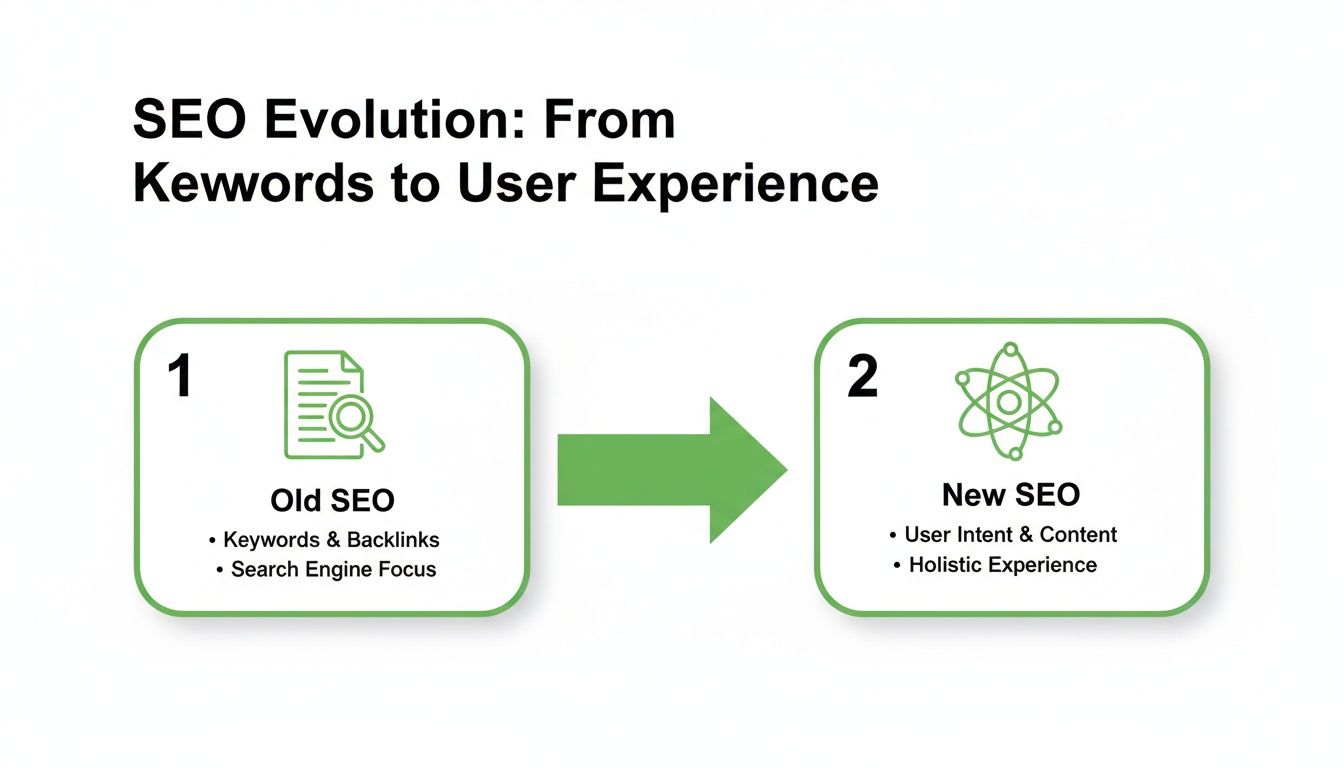
This evolution is key. It’s about moving from thinking about individual articles to building an intelligent, scalable system—that's the heart of programmatic SEO.
Module 1: The Programmatic Mindset (Spotting Patterns)
Before touching any tools, your team needs to understand the why. This module is about shifting their perspective from writing one-off articles to building content systems. It’s about learning to see the repeatable patterns hidden in how people search.
The main goal here is pattern recognition. You want your team to look at a search like "best coffee shops in Berlin" and see the underlying pattern: "best [business type] in [city]." Once they can see these patterns everywhere, they'll understand the opportunity.
Simple Exercise: Give your team a few broad topics (e.g., "car repair," "yoga classes"). Their task is to brainstorm all the possible words people might add to that search—like locations ("near me," "in Brooklyn"), needs ("for beginners," "emergency"), and qualities ("affordable," "best"). This simple activity starts building the programmatic muscle. For more foundational knowledge, you can explore our guides on getting started with programmatic SEO.
Module 2: Sourcing and Structuring Your Data (The Brain)
Programmatic SEO runs on data. This module demystifies where that data comes from and how to organize it—no advanced technical skills needed. The focus is on simple, accessible tools.
Your go-to tool here is Google Sheets. Seriously. Teach your team how to set up a clean spreadsheet with a separate column for every piece of information they'll need for their articles (like "City," "Service," "Price Range," etc.). This spreadsheet becomes the brain of their project.
Simple Exercise: Give them a real-world task: "Find the top 5 pizza places in 3 different cities." They then have to build a spreadsheet with columns for Restaurant Name, City, Address, and a unique feature for each one (e.g., "wood-fired oven," "vegan options"). This shows them exactly how raw information becomes structured, usable data.
The magic happens when your team realizes that a simple spreadsheet can power hundreds of specific, valuable pages. That's the "aha!" moment when scale suddenly feels achievable.
Module 3: Creating Content Templates with AI (The Engine)
This is where your data and content come together. In this module, you’ll teach your team how to design a master article template and write simple instructions (prompts) for an AI to turn the rows in their spreadsheet into unique, helpful articles.
A content template is just a reusable article structure with placeholders that match the columns in your spreadsheet. For instance:
- H1: The Best [Service Name] in [City]
- Intro: Finding a reliable [Service Name] in [City] can be tough. We’ve broken down the top options to help you choose...
- Unique Feature: One thing that makes [Business Name] stand out is its [Unique Feature].
Simple Exercise: Have your team work together in a Google Doc to build a content template for the pizza dataset they created earlier. Then, guide them in writing a simple, clear prompt for an AI, telling it exactly how to use the template and the data to write a complete article.
Module 4: Simple Publishing and Measurement (The Results)
The final module brings it all together. Here, you'll cover how to get all that content published and, just as importantly, how to measure what actually works. Keep the technical jargon light and focus on a straightforward workflow.
For publishing, show them how to export their spreadsheet as a CSV file and use a simple WordPress plugin to upload and create all the pages at once. This makes the idea of publishing at scale feel tangible and not at all intimidating.
When it comes to measurement, start with three simple metrics:
- Indexation Rate: How many of your new pages has Google found?
- Impressions: Are your pages starting to show up in search results?
- Clicks for Specific Searches: Are you getting traffic from the hyper-specific phrases you targeted (e.g., "wood-fired pizza in Berlin")?
Simple Exercise: Show the team a sample Google Search Console report from a real project. Ask them to find the pages and keywords that are bringing in the most traffic. This connects their work directly to real-world results and proves the value of the skills they've just learned.
Crafting Exercises That Create Real Skills
Theory is one thing, but skills are built by doing. The most powerful part of any SEO training workshop is when your team gets their hands dirty. This is where abstract concepts become clear and real confidence is built.
Forget generic examples. The best exercises mirror real-world projects. The goal is simple: every person should leave your workshop with something they’ve personally built—something tangible they can use right away. This is how you turn passive learning into active skill-building.
From Dataset To Dynamic Template
A fantastic hands-on exercise is guiding your team through building a dynamic content template from scratch. Start them off with a simple, real-world dataset. Nothing complex; a Google Sheet listing local services is perfect.
Think about a dataset for "pet grooming services" with columns like these:
- City: Berlin, Hamburg, Munich
- Service: Dog Grooming, Cat Grooming, Mobile Pet Spa
- Unique Feature: Eco-friendly products, Specialises in anxious pets, 24/7 booking
- Business Name: Pawsitively Clean, The Dapper Dog, Feline Fresh
Give this simple spreadsheet to your teams. Their first task is to jump into a shared Google Doc and collaboratively design a content template that uses these variables. This exercise forces them to think structurally, figuring out where each piece of information should go in a repeatable format.
Building With Reusable Templates And Prompts
To make things easy, provide a basic structure to work from. This isn't about giving them the answers, but about giving them the right tools to build their own solution. Our programmatic content brief template is a great example of what a complete and structured plan looks like.
Next, it's time to bring AI into the workflow. Provide a ready-to-use prompt that shows them how to instruct an AI to fill in their new template using the data from the spreadsheet. A solid starting prompt might look like this:
"You are an expert SEO content writer. Use the data I provide to fill in the following content template. Write in a helpful and friendly tone. Make sure the final article provides real value to someone searching for this service. Here is the template: [Paste Template Here]. Here is the data: City = [City], Service = [Service], etc."
This approach demystifies AI. It shows it's a powerful tool for execution, not a mysterious black box. Participants see firsthand how a simple spreadsheet and a well-designed template can produce high-quality content at scale.
Facilitator Notes for Deeper Learning
As the facilitator, your job is to guide, not to dictate. Move between the groups and ask targeted questions to deepen their understanding and connect the exercise to real business goals.
Here are a few great questions to ask:
- "What other information could make this page even more helpful?" (This gets them thinking about adding data like pricing or reviews).
- "How would you change the tone if you were writing for luxury pet owners versus budget-conscious students?" (This connects content directly to the target audience).
- "Look at your template. Where can you add unique value beyond just listing facts?" (This promotes critical thinking about content quality).
You should also be ready to spot and correct common mistakes.
Watching For Common Mistakes
As the teams work, you'll see a few common challenges pop up. Addressing these turns simple mistakes into valuable learning moments.
Mistake 1: Overly Generic Content: You might see a template that just lists facts without any narrative.
- The Fix: Guide them to add context. Instead of just, "Business X offers [Service]," push for something more like, "For residents in [City] looking for top-notch [Service], Business X is a great choice because of its focus on [Unique Feature]."
Mistake 2: Forgetting User Intent: The content might be accurate but misses what the user is really asking.
- The Fix: Prompt them by asking, "What is the real question someone is asking when they search for this?" This simple question reframes the entire task around solving a user's problem.
By the end of this exercise, each participant won't just understand the theory of programmatic SEO; they will have built a small-scale programmatic engine themselves. They'll have a dataset, a content template, and a sample article they created from scratch. This tangible result is what makes the lessons from your SEO training workshop stick.
Your Essential Programmatic SEO Toolstack
You don't need a huge budget to run a fantastic SEO training workshop. The truth is, a powerful and practical toolstack is already within reach, often using tools your team already knows. The trick is to focus on smart application over expensive software, showing how everyday tools can create a powerful programmatic workflow.

This approach immediately demystifies the process. It shows attendees that they likely have everything they need to start building at scale, right now.
Keeping Data Collection And Management Simple
Every programmatic project starts with gathering and organizing data. The great news is, you can teach your team how to do this without any complex or intimidating software.
For data collection, a free browser extension like Instant Data Scraper is perfect for a workshop. It shows people how to pull structured data from a webpage into a file with just a few clicks. It’s visual, it’s immediate, and it perfectly demonstrates how to source the raw information for a project.
Once you have that data, Google Sheets becomes your command center. Think of it as a free, collaborative database. In the workshop, you can walk attendees through cleaning and structuring their data, getting it perfectly ready for content creation. This hands-on experience proves that a solid data system doesn't need to be expensive.
Content Creation, No Coding Required
There's a common myth that using AI for content at scale requires complicated coding skills. Your workshop is the perfect place to bust that myth.
When you get to the content generation part, stick to the web interfaces of tools like ChatGPT or Claude. The goal is to teach how to write good instructions (prompts) and design smart templates, not how to code. By showing attendees how to combine a well-structured dataset from Google Sheets with a clear prompt, you empower them to generate high-quality content, one page at a time.
This manual-but-structured method is incredibly effective for training because:
- It forces a deep understanding of how data and templates actually interact.
- It builds confidence by proving that the core skill is strategic thinking, not technical wizardry.
The real magic isn't in the tool, but in the system you design. A great prompt and a clean dataset will always outperform a complex technical setup with a poor strategy.
Choosing Your Tools and Getting Published
Finally, you have to get the content published. WordPress, being the world's most popular CMS, is the ideal platform for this stage. When you pair it with user-friendly plugins like WP All Import, publishing hundreds of pages from a simple CSV file becomes a straightforward process anyone can master.
Equipping your team with the right tools is crucial, but it’s just as important to show them that effective options exist at every budget. Below is a simple breakdown of a sample toolstack, comparing free and paid options.
Sample pSEO Workshop Toolstack Comparison
| Workflow Stage | Free/Freemium Option | Paid/Advanced Option | Workshop Use Case |
|---|---|---|---|
| Data Collection | Instant Data Scraper | Scrape.do, Hexomatic | Visually demonstrate scraping structured data from websites. |
| Data Management | Google Sheets | Airtable, NocoDB | Clean, enrich, and organise the dataset for content generation. |
| Content Generation | ChatGPT / Claude (Web UI) | Zapier, Make.com | Craft prompts and generate unique content using prepared data. |
| Publishing | WordPress + WP All Import | Custom Script / API | Bulk-upload the generated content from a CSV to the website. |
| Keyword Research | Google Keyword Planner | Ahrefs, Semrush | Identify the head term and modifiers for the pSEO project. |
The best toolstack is simply the one that aligns with your team’s resources and goals. For those ready to explore more specialised SEO software, we’ve put together a detailed guide comparing Ahrefs vs SEMrush for SEO tasks.
Focusing on these practical, accessible workflows has proven incredibly effective. Here in Germany, workshops that teach these hands-on skills deliver real results. For instance, some providers have reported that 75% of trainees see a 25-35% increase in website traffic within a year of the training. By learning these efficient workflows, teams can also dramatically reduce their dependency on external agencies—sometimes by as much as 50%. This confirms that equipping your in-house team with practical skills is a direct investment in long-term organic growth.
How To Measure Your Workshop's True Impact
A successful SEO training workshop isn't just about positive feedback forms. The real win comes weeks or months later, when the skills you taught start delivering real business results. To prove the training's value, you have to track the right things.
The ultimate goal is to draw a straight line from the workshop to organic traffic growth. This means you need to track metrics that clearly show your team is actively using their new programmatic SEO skills.
Focus On Action-Oriented KPIs
Let's cut through the noise. You need Key Performance Indicators (KPIs) that directly reflect real-world implementation and impact. These are the numbers that tell a clear story.
I recommend starting with these three core areas:
- Adoption Rate: How many new programmatic SEO projects did the team start in the first 30-60 days after the workshop? This shows they were engaged and ready to act.
- Output Volume: How many new pages were published as a result of those projects? This measures the scale of implementation.
- Performance Lift: What was the increase in organic impressions, keyword rankings, and clicks for those new pages? This is the bottom-line business impact.
The most powerful way to demonstrate the workshop's value is to show a direct line from "training day" to "traffic growth." Everything you measure should help tell that story.
Creating A Post-Workshop Action Plan
To ensure people translate knowledge into action, give them a simple, structured plan before they leave. This bridges the gap between the classroom and their daily work, making it easy to get started while the ideas are fresh.
A solid action plan should prompt attendees to define their very first project. Get them to outline:
- The Target Opportunity: What user search pattern are they going after? (e.g., "best [product] for [use case]")
- The Data Source: Where will they get the data for the pages?
- The Timeline: What’s a realistic deadline for publishing the first batch of pages?
This simple framework turns abstract concepts into a concrete first step, which dramatically increases the chances they'll follow through.
Using A Dashboard To Track Progress
A shared dashboard is the simplest way to maintain momentum. You don't need fancy software; a well-organized Google Sheet works perfectly. Create a template to share with all attendees right after the workshop.
Your dashboard should track the key metrics you've already defined. I'd include columns for:
- Project Name
- Date Launched
- Number of Pages Published
- Monthly Organic Impressions
- Monthly Organic Clicks
- Key Keyword Rankings
This dashboard does two critical things. First, it helps attendees see their own progress, which is a huge motivator. Second, it gives you clear data to show leadership that the training was a success.
For a deeper dive into the financial justification, our guide on calculating the ROI of your SEO efforts provides a detailed framework. This is how you turn your SEO training workshop from a one-time expense into a proven, high-return investment.
Got Questions About SEO Workshops?
Jumping into programmatic SEO can feel like a big step, and it's natural to have questions. I’ve put together some of the most common ones I hear to give you clear, straightforward answers. My goal is to demystify the process so you feel confident and ready to dive in.
Who Is This Kind of Workshop For?
I'm often asked if you need to be a technical whiz for a programmatic SEO training workshop. The answer is a definite no. While developers can benefit, this training is designed for a much wider audience.
It’s a perfect fit for:
- Content Strategists: You’ll learn how to think in systems and scale your content efforts beyond one-off articles.
- SEO Managers: Get the skills to build a content engine that can dominate entire topics, not just a few keywords.
- Marketers at Start-ups: Discover how a small team can create a massive impact on organic traffic with limited resources.
- Founders and Business Owners: You’ll grasp the strategic value of programmatic SEO as a powerful, cost-effective growth channel.
The real focus is on strategy, data organization, and systems thinking—not complex coding.
Do I Need Expensive Tools to Get Started?
Absolutely not. This is probably the biggest myth holding people back. You can build incredibly powerful workflows using tools you likely already have.
Our workshop focuses on an accessible toolstack, proving you can get brilliant results with things like:
- Google Sheets: Your free, collaborative database for organizing all your project data.
- Free Browser Extensions: Simple tools like [Instant Data Scraper](https://chrome.google.com/webstore/detail/instant-data- scraper/ofaokhiedipichpaobibbnahnkdoiiah) can handle basic data collection tasks.
- AI Chat Interfaces: The standard web versions of ChatGPT or Claude are more than enough for generating content from your templates. No API access is needed.
The real investment isn't in fancy software; it's in learning the strategic framework. The system you build is far more important than the specific tools you use to execute it.
The workshop is all about the process and the mindset. Once you master the workflow, you can decide if and when paid tools might make sense for your needs.
How Is This Different from a Regular SEO Course?
Most online SEO courses are great for building a theoretical foundation, but a hands-on workshop is designed to build practical, applicable skills. The difference is in the "doing." A course might test your knowledge with a quiz; a workshop tests your ability to actually build something.
Think of it this way: a course might teach you what a keyword is, but a workshop will have you build a dataset of 100 specific keywords and design a content template to target them. By the end of our session, you won't just know about programmatic SEO; you'll have actually built a small-scale project yourself. The outcome is a tangible skill, not just a certificate.
What If My Team Has No Technical SEO Experience?
That’s perfectly fine and very common. Programmatic SEO is often mistaken for a highly technical discipline, but its foundation is more about logic and organization than code. At its core, it's about spotting patterns, structuring data, and creating repeatable templates.
This training is designed from the ground up to be non-technical. We break down every concept into simple, manageable steps. We teach you how to organize data in a spreadsheet and how to write clear instructions for an AI—skills accessible to everyone on a marketing team. You don't need to know how to code to build a system that can generate thousands of valuable pages.
Ready to build a content engine that drives real growth? At Programmatic SEO Hub, we provide the templates, systems, and practical advice you need to master scalable SEO. Start your journey here: https://programmatic-seo-hub.com/en