SEO oder SEM Ihr Leitfaden für die richtige Marketing-Strategie
When you're trying to figure out where to put your marketing budget, the SEO vs. SEM debate often comes down to one core trade-off: long-term asset building versus immediate visibility.
It's a common point of confusion. Search Engine Optimisation (SEO) is all about earning free, organic traffic over time. Think of it as building a brand that people naturally find and trust. Search Engine Marketing (SEM) is the bigger picture—it's the entire discipline of getting traffic from search engines, which includes both SEO and paid advertising for those instant results.
Which path you take really depends on your goals, how much you can spend, and how quickly you need to see a return.
Understanding the Difference Between SEO and SEM
Let's clear this up right away: SEO und SEM aren't the same thing, even though people often use the terms interchangeably. The easiest way to think about it is that SEM is the umbrella term for driving traffic from search engines. Under that umbrella, you have two main pillars:
- Search Engine Optimisation (SEO): This is the craft of improving your website so it shows up higher in the organic (non-paid) search results.
- Paid Search Advertising (PPC): This involves paying for ads to appear right at the top of the search results for specific keywords.
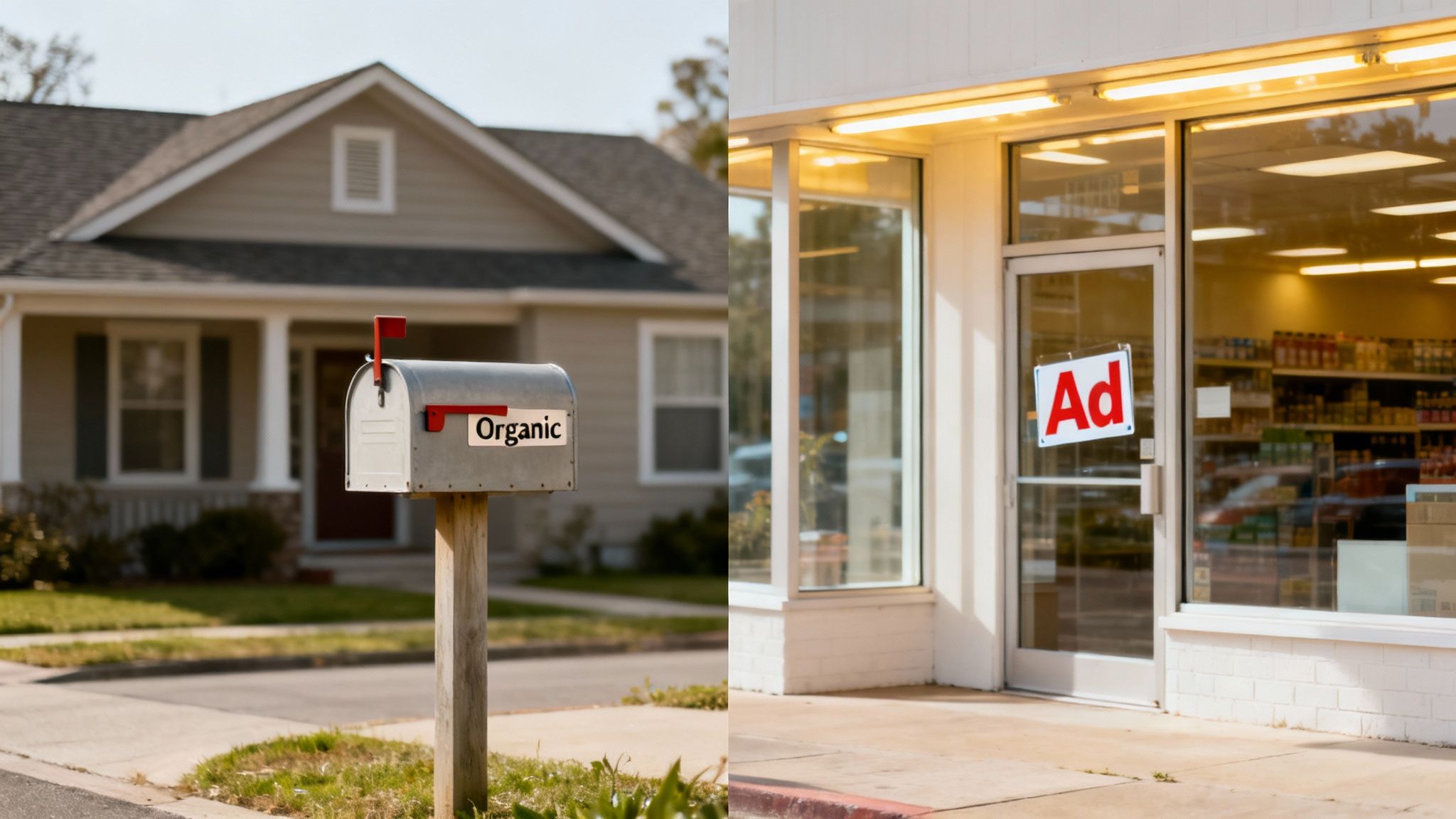
A simple real estate analogy works perfectly here. SEO is like buying and owning your house. It takes a lot of upfront work and time to build, but you're creating real equity. It becomes a valuable asset that keeps delivering returns long after the initial effort.
The paid side of SEM, on the other hand, is like renting a prime storefront on a busy street. You get immediate foot traffic and high visibility, but the second you stop paying rent, you're gone.
Core Distinctions SEO vs Paid SEM
To help you build a solid SEO strategy, it’s crucial to understand the fundamental differences between its two core components. This table breaks it down quickly.
| Factor | SEO (Organic) | SEM (Paid Ads) |
|---|---|---|
| Cost | No direct media spend; investment in resources (content, technical) | Direct cost per click (CPC) or impression (CPM) |
| Speed to Results | Slower; typically takes months to see significant results | Immediate; ads can drive traffic within minutes of launch |
| Sustainability | Long-lasting; builds a sustainable traffic source over time | Short-term; traffic stops as soon as ad spend is paused |
| Trust & Credibility | High; users often trust organic results more than ads | Lower; users are aware they are clicking on advertisements |
As you can see, one isn't inherently "better" than the other. They simply serve different purposes and operate on different timelines and cost models. The real magic often happens when you use both strategically.
Comparing Speed, Cost, and Long-Term Value
When you're weighing up SEO vs. SEM, the conversation almost always lands on two things: time and money. Each approach plays a completely different game when it comes to timelines and financial models, and understanding that is key to figuring out your growth path.
Paid SEM is all about speed. Get a campaign set up, put some budget behind it, and your ads can be live at the top of the search results almost instantly. This is perfect for driving predictable traffic right now—think time-sensitive promotions, product launches, or just quickly testing if a new offer has legs.
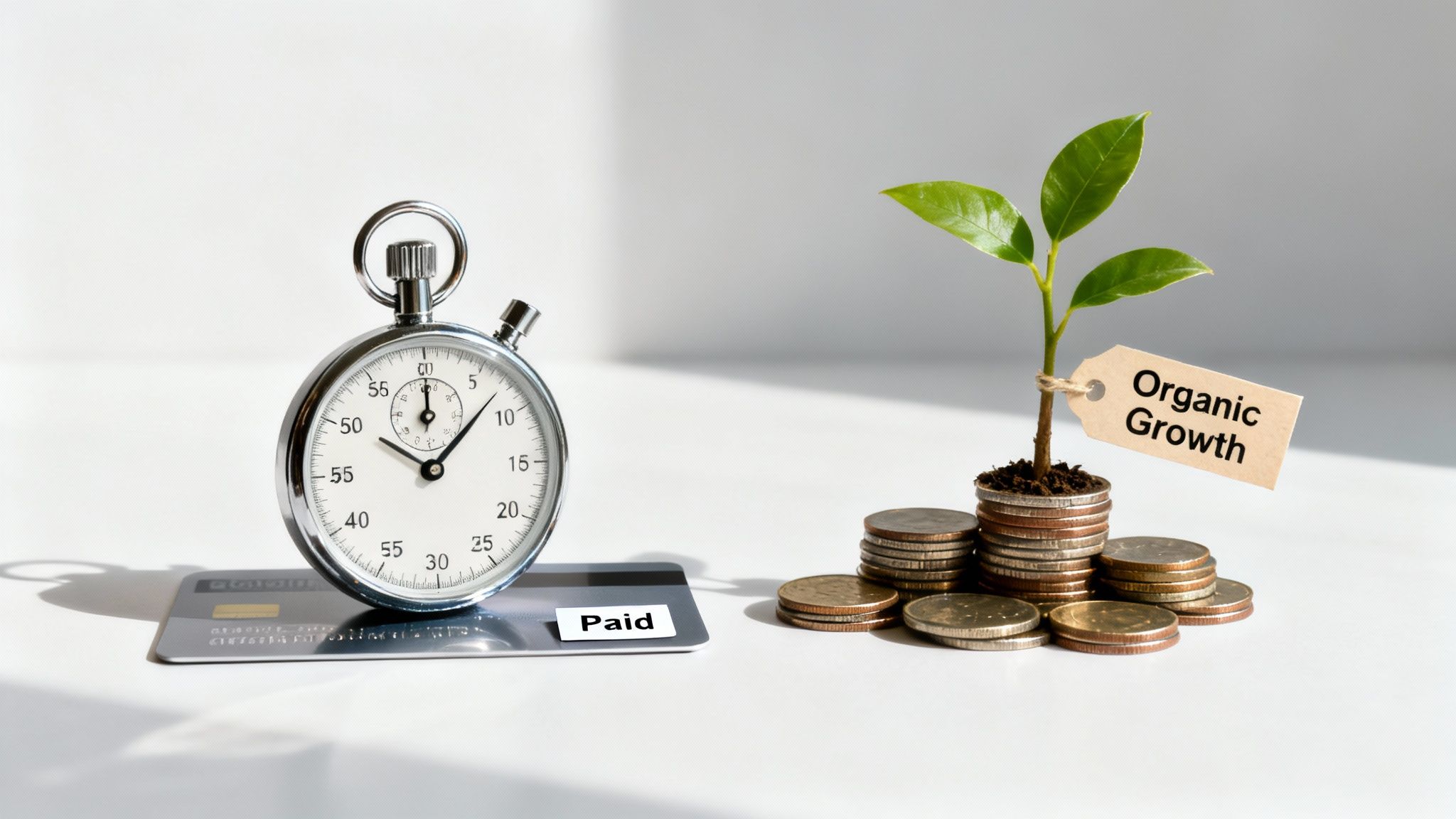
On the other hand, SEO is a marathon. It’s the slow, steady work of creating genuinely useful content, earning backlinks, and nailing the technical details. You're looking at a 6 to 12-month runway before you start seeing significant, meaningful results. The traffic is earned, not bought, building up momentum as search engines gradually recognise your site's authority.
Financial Commitment and ROI
The cost structures couldn't be more different. With paid search, the cost is direct and constant—you pay for every click or impression. Your budget is the tap that controls your visibility; turn it off, and the traffic stops. It gives you incredible control, but it demands continuous investment.
SEO is often called "free," but that’s a bit misleading. It requires a serious investment in resources, just of a different kind. The costs here are in:
- Content Creation: The time and talent needed for writing articles, shooting videos, or designing visuals.
- Technical Expertise: Making sure your site is fast, secure, and easy for search engines to crawl.
- Link Building: The strategic outreach needed to earn links from other authoritative sites.
The return on investment for each channel mirrors its nature. Paid SEM can deliver a fast, measurable return, but its value is fleeting. SEO, however, builds a durable asset. A well-ranked article can keep generating leads and sales for years with no extra media spend, creating powerful, compounding value over time. For a deeper dive, our guide on ROI calculation breaks down the frameworks.
SEO is like investing in property. It requires a substantial upfront commitment, and the returns aren't immediate. But over time, you build valuable equity that generates passive income and appreciates in value, becoming a cornerstone of your business.
Sustainability and Long-Term Asset Building
This brings us to the most critical difference: sustainability. A paid SEM campaign is a controllable switch for traffic—hugely useful, but the flow stops the second you cut the funding. You're essentially renting visibility from Google.
SEO is about building a channel you own. Every piece of content you publish and every backlink you earn adds to your website's authority and lasting value. This digital asset works for you 24/7, attracting customers long after the initial push. This sustainable growth is why so many businesses prioritise SEO as their core long-term strategy for building brand credibility and a reliable stream of organic traffic.
Ultimately, the choice comes down to a simple question: do you need results now, or are you building for the future?
Measuring Performance for SEO and SEM
You can't really choose between SEO and SEM until you know what success looks like for each one. They both chase visibility, but the way you measure them couldn't be more different. The key is to get beyond basic traffic numbers and dial in on the metrics that actually show you’re making money.
For SEO, success is all about sustainable growth and building authority over the long haul. You're tracking the overall health of your organic channel. SEM, on the other hand, is about instant results tied directly to your budget. It's a pure numbers game where every pound you spend has to justify itself.
Key Performance Indicators for SEO
With SEO, you're playing the long game, so your KPIs need to reflect the value you're building over time. Forget vanity metrics; focus on what shows real engagement and progress.
- Organic Traffic Growth: Keep a close eye on your month-over-month and year-over-year growth from non-paid search. A steady upward trend is the clearest sign your strategy is working.
- Keyword Ranking Improvements: Track where you stand for your most valuable keywords. Just moving from page two to page one for a critical term can be a game-changer for clicks and leads.
- Click-Through Rate (CTR): This is your best feedback loop, straight from Google Search Console. It tells you what percentage of people who see your site in the results actually click. A rising CTR means your headlines and descriptions are hitting the mark.
- Organic Conversions: This is the metric that matters most. Are people from organic search actually filling out forms, buying products, or signing up? This is how you tie SEO directly back to business goals.
Key Performance Indicators for SEM
In the fast-paced world of paid search, it’s all about efficiency and immediate financial return. You need to know exactly what you’re getting back for every single pound you put into your ads.
SEM measurement isn’t about some slow-burning brand authority. It’s about cold, hard data, right now. If your Cost Per Acquisition is higher than what that customer is worth, your campaign is broken. Simple as that.
The primary numbers to live by are:
- Return on Ad Spend (ROAS): This is the ultimate bottom line: how much revenue did you generate for every pound you spent? A ROAS of 4:1 means you made £4 for every £1 invested.
- Cost Per Acquisition (CPA): This tells you the average cost to land one new customer through your campaign. Keeping your CPA low is fundamental to staying profitable.
- Conversion Rate: This is the percentage of people who clicked your ad and then took the action you wanted, like making a purchase. A high conversion rate shows your ad creative and landing pages are perfectly aligned.
Of course, tracking these numbers is only half the battle. You have to make sure you're attributing conversions correctly to understand which touchpoints are actually driving the sale. For a much deeper dive, you can explore our guide on attribution modeling to see how different models work.
Choosing Your Strategy: When to Use SEO, SEM, or Both
The big question isn't whether SEO or SEM is "better." That's the wrong way to look at it. The real strategic decision comes down to your specific business goals, how fast you need to move, and what your budget looks like.
There’s no magic formula here, only the right tool for the right job. It’s all about matching the unique strengths of each channel to what you need to achieve right now versus what you're building for the future.
If you need results yesterday, paid SEM is your go-to. It's built for speed and precision.
When to Prioritise SEM
Paid search is your best friend when you need to switch on traffic instantly and test ideas without waiting. You'll want to lean heavily on SEM in these kinds of scenarios:
- Launching a New Product: You can't afford to wait months for organic rankings to build up. You need immediate visibility to create buzz and drive those crucial first sales.
- Running Time-Sensitive Promotions: Got a Black Friday sale or a limited-time offer? SEM lets you drive hyper-targeted traffic for the exact window your campaign is live.
- Validating Market Demand: Before you sink a huge budget into a new service, a small, targeted SEM campaign is the fastest way to find out if anyone is actually looking for what you're selling.
- Targeting High-Intent Keywords: For those "bottom-of-the-funnel" searches where people have their wallets out, paid ads put you right at the top, exactly when the buying decision is being made.
When to Prioritise SEO
Think of SEO as building a valuable company asset. It’s the engine for sustainable, long-term growth that pays dividends for years to come. You should be focusing your efforts on SEO if these are your main objectives:
- Building Brand Authority and Trust: Ranking organically for tough, informational keywords establishes you as a credible expert in your field. That's a level of trust that ads alone can rarely buy.
- Creating a Sustainable Traffic Engine: A well-optimised website becomes a predictable source of leads that doesn’t vanish the moment you turn off your ad spend. Your content keeps working for you, 24/7.
- Dominating Informational Searches: Nothing beats SEO for capturing people in the early research and awareness stages. You build a relationship long before they’re even thinking about making a purchase.
This decision tree gives you a clear visual of how to think about the two channels, mapping them against key performance indicators. It really boils down to organic growth versus immediate, transactional results.
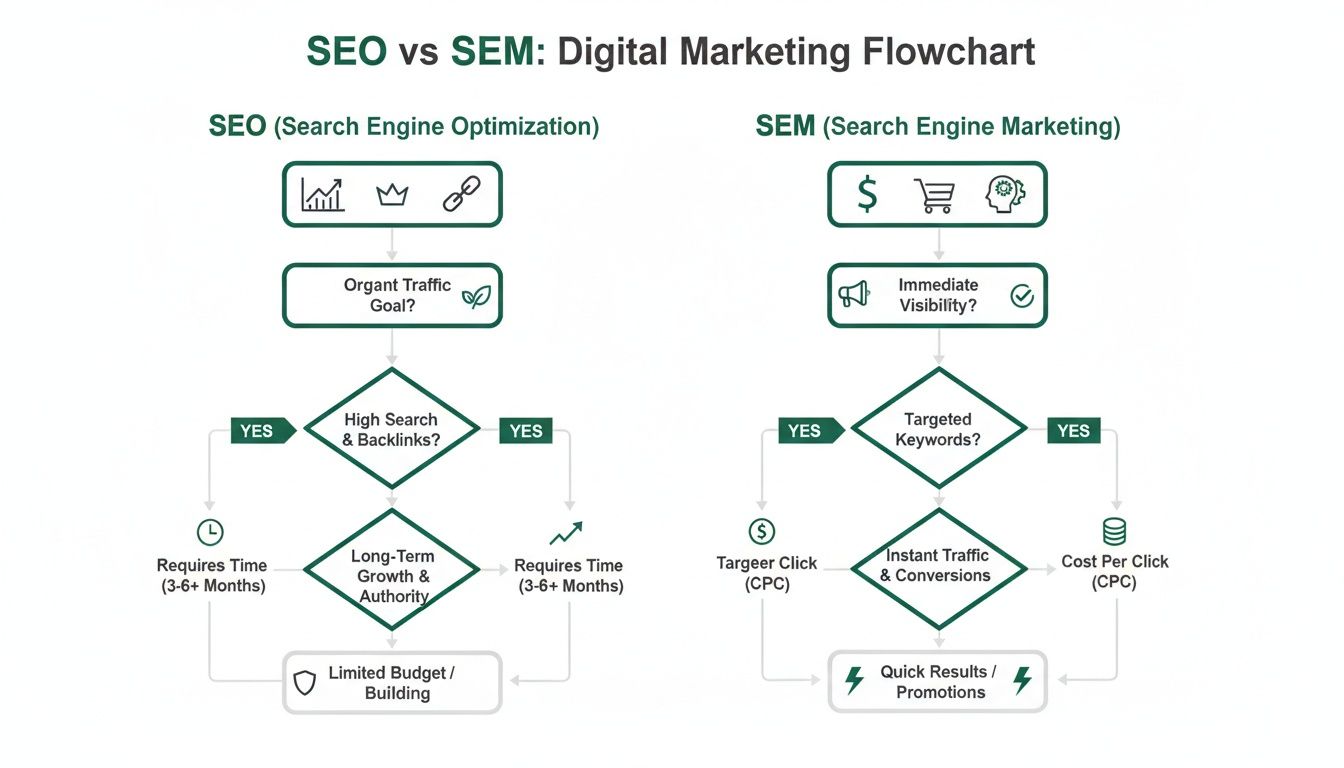
As you can see, SEO KPIs are all about building long-term assets like rankings and links, while SEM KPIs are tied directly to financial returns like cost and conversions.
The Power of a Hybrid Approach
Honestly, the most dominant strategies almost always use both SEO and SEM together. When you get them working in tandem, you create a powerful feedback loop where each channel amplifies the other, letting you completely own the search results page.
The ultimate goal isn't choosing SEO or SEM; it's about making them work together. Use SEM for quick wins and market intelligence, then use those insights to fuel a long-term SEO strategy that builds an untouchable brand asset.
Here’s a classic example: run a paid campaign and use the data to pinpoint your highest-converting keywords. Then, you can pour your resources into building targeted SEO content to rank for those terms organically. It works the other way, too. A strong organic presence builds brand credibility, which in turn can boost the click-through rates and Quality Scores on your paid ads, lowering your costs.
This integrated approach is especially critical in competitive spaces like Germany's search industry, which is projected to hit a massive €14.0 billion in revenue in 2025. With organic search already driving 33% of traffic across industries in the DE market, a smart hybrid model is the only way to capture the biggest possible share of the pie. You can dive deeper into the numbers with this IBISWorld research.
How to Scale Organic Growth with AI and Programmatic SEO
While traditional SEO often means pouring hours into crafting a single, perfect page, there’s a much more scalable way to operate. It’s called Programmatic SEO (pSEO). The idea isn’t to create spam, but to systematically build hundreds or thousands of specific pages that answer very niche questions.
Think of it as building a content factory instead of crafting one-off articles. Instead of writing one page on "best running shoes," you build a system that can automatically generate pages for "best running shoes for flat feet in London," "best trail running shoes for beginners," or "best waterproof running shoes under £100."
This approach helps you capture a massive amount of "long-tail" traffic—those longer, super-specific searches people make when they're close to making a decision.
A Practical, Step-by-Step Guide to Implementing pSEO with AI
The process might sound complex, but it's actually quite straightforward once you understand the logic. It’s about finding patterns in how people search and building a system to meet that demand.
Here’s how you can get started in three simple steps:
- Find Your Keyword Patterns: Start by identifying your main topic, like "financial advisor." Then, find the words people add to it, such as cities, specialties, or services. This gives you a repeatable formula, like
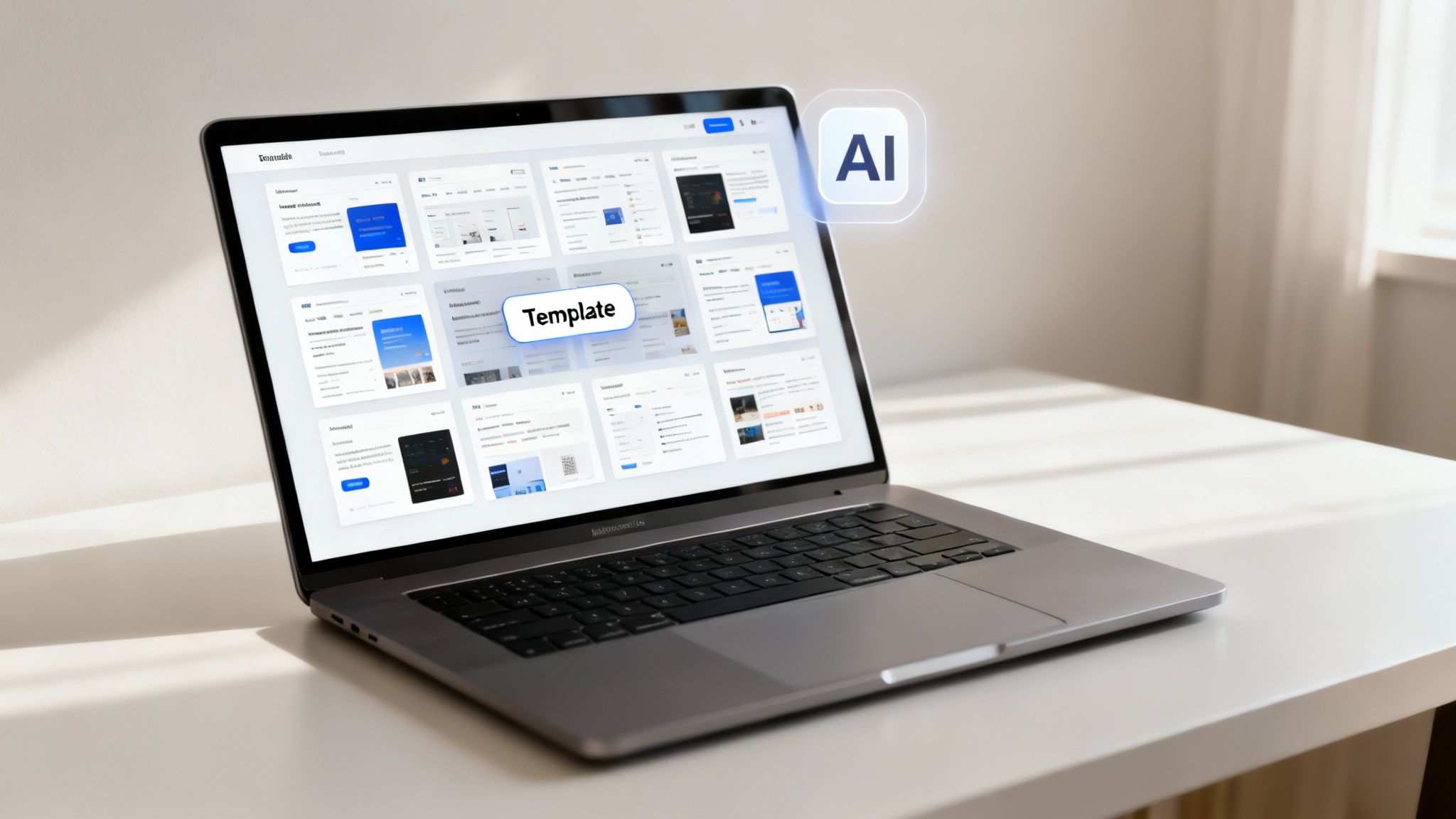
financial advisor in [City]oderfinancial advisor for [Retirement Planning]. - Create a Reusable Page Template: Design a single, high-quality page layout. This template will have placeholders for the specific details that will change for each page (like the city name or specialty). The overall structure—headings, images, call-to-action—stays the same.
- Use a Database and AI to Create the Pages: Gather your variable data (like a list of cities or specialties) in a simple spreadsheet. Then, use an AI content tool to populate your template for each row in your spreadsheet. This is where content automation with AI comes in, letting you generate unique, helpful text for hundreds of pages automatically.
With this system, you can build an authoritative hub that answers a huge range of specific user questions without having to write every single page by hand.
Programmatic SEO isn’t about replacing humans with AI. It’s about giving a small team the power to create the content footprint of a massive organisation. You're turning scalable patterns into a powerful engine for organic growth.
Staying Visible in an AI-Driven World
As search engines like Google incorporate more AI-generated answers, your SEO strategy needs to adapt. This new field is called Generative Engine Optimization (GEO). The goal is to make your content so clear, structured, and trustworthy that AI models use it as a source for their answers.
The good news is that programmatic SEO is perfectly suited for this. By creating well-structured pages that answer specific questions, you're not just ranking in traditional search; you're also creating perfect source material for AI. To understand this shift better, check out our guide on Generative Engine Optimization. This approach ensures your brand stays visible, whether a user finds you through a standard Google search or asks an AI assistant a question.
Your First Steps and Essential Tools
Okay, let's move from theory to action. Whether you’re leaning towards the long-term gains of SEO or the quick wins from SEM, you’ll need a solid workflow and the right tools in your corner.
If you're starting an SEO project, the first moves are pretty clear-cut:
- Keyword Research: First things first, you need to figure out what terms your audience is actually typing into Google to find what you offer.
- Content Creation: Next, you build high-quality articles, guides, or landing pages that perfectly match the intent behind those keywords.
- On-Page Optimisation: Finally, you make sure your titles, headings, and meta descriptions are sharp and compelling for both people and search engines.
For a paid SEM campaign, the game is all about immediate impact:
- Ad Group Setup: You’ll want to organise your campaigns into tightly themed keyword groups. This is non-negotiable for relevance.
- Ad Copywriting: The goal here is to write short, punchy ad copy that practically begs to be clicked.
- Landing Page Design: Create a dedicated landing page that follows through on the ad's promise and is laser-focused on getting that conversion.
Finding the Right Tools
Whichever path you take, you're not going to get far without good tools. For deep-diving into keyword research and seeing what your competitors are up to, platforms like Semrush are a game-changer. They give you the hard data you need to make smart decisions for both your organic and paid strategies.
Picking a tool often boils down to your specific needs and budget. The main thing is to find a platform that delivers solid data for keyword discovery, rank tracking, and competitive analysis. These are the absolute cornerstones of any successful search strategy.
If you’re stuck comparing the big all-in-one platforms, our detailed Ahrefs vs. Semrush guide gives you a proper side-by-side breakdown to help you make the right call.
Common Questions About SEO and SEM
When you're weighing up SEO and SEM, the same questions tend to pop up. Let's tackle them head-on with some straight, practical answers to help you decide on your next move.
How Long Does SEO Actually Take to Work?
You might notice small movements in a few weeks, but real, meaningful SEO results—like hitting the first page for keywords that matter—usually take somewhere between 6 to 12 months. Think of it as building a valuable digital asset for the long haul, not flipping a switch for instant traffic.
Can I Get Away With Just Doing SEO and Forgetting SEM?
Absolutely. Plenty of businesses have built huge success by focusing entirely on organic search, especially those that go all-in on great content and building brand authority over time. The trade-off? You'll be missing out on the immediate traffic, rapid market feedback, and priceless keyword data that a paid SEM campaign can deliver from day one.
What’s a Realistic SEM Budget to Start With?
There’s no magic number here, but for a small business testing the waters, a budget between €500 and €2,500 per month is a solid starting point. The trick is to start small, test your creative and landing pages relentlessly, watch your Return on Ad Spend (ROAS) like a hawk, and only pour more fuel on what’s already working.
Ready to build a scalable content engine that dominates organic search? Explore the guides, tools, and templates at Programmatic SEO Hub and learn how to future-proof your strategy for the age of AI. Visit us at https://programmatic-seo-hub.com/en to get started.
Verwandte Artikel
10 Social Media Key Performance Indicators to Master in 2025
Are you drowning in social media data but starving for real insights? In a world of vanity metrics like follower counts, identifying the right social media key performance indicators (KPIs) is the...

Wie man die beste SEO-Agentur findet: Ein praktischer Leitfaden für 2025
Finding the best SEO agency to boost your online presence can feel like searching for a needle in a haystack. The market is full of providers promising the moon, but it's hard to tell real experts...
SEO und SEM: Dein praktischer Leitfaden, um bei Google gesehen zu werden
Let's be honest, digital marketing jargon can be a real headache. When it comes to SEO and SEM, the difference is simpler than it sounds. Think of it like this: SEO is how you earn a free spot in...