SEO and SEM: Your Practical Guide to Getting Seen on Google
Let's be honest, digital marketing jargon can be a real headache. When it comes to SEO and SEM, the difference is simpler than it sounds.
Think of it like this: SEO is how you earn a free spot in Google's search results, while SEM is how you buy one. One builds long-term trust, while the other gets you immediate attention.
SEO vs. SEM: A Tale of Two Strategies

Imagine you’ve just opened a new restaurant. You have two main ways to get customers. You could slowly build a stellar, word-of-mouth reputation that grows over time. Or, you could launch a big advertising campaign for your grand opening.
That, in a nutshell, is the heart of the SEO vs. SEM debate.
The Slow Burn: SEO
Search Engine Optimisation (SEO) is the art of making your website so helpful and trustworthy that search engines like Google want to show it to people. It’s a long-term game, focused on improving your content and website to prove you're the best answer out there. It’s all about playing the long game to earn free, lasting visibility.
For our restaurant, this means:
- Creating incredible dishes (content): Publishing genuinely helpful blog posts, guides, and articles that people actually want to read.
- Building a great reputation (backlinks): Getting mentions and links from other respected websites, like a popular food blogger reviewing your restaurant.
- Ensuring fantastic service (user experience): Making your website fast, easy to use on a phone, and simple to navigate.
The results don't happen overnight. It can take months of consistent effort. But the payoff is huge: a reliable stream of free traffic from people who already trust you because Google does.
The Immediate Impact: SEM
Search Engine Marketing (SEM) is a broad term, but today it almost always means the paid side of search—specifically, Pay-Per-Click (PPC) advertising. Using platforms like Google Ads, you pay to place your website at the very top of the search results for specific keywords.
This is our restaurant's "grand opening special" ad campaign. You pay for the ad space, and the second it goes live, people see it. The catch? The moment you stop paying, the ads disappear, and that traffic stops.
SEM is all about speed and control. You can target specific customers, test different ad messages, and drive traffic to a specific page within hours. This makes it perfect for product launches, sales promotions, or capturing buyers who are ready to purchase right now.
To give you a clearer picture, let’s break down the key differences.
SEO vs. SEM At a Glance
This table offers a quick snapshot of how these two powerful approaches stack up.
| Aspect | SEO (Organic Search) | SEM (Paid Search) |
|---|---|---|
| Cost | "Free" traffic, but requires investment in time and resources (content, website improvements) | Pay-Per-Click (PPC); you pay every time someone clicks your ad |
| Speed | Slow and steady; can take 3-6+ months to see significant results | Nearly instant; traffic can start within minutes of launching a campaign |
| Longevity | Results are sustainable and can grow over time | Traffic stops the moment you stop paying for ads |
| Targeting | Broad targeting based on what people are searching for | Highly specific targeting (age, location, interests, time of day) |
| Placement | Ranks in the main, "organic" search results below the ads | Appears at the very top of the page, marked as "Sponsored" |
| Control | Less direct control; you're influenced by Google's algorithm updates | Full control over your ad message, landing pages, and budget |
While they operate differently, the best strategies don't treat them as rivals.
SEO builds foundational trust and long-term authority, while SEM delivers immediate visibility and precise control. Of course, mastering either requires the right tools. Understanding your competitive landscape through a detailed comparison of Ahrefs vs Semrush can give you a massive edge in both your paid and organic efforts.
Ultimately, the smartest brands don't choose one or the other. They weave SEO and SEM together to own the search results and drive real growth.
How SEO and SEM Create Unbeatable Synergy
Thinking of SEO and SEM as separate is one of the most common—and costly—mistakes you can make. They aren't rivals fighting over your budget; they're a tag team. SEO is your marathon runner, building long-term authority. SEM is your sprinter, delivering immediate speed. When they work together, they create a powerful feedback loop where each one makes the other stronger.
The smartest search strategies are built on this synergy. When you run paid ads, you get instant data on the exact words and messages that make people click. That information is pure gold for your SEO efforts. It removes the guesswork from your content plan, ensuring you invest your time and money wisely.
Using SEM Data to Fuel SEO Wins
One of the most frustrating parts of SEO is the waiting game. You can spend months creating content for a keyword, only to find it doesn't bring in customers. This is where SEM acts as a fantastic shortcut.
You can launch a targeted Google Ads campaign and know—within days—which keywords are driving genuinely valuable traffic. This lets you pinpoint high-converting terms that you can then target with your long-term, sustainable SEO content.
- Discover Your "Money" Keywords: Your paid campaigns will quickly show you which search terms lead to sales or sign-ups. You should immediately make these a priority for your SEO content to build a reliable stream of free, converting traffic.
- Test Headlines and Descriptions: Not sure which headline will grab the most attention for your next blog post? Run a small SEM campaign to A/B test different versions as ad copy. The ad with the highest click-through rate (CTR) is a strong signal of what will work best for your organic page title.
This approach turns your ad spend into a powerful research tool. You're not just buying traffic; you're buying market intelligence that makes every pound spent on your SEO efforts smarter.
The most valuable insight from your SEM campaigns isn't just about clicks—it's about understanding the precise language that gets a user to act. That data is the ultimate cheat sheet for writing SEO titles and meta descriptions that people can't help but click.
How Strong SEO Lowers Your Ad Costs
This synergy isn't a one-way street. A strong organic presence does more than bring in free traffic; it can actually make your paid ads cheaper and more effective. Google Ads uses a metric called Quality Score to decide your ad ranking and how much you pay per click.
A huge part of that Quality Score is the relevance and user experience of the page you send people to (your landing page). When your website is already well-optimised for SEO—with fast load times, clear navigation, and genuinely useful content—Google sees that as a very positive signal.
This means a strong organic ranking for a keyword often leads to a higher Quality Score for ads targeting that same term. The result? Your ads get better placement for a lower cost, making your SEM budget go much further. Knowing how different channels influence each other is crucial, which is why having a clear view of your marketing funnel through a robust attribution modelling framework is so important for measuring the true ROI.
Dominating the Search Results Page
Ultimately, the goal is to own the search engine results page (SERP) for your most important keywords. When a user sees your brand in the top paid ad spot and the number one organic listing, it creates a powerful psychological effect.
This "SERP domination" builds incredible credibility. It tells the user that your brand is the authority on the topic, pushing your competitors further down the page and out of sight. This combined visibility can dramatically increase your overall click-through rate. By integrating SEO and SEM, you're not just competing in search; you're owning it.
Matching Your Strategy to User Search Intent
Not all Google searches are created equal. Someone typing "how does a car engine work" wants something very different from someone searching "best price for Honda Civic oil change". That crucial difference is what we call search intent, and it’s the most important factor when deciding between SEO and SEM.
Understanding what a user actually wants lets you meet them with the perfect message at the perfect time. If you get this wrong, you're just wasting time and money.
The trick is to match your approach to where the user is in their journey. Once you align your tactics with their goals, you can build a far more effective search marketing machine.
Informational Intent: The Domain of SEO
When people are just starting to research something, their searches are broad and full of questions. They're looking for information, not a product. Think of searches like "what are the benefits of content marketing?" or "how to fix a leaky faucet." These users aren't ready to buy; they're just learning.
This is where SEO shines. Your goal is to be the most helpful teacher in the room.
- Content is King: This is the time for in-depth blog posts, comprehensive guides, and how-to articles that give users the answers they need. This builds trust and positions your brand as an expert long before they're ready to make a purchase.
- Long-Term Value: By ranking for these terms, you create a long-lasting asset that brings in free, top-of-funnel traffic for months or even years.
Trying to use paid ads (SEM) for these purely informational keywords is often a costly mistake. People at this stage aren't looking to buy, so you'd be paying for clicks from an audience that isn't ready to become a customer. It's much smarter to save your budget for later.
Commercial and Transactional Intent: Where SEM Excels
As a user gets closer to making a decision, their searches become more specific and signal a clear desire to act. They're now comparing options or are ready to buy.
This is the sweet spot for SEM.
Queries like "best project management software" show commercial investigation—the user is actively evaluating choices. Searches like "buy Nike Air Max size 10" signal pure transactional intent—they want to purchase right now.
For these high-intent searches, the speed and precision of SEM are unmatched. You can place a targeted ad directly in front of a user at the exact moment they are looking to buy, capturing their attention when it is most valuable.
While SEO is still important for these terms, it’s a much slower game. SEM lets you jump the queue and guarantee visibility when it truly counts, making it the perfect tool for driving sales and immediate revenue.
This flowchart shows how data from both SEO and SEM can feed into each other, creating a much more powerful, unified approach.
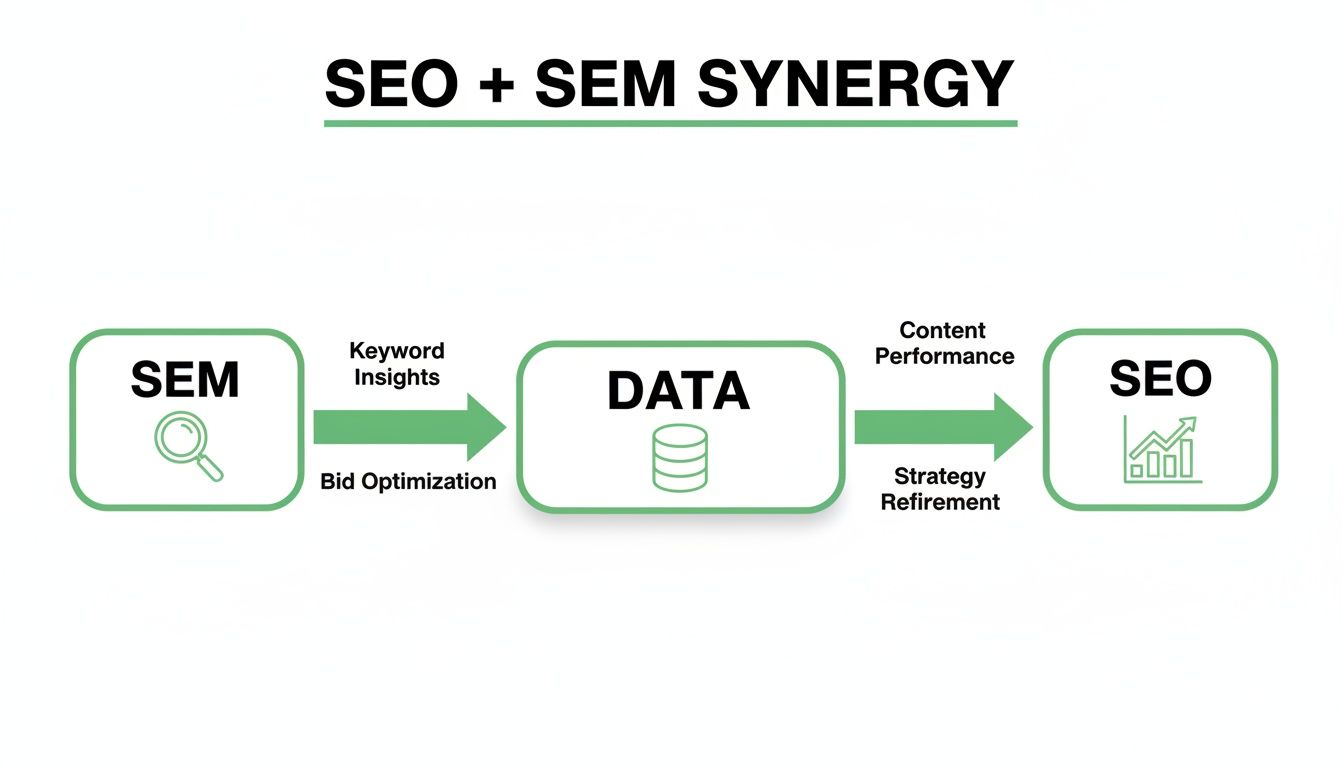
The key takeaway is that learnings from one channel directly inform and improve the other. This creates a cycle of continuous improvement that gets stronger over time.
A Practical Framework for Intent
To put this into practice, think of your customer's journey in three simple stages and assign the primary channel accordingly.
| Stage of Journey | User Intent | Primary Channel | Example Content/Ad |
|---|---|---|---|
| Awareness | Informational | SEO | A blog post titled "What is Programmatic SEO?" |
| Consideration | Commercial | SEO & SEM | A comparison guide on "Top SEO Tools" (SEO) and an ad for "Ahrefs vs Semrush Free Trial" (SEM) |
| Decision | Transactional | SEM | A Google Shopping ad for "Buy Ahrefs Subscription" |
By correctly identifying what the user is trying to do, you can invest your resources far more effectively. SEO builds the foundation of trust, while SEM swoops in to capture the final sale. For a deeper dive, you can find practical guidance on mapping search intent to your content strategy in our dedicated guide.
Budgeting and Measuring What Truly Matters
Throwing money at search marketing without tracking what comes back is like sailing without a compass. You’re moving, but you have no idea if you're getting closer to your destination. A smart approach to both SEO and SEM needs a clear budget and a relentless focus on the metrics that actually grow your business. It's time to stop chasing vanity numbers and start measuring what really matters.
Think of SEO as a long-term investment. You put in the work upfront—creating great content, fixing your website—and the payoff is an asset that keeps generating free traffic for months, sometimes even years.
SEM, on the other hand, is an ongoing expense. You pay for immediate visibility, and your budget is directly tied to the amount of traffic you want. Both are incredibly powerful, but they require different financial mindsets.
Measuring SEO Success Beyond Rankings
It’s easy to get obsessed with hitting the #1 spot for a keyword. But that's a dangerous vanity metric. A top ranking means nothing if it doesn't bring the right people to your site—people who will actually become customers. Instead, focus on metrics that show real business impact.
- Organic Traffic Growth: Is your overall free traffic from search engines going up month after month? This is the clearest sign your SEO efforts are working.
- Keyword Visibility for Valuable Terms: Are you showing up for keywords that signal someone is ready to buy or take action? Getting in front of your ideal customers is far more important than ranking for broad, generic terms.
- Conversions from Organic Visitors: How many people coming from search are actually doing something valuable—filling out a form, signing up for a newsletter, or making a purchase? This is the ultimate proof that your SEO is driving business.
These are the metrics that connect your SEO activities directly to your bottom line. For a crystal-clear picture of your return, check out our guide on how to calculate the ROI of your SEO campaigns, which helps translate performance into hard numbers.
Key SEM Metrics That Drive Profitability
With paid search, every single click has a direct cost, which makes precise measurement an absolute must. Your goal isn't just to get clicks; it's to get customers profitably. To do that, you need to live and breathe a few core metrics.
Don't just focus on how much you spend; focus on how much you get back. The most successful SEM campaigns are ruthless in their pursuit of a positive return on ad spend, cutting what doesn't work and doubling down on what does.
Take a look at digital ad spending in Germany, a real hotspot for SEM strategies. The market shows a clear divide: retail is exploding with 17% growth, while financial services is lagging behind at just 8.1%. Why the difference? Retail's dominance is fuelled by SEM's power to capture high-intent traffic in Germany's massive US$107.85 billion eCommerce market. Here, where organic search already drives a huge 46.98% of traffic, paid search is essential for plugging the gaps and converting customers who are ready to buy now. You can dig into more insights about German digital ad spending by industry on emarketer.com.
Budgeting for a Unified Search Strategy
So, how do you split your budget between the slow burn of SEO and the immediate hit of SEM? There's no magic formula, but a balanced approach is usually your best bet.
A common strategy, especially for new businesses, is to lean more heavily on SEM at the start. This generates immediate leads and provides a ton of valuable keyword data. As your SEO efforts start to gain traction and organic traffic begins to climb, you can gradually shift more of your budget toward maintaining that long-term asset.
This way, you get the best of both worlds: instant results that help fund sustainable, long-term growth.
Getting Started With Programmatic SEO Using AI
Let's demystify a powerful strategy called programmatic SEO (pSEO). Imagine you run a real estate website and want a unique page for every single neighbourhood in a country. Writing thousands of pages by hand is impossible. This is where programmatic SEO, supercharged with AI, comes in.
Don't worry, this isn't about creating spam. It's about automatically creating thousands of helpful, unique pages that answer very specific questions. Think of it like a mail merge for your website: you create one master template and connect it to a big spreadsheet of data. The system then builds all the pages for you.
The real magic is targeting hyper-specific searches that your competitors ignore, like "best coffee shops in Berlin Kreuzberg" or "family-friendly parks in Hamburg." Individually, these searches don't get much traffic, but together, they add up to a huge audience that knows exactly what it wants.
The Three Simple Parts of Programmatic SEO
Getting started is easier than you think. You only need three things:
- A Data Source: This is just a spreadsheet. Each row will become a new webpage (e.g., a neighbourhood), and each column is a piece of information for that page (e.g., average rent, local parks, population).
- A Page Template: This is the design for all your pages. It has fixed parts (like your logo and menu) and empty spots where the data from your spreadsheet will go.
- A Way to Generate Content: This is where you write the text for each page. Traditionally, this was a huge bottleneck, but AI has made it simple.
With these three pieces, you can turn a spreadsheet with 1,000 rows into 1,000 unique, optimised web pages automatically.
A Practical, AI-Powered Workflow
So, how do you actually use AI to do this? Instead of just plugging raw data into your template, you use AI to write natural, helpful sentences around that data. Here’s a simple, step-by-step way to think about it.
Step 1: Get Your Data
Find a spreadsheet with the information you need. For our real estate example, you could create a Google Sheet with columns for "Neighbourhood," "City," "Average Rent," and "Local Amenities."
Step 2: Design Your Template
Create a basic page layout. This will have placeholders like "[Neighbourhood]" where your data will be inserted. For example, a headline could be "Everything You Need to Know About Living in [Neighbourhood]."
The core idea is to transform raw data points into helpful, readable sentences. AI is brilliant at this, turning a simple data row into a unique paragraph that serves a user’s specific search query.
Step 3: Use AI to Write the Content
This is the game-changing part. Open a tool like ChatGPT and give it a clear instruction (a "prompt"). Your prompt can combine static text with your placeholders. For example:
"Write a 100-word paragraph about what it's like to live in [Neighbourhood], [City]. Mention that the average rent is around [Average Rent] and that great local spots include [Local Amenities]."
You can then automate the process of running this prompt for every single row in your spreadsheet. This creates unique, context-aware content at a scale that was impossible just a few years ago. This technique, called Natural Language Generation (NLG), is the engine behind modern pSEO. You can learn more about Natural Language Generation in our guide to see exactly how it works.
This combination of structured data and AI-written content builds a powerful bridge between SEO and SEM. You're creating thousands of highly relevant landing pages for SEO that can also dramatically improve the Quality Score of your hyper-targeted paid ad campaigns.
Your Essential Search Marketing Toolkit
Trying to manage search marketing without the right tools is like building a house with just a hammer. You might get somewhere, but it's going to be slow and messy. The right software doesn’t just speed things up; it gives you the data you need to make smart decisions that improve both your SEO and SEM results.
These platforms automate the boring stuff, reveal hidden opportunities, and give you a clear view of your performance. There's a reason the European SEO software market, with Germany leading the charge, was valued at USD 18.1 billion and is projected to hit USD 37.0 billion by 2030. That growth shows just how vital these tools have become. You can dig into more details about the European SEO software market on grandviewresearch.com.
Let’s break down the must-haves for your toolkit.
Tools for Keyword Research
Everything starts with knowing the exact words your audience is typing into Google. Keyword research tools help you find these terms, see how many people are searching for them, and figure out how hard it will be to rank for them.
- Ahrefs or Semrush (Paid): These are the Swiss Army knives of the SEO world. They are fantastic for seeing what your competitors rank for and uncovering valuable keyword opportunities you can target.
- Ubersuggest (Freemium): A great starting point if you're on a tighter budget. It gives you a solid amount of data for free, making it perfect for brainstorming ideas and getting a feel for search volumes.
Tools for Technical Health Checks
A website can look great on the outside but have technical problems that kill your SEO efforts. Technical SEO tools crawl your site like a search engine would, flagging hidden issues holding you back.
Think of these tools as a building inspector for your website. They find "digital cracks" in your foundation—like broken links, slow pages, or duplicate content—so you can fix them before they cause major problems.
Screaming Frog SEO Spider (Freemium) is the industry standard here. Its free version crawls up to 500 pages, which is plenty for most small websites. It gives you a full report on everything you need to fix to keep your site technically sound and in Google's good books.
Tools for Ad Management
Managing a paid search campaign directly in the web browser can be slow and clunky. Ad management tools are built to streamline this process, saving you time and reducing costly mistakes.
- Google Ads Editor (Free): This is a must-have for anyone running Google Ads. It’s a free app that lets you manage your campaigns offline and then upload all your changes at once. Tasks that used to take hours—like tweaking hundreds of ad headlines—can be done in minutes.
By arming yourself with the right toolkit, you can turn confusing data into a clear plan of attack. It gives you the confidence to manage both the long-term growth of your SEO and the immediate impact of your SEM.
SEO vs. SEM: Your Questions Answered
When you're first getting started, a few common questions always come up. Let's tackle them with some straight-talking advice to help you decide where to focus.
Which Is Better for a New Business: SEO or SEM?
For a brand-new business that needs results now, SEM is your best bet. Paid ads get you immediate traffic and potential customers, which is crucial for getting early feedback and making your first sales.
But don't ignore SEO. While SEM provides that initial boost, you should be laying the groundwork for your long-term organic strategy. Think of SEO as building a valuable asset. It takes time, but it eventually becomes a cost-effective machine that brings in traffic for years, long after you’ve scaled back your ad spend.
Can I Do SEO and SEM On My Own?
Absolutely. If you’re running a small business, you can definitely handle the basics yourself. Tools like Google Ads for SEM and countless user-friendly SEO plugins for platforms like WordPress have made both disciplines far more accessible.
The catch? As your business grows, so does the complexity. Managing larger campaigns and keeping up with constant algorithm changes can become a full-time job. Most businesses eventually reach a point where it makes sense to hire a specialist or an agency to get the best possible return on their investment.
How Long Does It Take to See SEO Results?
Here’s the honest truth: SEO is a marathon, not a sprint. You might see some small, encouraging signs within a few weeks, but you're typically looking at four to twelve months before you see significant, lasting results.
SEO success is all about consistent effort that builds on itself over time. The slow start can feel frustrating, but the payoff is huge: a stable, reliable stream of high-quality traffic that you don’t have to pay for with every click.
This timeline isn’t set in stone. It depends on how competitive your industry is, the current health of your website, and how consistently you’re creating genuinely helpful content and earning quality links from other sites.
Ready to move beyond the basics and master scalable content strategies? At Programmatic SEO Hub, we provide the guides, tools, and systems you need to dominate search in the age of AI. Explore our free resources today!
Related Articles
SEO or SEM Your Guide to the Right Marketing Strategy
When you're trying to figure out where to put your marketing budget, the SEO vs. SEM debate often comes down to one core trade-off: long-term asset building versus immediate visibility. It's...
10 Social Media Key Performance Indicators to Master in 2025
Are you drowning in social media data but starving for real insights? In a world of vanity metrics like follower counts, identifying the right social media key performance indicators (KPIs) is the...

How to Find the Best SEO Agency: A Practical Guide for 2025
Finding the best SEO agency to boost your online presence can feel like searching for a needle in a haystack. The market is full of providers promising the moon, but it's hard to tell real...