The Best Alternative to Google: 12 Top Search Engines for 2025

For years, Google has been the default gateway to the internet, but its dominance is no longer absolute. As privacy concerns intensify and the search experience is reshaped by AI, the demand for a capable alternative to Google has become critical for users and professionals alike. Whether you're an SEO practitioner seeking untracked search results, a marketer aiming to understand diverse user behaviours, or simply a user who values data privacy, a vast ecosystem of powerful search engines exists beyond the familiar Google interface.
This guide is your practical resource for navigating this new terrain. We will cut through the technical jargon and provide a simple breakdown of 12 leading alternatives, from privacy-focused engines like DuckDuckGo to innovative AI tools like Perplexity. Our goal is to demystify these platforms, making them easy to understand, even for beginners.
Inside, you will find more than just a list. Each entry includes a concise description, a clear breakdown of pros and cons, and specific examples to help you decide which is best for your needs. We've included screenshots for a visual preview and direct links to get you started immediately. For business owners and marketers, we'll explain how to use these tools to create content that ranks everywhere, not just on Google, using a strategy called Programmatic SEO. Let’s explore the options and find the perfect tool to reclaim your search.
1. DuckDuckGo
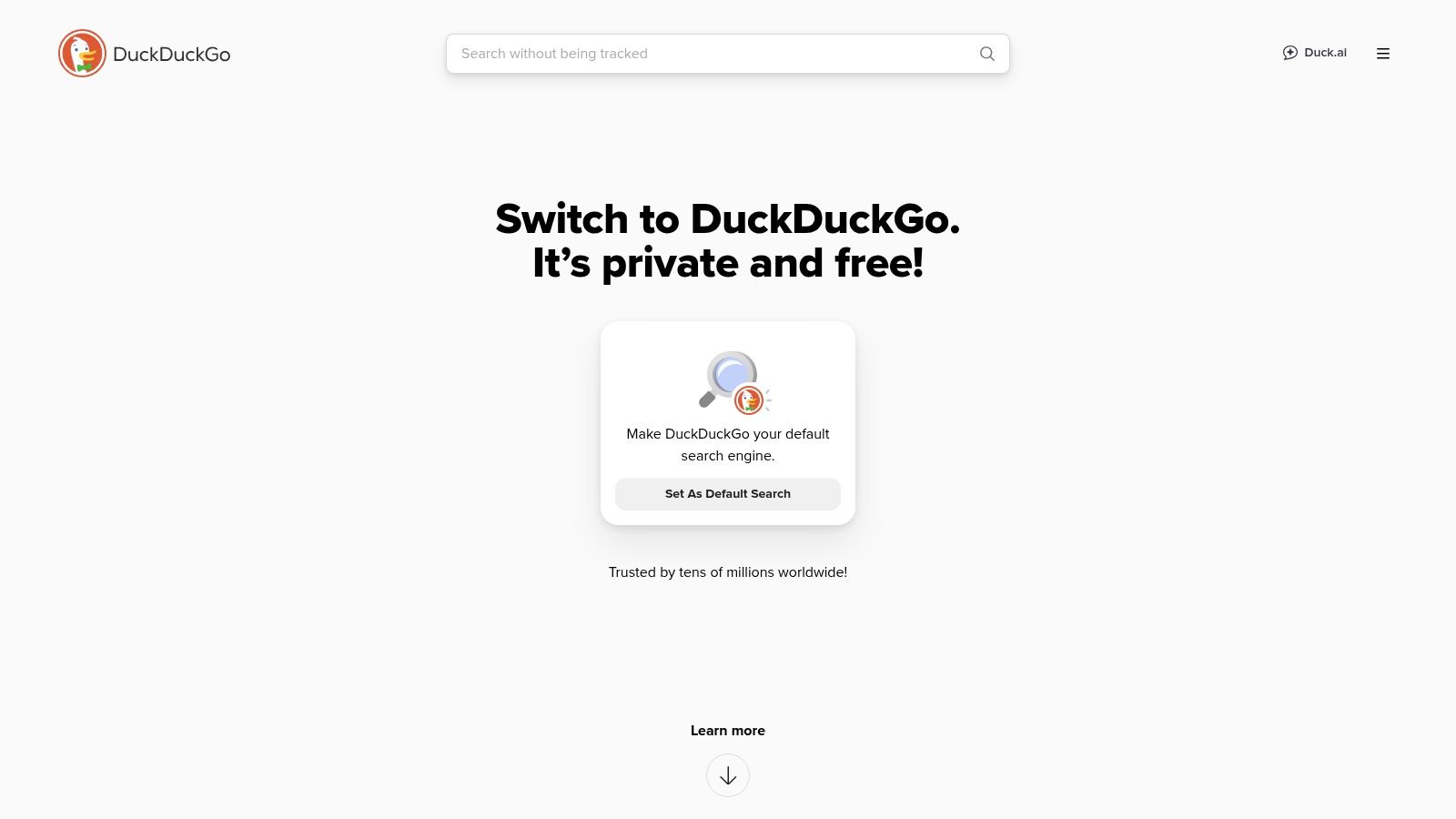
DuckDuckGo has long been the go-to alternative to Google for users prioritising privacy. Its core promise is simple: a search experience that doesn't track your activity, build a user profile, or filter your results based on your past behaviour. This makes it an excellent general-purpose replacement for daily searches, accessible via its website, browser extensions, and dedicated mobile and desktop apps.
The platform provides a clean, familiar search interface, which makes the transition from Google seamless. It differentiates itself by blocking hidden third-party trackers by default and enforcing encrypted connections, offering a layer of protection that goes beyond just search queries.
Key Features and Use Cases
DuckDuckGo has expanded beyond search into a comprehensive privacy suite. Its offerings include Duck.ai, a private chatbot that anonymises your IP address and provides access to models like GPT 3.5 Turbo and Claude 3 Haiku, with chat history stored only on your device.
- Privacy Pro Bundle: For a monthly fee (currently available in the U.S.), users get a VPN, a Personal Information Removal service that scans and removes your data from broker sites, and Identity Theft Restoration support.
- Search "Bangs": A powerful feature allowing you to search directly on thousands of other sites by using a prefix. For example, typing
!wbefore your query searches Wikipedia directly. - Implementation Note: When analysing user behaviour for programmatic SEO, remember that DuckDuckGo's results are less personalised. This can provide a more neutral baseline for understanding how your pages perform for queries without user-history bias. This focus on objective results means your content's ability to match a query's core purpose is paramount. Learn more about understanding search intent for SEO.
Pros and Cons
| Pros | Cons |
|---|---|
| Strong, clear privacy policy | Search results rely on syndication (Bing, etc.), not a fully independent index |
| Easy to use across all devices with integrated apps | Privacy Pro subscription is currently limited to the United States |
| No account required for core search and AI chat features | May lack some of the deep integrations of the Google ecosystem |
| Website: https://duckduckgo.com |
2. Brave Search
Brave Search is a powerful alternative to Google for those seeking transparency and control over their search results. Unlike many competitors that rely on Bing or Google, Brave has built its own independent search index. This independence means its ranking algorithms are not beholden to Big Tech, offering a genuinely different perspective on the web. The search engine is integrated into the privacy-first Brave browser but is also accessible on any device.
The platform is designed to give users more power, featuring an AI-driven Summarizer that provides concise answers with clear source citations. This focus on transparency makes it a great tool for unbiased research, as it avoids creating a filter bubble based on your past search history.
Key Features and Use Cases
Brave Search's standout features are built around user empowerment and result customisation. Its independence from other search indexes provides a valuable, unfiltered view of search engine results pages (SERPs).
- Independent Index: Brave crawls and indexes the web itself, providing an alternative to the dominant search duopoly. This offers a different set of ranking signals and can surface content that might be less visible on Google.
- Goggles: This unique feature allows users to create or apply custom re-ranking rules to their search results. You can prioritise results from specific domains, down-rank others, or apply community-created filters for a tailored experience.
- Implementation Note: For programmatic SEO professionals, Brave Search is an excellent tool for de-personalised SERP analysis. By checking rankings on Brave, you can get a clearer, unbiased view of how your pages perform based on content quality alone, free from Google's heavy personalisation. This helps you analyse how your content appears in various SERP features for a neutral user.
Pros and Cons
| Pros | Cons |
|---|---|
| Truly independent search index | Smaller index means long-tail query recall can sometimes lag behind Google |
| High degree of user control and result customisation | The AI Summarizer is still evolving and may not be present for all queries |
| Strong focus on privacy with no user profiling | Lacks the deep ecosystem integrations found within Google services |
| Website: https://search.brave.com |
3. Startpage
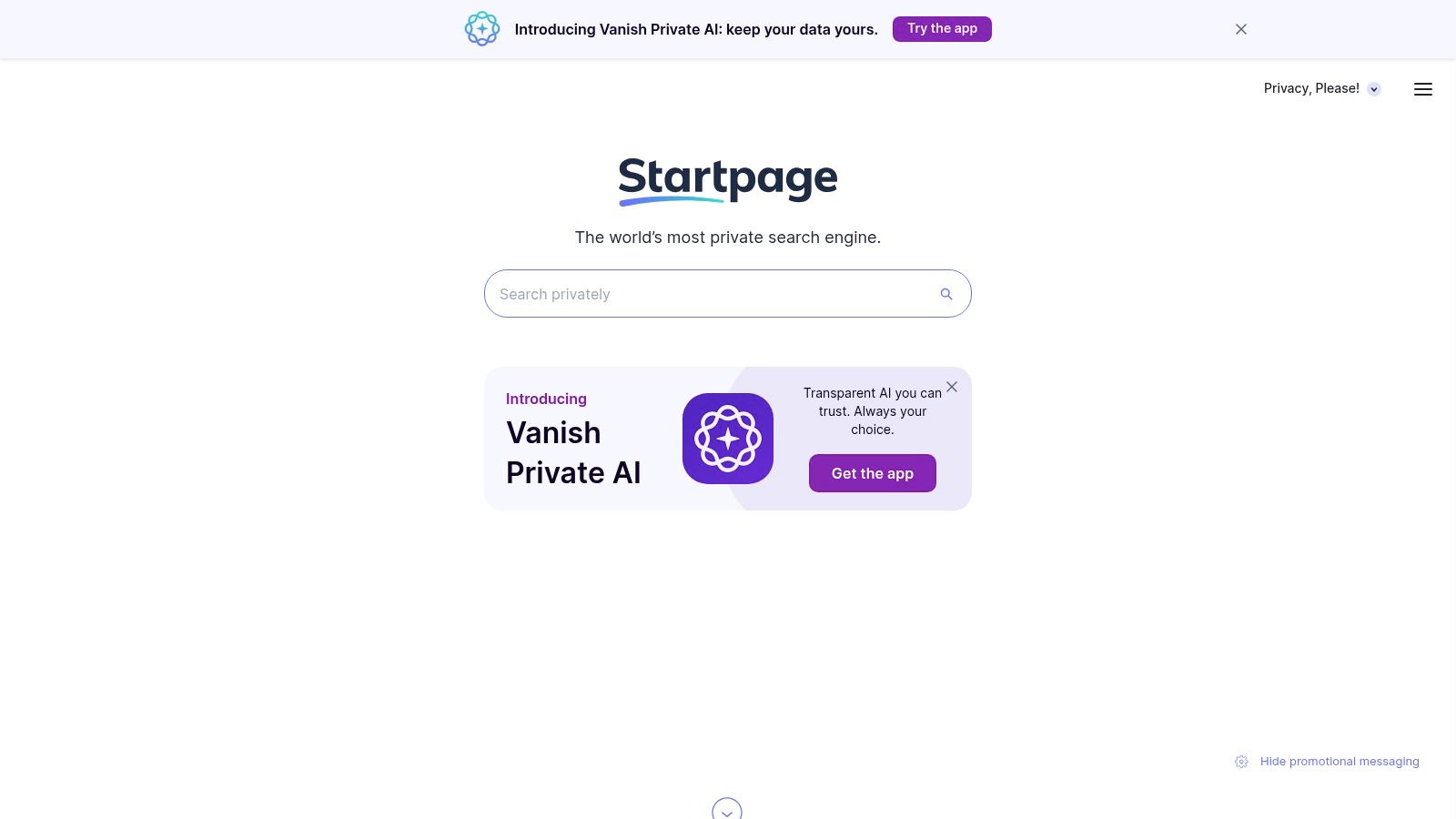
Startpage offers a compelling hybrid approach as an alternative to Google: it provides users with Google's powerful search results but without any of the tracking. This Dutch-based search engine acts as a privacy-focused intermediary, submitting your query to Google on your behalf and then returning the results to you anonymously. This unique model allows you to leverage Google's relevance and extensive index while completely stripping out personal identifiers, ensuring your search history remains private.
The platform's standout feature is 'Anonymous View,' a proxy service that lets you browse websites from the search results without revealing your IP address or user agent. This makes it an excellent choice for users, particularly in the EU, who demand Google-level search quality but are committed to GDPR-aligned privacy standards. The interface is clean and straightforward, prioritising a direct path to information.
Key Features and Use Cases
Startpage is built around delivering familiar, high-quality results while adding a robust layer of privacy protection. Its core value lies in its ability to anonymise the world's most popular search engine.
- Google Results, Total Privacy: The primary function is serving Google search results without passing any of your personal information, such as your IP address or search history, to Google's servers.
- Anonymous View Proxy: With a single click next to a search result, you can open the webpage through Startpage's proxy. This masks your identity from the destination website, preventing it from tracking you.
- Implementation Note: For SEO professionals, Startpage provides a valuable window into raw, non-personalised Google rankings. Since it removes user history bias, it’s an effective tool for analysing how your pages perform for specific queries on Google's index. This can help clarify if your content is truly aligned with keyword intent, a crucial factor in understanding the real search volume for your keywords.
Pros and Cons
| Pros | Cons |
|---|---|
| Google-level relevance minus profiling | Anonymous View proxy can slow down page loading speeds |
| Extra privacy layer when opening results via Anonymous View | Proxy may limit functionality on some sites (e.g., forms, JavaScript) |
| EU/NL-based option aligned to GDPR-focused users | Relies on Google's index, so it is not a fully independent search engine |
| Website: https://www.startpage.com |
4. Ecosia
Ecosia offers a unique value proposition as an alternative to Google by transforming user searches into environmental action. This Berlin-based search engine directs its advertising profits towards funding tree-planting projects globally. Its mission-driven approach makes it a compelling choice for users who want their digital activities to have a positive real-world impact, particularly those in Europe who appreciate its EU-based operations.
The platform delivers a familiar and straightforward search experience, making the switch from other major search engines feel effortless. By positioning itself as a social business, Ecosia provides a way for users to contribute to climate action simply by searching the web, without sacrificing the core functionality they expect from a modern search tool. It is available on its website and as a default search engine option in major browsers.
Key Features and Use Cases
Ecosia's primary differentiator is its business model, which is built on transparency and environmental dedication. It regularly publishes financial reports to show exactly how its revenue is allocated to reforestation projects, building a strong foundation of trust with its user base.
- Climate-Positive Searching: Every search contributes to funding tree planting. A personal counter shows users the approximate number of trees they have helped to plant.
- Privacy-Conscious: Ecosia anonymises search data within one week and does not sell user data to advertisers. It also doesn't use external tracking tools.
- Implementation Note: For SEO professionals targeting European audiences, Ecosia's popularity in regions like Germany offers a valuable data source. Analysing how your content performs here can reveal insights into a values-driven user segment. Performance on Ecosia, which is powered by Bing, can help you diversify your strategy beyond Google and understand what drives organic traffic from different sources.
Pros and Cons
| Pros | Cons |
|---|---|
| Clear, impactful environmental mission | Search results are powered by Bing, not a fully independent index |
| Strong privacy standards and transparent financial reports | May lack the advanced search tools and deep integrations of Google |
| Familiar user interface makes it easy to adopt | Niche or highly specific queries may yield less relevant results |
| Website: https://www.ecosia.org |
5. Qwant
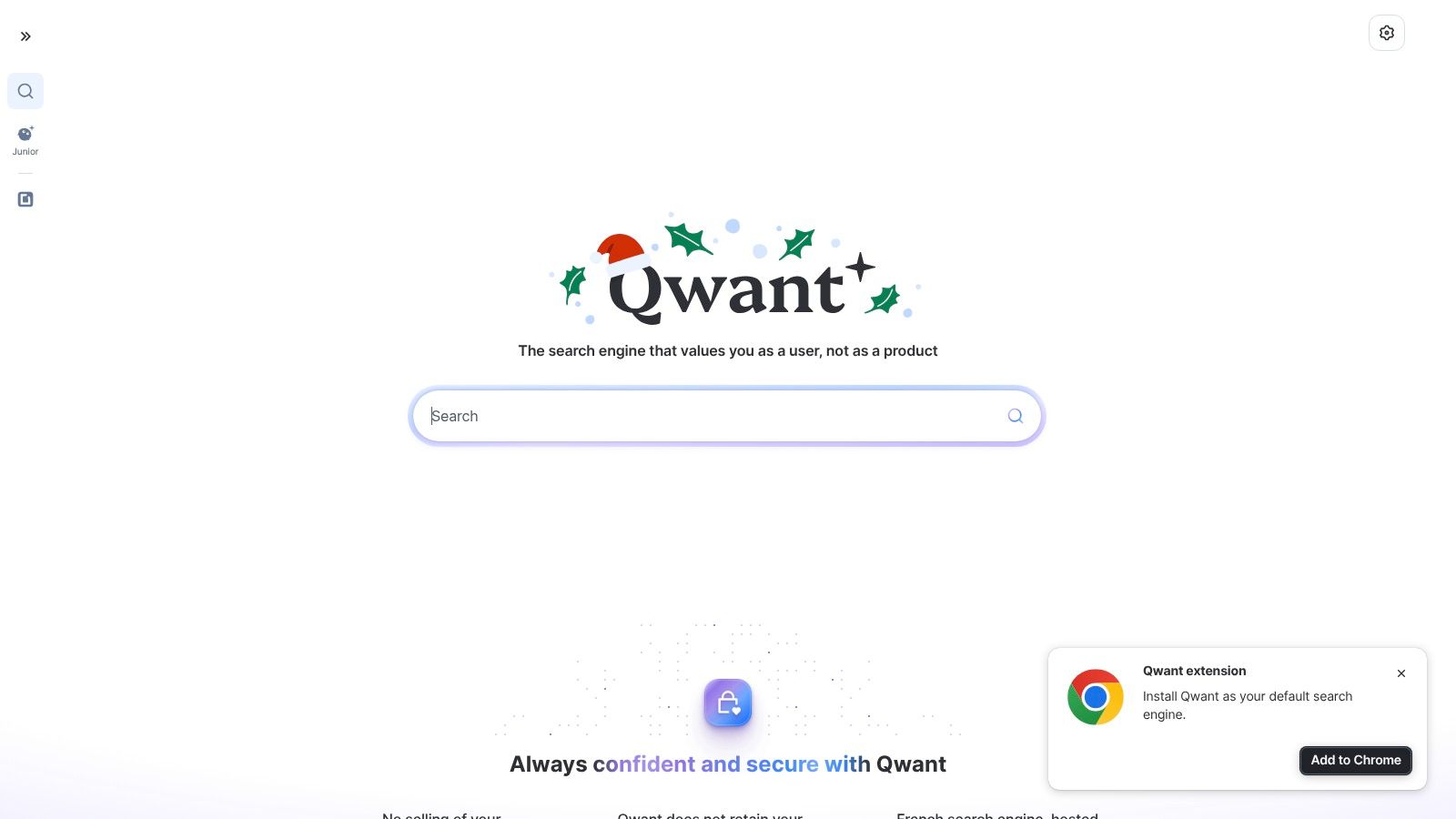
Based in France, Qwant presents itself as a distinctly European alternative to Google, built on a foundation of data privacy and sovereignty. Its core commitment is to provide a search experience that respects user privacy by not tracking searches or selling personal data, aligning with strict EU data-protection standards like GDPR. This makes it a compelling choice for users, particularly within Europe, who prioritise data governance and regional relevance.
Qwant's platform offers a familiar, intuitive search interface, ensuring a smooth transition for new users. It emphasises its own indexing technology to deliver impartial results, free from personalised filters. By processing user data exclusively in Europe, it offers a level of regional data security that global competitors cannot match.
Key Features and Use Cases
Qwant’s services extend beyond standard web search, providing a suite of tools that maintain its privacy-first ethos. Its Qwant Maps feature offers a privacy-conscious mapping solution, and Qwant Junior provides a safe, filtered search environment for children, making it a well-rounded ecosystem.
- European Data Sovereignty: All user data is processed and stored on servers located in Europe, adhering to some of the world's most stringent privacy laws.
- Neutral, Unfiltered Results: The search engine aims to deliver objective information by not tailoring results based on a user's past search history or location.
- Implementation Note: For programmatic SEO campaigns targeting European audiences, analysing search rankings on Qwant provides valuable insight into how content performs under EU-centric indexing. Its results can reveal regional search trends and keyword relevance without the personalisation bias found in Google, offering a clearer view of your content's foundational SEO strength in the European market.
Pros and Cons
| Pros | Cons |
|---|---|
| Strong adherence to EU privacy laws (GDPR) | Historically has relied on Bing for a portion of its search results |
| Unbiased results not influenced by user tracking | Smaller index size may occasionally lead to less comprehensive results |
| Offers privacy-focused supplementary services like Maps | Less market penetration outside of Europe, particularly in France |
| Website: https://www.qwant.com |
6. MetaGer
MetaGer is a unique alternative to Google operated by the German non-profit organisation, SuMa-e.V. (Association for Free Access to Knowledge). This metasearch engine emphasises privacy, transparency, and civil-society governance, making it a powerful choice for users who prioritise non-commercial, community-driven online tools. It queries a wide range of search engines to compile its results, all while anonymising the user's request.
The platform is distinguished by its open-source components and commitment to digital sovereignty. Based in Germany, it operates under strict data protection laws, providing a level of privacy assurance rooted in legal and ethical frameworks. Its search interface is straightforward, offering options to filter results by specific search engines, which gives users more control over their information sources.
Key Features and Use Cases
MetaGer’s approach is fundamentally different from profit-driven search engines. It offers a sustainable model that doesn't rely on selling user data, making it a reliable tool for researchers, activists, and privacy-conscious individuals.
- Non-Profit Governance: Being run by SuMa-e.V. ensures that its operations are guided by the principles of free knowledge access rather than commercial interests.
- Paid Keys Model: Users can purchase tokens ("keys") to perform ad-free searches. This anonymous payment system directly supports the infrastructure, offering a clear, privacy-respecting alternative to ad-based revenue models.
- Implementation Note: For programmatic SEO, MetaGer offers a valuable window into how content performs across a blended set of German and international search indexes. Analysing its results can help you understand your content's visibility in the DE market, especially for queries where local context and privacy are paramount concerns.
Pros and Cons
| Pros | Cons |
|---|---|
| Operated by a German non-profit with a strong focus on privacy | The paid "key" system for ad-free searching may be unfamiliar to casual users |
| Open-source and transparent operations | Results are aggregated and may lack the unique features of a primary index |
| Civil-society governance provides a non-commercial, trustworthy alternative | Smaller user base compared to mainstream search engines |
| Website: https://metager.org |
7. Swisscows
Swisscows positions itself as a family-friendly alternative to Google with a strong emphasis on privacy and content filtering. Based in Switzerland, it operates outside of US and EU data jurisdictions, a key selling point for privacy-conscious users. Its core mission is to provide a search environment free from tracking and explicit content, making it a popular choice for families, schools, and organisations wanting a safer internet experience by default.
The platform achieves this by enforcing a strict, non-negotiable safe-search filter that blocks pornographic and violent content. This approach differentiates it from competitors that offer optional filtering, as Swisscows builds its entire experience around this protective layer. It runs on its own infrastructure, hosted in Swiss data centres.

Key Features and Use Cases
Beyond its core search function, Swisscows offers a suite of privacy-respecting tools, including an anonymous messenger (TeleGuard) and a VPN service, positioning itself as a more comprehensive privacy solution. The search engine itself uses a combination of its own index and results from partners like Bing to ensure broad coverage.
- Family-Safe Search: The most prominent feature is its built-in filter for violent and pornographic content, which cannot be disabled. This makes it ideal for use in educational settings or on devices used by children.
- No Tracking or User Profiles: Swisscows does not collect or store any personal data, IP addresses, or search queries from its users, ensuring complete anonymity.
- Implementation Note: When conducting keyword research for programmatic SEO campaigns targeting family or educational niches, Swisscows can provide valuable insight. The heavily filtered results reveal how content is categorised and ranked in a highly restrictive environment, helping you optimise content to be universally "safe" and authoritative.
Pros and Cons
| Pros | Cons |
|---|---|
| Excellent for family-safe and educational environments | Strict filtering is not optional and may omit legitimate, non-explicit results |
| Swiss-based hosting offers strong data privacy | Search index is smaller and less comprehensive than Google's |
| No user tracking or data collection by default | Lacks the advanced search operators and tools for power users |
| Website: https://swisscows.com |
8. Mojeek
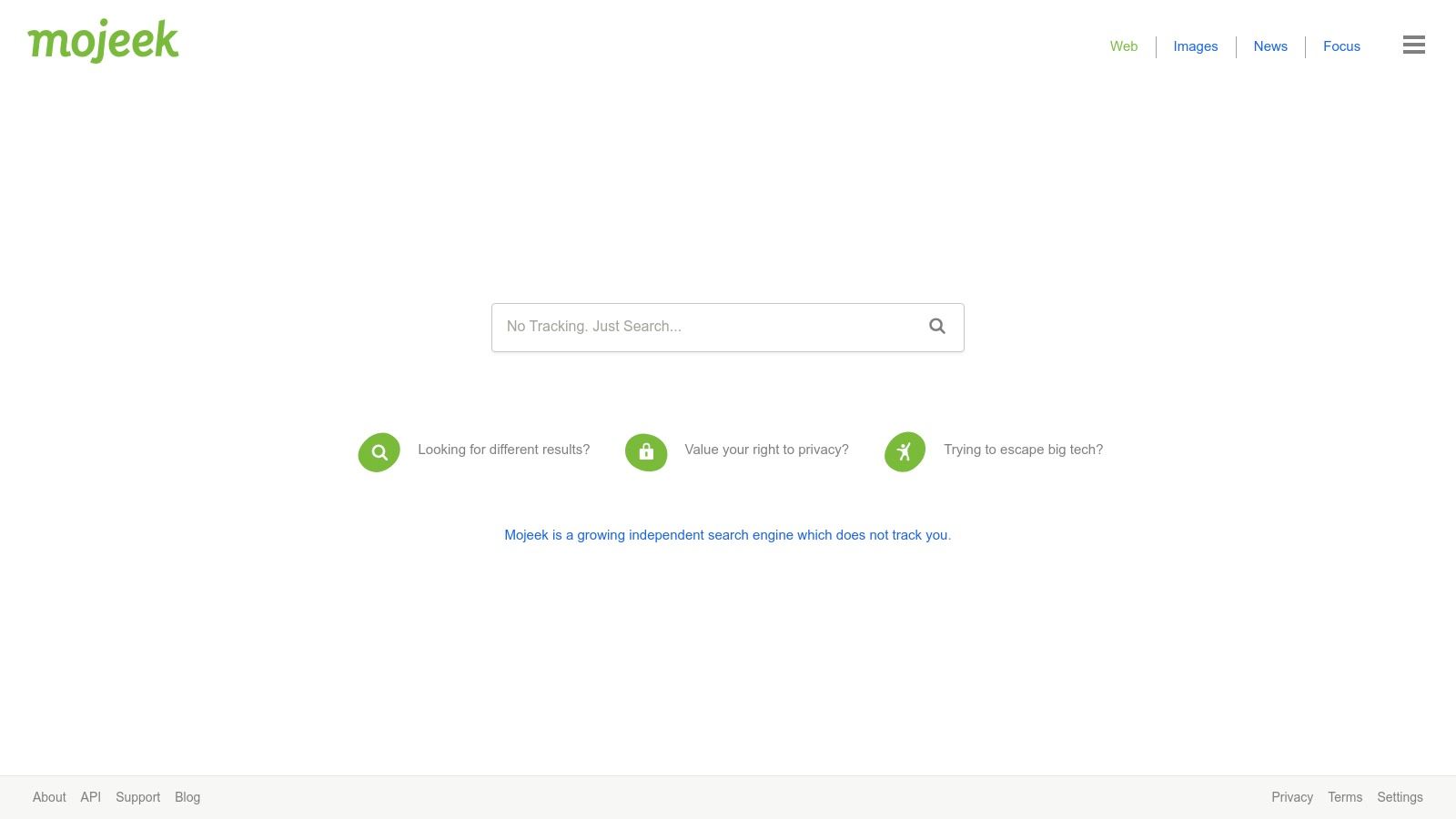
Mojeek stands out as a true alternative to Google by operating with its own completely independent web crawler and search index. Based in the UK, it offers a genuinely different set of search results, free from the influence of tech giants like Microsoft or Google. This commitment to an independent index, which has grown to over 9 billion pages, ensures that its rankings are not just a variation of Bing, providing a unique perspective on the web.
The platform is built on a staunch privacy-first principle, meaning it does not track, profile, or create a data-driven "bubble" around its users. This makes it an invaluable tool for marketers and SEOs seeking unbiased search results to analyse how content performs without personalisation filters.
Key Features and Use Cases
Mojeek's independence is its core feature, offering a distinct alternative to the dominant search ecosystems. Its tools are designed to provide unfiltered access to information, making it particularly useful for research and strategic analysis.
- Independent Index: Provides a unique set of search engine results pages (SERPs) that can reveal ranking opportunities and content gaps missed by mainstream engines.
- Privacy-First Approach: Guarantees that all searches are anonymous, with no tracking or user profiling, offering a clean slate for every query.
- Implementation Note: For programmatic SEO, use Mojeek to validate keyword opportunities and analyse SERP competition from a non-U.S., non-personalised viewpoint. Its results can offer insights into how well your content addresses a query's fundamental intent, independent of user data, which is crucial for building content that has universal appeal. Learn more about programmatic keyword research.
Pros and Cons
| Pros | Cons |
|---|---|
| Truly independent search index distinct from Google/Bing | Smaller index may miss some niche or long-tail regional content |
| Helpful for SEO competitive analysis without U.S. platform bias | Coverage for specific DE content may lag behind major engines |
| Strong commitment to privacy with no user tracking | User interface and features are more basic compared to larger competitors |
| Website: https://www.mojeek.com |
9. Kagi
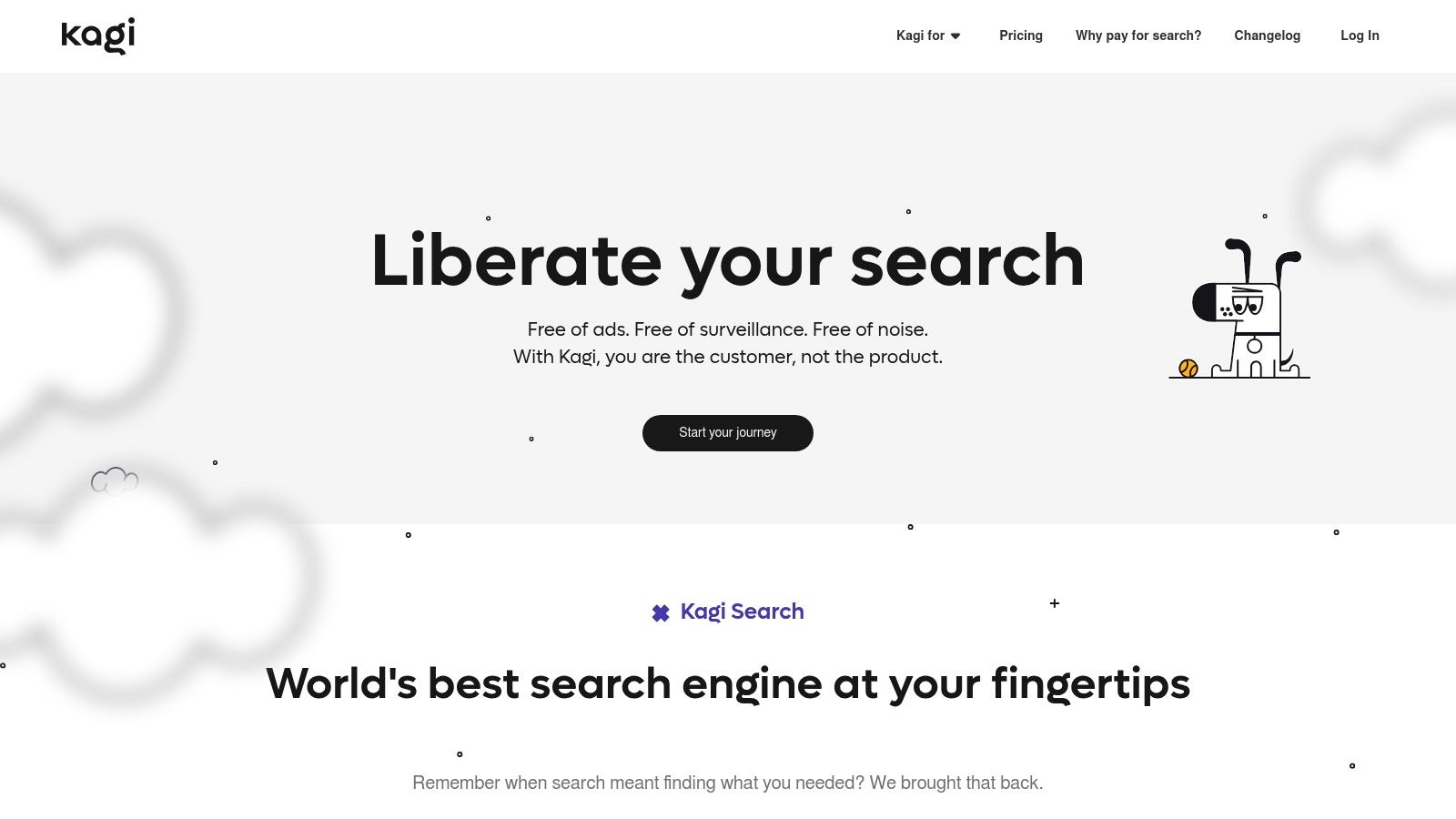
Kagi offers a premium, ad-free search experience, positioning itself as a powerful alternative to Google for professionals, developers, and researchers who value speed and control. Unlike ad-supported models, Kagi is a subscription-based service that prioritises user privacy and result quality. Its core mission is to provide an unbiassed, customisable search engine that works for you, not for advertisers.
The platform delivers a clean, fast interface and gives users unparalleled control over their search results. With features like "Lenses," you can create and save custom search filters, and you can permanently block or elevate specific domains in your results, ensuring every search is tailored to your preferences.
Key Features and Use Cases
Kagi is more than a search engine; it's a research tool designed for productivity. It integrates AI seamlessly and gives users granular control over the information they see, making it a favourite among power users.
- Customisable Search (Lenses): Create personalised search modes that filter results by specific criteria, such as restricting queries to certain websites or timeframes. This is invaluable for deep research or market analysis.
- Kagi Assistant: An integrated AI chat and research assistant that provides quick summaries, answers questions, and can access various AI models. It acts as a powerful co-pilot for complex information gathering.
- Implementation Note: Kagi's user base consists of discerning, tech-savvy individuals. Analysing its SERPs can provide insights into what this high-value audience seeks, which can inform your content strategy. It's a useful tool for advanced keyword research and content ideation by revealing what a privacy-focused, ad-averse audience values.
Pros and Cons
| Pros | Cons |
|---|---|
| Completely ad-free and private | Paid subscription is required after a limited free trial |
| High degree of search result customisation and control | Search allotments on some plans may not suit extremely heavy users |
| Integrated AI assistant enhances research efficiency | Smaller user base compared to mainstream search engines |
| Website: https://kagi.com |
10. You.com
You.com positions itself as a conversational AI search engine and a powerful alternative to Google for users who prioritise direct, AI-generated answers grounded in real-time web data. Instead of just a list of links, it provides summarised responses, citations, and access to various AI models, making it a strong choice for research, content ideation, and complex queries where synthesis is needed. Its focus is on providing a smarter, more efficient search experience.
The platform's interface is organised around its AI chat capabilities, blending traditional search results with direct answers. This makes it particularly useful for users looking to streamline their research workflows without leaving the search environment. It offers both free and premium tiers, with advanced features geared towards professionals and teams requiring API access for their own applications.
Key Features and Use Cases
You.com is built for a new generation of search, where users interact with AI agents to get tasks done. Its architecture is well-suited for both individual researchers and businesses looking to integrate intelligent search capabilities into their own products.
- AI Agents and Multi-Model Access: Users can leverage specialised agents for research, coding, or creative tasks. Pro plans provide access to advanced models like GPT-4o and Claude 3 Opus.
- API for Developers: You.com offers APIs for search, news, and content extraction. This is a significant feature for programmatic SEO, as it allows developers to build applications that can fetch and analyse real-time, web-grounded data for content generation or market research.
- Implementation Note: The Search API can be used in a programmatic SEO workflow to generate data-driven content. For example, you could use the API to pull the latest statistics or facts about a list of topics, then feed that structured data into an AI content generator to create timely, accurate articles at scale.
Pros and Cons
| Pros | Cons |
|---|---|
| Robust Pro features like file uploads and research agents | Premium features are gated behind paid plans |
| Actively developed with strong B2B and enterprise capabilities | Pricing can be higher for teams and enterprise use compared to consumer tools |
| Search APIs are well-suited for programmatic use cases | The user experience is more complex than a traditional search engine |
| Website: https://you.com |
11. Perplexity
Perplexity is a powerful AI answer engine that functions as a conversational alternative to Google, especially for research-heavy queries. Instead of just listing links, it synthesises information from multiple sources to provide direct, cited answers. This makes it a go-to tool for researchers, content creators, and SEO professionals who need to quickly gather and verify information for complex topics.
The platform provides a clean, chat-based interface that feels intuitive and focuses on the conversation. It distinguishes itself by always linking to the web pages it used to formulate its response, allowing users to easily check sources and delve deeper. Its ability to process and answer questions based on uploaded files like PDFs or text documents further enhances its research capabilities.
Key Features and Use Cases
Perplexity is designed to be a research assistant, offering specialised modes and features that go beyond a standard search. Its "Pro" search mode can perform deeper, multi-step analysis for highly complex questions, making it invaluable for in-depth topic exploration.
- Cited, Synthesised Answers: Every response includes numbered citations linked directly to the source articles, providing transparency and facilitating fact-checking.
- File-Grounded Research: Users can upload documents (PDFs, TXT files) and ask questions directly about their content, ideal for analysing academic papers, reports, or legal documents.
- Implementation Note: For programmatic SEO, Perplexity is excellent for the initial research and clustering phase. You can use it to generate structured outlines or FAQ sections for a parent topic by asking it to synthesise information from top-ranking competitor articles. The cited sources also provide a ready-made list of high-authority pages to analyse.
Pros and Cons
| Pros | Cons |
|---|---|
| Fast, source-linked outputs for exploratory analysis | Free tier has usage limits on advanced features |
| Enterprise tier offers SSO, SOC 2, and data controls | The most powerful models require a paid Pro subscription |
| Occasional partner promotions can expand user access | AI-synthesised answers can still require manual fact-checking |
| Website: https://www.perplexity.ai |
12. SearXNG
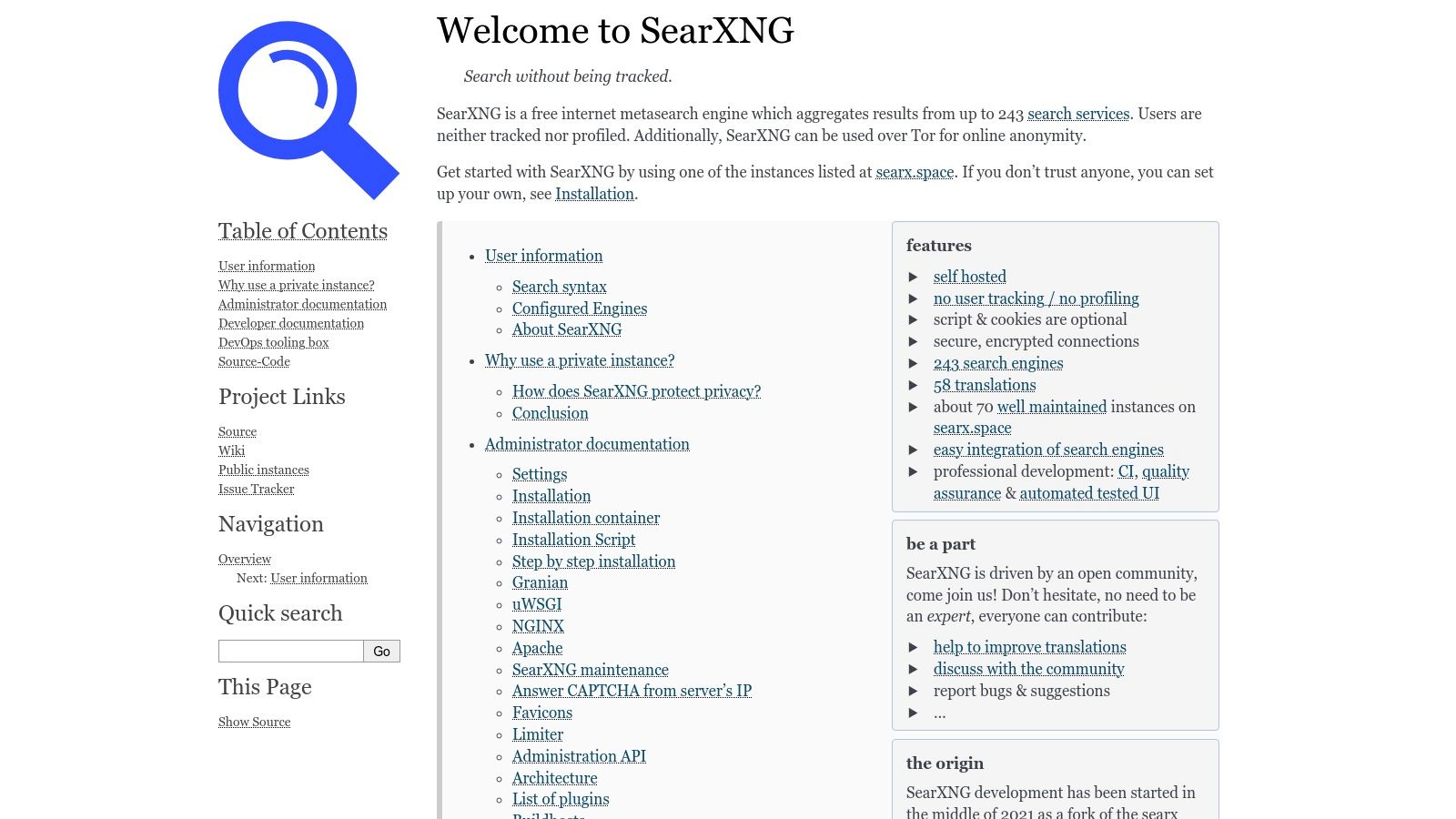
For users seeking maximum control and transparency, SearXNG presents a powerful alternative to Google. It is a free and open-source metasearch engine that aggregates results from over 200 services without tracking or profiling its users. This decentralised approach allows you to either use one of the many publicly available instances or self-host your own for complete authority over your search environment.
SearXNG distinguishes itself by fetching results from various sources and then anonymising your request, effectively stripping away all identifying information. This provides a highly private and customisable search experience, making it a favourite among privacy advocates and technical users who want to fine-tune their information sources.
Key Features and Use Cases
The core strength of SearXNG lies in its flexibility and privacy-first architecture. It is designed to be a versatile tool that can be adapted to specific needs, from general web searches to highly specialised queries across scientific, social, or news platforms.
- Self-Hosting & Customisation: The ability to self-host gives you total control. You can decide which search engines to query, how results are presented, and enforce strict privacy policies for your team or personal use.
- Public Instances: For those who prefer not to manage a server, a directory of public instances is available. This allows you to start using SearXNG immediately, though performance and reliability can vary between hosts.
- Implementation Note: From a programmatic SEO perspective, querying a self-hosted SearXNG instance can be a valuable method for unbiased SERP analysis. By aggregating results from multiple engines without user-specific data, you can build a more objective view of keyword landscapes and identify content gaps across different search platforms.
Pros and Cons
| Pros | Cons |
|---|---|
| Maximum privacy and control through self-hosting | Public instances can vary in uptime and performance |
| Aggregates results from hundreds of specialised sources | Self-hosting requires technical knowledge and ongoing maintenance costs |
| Completely free, open-source, and ad-free by design | User interface is functional but less polished than mainstream engines |
| Website: https://docs.searxng.org |
Top 12 Google Alternatives Comparison
| Product | Core / Unique ✨ | Quality ★ | Target 👥 | Value / Price 💰🏆 |
|---|---|---|---|---|
| DuckDuckGo | ✨ Non-tracking search + Duck.ai chatbot; Privacy Pro bundle | ★★★★ | 👥 Privacy-first general users & mobile | 💰 Free apps; Privacy Pro paid (US) · 🏆 easy switch |
| Brave Search | ✨ Own index, AI Summarizer with cited sources, Goggles | ★★★★ | 👥 Researchers, SEOs, transparency seekers | 💰 Freemium; optional features · 🏆 independent index |
| Startpage | ✨ Google results stripped + Anonymous View proxy | ★★★★ | 👥 EU users wanting Google‑level relevance privately | 💰 Free; proxy available · 🏆 privacy + Google relevance |
| Ecosia | ✨ Ad-funded; directs profits to tree‑planting (EU HQ) | ★★★ | 👥 Sustainability-minded European users | 💰 Free; mission-funded searches · 🏆 climate impact |
| Qwant | ✨ EU-focused index & CNIL-aligned privacy claims | ★★★ | 👥 EU users valuing data‑protection governance | 💰 Free; EU privacy posture |
| MetaGer | ✨ Non-profit metasearch, open-source, paid token keys | ★★★ | 👥 Civic-minded privacy users & researchers | 💰 Free + paid keys for ad‑free · 🏆 civil‑society governance |
| Swisscows | ✨ Swiss hosting, strong safe‑search, family‑friendly | ★★★ | 👥 Schools, parents, family environments | 💰 Free; Swiss hosting privacy |
| Mojeek | ✨ Independent crawler & own index (>9B pages), research tools | ★★★★ | 👥 SEOs & researchers needing de‑personalized SERPs | 💰 Free; growing independent index · 🏆 true independence |
| Kagi | ✨ Premium ad‑free search, Kagi Assistant & Lenses | ★★★★★ | 👥 Professionals, researchers, power users | 💰 Paid subscription tiers · 🏆 curated, research‑grade results |
| You.com | ✨ AI agents, real‑time web answers & APIs | ★★★★ | 👥 Teams, content creators, API consumers | 💰 Freemium; Pro/Enterprise paid · 🏆 APIs & agent tooling |
| Perplexity | ✨ Cited AI answers, file grounding, Pro/Enterprise controls | ★★★★ | 👥 Researchers, analysts, SEOs | 💰 Free + Pro/Enterprise tiers |
| SearXNG | ✨ Open‑source, self‑hostable metasearch aggregating 200+ services | ★★★ | 👥 Privacy‑maximalists, devs & self‑hosters | 💰 Free; self‑hosting costs · 🏆 maximum control |
How to Create Content That Ranks Everywhere (Using AI)
Finding a great alternative to Google is only half the battle. To truly succeed online, your content needs to show up everywhere your audience is searching. This is where Programmatic SEO (pSEO) comes in. Don't let the name scare you—it's just a simple method for creating lots of high-quality pages at once, and AI makes it easier than ever.
The basic idea is to create content that can be the main source of truth for both traditional search engines and new AI "answer engines" like Perplexity. When your content is clear, well-structured, and trustworthy, these AI tools are more likely to use it (and cite you) in their answers. This future-proofs your content strategy.
A Practical, Beginner-Friendly Workflow
Here’s a simple, step-by-step way to implement Programmatic SEO with AI, no technical skills required:
- Find Your Data Source: Start with a simple list. This could be a list of cities, job titles, product types, or services you offer. For example, a real estate agent might list all the neighbourhoods in their city. This data will be the backbone of your content pages. Put it in a spreadsheet.
- Create a Content Template: Write a single, high-quality article about one item from your list (e.g., one neighbourhood). Structure it with clear headings like "Things to Do in [Neighbourhood]," "Schools in [Neighbourhood]," and "Cost of Living in [Neighbourhood]." This will be your master template.
- Use AI to Generate Content at Scale: Now, you'll use an AI tool (like ChatGPT, Claude, or a specialised pSEO tool) to apply your template to your entire data list. You can give the AI your template and the spreadsheet, and ask it to generate a unique page for every single row. For example: "Using my template, write an article for every neighbourhood in this spreadsheet."
- Review and Publish: The AI will generate hundreds or even thousands of pages for you. Your job is to review them for quality and accuracy. Make sure they are helpful and sound human. Then, publish them on your website.
By following this simple process, you create a massive library of useful content that directly answers the specific questions people are searching for. This makes your website a go-to authority, not just on Google, but across every platform where people look for information.
Why This Approach Works So Well
This strategy is effective because it aligns with how both people and algorithms work.
- You answer specific questions: People don't just search for "real estate"; they search for "best schools in the Northwood neighbourhood." Your pages provide those direct answers.
- You build authority: A website with 1,000 helpful pages on a topic is seen as more authoritative than a site with just five.
- You prepare for the future of search: AI answer engines need well-structured data to provide good answers. Your programmatic content is exactly that—a structured database of knowledge they can rely on.
The goal is to stop thinking only about Google and start creating content that is fundamentally valuable and easy to understand. By using Programmatic SEO with AI, you build a resilient content engine that works everywhere, attracting visitors today and positioning you for success in the AI-driven future of search.
Ready to build a content strategy that thrives in the new era of search? At Programmatic SEO Hub, we provide the guides, templates, and insights you need to scale your content effectively. We demystify the process, helping you create a content moat that performs exceptionally well, whether on Google or any powerful alternative to Google. Visit Programmatic SEO Hub to get started.