Ein Praxisleitfaden zur SEO für Blogwachstum
When we talk about SEO for your blog, what do we really mean? It's the art and science of setting up your content and website so that search engines like Google can easily find, understand, and ultimately rank your articles. This isn't about playing games with algorithms. It's about making your blog the single best possible answer for people searching for what you write about. Get that right, and the organic traffic will follow.
Your Modern Blueprint for Blog SEO Success
You can safely ignore most of the outdated advice floating around. A modern blog SEO strategy isn't some overwhelming checklist of a hundred different tasks. It's a focused framework built on just three core pillars.
Mastering these is what separates the blogs that see real, sustainable growth from the ones that just spin their wheels. Think of this as your new command centre for driving traffic.
My goal here is to give you an actionable blueprint. We're moving beyond abstract theory to show you exactly how to blend technical precision with creative, user-focused content. In a search world increasingly shaped by AI, this combination is the only reliable path forward.
The Three Core Pillars of Blog SEO
Every single successful blog SEO strategy I've ever seen or built rests on this simple but powerful foundation. Each pillar supports the others, creating a solid structure that Google learns to trust and reward.
Your focus should be squarely on these three areas:
- Technical SEO: This is the bedrock of your blog. It’s all about ensuring search engines can crawl and index your site without hitting any roadblocks. Think of it as building a house on solid ground—if you skip this, everything else you build on top is at risk of collapse.
- High-Quality Content: This is your engine for growth. It’s not just about writing; it’s about creating articles that genuinely answer your audience's questions, solve their problems, and completely satisfy their reason for searching in the first place.
- Authority & Trust: This is what elevates your blog above the sea of competition. You build it by earning credibility through backlinks from other reputable sites and by creating a smart internal linking structure that showcases the depth of your expertise.
The real goal is to create a system where a technically sound website makes your great content visible, and that great content naturally earns the authority needed to rank higher. It's a self-reinforcing cycle of success.
To make sure your blog is on the right track, these blog SEO best practices offer a fantastic overview of the top-level tactics you should be considering for 2025. It's a great resource for seeing the bigger picture.
Blog SEO Core Pillars at a Glance
To bring it all together, here's a quick summary of these essential components. Use this table to quickly gauge where your blog currently stands and figure out where you need to focus first.
| Pillar | Primary Goal | Key Action for Your Blog |
|---|---|---|
| Technical | Make your blog easy for Google to crawl and understand. | Run a site speed test and check for mobile-friendliness. |
| Content | Satisfy the user's search intent completely. | Analyse the top-ranking posts for your main keyword. |
| Authority | Establish your blog as a credible source of information. | Add 2-3 internal links from older posts to your newest one. |
This table sets a clear foundation. In the next sections, we'll dive deep into each of these pillars, giving you actionable steps to audit, implement, and scale your efforts for meaningful, long-term growth.
Building a Rock-Solid Technical SEO Foundation
Think of your blog's technical setup as the engine in a race car. It doesn't matter how sleek the car looks or how skilled the driver is; if the engine isn't working perfectly, you're not going to win. Before your brilliant content can even compete for a top spot on Google, your blog needs a flawless technical foundation. This isn't optional—it's the price of entry.
We'll skip the complex jargon and focus on a practical audit you can perform yourself. The goal is simple: make it effortless for search engines to find, crawl, and understand your content. This ensures your hard work gets the visibility it deserves.

Prioritise Site Speed and Mobile Experience
Page speed is no longer just a "nice-to-have." With over 60% of searches happening on mobile devices, speed is a critical ranking factor. A slow blog frustrates users, sending them clicking back to the search results—a signal Google pays close attention to.
Your blog must load quickly and look great on a phone. It's that simple. A clunky mobile experience is one of the fastest ways to lose potential readers and damage your rankings.
You don't need expensive software to check these vitals. Google provides free tools that do the job perfectly:
- PageSpeed Insights: This tool analyses your blog's load time on both mobile and desktop. It gives you a score from 0-100 and provides specific, actionable recommendations, like compressing images or reducing server response times.
- Mobile-Friendly Test: This gives you a clear pass or fail verdict on whether your site meets Google's mobile usability standards.
The key takeaway is that user experience directly impacts your SEO for blog success. A fast, mobile-responsive site tells Google you care about your visitors, which is a powerful signal for building trust and authority.
To truly master this, it's worth understanding the metrics Google uses. Our guide to Core Web Vitals breaks down what these speed and experience metrics mean in plain English, helping you focus on what really matters.
Create a Clean and Logical Site Structure
A messy site structure is like a library with no signs or categorisation—chaotic for visitors and impossible for librarians (or search engines) to navigate. A clean structure helps Google understand which pages are most important and how they relate to one another.
For most blogs, a simple, hierarchical structure works best. Think of it like this:
Homepage → Category Pages → Individual Blog Posts
This logical flow makes your blog intuitive for users and allows "link equity" or authority to flow smoothly from your most powerful pages down to your newer articles. This organised approach is fundamental to good blog SEO.
Demystifying Core Technical Files
Finally, a few key files guide search engines on how to interact with your blog. You don't need to be a developer to understand them, but knowing their purpose is important.
- Sitemap.xml: This is a roadmap of your blog, listing all the important pages you want Google to find and index. Most modern blogging platforms and SEO plugins (like Yoast or Rank Math for WordPress) generate this for you automatically.
- Robots.txt: This simple text file tells search engine bots which parts of your site they shouldn't access. For example, you might block admin pages or thank-you pages that don't need to appear in search results.
- SSL Certificate: This is what puts the "s" in "https" and displays a padlock icon in the browser. It encrypts data between your site and the user, and having one is a confirmed, albeit small, ranking signal. It’s a basic requirement for any trustworthy website today.
Getting these technical elements right is the first major step. By ensuring your blog is fast, mobile-friendly, and well-structured, you create the perfect stage for your content to perform.
Crafting Content That Actually Ranks
A technically sound blog gets you to the starting line, but it’s the content that wins the race. Getting an article to the top of Google isn't about finding some secret loophole; it's about following a repeatable, almost scientific process. It all comes down to creating posts that serve a clear purpose for both search engines and, more importantly, the real people reading them.
So, let's ditch the vague advice like "just write great content." Instead, I'll walk you through the practical steps to build blog posts that consistently climb their way to page one. This whole process starts with understanding what your audience is really looking for.
Uncover What Your Audience Is Searching For
Every single piece of content worth its salt begins with keyword research. This isn't a guessing game. It's about using simple tools to find the exact phrases people are typing into Google, so you can build your content around a single, primary keyword for each post.
When you zero in on one main keyword, you're sending a crystal-clear signal to Google about what your page is about. If your blog is new, the smartest move you can make is targeting long-tail keywords. These are the longer, more specific search queries that usually have way less competition, giving you a real shot at ranking. For a deeper look at this strategy, check out our guide on how to leverage long-tail keywords for SEO.
A dead-simple way to find these is to just type a broad topic into Google. Pay attention to the "People also ask" box and the autocomplete suggestions that pop up. Those are real queries from real people—goldmines for content ideas.
Decode the Why Behind the Search
Once you've got your keyword, the next critical step is figuring out the search intent. This is all about the 'why' behind the search. Is someone looking to buy? Are they trying to learn something? Or do they just need a quick definition?
To crack the code, just search for your target keyword yourself and look at what’s already on page one.
- Are they mostly "how-to" guides?
- Do you see a lot of listicles (like "Top 10...")?
- Is it all product comparisons?
The top results are your blueprint. Google is literally showing you the type of content it thinks best answers that search. Your job isn’t to reinvent the wheel. It's to create a better, more detailed, and more helpful version of what's already proven to work.
Satisfying search intent is the undisputed number one rule of modern SEO for blog content. If your article doesn't align with the format and depth of what's already ranking, it has almost zero chance of success, no matter how brilliant the writing is.
Weave Keywords into Your Content Naturally
Alright, you've got your keyword and a solid grasp of the intent. Now it's time to actually write. The goal here is to place your main keyword in a few strategic spots without sounding like a robot. This is classic on-page SEO.
Here’s your checklist for primary keyword placement:
- Page Title (Title Tag): This is the big one. It's the blue link people see in the search results. Make it pop, and get your keyword in there, preferably near the start.
- H1 Heading: This is the main headline on the page itself. It should be nearly identical to your page title. Good news: most blogging platforms handle this for you by making the post title the H1.
- Introduction: Drop your keyword somewhere within the first 100 words. This instantly tells both the reader and Google that they've landed in the right place.
- At Least One Subheading (H2 or H3): Using subheadings to break up your content is just good practice for readability. It also gives you a natural spot to include your keyword.
- Image Alt Text: When you add an image, describe it in the alt text field. If it fits naturally, include your keyword. This helps search engines understand the image and is great for accessibility.
For a more comprehensive look at writing for search engines, these SEO content writing best practices are an excellent resource.
Structure for People First Search Engines Second
Finally, remember that how you structure your article is just as important as the words you use. Nobody wants to read a giant wall of text. Good structure keeps people engaged, and that sends all the right signals to Google.
Just stick to these simple rules:
- Use extremely short paragraphs: Aim for 1-3 sentences, max. This makes your content easy to scan, especially on a phone.
- Leverage headings and subheadings: Break up your article with H2s for the main sections and H3s for the points within them. This creates a clean, logical flow.
- Incorporate bullet points and numbered lists: They’re perfect for summarising information or making complex steps easy to follow.
- Add images and visuals: Relevant photos, charts, and videos break up the monotony of text and can often explain a concept better than words alone.
By following this framework—from research to writing to structuring—you’re no longer just writing articles. You’re engineering content that is built to rank and genuinely help your audience.
How to Scale Content with Programmatic SEO and AI
Writing one great blog post is a fantastic start. But what if you need to create hundreds, or even thousands, of articles to cover every corner of your topic? This is where a powerful strategy called Programmatic SEO (pSEO) comes in, and with modern AI, it’s easier than ever for anyone to use.
Let's demystify pSEO. At its core, it's about finding a content formula you can repeat over and over again. Think of it like a cookie-cutter for blog posts. You create one master template, and then you use data to create dozens or hundreds of unique variations. It's the secret to scaling your blog's content without burning out.
Step 1: Find a Repeatable Keyword Pattern
The first step is to spot a pattern in what people search for. You're looking for phrases where one part stays the same, and another part changes.
Here are some classic examples that work for almost any blog:
- "[Topic] for [Audience]": e.g., "Budgeting tips for students," "Budgeting tips for freelancers."
- "[Product A] vs [Product B]": e.g., "iPhone vs Samsung," "Asana vs Trello."
- "Best [Topic] in [Location]": e.g., "Best coffee shops in Brooklyn," "Best pizza in Chicago."
- "[Goal] with [Tool]": e.g., "How to build a website with WordPress," "How to create a logo with Canva."
The key is to find a formula that can generate many different, but still valuable, search terms for your audience. For example, a real estate blog could create a page for "Cost of living in [City]" for every major city in the country.
Step 2: Gather Your Data in a Simple Spreadsheet
Once you have your pattern, you need the data to fill in the blanks. Don’t worry, this doesn't have to be complicated. A simple spreadsheet (like Google Sheets) is all you need.
Let's use the "Best coffee shops in [City]" example. Your spreadsheet would have a row for each coffee shop you want to feature. The columns would contain the specific pieces of information you want in your articles.
It might look like this:
| Shop Name | City | Address | Speciality | Why We Love It |
|---|---|---|---|---|
| The Daily Grind | Brooklyn | 123 Main St | Cold Brew | Amazing patio space for working |
| Morning Buzz | Chicago | 456 Oak Ave | Espresso | They roast their own beans daily |
| Coffee Corner | Brooklyn | 789 Pine Ln | Lattes | Cozy vibe and friendly staff |
This spreadsheet is your content engine. Each row will become its own unique article.
Step 3: Create Your Master Template and Use AI to Help
Now, you build a single master template for your article. This template will have placeholders for the data in your spreadsheet. This is where AI becomes your super-smart assistant.
Imagine a section of your template looks like this:
Why You Should Visit [Shop Name]
Located at [Address], [Shop Name] is a must-visit spot in [City]. They are especially known for their fantastic [Speciality]. What really sets this place apart is that [Why We Love It].
For the AI part, you can create a simple prompt to generate unique text for each article. For example: "Write a friendly, 100-word paragraph about a coffee shop called [Shop Name]. Mention that its specialty is [Speciality] and that a key highlight is [Why We Love It]."
You use AI not to write the whole article from scratch, but to craft unique, human-sounding paragraphs based on your structured data. This helps you avoid creating duplicate content.
This flowchart breaks down the pSEO process, from finding the pattern to generating the content.
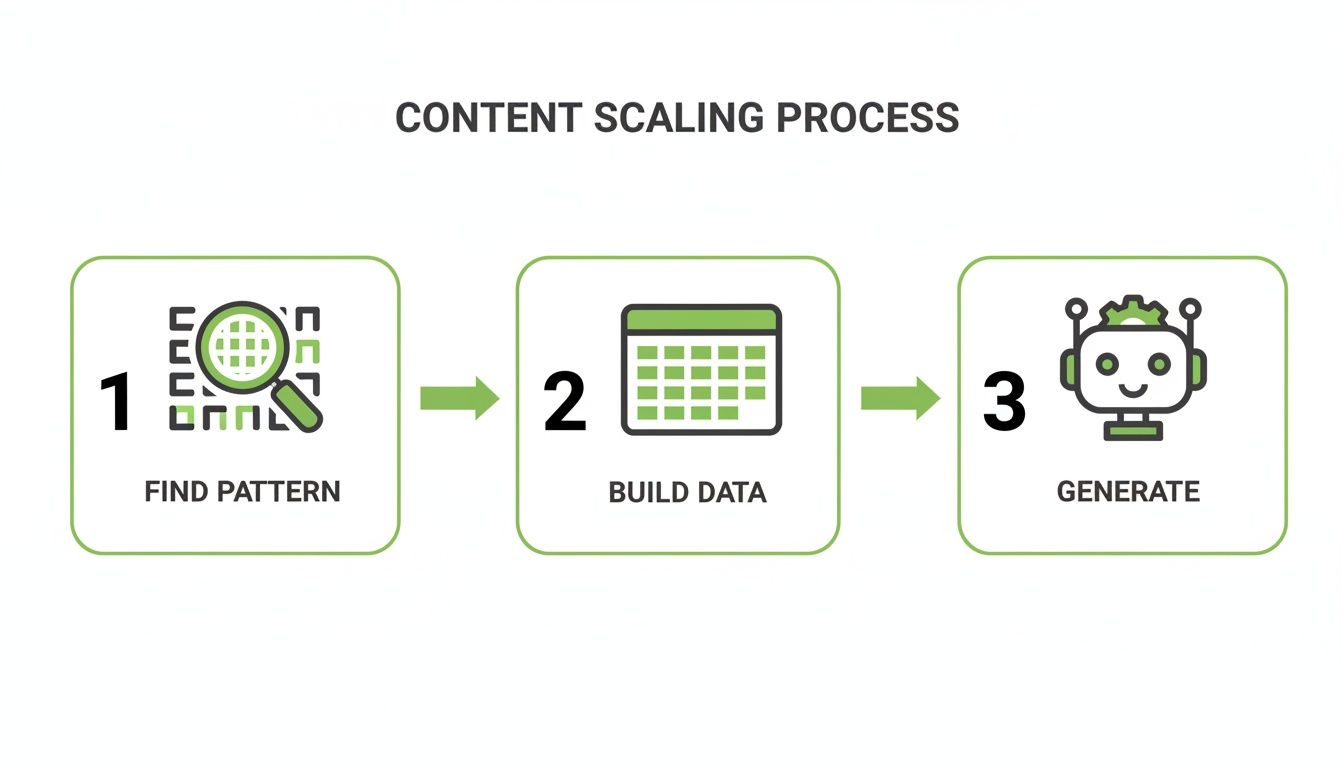
As the visual shows, it all starts with identifying a repeatable query before you even think about data or generation.
To dive deeper into the mechanics, you can explore the fundamentals of Natural Language Generation in pSEO, which breaks down how these systems work under the hood.
Step 4: Automate and Publish Your Pages
This is the magic step. Using simple, "no-code" tools, you can connect your spreadsheet directly to your blog (whether it's on WordPress, Webflow, or another platform).
Tools like Zapier, Whalesync, or Seomatic can automate the process. You'll "map" the columns from your spreadsheet to the placeholders in your template. Once it's set up, you can hit a button, and the tool will automatically create a new, fully-formatted blog post for every single row in your spreadsheet.
Instead of spending months writing hundreds of articles by hand, you can create them in an afternoon. This is how you achieve a true breakthrough in your blog's traffic and fully master SEO for blog growth.
Building Authority That Google Trusts
Even with the most incredible content on a technically perfect blog, you'll struggle to get noticed if Google doesn't see you as a credible source. Authority is all about trust. When other reputable websites link to your blog, they're basically vouching for you, signalling to Google that your content is valuable. This trust, built primarily through links, is a massive ranking factor.
We're going to skip the spammy, outdated tactics here. Instead, let's focus on two powerful, white-hat strategies that build authority that lasts: earning high-quality backlinks and mastering your own internal linking structure.

Earning Backlinks the Right Way
A backlink is simply a link from another website pointing to yours. It’s tempting to chase down every link you can find, but the truth is quality matters far more than quantity. A single link from a well-respected industry publication is worth more than a hundred links from sketchy, low-quality directories.
The only sustainable way to earn these golden links is to create content that people naturally want to reference and share. These are often called "link-worthy assets."
Here are a few proven types of content that are absolute link magnets:
- Original Research and Data: When you publish a unique study, survey results, or a deep data analysis, you become the primary source. Others have no choice but to link back to you when they cite your findings.
- In-Depth Guides and Tutorials: A truly comprehensive "ultimate guide" on a tricky subject becomes the definitive go-to resource. People will link to it because it’s the best explanation out there.
- Free Tools and Templates: A simple calculator, checklist, or template that solves a genuine problem for your audience is incredibly shareable and valuable.
Of course, you can't just publish great content and wait for the links to roll in. You have to be proactive with targeted outreach. This means finding other blogs, publications, or resource pages that would find your content genuinely useful for their audience and sending them a brief, personalised email to let them know it exists.
The core principle of link building hasn't changed a bit: create genuine value first. When you produce something truly exceptional, asking for a link feels less like a request and more like offering a helpful resource.
To really get why Google values these so much, it’s worth exploring the core concepts behind backlinks in SEO, which breaks down the mechanics of how these trust signals work.
Mastering Your Internal Linking Structure
While backlinks are external votes of confidence, internal links are how you vote for your own content. An internal link is just a link from one page on your blog to another page on your blog. This is one of the most underrated parts of SEO for blog success, und es's 100% within your control.
A smart internal linking strategy does three critical things:
- Spreads Authority: It funnels "link equity" from your most powerful pages (like your homepage or a viral post) to newer or less-visible articles, giving them a boost.
- Improves Crawlability: It creates a neat web for search engine bots to follow, helping them discover and index all of your content much more efficiently.
- Enhances User Experience: It guides your readers to other relevant content on your site, keeping them engaged for longer and encouraging them to dive deeper into your expertise.
How to Build Topic Clusters
By far, the most effective way to structure your internal links is by creating topic clusters. This model organises your content architecture to signal deep expertise on a specific subject.
Here’s how it works:
- Pillar Page: First, you create a major, comprehensive guide on a broad topic (e.g., "The Complete Guide to Digital Photography"). This page targets a high-volume, competitive keyword.
- Cluster Content: Then, you write several more specific articles that cover related subtopics in greater detail (e.g., "Best Camera Settings for Portraits," "Understanding ISO," "How to Edit Photos in Lightroom").
- The Linking Magic: All of your specific cluster articles link back up to the main pillar page. The pillar page, in turn, links out to each of the individual cluster articles.
This creates a tightly-knit hub of content. You’re not just publishing random articles; you're proving to Google that you are a genuine authority on "digital photography." This model helps your entire collection of related articles rank higher together.
Measuring SEO Success and Refining Your Strategy
Hitting "publish" on a blog post isn't the finish line—it's the starting block. Real growth from your blog's SEO comes from building a tight feedback loop where you let actual performance data drive your next move. This isn't about chasing vanity metrics. It's about figuring out what’s genuinely working so you can do more of it, and what isn’t, so you can fix it.
Your two best friends here are Google Search Console and Google Analytics. They’re free, surprisingly powerful, and give you everything you need to make intelligent decisions. The key is not to get lost in a sea of data; focus on just a handful of metrics that tell you the real story.
Key Metrics to Monitor
Instead of drowning in spreadsheets, just concentrate on these core indicators. They’ll give you a crystal-clear picture of your blog's SEO health and point you towards your next big growth opportunity.
- Organic Traffic: This is your bread and butter—the total number of visits from search engines. If this number is trending up in Google Analytics, you know you’re on the right track. It’s the ultimate signal.
- Keyword Rankings: Google Search Console is your window into what Google thinks you're relevant for. It shows you exactly which search queries your blog shows up for and your average position. Keeping an eye on this helps you confirm you’re gaining traction for the keywords you actually care about.
- Click-Through Rate (CTR): Also found in Search Console, CTR tells you what percentage of people who see your blog in the search results actually click through to read it. A low CTR, even with a high ranking, is a huge red flag. It often means your title and meta description aren't compelling enough to earn the click.
Understanding your core Search Console metrics is non-negotiable. It’s the most direct feedback you'll get from Google on how it perceives your site and how searchers are reacting to it.
Why is this so critical? Because organic search is responsible for 46.98% of all website traffic. In a market like Germany, with its 67 million internet users, that's a massive audience to tap into. The data doesn't lie: the number one spot in Google gets a whopping 39.8% CTR, which is over ten times higher than the tenth position. And since 99.37% of people never click past page one, optimising every aspect of your search appearance is essential. You can dig deeper into digital marketing trends on bitkom.org.
Refining Your Approach with Data
Once you start tracking this data, you can begin to fine-tune your strategy with real insights.
Let's say a blog post is ranking well for its target keyword but has a depressingly low CTR. Don't just leave it. Try A/B testing a few different headlines. Tweak the title for a couple of weeks, then check back in Search Console to see if the CTR has improved. This one simple test can bring a flood of new traffic to an existing article without you having to write a single new word.
Common Questions About Blog SEO
Let's tackle some of the questions that always come up when people dive into blog SEO. Getting these cleared up helps you focus on what really moves the needle.
How Long Does It Take for Blog SEO to Work?
This is the big one, and the honest answer is: SEO is a long game. It’s a marathon, not a sprint.
You might see some small wins in a few weeks, but for significant, meaningful growth in organic traffic, you need to plan for 6 to 12 months of consistent work. Things like how competitive your niche is, the age of your blog, and the sheer quality of your content will all impact that timeline. Patience and steady effort are your best friends here.
Can I Do SEO for My Blog Myself?
Absolutely. You don't need a massive agency budget to get this right.
While big companies often outsource, the core principles of great SEO for a blog are completely within your reach. If you build a solid technical foundation, obsess over creating high-quality content that genuinely answers a searcher's query, and build a smart linking strategy, you can get incredible results all on your own.
The best SEO tools are more user-friendly than ever, putting powerful tactics in the hands of creators, not just corporations. You can absolutely compete and win in the search results without a dedicated team.
How Often Should I Publish New Articles?
Think quality and consistency, not just raw frequency.
Publishing one deeply researched, perfectly optimised article per week will always beat churning out five short, low-value posts. For a brand-new blog, setting a steady pace of 1-2 fantastic posts a week is a great way to build momentum.
If you have an established blog, a powerful strategy is to publish one new post and spend the rest of your time updating and improving your existing content. That's a killer formula for long-term growth.
Ready to scale your content and master the future of search? Programmatic SEO Hub provides the playbooks, templates, and systems you need to turn your blog into an organic traffic powerhouse. Explore our free resources at https://programmatic-seo-hub.com/en.
Verwandte Artikel

Ein moderner Leitfaden für AI-gestütztes SEO Content Marketing
Im Kern dreht sich Content Marketing im Bereich SEO darum, die beste, hilfreichste Antwort auf die Fragen zu liefern, die Ihre idealen Kunden bei Google eingeben. Es ist die Kunst, wirklich nützliche...

Wachsen mit SEO für Content Marketing: Ein praktischer Leitfaden zur Skalierung Ihres Contents
Also, was genau ist SEO for content marketing? Stellen Sie es sich vor als das Erstellen und Teilen von wirklich nützlichem Content, der Menschen aus Suchmaschinen wie Google anzieht, mit dem...

Seo in Blogs: Ein praktischer Leitfaden für AI-getriebenes Wachstum
Blog SEO dreht sich darum, deine Artikel so abzustimmen, dass sie in Suchergebnissen höher ranken und einen stetigen Zustrom der richtigen Art von Besuchern auf deine Seite lenken. Es geht um mehr...